

 Preview
 Send
Send Share
Share
 Details

 Download
 Similars
 X-Ray
X-Ray Diaporama
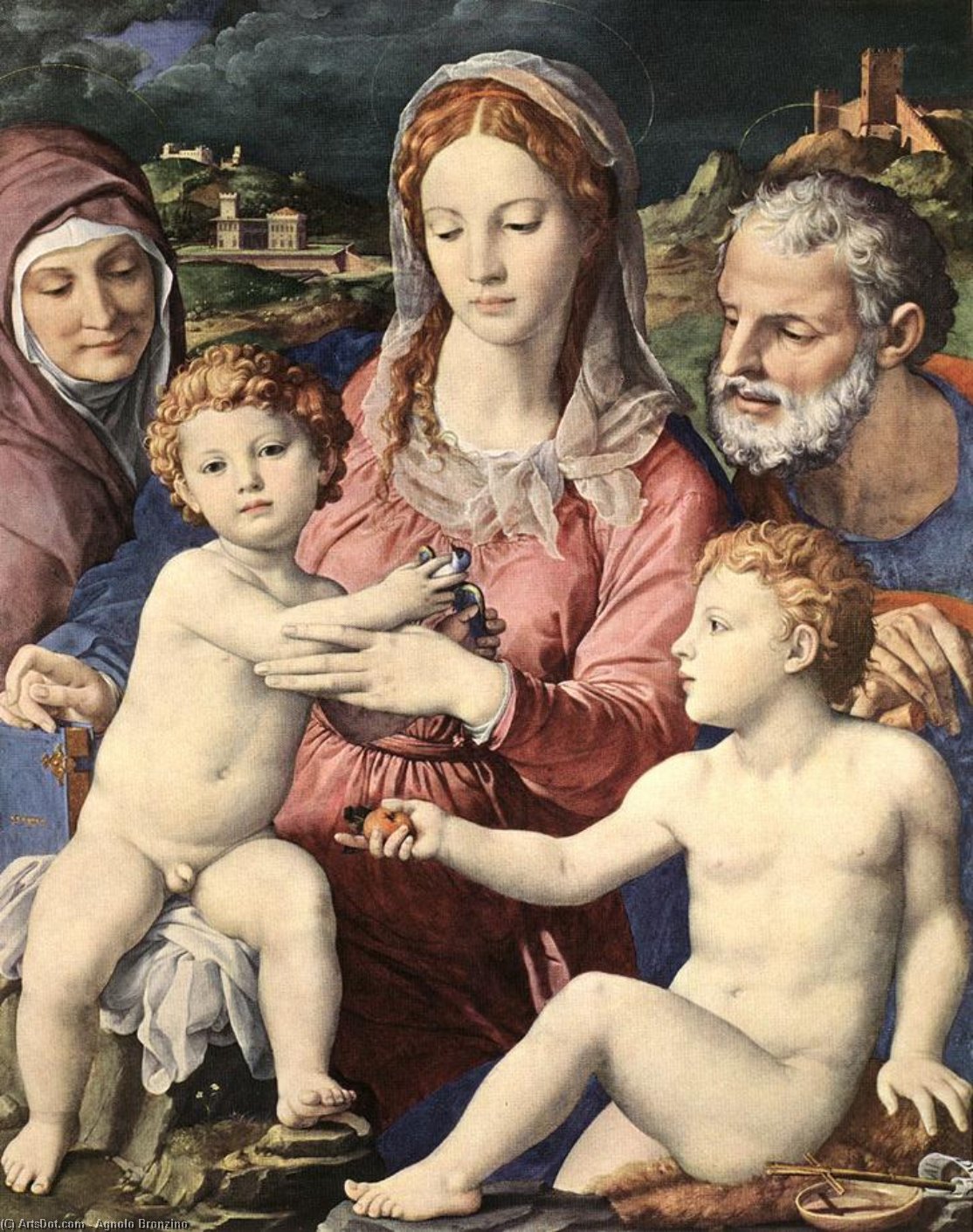
Holy Family
 Acrylic On Canvas
- WallArt
- mannerism
 1534
1534 124.0 x 99.0 cm
 Kunsthistorisches Museum
 Read More
Purchase a high-resolution, enhanced digital image, far superior to the online preview.
Each file is meticulously prepared by our in-house specialists using advanced tools and expert manual retouching. We ensure every image has exceptional clarity, precise color accuracy, and fine detail.
The final file is delivered via email within 72 hours, optimized for immediate use in professional, editorial, and print environments. This is the same quality trusted by top-tier design studios, publishers, and galleries.
Digital Image
Download a high-resolution file for personal display, printing, and creative projects. ( Buy Print Buy Hand Made Painting)
Included in Every Digital Image Order
Expert Digital Delivery, Guaranteed
When you choose ArtsDot.com, you're not just getting an image - you're receiving a professionally enhanced digital artwork, crafted with precision and backed by a satisfaction guarantee. Here's everything that comes with your order, automatically:

Fast Email Delivery
Your high-resolution digital image file will be emailed to you within 72 hours of ordering - ready for immediate use.

AI-Enhanced Digital File
Your artwork is professionally optimized using advanced AI tools and manual editing, ensuring maximum detail, clarity, and color accuracy.

Free Lifetime Re-Delivery
Accidentally deleted or lost your file? No worries - we'll resend it to you anytime, free of charge.

No Import Fees - Ever
Enjoy your artwork instantly with zero customs, duties, or delivery fees - digital downloads are always tax-free.

Color Accuracy Guarantee
We ensure your digital image reflects the original colors as closely as possible using professional tools and color management.

60-Day Satisfaction Guarantee
If you're not satisfied with your digital image, we'll revise it or refund 100% within 60 days - no questions asked.

100% Money-Back Guarantee
Not satisfied? Get a full refund within 60 days of receiving your digital file - no questions asked.

Bulk Order Discounts
Buy 3 images, save 10% - Buy 5, save 15% - Buy 10+, save 20%. Great for creative projects, galleries, and agencies.
Collectible Description
A Glimpse into Florentine Mannerism: Agnolo Bronzino’s Holy Family
The painting “Holy Family” by Agnolo Bronzino, completed in 1534, stands as a testament to the refined aesthetic sensibilities of Renaissance Florence during its twilight years. More than just a depiction of biblical figures—Mary cradling Jesus and Joseph—it embodies the core tenets of Mannerism, an artistic movement that prioritized elegance, psychological complexity, and subtle distortions over the idealized beauty championed by earlier generations. Bronzino’s masterful execution captures not merely what is seen but what is felt, inviting viewers into a moment of quiet contemplation amidst opulent surroundings.Style and Technique: A Calculated Distortions
Bronzino's approach diverges dramatically from the humanist ideals prevalent in his time. Unlike Michelangelo or Leonardo da Vinci who sought to convey emotion through expressive gestures and dynamic compositions, Bronzino favored a deliberately restrained style characterized by meticulous detail and a disconcerting stillness. The figures are rendered with unnervingly smooth surfaces—a technique achieved through layering thin glazes of pigment—creating an illusion of depth that defies naturalism. Observe how the drapery folds subtly exaggerate their contours, contributing to an overall sense of artificial perfection. This calculated distortion wasn’t intended to shock or provoke but rather to heighten the viewer's awareness of form and color, pushing boundaries of representation.Historical Context: The Shadow of Michelangelo
Florence in 1534 was grappling with profound religious and political upheaval following the Sack of Rome in 1527—an event that shook the foundations of papal authority and fueled anxieties about artistic patronage. Bronzino’s commission reflects this climate, aligning him firmly within the humanist circle yet subtly distancing himself from Michelangelo's monumental grandeur. While Michelangelo wrestled with colossal sculptures like David, striving for heroic proportions and conveying palpable emotion, Bronzino focused on capturing a serene familial tableau—a deliberate choice that speaks to the anxieties of his era regarding stability and moral virtue. The painting’s quiet dignity serves as an antidote to the turbulent times, presenting an idealized vision of domestic harmony.Symbolism: Beyond Simple Narrative
The Holy Family itself is laden with symbolic significance. Mary embodies piety and maternal devotion—a cornerstone of Christian iconography—while Joseph represents steadfastness and protection. The inclusion of three children underscores the importance of lineage and continuity within the family unit. Furthermore, consider the carefully positioned objects – the bowl, cup, and spoon – which are not merely props but symbols of nourishment and communion. They reinforce the painting’s central theme: a celebration of familial love and spiritual grace. Bronzino's subtle use of color—primarily muted reds and golds—adds to this symbolic richness, conveying warmth and prestige.Emotional Impact: A Moment Frozen in Time
Ultimately, “Holy Family” transcends its narrative content to evoke a profound emotional response. The stillness of the scene invites viewers to linger on the faces of the figures, capturing fleeting expressions of tenderness and concern. Bronzino’s masterful rendering captures not just physical likeness but also psychological nuance—a feat rarely achieved in Mannerist art. It's a painting that speaks to universal themes of family, faith, and beauty, reminding us of the enduring power of art to convey emotion and inspire contemplation. Like the Holy Spirit Church in Sopron, Hungary, Bronzino’s masterpiece exemplifies how artistic excellence can elevate our understanding of human experience.Related Artworks

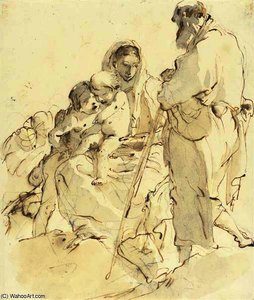
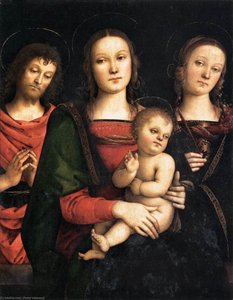
Artist Biography
A Florentine Master of Reserved Elegance
Agnolo di Cosimo, known to history as Bronzino, emerged from the vibrant artistic landscape of Renaissance Florence in 1503, a period already brimming with genius. Born the son of a butcher, his path diverged sharply from familial trade, guided instead by an innate talent that would see him become one of the most sought-after portraitists of his era and a defining figure of Mannerism. His early training began with Raffaellino del Garbo, but it was under the tutelage of Jacopo da Pontormo that Bronzino’s artistic sensibilities truly took shape. While absorbing Pontormo's innovative style, he ultimately forged his own distinct voice—one characterized by a cool composure and refined detail markedly different from his teacher’s often emotionally charged works. This early period was also influenced by studies with Andrea del Sarto, exposing him to the legacies of Michelangelo and Leonardo da Vinci, foundational influences that would subtly permeate his mature style. The young Bronzino quickly demonstrated an aptitude for capturing not just physical likeness but a certain psychological depth, even in his earliest commissions.Ascension at the Medici Court
Bronzino’s career ascended dramatically with the patronage of Cosimo I de’ Medici, Duke of Tuscany. This relationship, solidified after Bronzino contributed to the lavish decorations celebrating Cosimo’s wedding to Eleonora di Toledo in 1539, cemented his position as the official court painter for much of his life. It was a role he fulfilled with unwavering dedication and remarkable skill. The portraits emanating from this period are not merely likenesses; they are carefully constructed statements of power, status, and dynastic ambition. Cosimo and Eleonora themselves became frequent subjects, immortalized in paintings that exude an aristocratic aloofness and polished elegance. These works weren’t simply about capturing physical resemblance but crafting enduring symbols of Medici authority. Bronzino's mastery extended beyond portraiture; he was entrusted with decorating the chapel dedicated to Eleonora, a project spanning two decades and showcasing his versatility as a fresco painter. The meticulous detail and refined technique evident in these works established Bronzino as the preeminent artist of the Florentine court, shaping the visual language of power for generations to come.The Art of Mannerist Refinement
Bronzino’s artistic style is quintessentially Mannerist—a movement that flourished in Italy during the mid-16th century as a reaction against the High Renaissance's emphasis on naturalism and harmonious balance. He embraced elongated forms, stylized poses, and an often cool, detached emotionality. His figures are rarely caught in moments of spontaneous action; instead, they appear carefully posed, almost sculptural in their stillness. Venus, Cupid, Folly and Time (c. 1544-45), perhaps his most celebrated allegorical work, exemplifies this approach. The painting is a complex tapestry of symbolism, inviting multiple interpretations while simultaneously maintaining an air of enigmatic detachment. His portraits are renowned for their meticulous attention to detail—the textures of fabrics, the gleam of jewels, the subtle nuances of expression—all rendered with an almost enamel-like precision. This dedication to surface refinement and intellectual complexity distinguishes Bronzino’s work from that of his contemporaries. He wasn't interested in simply replicating reality; he sought to elevate it through artifice and stylistic control.Legacy and Lasting Influence
Beyond his prolific output as a painter, Bronzino played an important role in the Florentine artistic community. He was a founding member of the Accademia delle Arti del Disegno in 1563, an institution dedicated to promoting the study of art and fostering artistic excellence. His influence extended far beyond Florence, impacting court portraiture throughout Europe for generations. The cool elegance and refined technique he championed became hallmarks of aristocratic representation. Though his style fell somewhat out of favor during periods that prioritized more emotive or naturalistic approaches, Bronzino’s work has experienced a resurgence in appreciation in recent decades. Scholars now recognize the intellectual depth and stylistic innovation inherent in his art. He passed away in Florence in 1572, leaving behind a legacy as one of the most important Mannerist painters—a master of reserved elegance whose portraits continue to captivate and intrigue viewers centuries later. His ability to capture not just likeness but also the essence of power and status ensures his enduring place in art history.- Born: Florence, Italy, 1503
- Died: Florence, Italy, 1572
- Key Movement: Mannerism
- Notable Works: *Venus, Cupid, Folly and Time*, Portraits of Cosimo I de’ Medici and Eleonora di Toledo
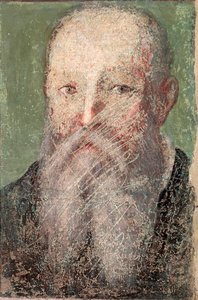
Agnolo Bronzino
1503 - 1572 , Italy
Quick Facts
- Artistic Movement Or Style: Mannerism
- Artists Or Movements Influenced By This Artist: European court portraiture
- Artists Who Influenced This Artist:
- Pontormo
- Michelangelo
- Leonardo da Vinci
- Date Of Birth: November 17, 1503
- Date Of Death: November 23, 1572
- Full Name: Agnolo di Cosimo
- Nationality: Italian
- Notable Artworks:
- Venus, Cupid, Folly & Time
- Ugolino Martelli
- The Holy Family
- Place Of Birth: Florence, Italy

