 Preview
 Send
Send Share
Share
 Details

 Download
 Similars
 X-Ray
X-Ray Diaporama
Klara zach

 Read More
Giclée / Art Print
Museum-quality giclée or canvas print with fast production and flexible finish options. ( Buy Hand Made Painting Buy Image)




P118B $10

P118H $10

P118W $10

P438Z $10

P508JH $12

P508YH $12

P805H $10

P805Z $10

P919BZ $10

P919G $10

P919XJ $10

P959ZH $10

P968JZ $12

W106C $8

W218G $10

W218JH $8

W218Y $10

W307PJ $10

W316G $10

W316PJ $8

W316Y $10

W398PJ $8

W4111J $10

W500HY $15

W500JH $15

W692G $12

W849H $8

W940BG $15

W953PJ $8




Pick from our preset sizes that match the artwork's original proportions.

You may enter your own dimensions to fit a specific frame or space. If your selected size does not match the original image's proportions, we will either crop the artwork or extend the image with a mirrored or solid-fill edge. A digital mockup will be sent for your approval before production begins.
Please note that the on-screen preview does not reflect the actual cropping or extension. Only the mockup will accurately show the final composition.
While custom sizes are available, we recommend selecting a dimension from the predefined list to preserve the original proportions.
Worldwide Delivery () in 2 weeks instead of standard 4/5 weeks. (21 August)

Free Worldwide Express Shipping

High-Quality Linen Canvas

Full Shipping Insurance

Customs Tax Refund Guarantee

True Color Matching Guarantee

60-Day Return Policy (Defects Only)

100% Money-Back Guarantee

Bulk Discount Offer
 Glass option is only available in size under 110 CM

Klara zach
Giclée / Art Print
Reproduction Size
-


Total Price
$ 63
Related Artworks
Artist Biography
Edvard Munch: A Soul Exposed
Edvard Munch (1863 – 1944) stands as one of the most profoundly influential and emotionally resonant figures in modern art. Born in Løten, Norway, into a family marked by illness and loss, his early life shaped him irrevocably, imbuing his work with an enduring sense of anxiety, mortality, and the raw experience of human emotion. More than simply a painter, Munch was a chronicler of the soul—a visionary who dared to expose the darkest corners of the human psyche through a uniquely expressive and unsettling visual language. His legacy extends far beyond Norway’s borders, profoundly impacting movements like Symbolism and Expressionism and continuing to resonate with audiences today.Early Life and Influences: A Cradle of Sorrow
Munch's childhood was shadowed by tragedy. The death of his mother when he was only five years old, followed by the loss of his sister and brother, instilled in him a deep-seated fear of disease and death. These early traumas, coupled with the family’s history of mental illness, formed the bedrock of his artistic vision. He received limited formal training, but found solace and inspiration within the bohemian circles of Kristiania (now Oslo), engaging with writers and artists who championed individual expression and challenged societal norms. Figures like Christian Krohg encouraged him to explore his inner world, urging him to paint “soul painting”—a concept that prioritized emotional truth over objective representation. The influence of French Impressionism and Post-Impressionists such as Paul Gauguin and Henri de Toulouse-Lautrec also played a crucial role in shaping his artistic style, particularly his use of color and brushwork.The Development of a Distinctive Style: From Symbolism to Expressionism
Munch’s artistic journey was marked by experimentation and evolution. Initially drawn to Symbolist aesthetics, he sought to capture the intangible—dreams, anxieties, and spiritual experiences—through evocative imagery and symbolic color palettes. However, his work quickly moved beyond mere symbolism, embracing a more direct and visceral approach. The pivotal moment in this transition came with *The Scream* (1893), an iconic image that has become synonymous with modern angst and existential dread. This painting, along with works like *Madonna*, *Death*, and *Vessel*, demonstrated his ability to translate subjective experience into powerful visual forms—characterized by distorted figures, swirling lines, and intensely saturated colors. Munch’s style became increasingly expressive, prioritizing the conveyance of raw emotion over realistic depiction. He explored themes of love, loss, illness, and death with unflinching honesty, creating a body of work that is both deeply personal and universally relatable.Key Works and Recurring Themes
Munch’s oeuvre encompasses a vast range of subjects—portraits, landscapes, scenes of urban life, and intimate depictions of human relationships. Yet, certain themes recur throughout his work, reflecting the core concerns that preoccupied him: mortality, anxiety, love, loss, and the experience of isolation. *The Scream* remains his most famous work, but other paintings such as *Madonna*, *Vessel*, *Despair*, and *Red Dance* offer profound insights into his artistic vision. His series *Frieze of Life*, comprising fourteen large-scale paintings depicting stages of human existence—love, ecstasy, sin, death—provides a comprehensive exploration of the emotional landscape of life. Beyond painting, Munch was also a prolific printmaker, creating lithographs and woodcuts that further explored these themes with remarkable intensity.Legacy and Historical Significance
Edvard Munch’s impact on 20th-century art is undeniable. His pioneering exploration of psychological themes paved the way for Expressionism, influencing artists such as Ernst Ludwig Kirchner and Emil Nolde. *The Scream*, in particular, has become a potent symbol of modern anxiety—a visual shorthand for the alienation and existential dread that characterize the human condition. Despite facing periods of mental instability and professional setbacks, Munch’s work continues to captivate audiences worldwide. His unflinching honesty, emotional depth, and innovative use of color and form ensure his place as one of the most important and enduring artists of the modern era—a true visionary who dared to expose the soul.
aladar korosfoi kriesch
1863 - 1920 , Hungary
Quick Facts
- Artistic Movement Or Style: Expressionism, Symbolism
- Artists Or Movements Influenced By This Artist: ['German Expressionism']
- Artists Who Influenced This Artist:
- Vincent van Gogh
- Paul Gauguin
- Date Of Birth: December 12, 1863
- Date Of Death: January 23, 1944
- Full Name: Edvard Munch
- Nationality: Norwegian
- Notable Artworks:
- The Scream
- Madonna
- Vierge Orphée
- Place Of Birth: Løten, Norway
Related Articles
Echoes of Time: Nostalgia, Technique & Cultural Significance in Vintage Paintings
Explore the captivating world of vintage paintings! Discover key styles, cultural significance & collecting tips from art experts at ArtsDot. Find authentic reproductions and elevate your home décor.
Art Nouveau's Golden Age: 10 Masterpieces for Your Home |
Journey into Art Nouveau's golden age! Explore 10 masterpieces by Klimt, Mucha & more. Discover captivating stories behind iconic paintings, floral motifs & flowing lines. Find museum-quality art reproductions for your home at .
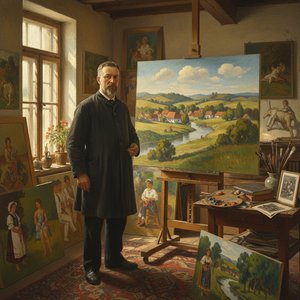
Károly Ferenczy: Pioneering Hungarian Modernism & the Soul of a Nation
Explore the life & art of Károly Ferenczy, a pivotal figure in Hungarian Modernism. Discover his landscapes, portraits, and role in founding the Nagybánya colony. Expert insights for collectors & enthusiasts.
Echoes of Time: Exploring the Enduring Appeal of Vintage Artwork
Explore the captivating world of vintage art! Discover its history, enduring appeal, & how to build your own collection. Expert advice, custom reproductions & museum-quality prints at ArtsDot.

Echoes of Time: Exploring the Enduring Appeal & Historical Context of Vintage Art Prints
Explore the captivating world of vintage art prints! Discover their history, collecting tips & enduring appeal. Expert insights on chromolithography and building a legacy collection with ArtsDot.