 Preview
 Send
Send Share
Share
 Details

 Download
 Similars
 X-Ray
X-Ray Diaporama
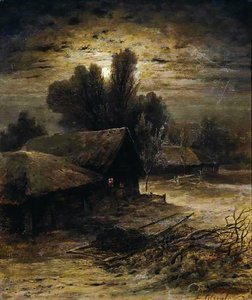
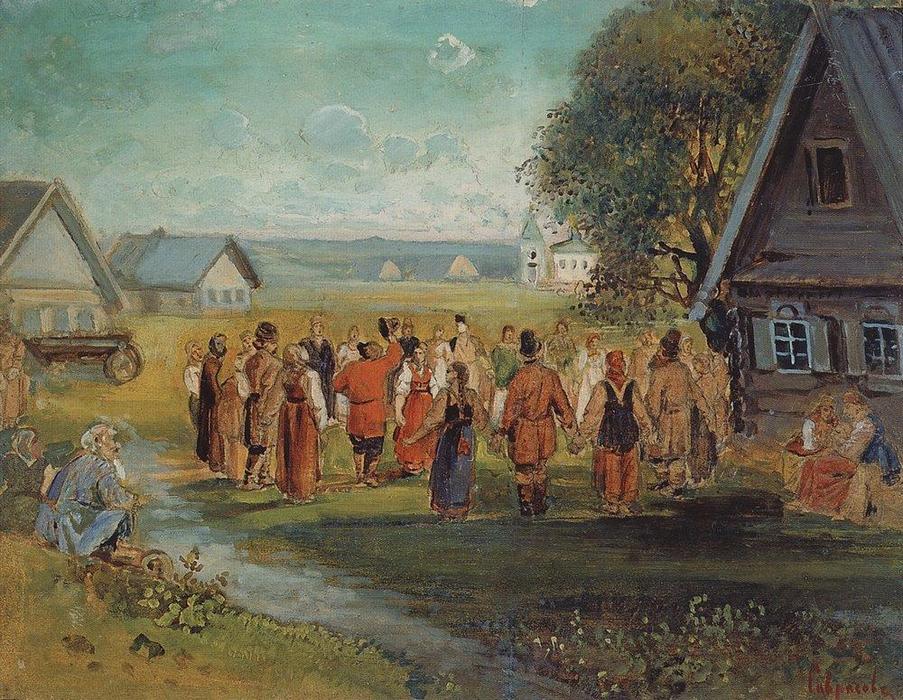
Round dance in the village


 Read More
Giclée / Art Print
Museum-quality giclée or canvas print with fast production and flexible finish options. ( Buy Hand Made Painting Buy Image)




































Pick from our preset sizes that match the artwork's original proportions.

You may enter your own dimensions to fit a specific frame or space. If your selected size does not match the original image's proportions, we will either crop the artwork or extend the image with a mirrored or solid-fill edge. A digital mockup will be sent for your approval before production begins.
Please note that the on-screen preview does not reflect the actual cropping or extension. Only the mockup will accurately show the final composition.
While custom sizes are available, we recommend selecting a dimension from the predefined list to preserve the original proportions.
Worldwide Delivery () in 2 weeks instead of standard 4/5 weeks. (26 August)

Free Worldwide Express Shipping

High-Quality Linen Canvas

Full Shipping Insurance

Customs Tax Refund Guarantee

True Color Matching Guarantee

60-Day Return Policy (Defects Only)

100% Money-Back Guarantee

Bulk Discount Offer
 Glass option is only available in size under 110 CM

Round dance in the village
Giclée / Art Print
Reproduction Size
-


Total Price
$ 63
Collectible Description
A Glimpse into Rural Life: "Round Dance in the Village" by Alexei Savrasov
Alexei Kondratyevich Savrasov's "Round Dance in the Village," painted in 1874, offers a captivating window into the heart of rural Russia. This charming artwork depicts a lively communal gathering, likely a celebration or folk tradition, set against a backdrop of rolling hills and traditional village architecture. More than just a depiction of everyday life, it’s an evocative portrayal of community spirit and connection to nature.
Style and Technique: Naive Realism & Atmospheric Perspective
Savrasov's style in this piece leans towards what is often termed "naive realism," characterized by its accessible and somewhat stylized representation of figures and landscapes. While rooted in observation, the painting isn’t striving for photographic accuracy; instead, it embraces a simplified aesthetic reminiscent of folk art traditions. Notice the loose, expressive lines that define forms and contribute to the artwork's inherent charm. The technique employs visible brushstrokes and an impasto application of oil paints, creating a textured surface that adds depth and visual interest. The perspective is notably limited; Savrasov masterfully uses atmospheric cues – subtle shifts in color and clarity – rather than strict linear recession to suggest depth and distance. This creates a slightly hazy, dreamlike quality that enhances the painting's tranquil atmosphere.
Historical Context: The Rise of Mood Painting
“Round Dance in the Village” emerged during a pivotal period in Russian art history. Savrasov was a key figure in the development of "mood painting" (lyrical landscape), a movement that prioritized conveying emotional and atmospheric impressions over meticulous detail. This shift reflected a growing interest among Russian artists to capture the unique beauty and spirit of their homeland, moving away from academic conventions towards more personal and expressive forms of representation. Savrasov’s work directly influenced later masters like Isaac Levitan, solidifying his place as a pioneer in this influential movement.
Symbolism & Emotional Impact
While subtle, symbolic elements enrich the artwork's narrative. The round dance itself—a traditional folk custom—represents unity, community, and the cyclical nature of life. The gathering suggests shared joy and connection amongst villagers. The overall color palette, dominated by calming greens and blues, evokes a sense of tranquility and harmony with nature. Savrasov’s skillful use of light and shadow further enhances the emotional impact, creating a scene that is both visually appealing and deeply resonant. "Round Dance in the Village" invites viewers to step into a moment of rural serenity, offering a glimpse into a simpler time and celebrating the enduring power of human connection.
Why Choose a Reproduction?
A hand-painted reproduction of “Round Dance in the Village” allows you to bring this captivating scene into your own space. Whether you're an art enthusiast, collector, or interior designer seeking a touch of rustic charm and historical significance, this artwork offers a unique opportunity to appreciate Savrasov’s talent and capture the essence of rural Russian life. The textured brushstrokes and subtle color nuances are faithfully recreated in our reproductions, ensuring a piece that is both visually stunning and historically accurate.
Related Artworks
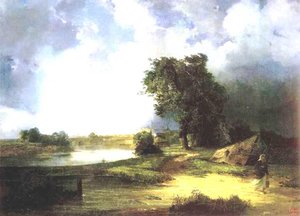
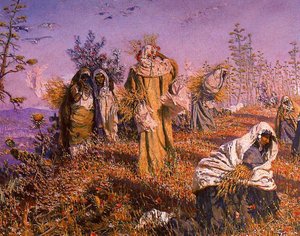
Artist Biography
The Soul of the Russian Landscape: The Life and Legacy of Alexei Savrasov
In the vast, sweeping expanse of nineteenth-century Russian art, few names evoke the quiet, melancholic beauty of the natural world as poignantly as Alexei Kondratyevich Savrasov. Born in Moscow in 1830, Savrasov did not merely paint landscapes; he captured the very breath of the Russian earth. His journey began within the hallowed halls of the Moscow School of Painting, Sculpture, and Architecture, where he studied under the guidance of masters such as Vasily Petrovich Verkhoff. It was during these formative years that Savrasov developed a profound sensitivity to his surroundings, learning to look past the surface of the terrain to find the emotional pulse beneath the frost and the foliage. His early training instilled in him a rigorous commitment to Realism, yet his spirit remained deeply tethered to the lyrical nuances of Romanticism, allowing him to transform topographical observations into profound psychological experiences.
The evolution of Savrasov’s style is most brilliantly illuminated by his ability to find grandeur in the humble and the overlooked. While many of his contemporaries sought the dramatic peaks of distant mountains, Savrasov turned his gaze toward the intimate, often somber realities of the Russian countryside. His breakthrough arrived with the monumental “Winter Landscape” in 1865, a work that would redefine the genre. In this masterpiece, he moved away from mere photographic accuracy to embrace an atmospheric perspective, utilizing muted palettes and subtle gradations of gray, white, and brown to evoke the biting chill and the heavy silence of a snow-covered world. This shift toward mood over literal detail established him as a pioneer of lyrical landscape art, proving that a painting could serve as a mirror to the human soul.
Mastery of Atmosphere and the Poetics of Nature
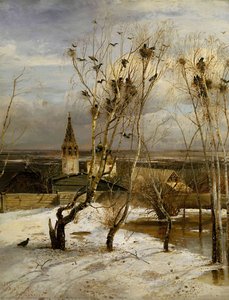
Savrasov’s technical prowess lay in his masterful command of light and tonal variation. He possessed an uncanny ability to render the dampness of melting snow, the heavy humidity following a storm, and the soft, diffused light of a spring afternoon. His works often feature a delicate interplay of textures—the rough bark of a birch tree against the smooth, glassy surface of a frozen river. This is perhaps most famously realized in his iconic “The Rooks Have Returned” (1871). In this painting, the sight of birds returning to a snow-dusted grove serves as a powerful symbol of hope and the cyclical nature of life, embodying a uniquely Russian brand of seasonal melancholy that resonates with viewers to this day.
Beyond the winter scenes, his repertoire included works of immense atmospheric depth, such as:
- After a Thunderstorm: A study in the clarity and freshness of the air following a tempest, showcasing his ability to capture light.
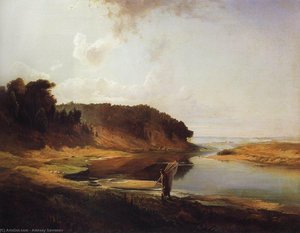
- Landscape with a River and an Angler: A serene exploration of the tranquil Russian countryside, blending human presence with the timeless flow of nature.
- A Pine Forest: An evocative depiction of the dense, shadowed majesty of the woodland, demonstrating his skill with deep tonal contrasts.
Through these works, Savrasov achieved a sense of communion between the observer and the observed. He did not treat nature as a backdrop for human drama, but as the protagonist itself. His paintings invite a state of contemplation and solitude, urging the viewer to find beauty in the austere, the quiet, and the transient. By elevating the Russian landscape to a subject of high emotional significance, Savrasov left an indelible mark on art history, ensuring that his vision of the soulful, breathing earth would endure long after his passing in 1897.
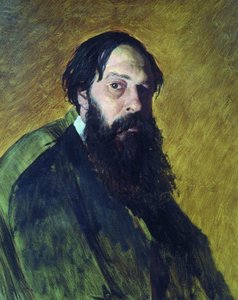
aleksey savrasov
1830 - 1897 , Russia
Quick Facts
- Artistic Movement Or Style: Lyric Landscape Painting
- Artists Who Influenced This Artist:
- Ivan Kramskoi
- Vasily Polenov
- Date Of Birth: May 24, 1830
- Date Of Death: 1897
- Full Name: Aleksey Kondratyevich Savrasov
- Nationality: Russian
- Notable Artworks:
- The Rooks Have Returned
- Landscape with a River and an Angler
- After a Thunderstorm
- Place Of Birth: Moscow, Russia
Related Articles
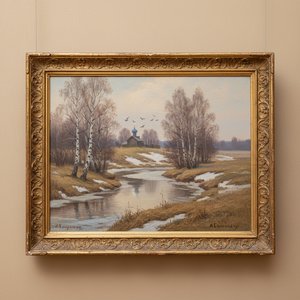
Aleksey Savrasov: The Poetic Realism That Defined Russian Landscape Painting
Explore the poetic realism of Aleksey Savrasov, founder of Russian lyrical landscape painting. Discover his masterpieces like 'The Rooks Have Returned' and learn about his lasting influence on 19th-century art. ArtsDot offers high-quality reproductions.
Ivan Bilibin: A Synthesis of Folklore, Modernism & National Identity in Russian Illustration
Explore the enchanting world of Ivan Bilibin, a master Russian illustrator who synthesized folklore, Art Nouveau & national identity. Discover his iconic fairy tale illustrations and legacy with ArtsDot.

The Enduring Legacy of Oil on Canvas: Technique, History & Aesthetic Impact
Explore the rich history & techniques of oil painting – from Renaissance masters to Impressionism. Discover pigments, layering methods, and why this timeless medium endures. Expert insights for artists & art enthusiasts.

Oil on Canvas: A Historical & Technical Exploration of a Timeless Artistic Medium
Explore the rich history & enduring techniques of oil painting on canvas. Discover the science behind its longevity, conservation practices, and contemporary relevance. Expert insights for art enthusiasts.
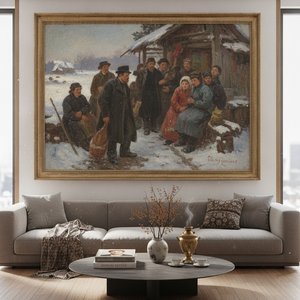
Discover Russian Realism: Soulful Masterpieces and the Timeless Spirit of the Peredvizhniki for Your Modern Home
Elevate your home with the soulful beauty of Russian Realism. Discover exquisite hand-painted reproductions of Peredvizhniki masterpieces, from lyrical landscapes to profound portraits, curated to bring historical depth and timeless elegance to your modern interior design.