Preview
 Send
Send Share
Share
 Details

 Download
 Similars
 X-Ray
X-Ray Diaporama
 Stats
StatsSummer Landscape


 Read More
Hand Made Oil Reproduction
Hand-painted oil on canvas in your size and frame, made to order by our artists. ( Switch to Print Switch to Digital Image)




P118B $10

P118H $10

P118W $10

P438Z $10

P508JH $12

P508YH $12

P805H $10

P805Z $10

P919BZ $10

P919G $10

P919XJ $10

P959ZH $10

P968JZ $12

W106C $8

W218G $10

W218JH $8

W218Y $10

W307PJ $10

W316G $10

W316PJ $8

W316Y $10

W398PJ $8

W4111J $10

W500HY $15

W500JH $15

W692G $12

W849H $8

W940BG $15

W953PJ $8
Pick from our preset sizes that match the artwork's original proportions.

You may enter your own dimensions to fit a specific frame or space. If your selected size does not match the original image's proportions, we will either crop the artwork or extend the painting with additional hand-painted elements. A digital mockup will be sent for your approval before production begins.
Please note that the on-screen preview does not reflect the actual cropping or extension. Only the mockup will accurately show the final composition.
While custom sizes are available, we recommend selecting a dimension from the predefined list to preserve the original proportions.
After order, ArtsDot.com team will email client for instructions and provide a mockup preview
Worldwide Delivery () in 3/4 weeks instead of standard 5 weeks. (16 September). No compromise on quality.

Free Worldwide Express Shipping

High-Quality Linen Canvas

Full Shipping Insurance

Customs Tax Refund Guarantee

True Color Matching Guarantee

100-Day Return Policy (Defects Only)

100% Money-Back Guarantee

Bulk Discount Offer
 Glass option is only available in size under 110 CM

Summer Landscape
Reproduction Medium
Reproduction Size
-


Total Price
$ 263
A Summer’s Dream: Alexander Helwig Wyant's "Summer Landscape"
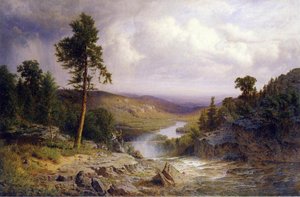
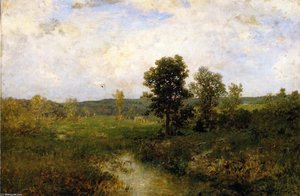
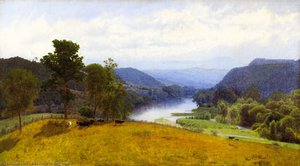
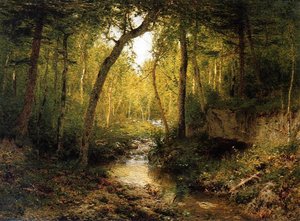
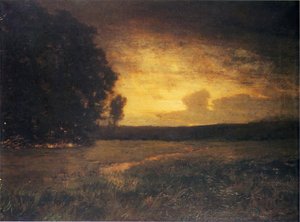
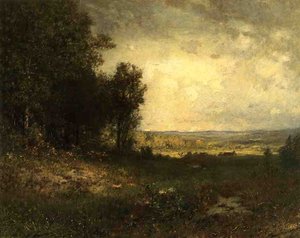
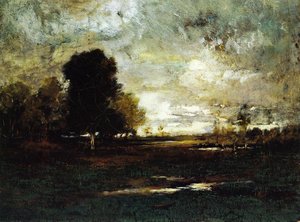
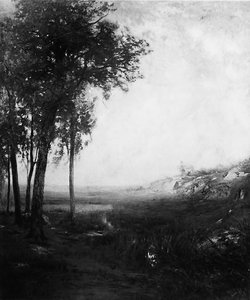
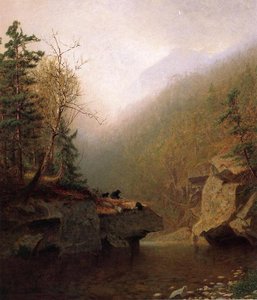
Alexander Helwig Wyant’s “Summer Landscape” isn’t merely a depiction of a pleasant afternoon; it’s an immersion into the very soul of nature, rendered with a sensitivity that borders on poetic. Painted in 1889, this work stands as a pivotal bridge between the grand narratives of the Hudson River School and the quieter, more introspective currents of Tonalism – a movement defined by its subtle color palettes and evocative atmosphere. Wyant, often described as “a poet of atmospheric landscapes,” masterfully captures the fleeting beauty of a summer’s day, imbuing it with a profound sense of tranquility and observation.
The scene unfolds before us: a gently sloping hillside dotted with a solitary, majestic tree that dominates the composition. Below, a body of water – likely a lake or pond – reflects the sky above, creating an illusion of infinite depth. Scattered throughout this idyllic setting are two figures, seemingly engaged in quiet contemplation near the water’s edge. Their presence isn't intrusive; rather, they serve as anchors for our gaze, inviting us to share in the stillness and absorb the scene’s inherent peace. The artist’s choice to depict these individuals subtly suggests a connection between humanity and the natural world – a recognition of shared beauty and a quiet appreciation for the simple pleasures of life.
The Language of Light and Shadow
Wyant's technique is characterized by its masterful manipulation of light and shadow. He employs a predominantly tonal approach, favoring muted earth tones—ochres, browns, and greens—that blend seamlessly to create an atmosphere of hazy warmth. The brushstrokes are loose and expressive, avoiding sharp outlines in favor of soft gradations that mimic the diffused light of a summer afternoon. This deliberate blurring of edges contributes significantly to the painting’s dreamlike quality, as if we're peering into a memory rather than witnessing a concrete reality.
Notice how Wyant uses highlights to draw attention to the tree – its branches reaching upwards like supplicating arms towards the light. The reflections on the water surface are equally delicate, shimmering with an ethereal glow. This careful orchestration of light and shadow isn’t simply about aesthetic effect; it's a fundamental element of Wyant’s artistic philosophy—a belief that true beauty lies in capturing the subtle nuances of atmosphere and mood.
A Window into the Artist’s World
Alexander Helwig Wyant’s biography is as compelling as his art. Born in Ohio, he initially trained at the National Academy of Design in New York City, where he was profoundly influenced by George Inness's emphasis on atmospheric perspective and tonal values. However, a pivotal journey to Europe in 1860 exposed him to the works of Corot and Dupré, artists who championed a more subjective approach to landscape painting—one that prioritized emotional resonance over strict topographical accuracy. This encounter marked a turning point in Wyant’s artistic development, leading him away from the conventions of the Hudson River School and towards a more personal and introspective style.
His subsequent life was marked by both professional challenges and personal tragedies – including a debilitating stroke that left him unable to use his right arm. Remarkably, he continued to paint with his left hand, demonstrating an extraordinary resilience and unwavering dedication to his craft. This experience undoubtedly deepened his understanding of the human condition—a recognition of vulnerability, perseverance, and the enduring power of creativity.
Collecting a Moment in Time
"Summer Landscape" is more than just a beautiful painting; it’s a testament to Wyant's artistic vision and his profound connection with nature. Its quiet elegance, evocative atmosphere, and subtle symbolism make it a captivating work for collectors and interior designers alike. Reproductions of this piece offer a wonderful opportunity to bring a touch of serenity and timeless beauty into any space – a reminder that even in the midst of a busy world, there is always time to appreciate the simple wonders of nature.
Consider how the painting’s muted palette and soft focus would complement a variety of interior styles—from minimalist Scandinavian designs to rustic farmhouse aesthetics. Its timeless appeal ensures that “Summer Landscape” will remain a cherished addition to any art collection for generations to come.
Related Artworks

Artist Biography
A Poet of Atmospheric Landscapes: The Life and Art of Alexander Helwig Wyant
Alexander Helwig Wyant, born in 1836 in Port Washington, Ohio, occupies a fascinating transitional space in American art history. He wasn’t merely a painter *of* landscapes; he was a poet *with* landscapes, translating the subtle moods of nature onto canvas with an increasingly refined sensitivity. His journey began humbly, sketching along the banks of the Ohio River near Cincinnati, but quickly blossomed into a dedicated pursuit fueled by encounters with pivotal figures and transformative experiences. A crucial moment arrived in 1857 when Wyant encountered the work of George Inness, whose influence would profoundly shape his artistic trajectory. This meeting spurred him to relocate to New York City, seeking mentorship and formal training at the National Academy of Design, generously supported by the patronage of Nicholas Longworth. A subsequent journey to Europe in 1860 further broadened his horizons, exposing him to diverse artistic traditions in Germany and brief sojourns in England and Ireland. These early experiences laid the foundation for a career that would bridge the detailed realism of the Hudson River School with the evocative subtleties of Tonalism.From Detailed Observation to Atmospheric Resonance
Wyant’s initial works clearly demonstrate the influence of the Hudson River School, characterized by meticulous depictions of natural scenes and a celebration of America's pristine wilderness. However, even in these early paintings, hints of his future direction are visible – a growing interest in atmospheric effects and a tendency towards more subdued color palettes. Over time, this inclination intensified, leading him away from purely representational painting and toward the emerging aesthetic of Tonalism. This movement, which flourished in the late 19th century, prioritized mood, atmosphere, and poetic interpretation over precise detail. Wyant became increasingly reliant on a restricted palette dominated by whites, grays, and earth tones, using these nuanced shades to capture the ephemeral qualities of light and shadow. He masterfully employed clouds not as dramatic focal points, but as vehicles for creating subtle emotional resonance within his landscapes. A defining moment in this artistic evolution occurred in 1873 when a stroke paralyzed his right arm. Forced to adapt, Wyant remarkably taught himself to paint with his left hand – an adversity that arguably intensified his focus on atmospheric effects and emotional expression, stripping away any reliance on technical virtuosity and forcing him to distill his vision to its purest essence.Exhibitions, Affiliations, and a Growing Recognition
Throughout his career, Wyant actively sought opportunities to showcase his work, exhibiting consistently at the National Academy of Design from 1864 until his death in 1892. He also participated in exhibitions organized by prominent art associations such as the Brooklyn Art Association, Boston Art Club, and Pennsylvania Academy of Fine Arts, steadily building a reputation among collectors and fellow artists. Notable works like *Mohawk Valley*, now held at the Metropolitan Museum of Art, exemplify his mature style – a harmonious blend of detailed observation and atmospheric sensitivity. His final painting, *Arkville Autumn Landscape*, stands as a poignant testament to his enduring passion for landscape art. Beyond exhibitions, Wyant was deeply involved in the artistic community, playing an instrumental role in the founding of the American Watercolor Society in 1878, further solidifying his commitment to advancing American painting. He also maintained affiliations with prestigious organizations like the Century Association and the National Academy of Design, demonstrating his standing within the established art world.A Legacy Bridging Traditions
Alexander Helwig Wyant’s historical significance lies in his ability to synthesize diverse artistic influences and forge a unique path between the grandeur of the Hudson River School and the introspective moodiness of Tonalism. He wasn't simply imitating earlier styles; he was actively transforming them, shifting the focus from purely representational depictions of nature towards more subjective and emotionally resonant interpretations. His work reflects a growing desire among American artists to move beyond mere imitation of European models and develop a distinctly national artistic voice. While not widely celebrated during his lifetime, Wyant’s paintings have gained increasing recognition in recent decades for their poetic quality, subtle beauty, and profound understanding of the natural world. His later works, particularly those created in Arkville, New York, reveal a clear connection to the Barbizon painters – a group of French artists who emphasized *plein air* painting and a focus on capturing the fleeting effects of light and atmosphere. Wyant’s contemplative approach to landscape art continues to inspire artists and captivate audiences today, cementing his place as a pivotal figure in American art history.Influences and Artistic Kinship
- George Inness: A primary mentor whose emphasis on tonal values and atmospheric effects profoundly influenced Wyant’s artistic development.
- John Constable & J.M.W. Turner: British landscape painters whose innovative use of light, color, and atmosphere served as a source of inspiration for Wyant's evolving style.
- Hudson River School: Wyant initially followed this tradition, absorbing its emphasis on detailed observation and grand vistas, but ultimately diverged towards the more nuanced aesthetic of Tonalism.
- American Barbizon Movement: His later work aligned with the principles of this movement, emphasizing *plein air* painting, a focus on natural light, and a rejection of academic conventions.
- Century Association & National Academy of Design: Wyant’s membership in these prestigious artistic organizations underscored his standing within the American art community and provided opportunities for exhibition and networking.
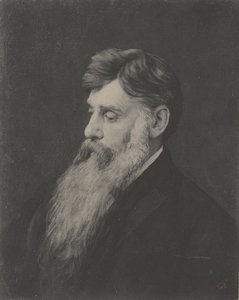
Alexander Helwig Wyant
1836 - 1892 , United States of America
Quick Facts
- Artistic Movement Or Style: Tonalism, Hudson River School
- Artists Or Movements Influenced By This Artist:
- American Watercolor Society
- Barbizon movement
- Artists Who Influenced This Artist:
- George Inness
- John Constable
- J.M.W. Turner
- Date Of Birth: January 11, 1836
- Date Of Death: November 29, 1892
- Full Name: Alexander Helwig Wyant
- Nationality: American
- Notable Artworks:
- Mohawk Valley
- Arkville Autumn Landscape
- The Flume
- Pool in the Woods
- Place Of Birth: Port Washington, USA
Related Articles

Evocations of Place: A Historical Journey Through Landscape Art
Explore the rich history of landscape art with ArtsDot. Discover renowned artists, movements like Impressionism & Romanticism, and expert guidance for collecting timeless pieces. Find your perfect serene escape today!

Romantic Landscapes: 10 Masterpieces for Your Home | ArtsDot
Journey through 10 Romantic landscape masterpieces by Friedrich, Turner & Cole. Explore emotional art, sublime nature scenes & iconic 19th-century paintings. Find museum-quality reproductions for your home at ArtsDot.com – discover the full collection online!

John Constable's Masterpieces: Explore 25 Iconic Landscapes for Your Home
Journey through John Constable's 25 most celebrated landscapes. Explore Romanticism, Dedham Vale & his masterful use of light in iconic paintings like 'Hay Wain'. Find museum-quality art reproductions and elevate your home decor on ArtsDot.com.

Hokusai's Masterpieces: 25 Iconic Prints & Paintings for Art Lovers | ArtsDot
Journey through Katsushika Hokusai’s 25 most iconic artworks, including *The Great Wave*. Explore the ukiyo-e master's history, style & timeless Japanese woodblock prints. Find museum-quality reproductions for your home at ArtsDot.com.
Arboreal Echoes: A Historical & Artistic Exploration of Trees in Painting
Explore the rich history of trees in painting! Discover symbolism, Romantic masterpieces by Caspar David Friedrich & beyond. A curated journey for art enthusiasts.