 Preview
 Send
Send Share
Share
 Details

 Download
 Similars
 X-Ray
X-Ray Diaporama
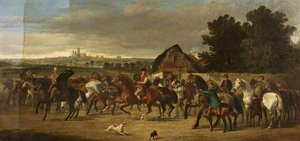
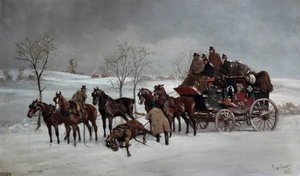
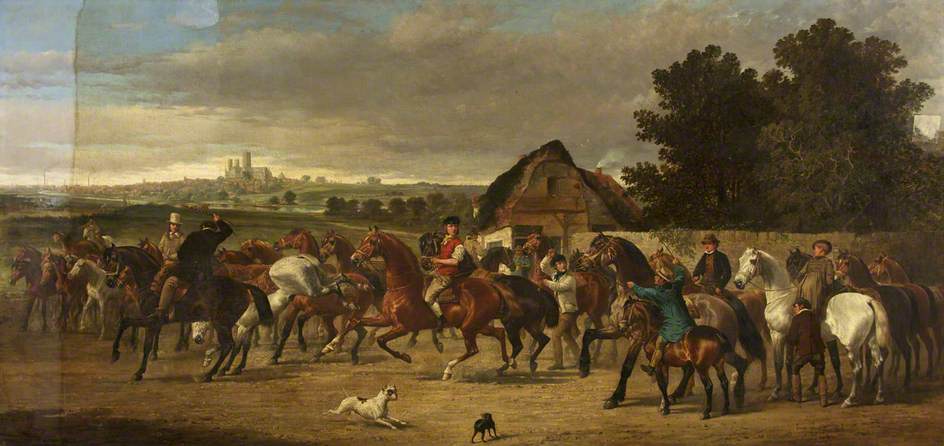
Horses Going to a Fair, Lincoln
 Historical Painting
 1861
1861 104.0 x 217.0 cm
 Bristol Museum - Art Gallery
 Read More
Giclée / Art Print
Museum-quality giclée or canvas print with fast production and flexible finish options. ( Buy Hand Made Painting Buy Image)




































Pick from our preset sizes that match the artwork's original proportions.

You may enter your own dimensions to fit a specific frame or space. If your selected size does not match the original image's proportions, we will either crop the artwork or extend the image with a mirrored or solid-fill edge. A digital mockup will be sent for your approval before production begins.
Please note that the on-screen preview does not reflect the actual cropping or extension. Only the mockup will accurately show the final composition.
While custom sizes are available, we recommend selecting a dimension from the predefined list to preserve the original proportions.
Worldwide Delivery () in 2 weeks instead of standard 4/5 weeks. (21 August)

Free Worldwide Express Shipping

High-Quality Linen Canvas

Full Shipping Insurance

Customs Tax Refund Guarantee

True Color Matching Guarantee

60-Day Return Policy (Defects Only)

100% Money-Back Guarantee

Bulk Discount Offer
 Glass option is only available in size under 110 CM

Horses Going to a Fair, Lincoln
Giclée / Art Print
Reproduction Size
-


Total Price
$ 63
Related Artworks
Artist Biography
The Equestrian Visionary: The Life and Legacy of Alfred Frank de Prades
In the golden age of Victorian sporting art, few names resonated with the same anatomical precision and romantic vigor as Alfred Frank de Prades. A master of the animalier tradition, de Prades possessed a rare ability to breathe life into canvas, transforming static depictions of horses and military figures into breathing, pulsing scenes of historical drama. Though born in Lunel, Hérault, France, his artistic soul was deeply entwined with the landscape and culture of England. This unique duality—a French sensibility meeting British sporting passion—allowed him to capture the grandeur of the equestrian world with a nuance that captivated the noble British aristocracy and established him as one of the most sought-after painters of his era.
The foundations of his talent were laid in a childhood marked by movement and transition. Following a dramatic separation between his parents, de Prades relocated to London at the age of sixteen. This early immersion in British society proved pivotal; the sights of the English countryside and the prestige of the local racing culture became the primary muses for his developing eye. While much of his formal training remains shrouded in the mists of history, his innate grasp of equine anatomy suggests a profound, perhaps self-taught, dedication to the study of nature. Even as a young prodigy, his work displayed an uncanny ability to replicate the tension of a muscle or the frantic energy of a gallop, a skill famously evidenced by his early piece, “Down the Stretch,” painted when he was a mere thirteen years old.
A Legacy of Precision and Patronage
As de Prades matured, his artistic lineage became increasingly clear. He worked within the prestigious tradition established by George Stubbs, adopting a style characterized by scientific accuracy and emotional depth. This connection to the great masters of equine art allowed him to navigate the elite circles of London’s Covent Garden, where he became a fixture in the exhibitions of the British Institution and the Royal Academy of Arts. His work was not merely decorative; it was an exploration of power, nobility, and the symbiotic relationship between man and beast. The British sporting set, driven by a passion for hunting, racing, and military prowess, found in de Prades a chronicler who could immortalize their finest steeds and most heroic officers.
His oeuvre is marked by several defining characteristics that elevate his work above mere portraiture:
- Anatomical Realism: A relentless pursuit of truth in the depiction of equine musculature, bone structure, and movement.
- Military Grandeur: The ability to blend the elegance of cavalry uniforms with the raw energy of battle or parade scenes.
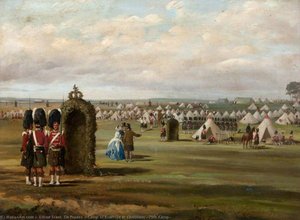
- Atmospheric Depth: Using light and shadow to create a sense of place, whether in the snowy expanses of a mail coach journey or the dusty heat of a military camp.
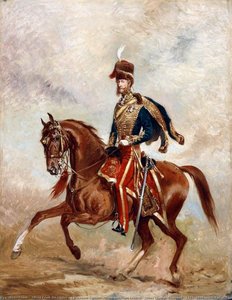
Through his brush, historical figures were rendered not just as icons, but as living participants in their time. His portraits of high-ranking officers, such as the 7th Earl of Cardigan, serve as vital windows into the Victorian era, capturing the intricate details of Hungarian attire and the spirited temperament of the horses they rode. De Prades did more than paint animals; he painted the very essence of an age defined by expansion, cavalry charges, and the romanticized glory of the hunt.
The Enduring Impression of a Master
Though his life came to an end in 1885, the impact of Alfred Frank de Prades continues to resonate within the halls of art history. He remains a pivotal figure for those studying the evolution of animalier painting, representing a bridge between the classical anatomical studies of the eighteenth century and the more dramatic, narrative-driven styles of the late nineteenth century. His ability to command the viewer's attention through the sheer vitality of his subjects ensures that his works remain much more than historical artifacts; they are enduring celebrations of motion, strength, and the timeless beauty of the equine form.
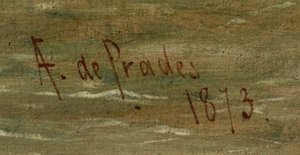
alfred frank de prades
1825 - 1885
Quick Facts
- Artistic Movement Or Style: Victorian Equestrian Art
- Artists Or Movements Influenced By This Artist: ['Victorian Painting']
- Artists Who Influenced This Artist: ['George Stubbs']
- Date Of Birth: March 24, 1825
- Date Of Death: July 7, 1885
- Full Name: Alfred Frank de Prades
- Nationality: French
- Notable Artworks:
- Horses Pulling a Flatboat Barge
- On the Heights Near Boulogne
- Fairplay
- Place Of Birth: Lunel, France
Related Articles

Demandes Commerciales
APS ofrece reproducciones de bellas artes y encargos personalizados desde 2004. Confían en nosotros corporaciones, hoteles y coleccionistas selectos para obras de arte de calidad museística, servicio discreto y soluciones artísticas completas. ¡Póngase en contacto con nosotros para obtener un presupuesto personalizado!

Sir Alfred Munnings' Masterpieces: 25 Paintings That Define Equine Art | ArtsDot
Explore 25 iconic Sir Alfred Munnings paintings! Discover the beauty of British Impressionism, equine art & rural England. Find museum-quality reproductions and elevate your home decor with ArtsDot. Explore the full collection online.

Goya's Masterpieces: Explore 25 Iconic Paintings & Art Prints | ArtsDot
Delve into the world of Francisco Goya with ArtsDot. Explore 25 iconic paintings – from 'The Third of May' to his haunting Black Paintings. Discover the stories, techniques & emotions behind these Spanish masterpieces. Find museum-quality art reproductions for your home at ArtsDot.com!
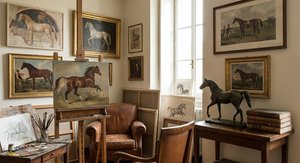
The Equine Muse: A Historical & Artistic Exploration of Horses in Painting
Explore the captivating history of horses in painting! Discover Renaissance masterpieces, Baroque grandeur & expert insights for collecting equestrian art. Learn about symbolism, techniques & lasting value with ArtsDot.
A riguardo di noi
Découvrez notre histoire ! Nous apportons l'art de classe mondiale dans votre vie grâce à une sélection experte, des créations personnalisées et des aperçus gratuits. Approuvé par les particuliers et les entreprises depuis 2000.