 Preview
 Send
Send Share
Share
 Details

 Download
 Similars
 X-Ray
X-Ray Diaporama
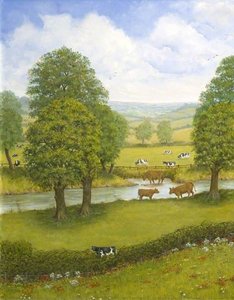
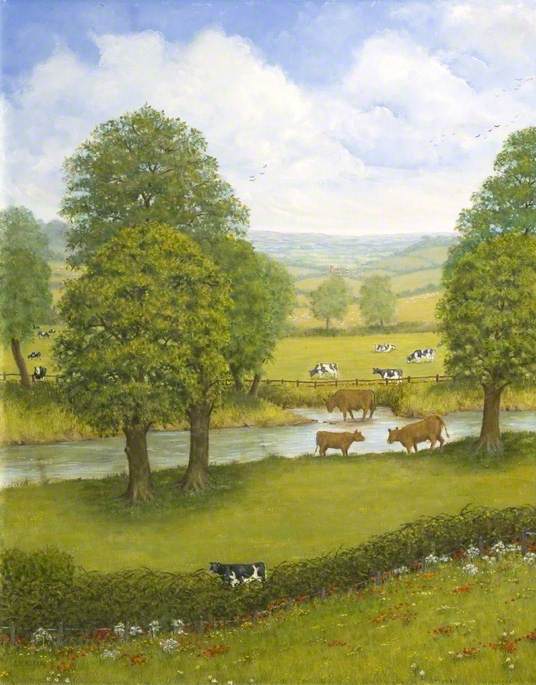
Dorset Landscape with a River and Cows
 Traditional Landscape Painting
 70.0 x 55.0 cm
 Dorset County Hospital
 Read More
Giclée / Art Print
Museum-quality giclée or canvas print with fast production and flexible finish options. ( Buy Hand Made Painting Buy Image)




































Pick from our preset sizes that match the artwork's original proportions.

You may enter your own dimensions to fit a specific frame or space. If your selected size does not match the original image's proportions, we will either crop the artwork or extend the image with a mirrored or solid-fill edge. A digital mockup will be sent for your approval before production begins.
Please note that the on-screen preview does not reflect the actual cropping or extension. Only the mockup will accurately show the final composition.
While custom sizes are available, we recommend selecting a dimension from the predefined list to preserve the original proportions.
Worldwide Delivery () in 2 weeks instead of standard 4/5 weeks. (18 August)

Free Worldwide Express Shipping

High-Quality Linen Canvas

Full Shipping Insurance

Customs Tax Refund Guarantee

True Color Matching Guarantee

60-Day Return Policy (Defects Only)

100% Money-Back Guarantee

Bulk Discount Offer
 Glass option is only available in size under 110 CM

Dorset Landscape with a River and Cows
Giclée / Art Print
Reproduction Size
-


Total Price
$ 63
Related Artworks
Artist Biography
A Life Immersed in the Dorset Landscape: The World of Alfred William Watkin
Alfred William Watkin (1854-1933) wasn't a painter who sought dramatic innovation or radical departures from tradition. Instead, he dedicated his life to capturing the quiet beauty and subtle nuances of his native Dorset, England. Born into a rural environment, Watkin’s artistic journey was one of deep observation and affectionate rendering of the landscapes that surrounded him – the rolling hills, the rugged coastline, the meandering rivers, and the pastoral scenes of everyday life. He wasn't driven by ambition for widespread fame but by an intrinsic need to translate his personal connection with nature onto canvas. This dedication resulted in a body of work that offers a poignant glimpse into a vanishing England, a world before rapid industrialization irrevocably altered its character. While not widely known during his lifetime, Watkin’s paintings have experienced a resurgence in popularity as collectors and art enthusiasts rediscover the charm and authenticity of his vision.Early Influences and Artistic Development
Watkin's early life was steeped in the traditions of rural England. His father was a farmer, and the rhythms of agricultural life profoundly shaped his aesthetic sensibility. Though largely self-taught, Watkin benefited from the burgeoning art scene in Dorset during the late 19th century. The influence of the Barbizon school is discernible in his early works – a focus on realistic depictions of nature, an emphasis on tonal values, and a preference for working *en plein air*. He also absorbed lessons from contemporary British landscape painters like John Constable and Thomas Gainsborough, though he never fully embraced their more dramatic or idealized styles. Instead, Watkin developed a uniquely personal approach characterized by meticulous detail, soft lighting, and a restrained palette. His initial subjects were often the immediate surroundings of his family farm – cows grazing in fields, haystacks bathed in golden sunlight, and local villages nestled amongst the hills. As he matured as an artist, Watkin expanded his range to include coastal scenes, river landscapes, and more expansive views of the Dorset countryside.Themes and Techniques: A Celebration of Rural England
Watkin’s paintings are united by a consistent thematic focus – a celebration of rural England and its enduring beauty. He was particularly drawn to the interplay of light and shadow, using subtle gradations of tone to create atmosphere and evoke mood. His technique was characterized by careful observation and meticulous detail. He often worked in watercolor, a medium that allowed him to capture the delicate nuances of color and texture. However, he also produced oil paintings, which enabled him to achieve greater depth and richness of tone. Recurring motifs in his work include:- Cows – often depicted as peaceful symbols of rural life.
- Rivers – representing the flow of time and the connection between land and water.
- Coastal scenes – capturing the rugged beauty of the Dorset coastline.
- Harbors and villages – depicting the everyday lives of local communities.
Legacy and Historical Significance
Although Watkin did not achieve widespread recognition during his lifetime, his paintings have experienced a resurgence in popularity in recent years. This renewed interest is due in part to a growing appreciation for the charm and authenticity of his vision. In an age dominated by abstract expressionism and conceptual art, Watkin’s realistic depictions of nature offer a refreshing alternative – a reminder of the enduring beauty of the natural world. His work provides valuable insight into the social and cultural history of rural England during the late 19th and early 20th centuries. He documented a way of life that was rapidly disappearing, preserving it for future generations. Watkin’s paintings are now sought after by collectors and art enthusiasts who appreciate his meticulous technique, subtle palette, and affectionate rendering of the landscapes he loved. His legacy lies not in groundbreaking innovation but in his unwavering dedication to capturing the quiet beauty and enduring spirit of Dorset, a world that continues to captivate and inspire.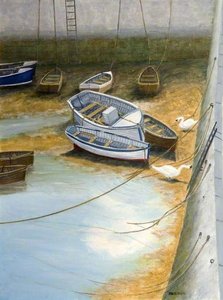
Related Articles

Sir Alfred Munnings' Masterpieces: 25 Paintings That Define Equine Art | ArtsDot
Explore 25 iconic Sir Alfred Munnings paintings! Discover the beauty of British Impressionism, equine art & rural England. Find museum-quality reproductions and elevate your home decor with ArtsDot. Explore the full collection online.

Beyond the Horizon: 10 Landscape Masterpieces for Your Home Decor
Journey through 10 breathtaking landscape paintings by Monet, Van Gogh & more! Explore iconic artworks, artistic techniques & find inspiration for your home decor. Museum-quality reproductions at ArtsDot.com. Discover all masterpieces on ArtsDot.com
Evoking Nature's Sublime: A Comprehensive Exploration of 19th-Century Landscape Painting
Explore the captivating world of 19th-century landscape painting! Discover renowned artists like Friedrich & Monet, key movements, and find the perfect artwork to bring nature's serenity into your home. Expert insights at ArtsDot.

Romantic Landscapes: 10 Masterpieces for Your Home | ArtsDot
Journey through 10 Romantic landscape masterpieces by Friedrich, Turner & Cole. Explore emotional art, sublime nature scenes & iconic 19th-century paintings. Find museum-quality reproductions for your home at ArtsDot.com – discover the full collection online!
Alfred East: Pioneering Plein Air & Evoking Atmospheric Landscapes
Explore the life & work of Alfred East, a pioneer of British plein air painting. Discover his techniques for capturing atmospheric landscapes, Barbizon influences, and lasting legacy. Learn more at ArtsDot.