 Preview
 Send
Send Share
Share
 Details

 Download
 Similars
 X-Ray
X-Ray Diaporama
evening reverie - nocturnal slumber


 Read More
Hand Made Oil Reproduction
Hand-painted oil on canvas in your size and frame, made to order by our artists. ( Buy Print Buy Image)




P118B $10

P118H $10

P118W $10

P438Z $10

P508JH $12

P508YH $12

P805H $10

P805Z $10

P919BZ $10

P919G $10

P919XJ $10

P959ZH $10

P968JZ $12

W106C $8

W218G $10

W218JH $8

W218Y $10

W307PJ $10

W316G $10

W316PJ $8

W316Y $10

W398PJ $8

W4111J $10

W500HY $15

W500JH $15

W692G $12

W849H $8

W940BG $15

W953PJ $8




Pick from our preset sizes that match the artwork's original proportions.

You may enter your own dimensions to fit a specific frame or space. If your selected size does not match the original image's proportions, we will either crop the artwork or extend the painting with additional hand-painted elements. A digital mockup will be sent for your approval before production begins.
Please note that the on-screen preview does not reflect the actual cropping or extension. Only the mockup will accurately show the final composition.
While custom sizes are available, we recommend selecting a dimension from the predefined list to preserve the original proportions.
After order, ArtsDot.com team will email client for instructions and provide a mockup preview
Worldwide Delivery () in 3/4 weeks instead of standard 5 weeks. (17 August). No compromise on quality.

Free Worldwide Express Shipping

High-Quality Linen Canvas

Full Shipping Insurance

Customs Tax Refund Guarantee

True Color Matching Guarantee

60-Day Return Policy (Defects Only)

100% Money-Back Guarantee

Bulk Discount Offer
 Glass option is only available in size under 110 CM

evening reverie - nocturnal slumber
Reproduction Medium
Reproduction Size
-


Total Price
$ 263
Artwork Description
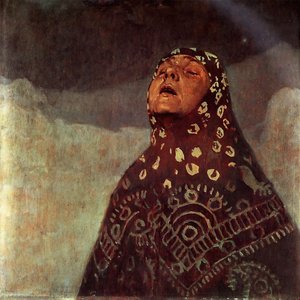
Evening Reverie - Nocturnal Slumber: A Portrait of Tranquility in Art Nouveau
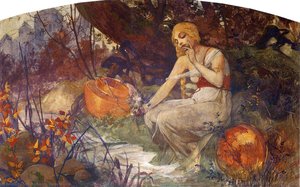
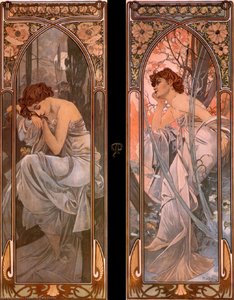
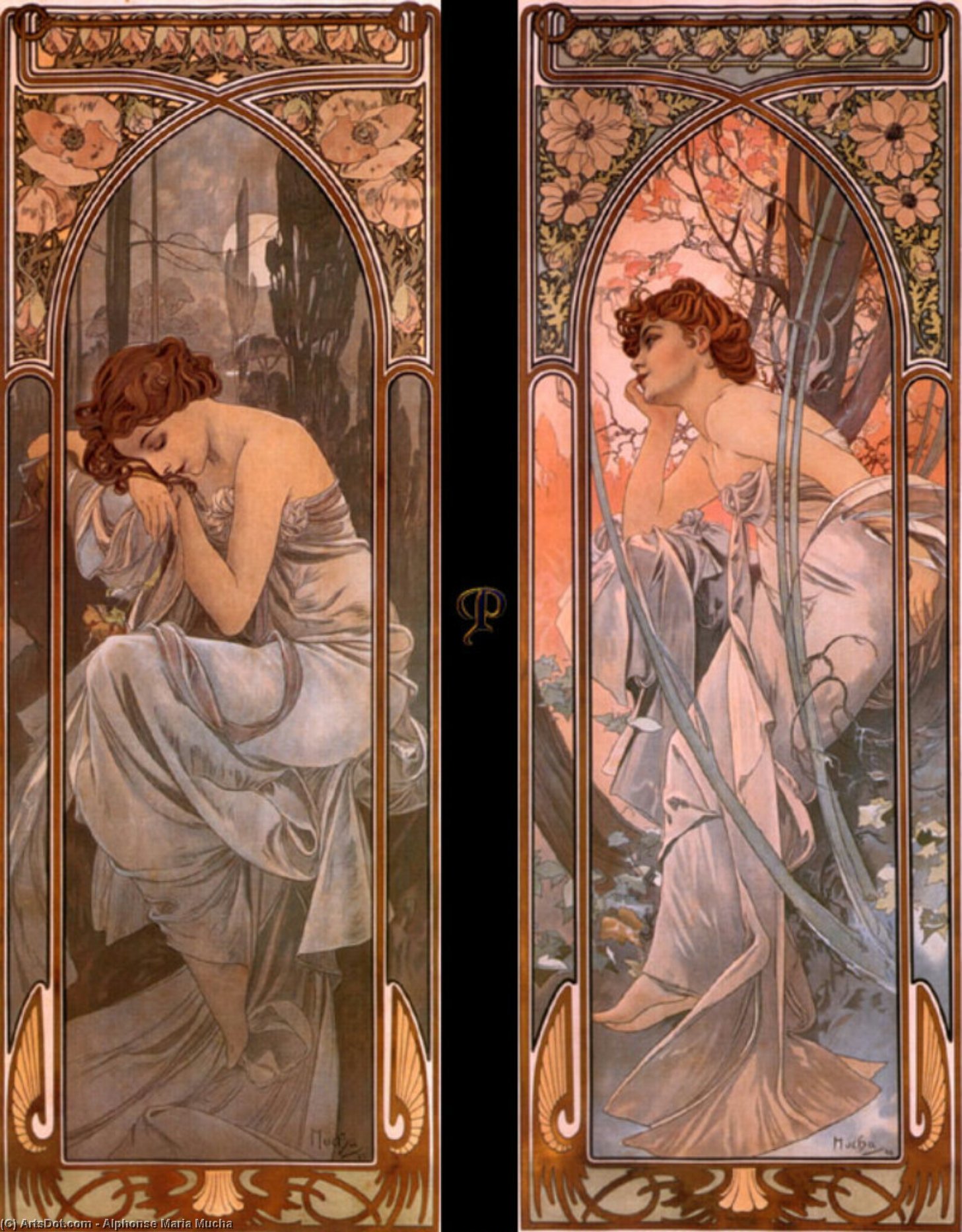
Alphonse Mucha’s “Evening Reverie” – or “Nocturnal Slumber,” as it’s more formally titled – is a captivating painting that embodies the very essence of Art Nouveau, capturing a moment of serene contemplation amidst an exquisitely rendered landscape. Created in 1898, this artwork transcends mere visual representation; it speaks to themes of femininity, spirituality, and the harmonious relationship between humanity and nature—elements deeply ingrained within Mucha’s artistic vision.
Mucha, born in Brno, Czech Republic, in 1860, initially pursued traditional academic training at Prague’s Academy of Fine Arts but swiftly rejected its rigid conventions. Recognizing the limitations of conventional art forms, he embarked on a transformative journey to Paris in 1887, where he established his studio and cultivated an independent style—a style that would become synonymous with Art Nouveau.
Style and Technique: Flowing Lines and Organic Forms
The painting’s aesthetic is undeniably defined by Art Nouveau’s hallmark characteristics. Mucha skillfully employs flowing lines – reminiscent of vines and blossoms – to delineate the contours of the tree dominating the background, creating a sense of dynamic movement that contrasts beautifully with the stillness of the two women depicted within.
Mucha’s technique is characterized by meticulous detail combined with an ethereal quality. He utilizes pastel shades—primarily lavender, pale pink, and creamy beige—to imbue the scene with a soft luminescence, mirroring the tranquility of nighttime. The brushstrokes are delicate yet purposeful, capturing subtle nuances of light and shadow that contribute to the painting’s overall atmosphere.
Symbolism: Femininity and Spiritual Reflection
The central figures – two women seated beneath the tree—represent idealized femininity, a recurring motif in Mucha's oeuvre. One woman rests her head on her hand, conveying vulnerability and introspection; the other gazes serenely outwards, embodying spiritual awareness and receptiveness to beauty.
The tree itself serves as a potent symbol of resilience and regeneration – mirroring Mucha’s belief in the transformative power of nature. Its branches reach upwards towards the heavens, symbolizing aspiration and connection with the divine—concepts central to Art Nouveau's philosophical undercurrents.
Historical Context: The Dawn of Modern Decorative Arts
"Evening Reverie" emerged during a period of significant artistic innovation in Europe. Art Nouveau was reacting against Victorian formalism, prioritizing organic forms and decorative embellishment over rigid geometric patterns. Mucha’s work aligns perfectly with this movement's ambition to elevate the visual arts into instruments of cultural enrichment—a legacy that continues to inspire artists and designers today.
This painting exemplifies Mucha’s ability to fuse artistic skill with profound symbolic meaning, cementing his place as one of Art Nouveau’s foremost practitioners. Its enduring appeal lies in its capacity to evoke feelings of peace, beauty, and contemplation—qualities that resonate powerfully within the viewer's imagination.
Related Artworks
Artist Biography
Early Life and Education
- Born: July 15, 1860, in Ivanačice, Moravia (now part of the Czech Republic)
- Showed artistic talent from a young age.
- Studied at the Academy of Fine Arts in Prague but became disillusioned with traditional approaches.
- Moved to Paris in 1887 to pursue his own style.
Artistic Style and Notable Works
- Known for distinctive Art Nouveau style characterized by flowing lines, organic forms, and a sense of movement.
- Influenced by artists like Pierre-Auguste Renoir and Gustave Moreau.
- Notable Works:
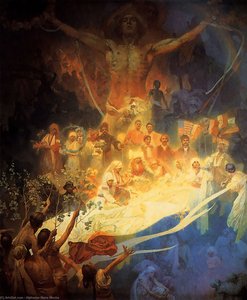
- The Slavonic Uprising - Showcases blending traditional Czech motifs with modern Art Nouveau elements.
- Salon des Cent
- Paintings inspired by works like The Daughters of Tespio by Gustave Moreau, and La Ribambelle des Gobelins by Piero Dorazio.
- Illustrations based on Young Farmers Breaking Flax by Sir Hubert von Herkomer.
- Frequently featured idealized women in flowing robes surrounded by lush flowers.
Career Highlights and Major Commissions
- Sarah Bernhardt Collaboration: Created posters and designs for the actress Sarah Bernhardt, starting with the poster for Gismonda (1894), which launched his career.
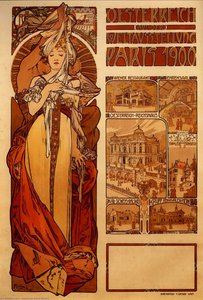
- Universal Exhibition in Paris (1900): His Art Nouveau style gained international recognition at this exhibition. He decorated the Bosnia and Herzegovina Pavilion and collaborated on the Austrian Pavilion.
- Charles Richard Crane Patronage: Received support from Charles Richard Crane, which enabled him to create the monumental series The Slav Epic (1912-30).
- Post-Independence Czechoslovakia: Designed postage stamps, banknotes, and government documents for newly independent Czechoslovakia.
Influences and Legacy
- Influenced by Czech artistic traditions and modern European art movements.
- His unique style paved the way for future generations of artists in Art Nouveau and Secessionism.
- Inspired other artists like Eva Prokopcová.
- Legacy extends beyond his artwork to influence design and aesthetics.
Later Life and Death
- Married Maruska (Marie/Maria) Chytilová in 1906.
- Visited the United States from 1906-1910, where their daughter Jaroslava was born.
- Died on July 14, 1939, in Prague, Czechoslovakia.
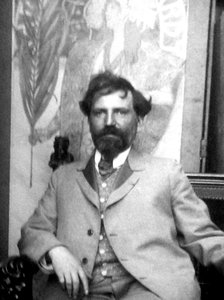
Alphonse Mucha
1860 - 1939 , Czech Republic
Quick Facts
- Artistic Movement Or Style: Art Nouveau
- Artists Or Movements Influenced By This Artist: ['Eva Prokopcová']
- Artists Who Influenced This Artist:
- Pierre-Auguste Renoir
- Gustave Moreau
- Dante Gabriel Rossetti
- Date Of Birth: July 15, 1860
- Date Of Death: 1939
- Full Name: Alphonse Maria Mucha
- Nationality: Czech
- Notable Artworks:
- Slavic Uprising
- Salon des Cent
- The Daughters of Tespio
- La Ribambelle des Gobelins
- Young Farmers Breaking Flax
- Place Of Birth: Brno, Czech Republic