

 Preview
 Send
Send Share
Share
 Details

 Download
 Similars
 X-Ray
X-Ray Diaporama
 Stats
StatsThe Start of the Race of the Riderless Horses
 Oil
Oil- WallArt
- Romanticism
 1820
1820- 19th Century
 46.0 x 54.0 cm
 Read More
Purchase a high-resolution, enhanced digital image, far superior to the online preview.
Each file is meticulously prepared by our in-house specialists using advanced tools and expert manual retouching. We ensure every image has exceptional clarity, precise color accuracy, and fine detail.
The final file is delivered via email within 72 hours, optimized for immediate use in professional, editorial, and print environments. This is the same quality trusted by top-tier design studios, publishers, and galleries.
Digital Image
Download a high-resolution file for personal display, printing, and creative projects. ( Switch to Print Buy Hand Made Painting)
Included in Every Digital Image Order
Expert Digital Delivery, Guaranteed
When you choose ArtsDot.com, you're not just getting an image - you're receiving a professionally enhanced digital artwork, crafted with precision and backed by a satisfaction guarantee. Here's everything that comes with your order, automatically:

Fast Email Delivery
Your high-resolution digital image file will be emailed to you within 72 hours of ordering - ready for immediate use.

AI-Enhanced Digital File
Your artwork is professionally optimized using advanced AI tools and manual editing, ensuring maximum detail, clarity, and color accuracy.

Free Lifetime Re-Delivery
Accidentally deleted or lost your file? No worries - we'll resend it to you anytime, free of charge.

No Import Fees - Ever
Enjoy your artwork instantly with zero customs, duties, or delivery fees - digital downloads are always tax-free.

Color Accuracy Guarantee
We ensure your digital image reflects the original colors as closely as possible using professional tools and color management.

100-Day Satisfaction Guarantee
If you're not satisfied with your digital image, we'll revise it or refund 100% within 100 days - no questions asked.

100% Money-Back Guarantee
Not satisfied? Get a full refund within 100 days of receiving your digital file - no questions asked.

Bulk Order Discounts
Buy 3 images, save 10% - Buy 5, save 15% - Buy 10+, save 20%. Great for creative projects, galleries, and agencies.
A Symphony of Chaos and Elegance
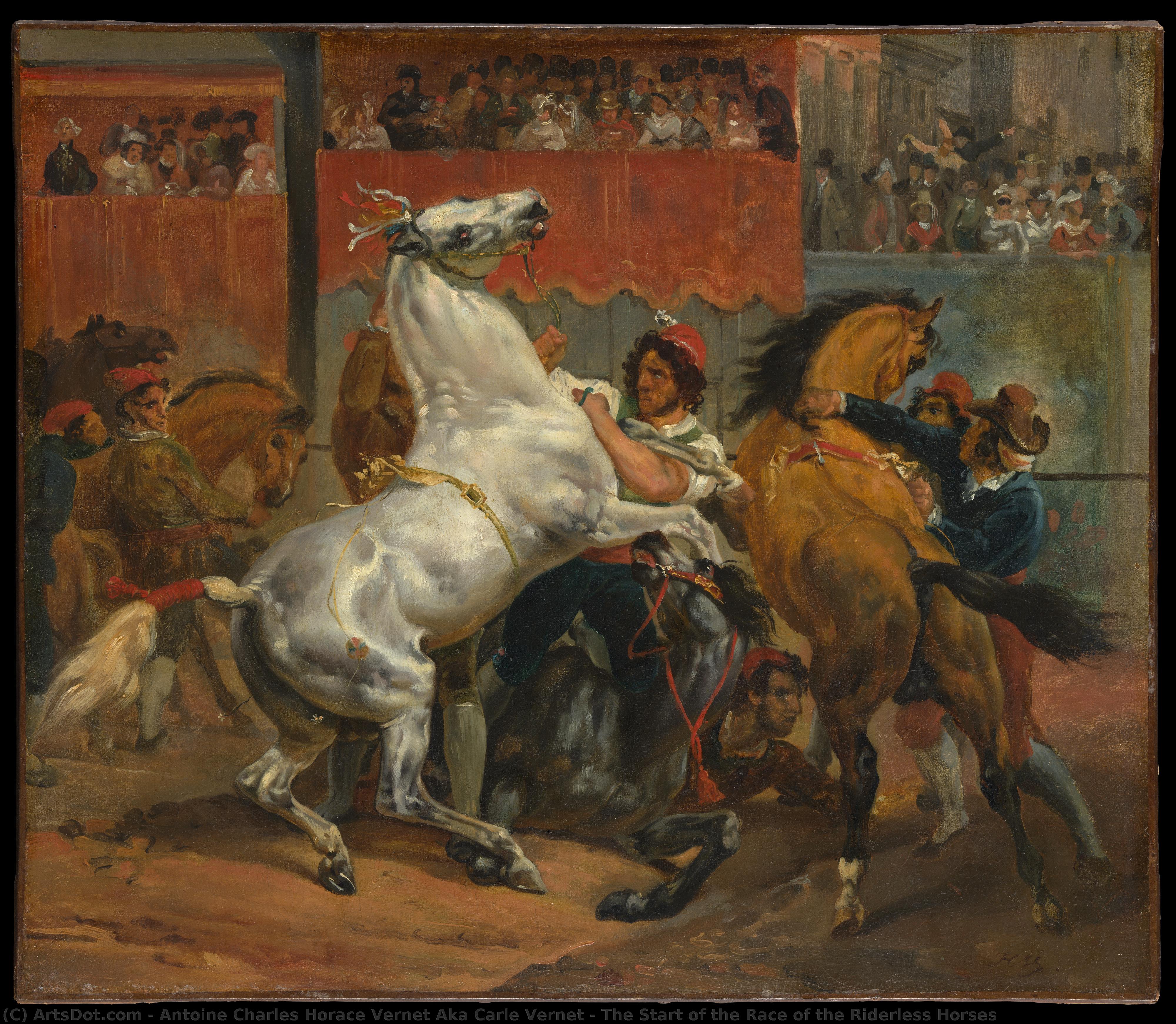
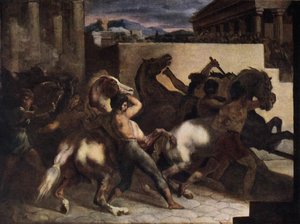
In the heart of Rome’s historic Piazza del Popolo, a moment of breathless anticipation is frozen in time within Antoine Charles Horace Vernet’s 1820 masterpiece, The Start of the Race of the Riderless Horses. This evocative painting captures the raw, unbridled energy of the Roman Carnival, specifically the legendary race of riderless horses that took place each February before the solemnity of Lent. The scene is a masterclass in controlled tension; Vernet invites us into the frantic seconds of la mossa, where grooms and handlers struggle with Herculean effort to restrain powerful steeds that yearn for flight. There is a palpable sense of movement—a swirling dance of muscle, dust, and human desperation that draws the viewer directly into the center of the spectacle.
The composition is anchored by a striking white horse, its luminous coat acting as a focal point amidst the more muted tones of the surrounding crowd. As this magnificent creature fights against its restraint, the eye is led through a complex tapestry of secondary figures: men leaning into the weight of the animals, onlookers caught in various states of awe, and subtle details like the glint of a sword or the steady presence of a clock on a distant wall. Vernet’s ability to balance this chaotic subject matter with a structured, classical sensibility is what makes this work so enduringly captivating for the modern eye.
The Mastery of the French Equestrian Tradition
As a pivotal figure in 19th-century French art, Carle Vernet brought an unparalleled expertise in equestrian subjects to this canvas. His technique reflects a deep, lifelong devotion to the anatomy and spirit of the horse—a passion that began in his early childhood in Bordeaux. In this work, we see the influence of his academic training blended with a Romantic sensibility. The brushwork is fluid yet precise, capturing the sheen of sweat on a horse's flank and the heavy textures of the Roman architecture. The lighting plays a crucial role, casting dramatic shadows that heighten the theatricality of the event, much like a stage production set in the open air.
Historically, this painting serves as a fascinating bridge between eras. While Vernet was known for glorifying Napoleonic glory and battle scenes, here he captures a moment of civic celebration and cultural heritage. The piece even hints at a dialogue with his contemporary, Gericault, whose own studies of horse races informed the broader movement of French Romanticism. For the collector or interior designer, this painting offers more than just a depiction of an event; it provides a window into the soul of 19th-century European festivities, making it a profound addition to any collection focused on historical narrative and classical elegance.
An Evocative Presence for Sophisticated Interiors
For those seeking to infuse a space with character and movement, The Start of the Race of the Riderless Horses offers an unparalleled emotional impact. The painting possesses a unique duality: it is simultaneously high-energy and deeply nostalgic. Its palette of earthy tones punctuated by brilliant whites and deep shadows allows it to integrate seamlessly into diverse decor styles, from traditional manor aesthetics to more contemporary, curated galleries. It serves as a conversation piece that commands attention, evoking the grandeur of old-world Rome and the timeless thrill of the race.
Owning a high-quality reproduction of this work means bringing a sense of history and drama into the home. The sheer scale of the tension captured within its 46 x 54 cm frame provides a concentrated burst of vitality. Whether placed in a study, a grand hallway, or a formal dining room, Vernet’s work acts as an anchor of sophistication, reminding the observer of a time when art sought to capture the very heartbeat of human and animal passion.
Related Artworks
Artist Biography
Antoine Charles Horace Vernet: The Horseman of Napoleonic Glory
Carle Vernet, as he’s often known, was a pivotal figure in 19th-century French art – a painter who seamlessly blended the dynamism of battle scenes with the captivating elegance of equestrian subjects. Born in Bordeaux in 1758, into an artistic lineage stretching back to his father, Claude Joseph Vernet, Carle’s early life foreshadowed his future career. From the age of five, he displayed an extraordinary aptitude for drawing horses, a passion nurtured through rigorous academic training alongside Nicolas-Bernard Lépicié, yet ultimately leading him away from the traditional path laid out for him. A surprising turn occurred when he won the prestigious Prix de Rome in 1782 – an achievement that initially seemed to propel him towards a conventional artistic career, but which was swiftly curtailed by his father’s intervention, preventing him from entering a monastery, a fate seemingly ordained by his success. This early experience shaped Carle's approach; he deliberately broke with established conventions, drawing inspiration directly from the stables and riding schools where he observed horses in their natural environment – a radical departure from the idealized representations prevalent at the time. His most celebrated works, such as *Triumph of Aemilius Paulus*, showcased this innovative technique, capturing the raw power and movement of equine subjects with unprecedented realism. The revolution profoundly impacted his life; his sister’s execution cast a long shadow, leading him to abandon art for a period before returning to the profession under the French Directory. This later phase saw a dramatic shift in his style, fueled by his service to Napoleon Bonaparte.The Napoleonic Years: Painting Victory and Glory
Carle Vernet’s artistic trajectory took an extraordinary turn during the Napoleonic era. Recognizing the power of visual propaganda, Napoleon commissioned him to document his military campaigns with a series of meticulously detailed drawings. These weren't mere illustrations; they were strategic tools designed to glorify the Emperor and bolster morale. Works like *The Battle of Marengo* (1804), now housed at Versailles, stand as testaments to this period – vast canvases teeming with soldiers, cavalry charges, and the chaos of battle rendered with remarkable precision and dramatic intensity. He captured not just the events themselves but also the atmosphere of victory, imbuing his scenes with a palpable sense of heroism and triumph. The acclaim he received for these works, including the Legion of Honour bestowed by Napoleon himself, cemented his position as a court painter and a key propagandist for the regime.Beyond the Battlefield: A Master of Equestrian Art
While his early work was dominated by military subjects, Carle Vernet’s artistic interests broadened significantly in the decades following the fall of Napoleon. He developed an unparalleled expertise in depicting horses – not just as instruments of war but as symbols of grace, power, and elegance. His hunting scenes, races, and depictions of various breeds showcased a deep understanding of equine anatomy, movement, and temperament. He wasn’t simply painting horses; he was capturing their essence, conveying their spirit through subtle gestures and nuanced expressions. Critics at the time noted his unique approach, describing how he drew inspiration from the stables and riding schools rather than relying on traditional academic formulas – a testament to his observational skills and dedication to realism. His meticulous studies of horse breeds became highly sought after by wealthy patrons and breeders alike.Lithography and Fashion: A Dual Talent
Carle Vernet’s artistic versatility extended beyond painting. He was an early adopter of lithography, a technique that allowed him to reproduce his drawings on paper with remarkable clarity and detail. This medium proved particularly well-suited for capturing the fashionable trends of Parisian society. He produced a series of striking costume studies – *Incroyables et merveilleuses* (1797) – depicting elegantly dressed Parisians engaged in various social activities, offering a fascinating glimpse into the culture of the late 18th and early 19th centuries. These prints were immensely popular, establishing his reputation as both an artist and a keen observer of contemporary manners. His work reflected not only artistic skill but also a shrewd understanding of public taste.Legacy and Influence
Carle Vernet’s impact on the art world is undeniable. His innovative approach to depicting horses, particularly his focus on naturalism and movement, influenced generations of artists. His meticulous attention to detail and dramatic compositions set a new standard for battle scenes and sporting subjects. Even more significantly, he bridged the gap between classical artistic traditions and the burgeoning Romantic era, demonstrating a willingness to break with convention in pursuit of greater realism and emotional impact. His pupil, Théodore Géricault, famously trained in Vernet’s studio, inheriting and further developing many of the techniques that defined the artist's distinctive style. Carle Vernet died in Paris in 1836, leaving behind a rich legacy of paintings, drawings, and prints – a testament to his extraordinary talent and enduring influence on French art history.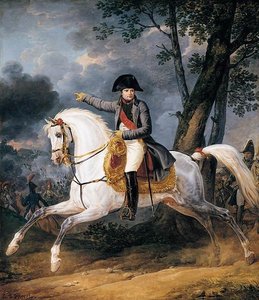
antoine charles horace vernet aka carle vernet
1758 - 1836 , France
Quick Facts
- Artistic Movement Or Style: Neoclassical, Battle scenes
- Artists Or Movements Influenced By This Artist: ['Horace Vernet']
- Artists Who Influenced This Artist: ['Claude Joseph Vernet']
- Date Of Birth: August 14, 1758
- Date Of Death: November 27, 1836
- Full Name: Antoine Charles Horace Vernet
- Nationality: French
- Notable Artworks:
- Triumph of Aemilius Paulus
- Battle of Marengo
- Return from the Hunt
- Place Of Birth: Bordeaux, France