 Preview
 Send
Send Share
Share
 Details

 Download
 Similars
 X-Ray
X-Ray Diaporama
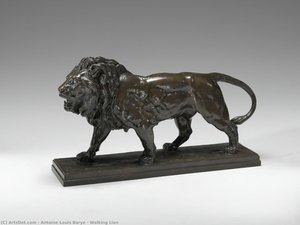
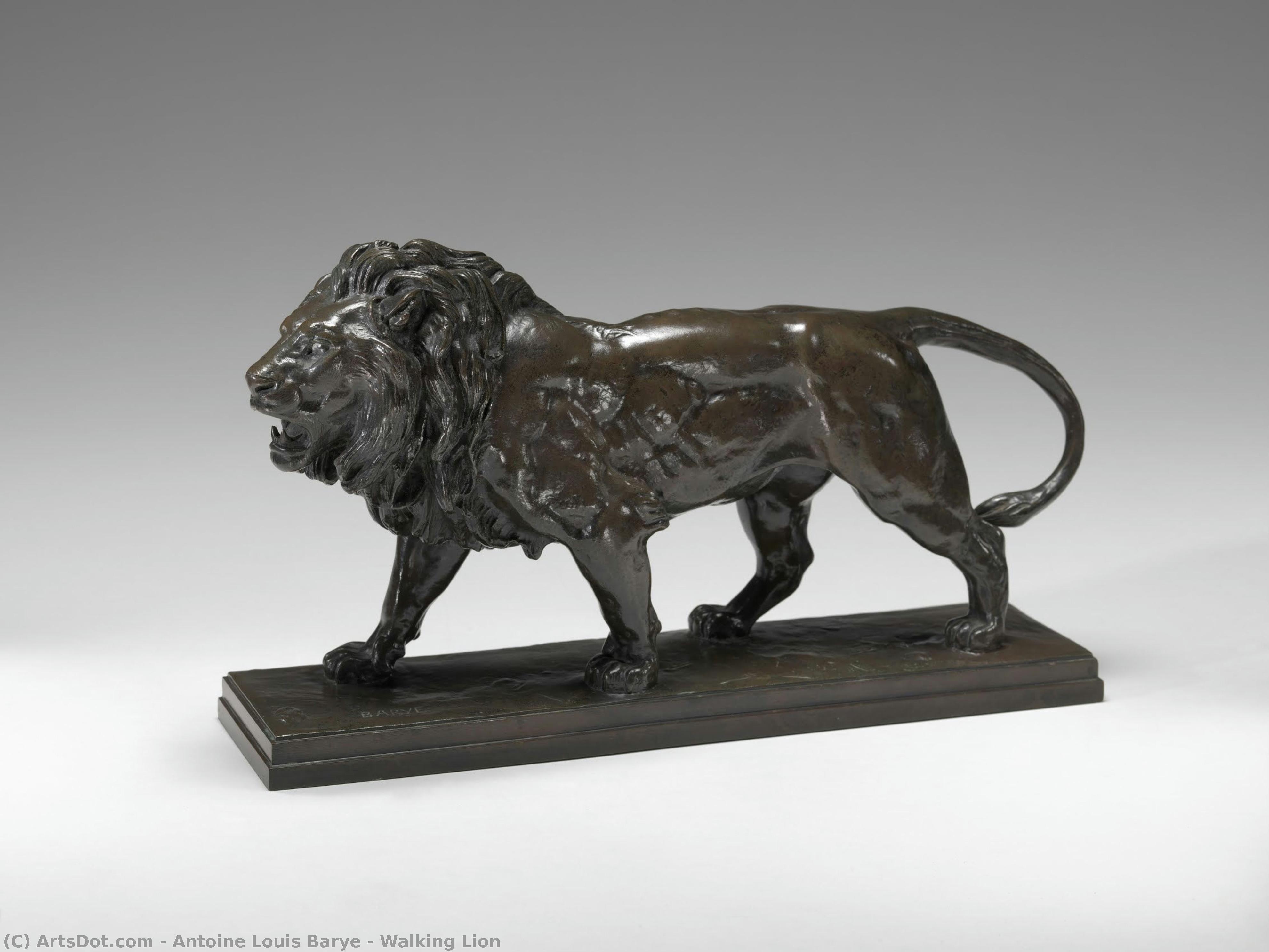
Walking Lion


 Read More
Hand Made Oil Reproduction
Hand-painted oil on canvas in your size and frame, made to order by our artists. ( Buy Print Buy Image)




P118B $10

P118H $10

P118W $10

P438Z $10

P508JH $12

P508YH $12

P805H $10

P805Z $10

P919BZ $10

P919G $10

P919XJ $10

P959ZH $10

P968JZ $12

W106C $8

W218G $10

W218JH $8

W218Y $10

W307PJ $10

W316G $10

W316PJ $8

W316Y $10

W398PJ $8

W4111J $10

W500HY $15

W500JH $15

W692G $12

W849H $8

W940BG $15

W953PJ $8




Pick from our preset sizes that match the artwork's original proportions.

You may enter your own dimensions to fit a specific frame or space. If your selected size does not match the original image's proportions, we will either crop the artwork or extend the painting with additional hand-painted elements. A digital mockup will be sent for your approval before production begins.
Please note that the on-screen preview does not reflect the actual cropping or extension. Only the mockup will accurately show the final composition.
While custom sizes are available, we recommend selecting a dimension from the predefined list to preserve the original proportions.
After order, ArtsDot.com team will email client for instructions and provide a mockup preview
Worldwide Delivery () in 3/4 weeks instead of standard 5 weeks. (17 August). No compromise on quality.

Free Worldwide Express Shipping

High-Quality Linen Canvas

Full Shipping Insurance

Customs Tax Refund Guarantee

True Color Matching Guarantee

60-Day Return Policy (Defects Only)

100% Money-Back Guarantee

Bulk Discount Offer
 Glass option is only available in size under 110 CM

Walking Lion
Reproduction Medium
Reproduction Size
-


Total Price
$ 263
Artwork Description
A Regal Presence: Deconstructing the Majesty of Barye’s Walking Lion
Antoine-Louis Barye's "Walking Lion," a bronze sculpture dating from the mid-19th century, isn’t merely a depiction of an animal; it’s a visceral embodiment of power, grace, and untamed wilderness. Born in Paris during a period of profound artistic transformation – the rise of Romanticism – Barye sought to move beyond the static formality of Neoclassical sculpture, instead capturing the dynamic energy and raw emotion inherent in the natural world. This particular piece, rendered with an almost palpable sense of movement, invites us into the heart of the lion’s spirit, a testament to Barye's revolutionary approach to animal representation.
The sculpture immediately commands attention through its sheer physicality. The bronze itself, meticulously cast and patinated to achieve a rich, burnished surface, speaks volumes about Barye’s mastery of lost-wax casting – a technique demanding both technical precision and artistic intuition. Notice the subtle variations in tone; the darker recesses of the musculature contrast beautifully with the highlights that accentuate the lion's powerful form. The texture is crucial: it’s not smooth or polished, but retains a tactile quality, hinting at the rough hide and formidable strength beneath. The wooden base, deliberately simple and rectangular, provides a grounding element, anchoring this embodiment of wildness within a contained space.
Capturing the Spirit of the Animalier
Barye’s work falls squarely within the burgeoning “animalier” movement – a trend that championed the study and representation of animals in sculpture. Prior to Barye, depictions of lions were often idealized or stylized, frequently serving as symbols of royalty or military might. However, Barye sought to capture the *essence* of the lion, its predatory instincts, its territoriality, and its inherent wildness. He achieved this through an intensely detailed anatomical study, meticulously rendering every muscle fiber, every ripple of fur, and every glint of light on the bronze surface. The pose itself – a deliberate stride forward, head held high – conveys a sense of confident authority and unwavering determination.
Consider the influence of Romanticism, which emphasized emotion, individualism, and the sublime power of nature. Barye’s lion embodies these ideals perfectly. It's not simply a beautiful animal; it’s a force of nature, a symbol of courage and resilience. The sculpture resonates with a primal energy, evoking a sense of awe and respect for the untamed wilderness.
Symbolism and Historical Context
The lion has long held significant symbolic weight across cultures – representing strength, nobility, justice, and vigilance. In ancient Egypt, it was associated with the sun god Ra; in Judeo-Christian tradition, it symbolizes Christ as “the Lion of Judah.” Barye’s sculpture taps into this rich tapestry of symbolism, reinforcing the lion's image as a creature of power and majesty. Furthermore, Barye’s work emerged during a period of significant social and political upheaval – the rise of nationalism, the Napoleonic Wars, and the burgeoning industrial revolution. His sculptures served as a powerful antidote to the rigid formality of classical art, offering instead a celebration of the natural world and its inherent beauty.
A Legacy in Bronze: Barye’s Enduring Influence
Antoine-Louis Barye remains one of the most celebrated sculptors of the 19th century. His pioneering work as an animalier fundamentally changed the way artists approached the representation of animals, paving the way for future generations of sculptors and artists. “Walking Lion” stands as a prime example of his genius – a captivating blend of technical skill, artistic vision, and profound understanding of the natural world. Today, reproductions of this iconic sculpture continue to inspire and delight, offering a tangible connection to a bygone era of artistic innovation and romantic fervor.
Related Artworks
Artist Biography
A Pioneer of Animal Sculpture: The Life and Legacy of Antoine-Louis Barye
Antoine-Louis Barye, born in Paris on September 24, 1795, emerged as a pivotal figure in the world of 19th-century sculpture. He wasn’t merely depicting animals; he was imbuing them with a dramatic intensity and anatomical accuracy previously unseen, effectively launching the *animalier* genre – a dedicated focus on animal forms – into the realm of fine art. Barye's journey began not in the studio of a sculptor, but as an apprentice goldsmith following in his father’s footsteps. This early training instilled within him a meticulous attention to detail and a mastery of technique that would prove invaluable throughout his career. He honed these skills further under sculptors like François-Joseph Bosio and Baron Antoine-Jean Gros, absorbing classical principles while simultaneously developing a uniquely Romantic sensibility. His formal education at the École des Beaux-Arts provided a solid foundation, but it was an encounter with the living world – specifically, the animals housed within the Jardin des Plantes in Paris around 1823 – that truly ignited his artistic vision.From Goldsmith to Animalier: The Development of a Unique Style
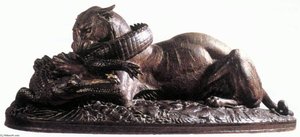
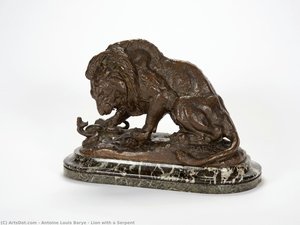
Barye’s dedication to observing animals was obsessive. He didn't simply glance; he studied, sketched, and meticulously analyzed their anatomy, movements, and behaviors. This commitment to realism wasn’t cold or clinical, however. It was infused with the emotional fervor characteristic of the Romantic movement. Early works like “Milo of Crotana Devoured by a Lion” (1819) and “Hercules with the Erymanthean Boar” (c. 1820), created while still a student, hinted at his emerging talent for dynamic composition and dramatic narrative. But it was with sculptures such as "Tiger Devouring a Gavial Crocodile" (1831) – a monumental plaster that caused a sensation at the Salon – and “Lion Crushing a Serpent” (1832), cast in bronze, that Barye truly established his signature style. These weren’t static representations; they were moments of raw power frozen in time, capturing the brutal beauty of nature's struggle for survival. He moved beyond mere imitation to convey the very essence of animal life – their strength, agility, and untamed spirit. His work resonated with a growing public fascination with the exotic and the wild, reflecting a Romantic yearning for experiences beyond the confines of civilized society.Major Works and Monumental Commissions
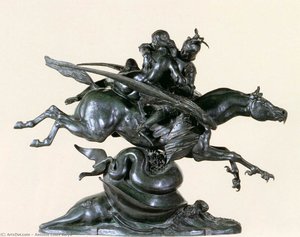
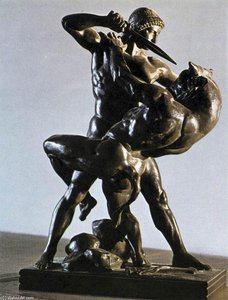
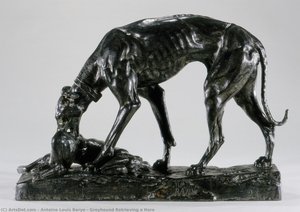
Throughout his career, Barye produced an astonishing array of sculptures, each demonstrating his unparalleled skill in capturing animal form and movement. Beyond the iconic “Tiger Devouring a Gavial Crocodile” and “Lion Crushing a Serpent,” masterpieces like "Theseus and the Minotaur" (1843), “Roger and Angelica on the Hippogriff” (1846), “Lapitha and Centaur” (1848) and “Jaguar Devouring a Hare” (1850) showcased his versatility and imaginative power. He wasn’t limited to depictions of predatory encounters; he also explored mythological scenes, imbuing them with the same dynamic energy and anatomical precision that defined his animal studies. His talent extended beyond smaller-scale bronzes as well. Barye received prestigious commissions for monumental works, including the “Lion of the Column of July,” a powerful symbol of French resilience, and sculptures adorning the Tuileries Garden in Paris. These large-scale projects demonstrated his ability to translate his artistic vision into public art, solidifying his reputation as one of France’s leading sculptors.Influences, Struggles, and Lasting Significance
Barye's work was a synthesis of diverse influences. The Romantic emphasis on emotion and individualism is palpable in the dramatic tension of his sculptures. Simultaneously, he drew inspiration from classical art, evident in his attention to anatomical accuracy and idealized forms. However, what truly set him apart was his scientific approach to observation – a direct result of his countless hours spent studying animals at the Jardin des Plantes. Despite achieving critical acclaim, Barye’s life wasn't without hardship. He struggled with financial difficulties throughout much of his career, largely due to poor business acumen. A bankruptcy in 1848 forced him to sell his models and molds, leading to a period where inferior copies flooded the market, damaging his reputation. He found some stability as Professor of Drawings at the Museum of Natural History in 1854, but it was only posthumously that his genius received its full due. Today, Antoine-Louis Barye is recognized as the father of modern animal sculpture. His influence on subsequent generations of artists is undeniable, and his works are celebrated for their power, realism, and enduring beauty. He elevated the *animalier* genre from a niche pursuit to a respected form of artistic expression, leaving an indelible mark on the history of sculpture. His legacy continues to inspire awe and admiration in collectors and museums worldwide.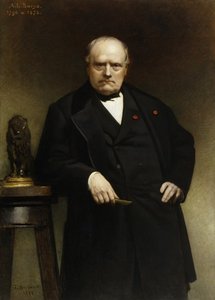
Antoine-Louis Barye
1796 - 1875 , France
Quick Facts
- Artistic Movement Or Style: Romanticism
- Artists Or Movements Influenced By This Artist: ['Animal sculptors']
- Artists Who Influenced This Artist:
- Francois-Joseph Bosio
- Baron Antoine-Jean Gros
- Date Of Birth: September 24, 1795
- Date Of Death: June 25, 1875
- Full Name: Antoine-Louis Barye
- Nationality: French
- Notable Artworks:
- Tiger Devouring a Gavial
- Lion Crushing a Serpent
- Theseus and the Minotaur
- Roger & Angelica
- Lapitha and Centaur
- Jaguar Devouring Hare
- Place Of Birth: Paris, France
Related Articles

Bronze Age to Modern Masters: 10 Sculptures That Redefined Art | ArtsDot
Journey through art history with 10 legendary bronze sculptures – from Michelangelo's David to Rodin’s Thinker. Explore the stories, techniques & timeless beauty of these masterpieces. Find museum-quality reproductions & elevate your home decor on ArtsDot.com.

Bronze Sculptures That Defined Art History | ArtsDot
Journey through art history with our Top 10 bronze sculptures! Explore masterpieces by Rodin, Michelangelo & more. Discover stories behind iconic statues and find museum-quality reproductions for your home decor at ArtsDot.com.
The Enduring Legacy of Bronze: A Historical & Artistic Exploration for the Collector
Explore the rich history & enduring appeal of bronze sculpture with expert insights for collectors at ArtsDot. Learn about casting techniques, iconic artists, collecting tips & contemporary interpretations.
The Enduring Legacy of Bronze: History, Technique & Artistic Expression for the Collector
Explore the rich history & enduring appeal of bronze sculpture with expert insights for collectors at ArtsDot. Learn about casting techniques, iconic artists, and collecting tips.
The Enduring Legacy of Bronze Sculpture: A Collector's Guide to Form & Cultural Significance
Explore the rich history & enduring appeal of bronze sculpture with expert insights for collectors at ArtsDot. Learn about casting techniques, iconic artists, and collecting tips to build a discerning art collection.