 Preview
 Send
Send Share
Share
 Details

 Download
 Similars
 X-Ray
X-Ray Diaporama
Louis-Joseph Papineau
 Oil On Canvas
- WallArt
- Neoclassicism
 1836
1836 122.0 x 106.0 cm
 National Gallery of Canada
 Read More
Giclée / Art Print
Museum-quality giclée or canvas print with fast production and flexible finish options. ( Buy Hand Made Painting Buy Image)




P118B $10

P118H $10

P118W $10

P438Z $10

P508JH $12

P508YH $12

P805H $10

P805Z $10

P919BZ $10

P919G $10

P919XJ $10

P959ZH $10

P968JZ $12

W106C $8

W218G $10

W218JH $8

W218Y $10

W307PJ $10

W316G $10

W316PJ $8

W316Y $10

W398PJ $8

W4111J $10

W500HY $15

W500JH $15

W692G $12

W849H $8

W940BG $15

W953PJ $8




Pick from our preset sizes that match the artwork's original proportions.

You may enter your own dimensions to fit a specific frame or space. If your selected size does not match the original image's proportions, we will either crop the artwork or extend the image with a mirrored or solid-fill edge. A digital mockup will be sent for your approval before production begins.
Please note that the on-screen preview does not reflect the actual cropping or extension. Only the mockup will accurately show the final composition.
While custom sizes are available, we recommend selecting a dimension from the predefined list to preserve the original proportions.
Worldwide Delivery () in 2 weeks instead of standard 4/5 weeks. (22 August)

Free Worldwide Express Shipping

High-Quality Linen Canvas

Full Shipping Insurance

Customs Tax Refund Guarantee

True Color Matching Guarantee

60-Day Return Policy (Defects Only)

100% Money-Back Guarantee

Bulk Discount Offer
 Glass option is only available in size under 110 CM

Louis-Joseph Papineau
Giclée / Art Print
Reproduction Size
-


Total Price
$ 63
Collectible Description
A Portrait of Authority: Antoine Plamondon’s Louis-Joseph Papineau
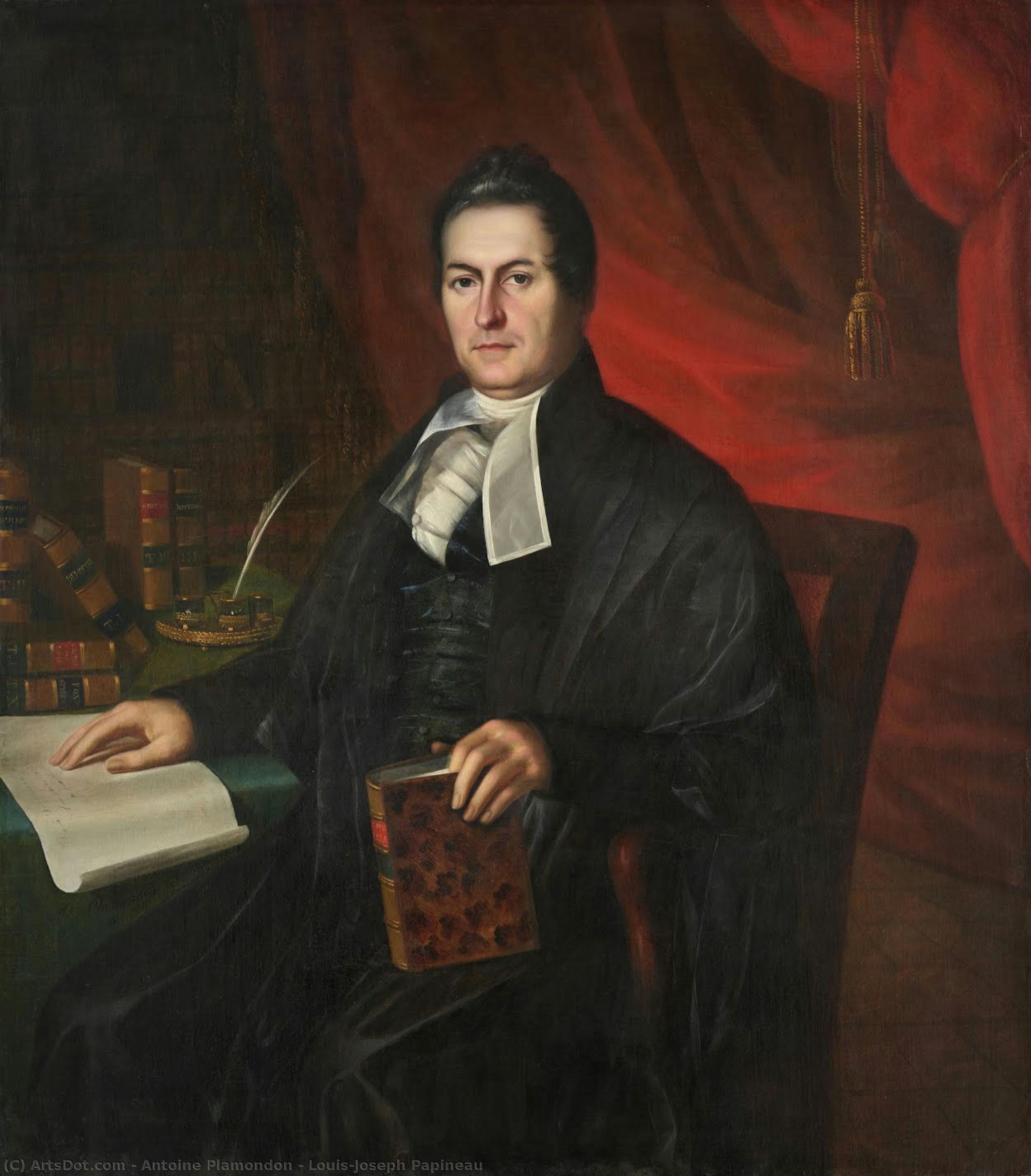
Antoine Plamondon's 1836 portrait of Louis-Joseph Papineau is more than just a likeness; it’s a carefully constructed embodiment of power, intellect, and the burgeoning spirit of Quebec. Rendered in the rich, layered style of Neoclassical portraiture, this oil painting captures not merely the physical appearance of a prominent political figure but also his projected authority within a pivotal moment in Canadian history. The artwork immediately commands attention with its formal composition – Papineau dominates the frame, seated centrally and occupying nearly two-thirds of the canvas, creating an intimate yet imposing presence for the viewer.
The background is meticulously detailed, suggesting both erudition and political engagement. Bookshelves overflow with volumes, hinting at a learned mind and a dedication to legal practice – Papineau’s role as a judge or lawyer is subtly reinforced by his attire and the overall setting. A draped red curtain adds a touch of theatricality, perhaps alluding to the dramatic events unfolding in Lower Canada during this period. The use of geometric shapes—rectangles for the books, the table, and the man's clothing; circles for the eyes and mouth—provides a grounding structure while simultaneously contributing to the painting’s formal elegance. Plamondon masterfully employs light and shadow, directing our gaze towards Papineau’s face, highlighting his features with a subtle yet deliberate chiaroscuro effect that emphasizes his seriousness and gravitas.
The Neoclassical Echo: Style and Technique
Plamondon's style is deeply rooted in the artistic conventions of 18th and early 19th-century Neoclassicism. This movement, inspired by the art of ancient Greece and Rome, prized clarity, order, and a sense of moral purpose. The portrait adheres to these principles through its balanced composition, precise detailing, and restrained palette. The artist’s brushwork is remarkably controlled, creating a smooth, polished surface that reflects the meticulous attention to detail characteristic of Neoclassical painting. Note the subtle blending of colors in the fabrics—the rich textures of his coat and waistcoat are rendered with remarkable realism – and the careful modeling of his face, conveying both strength and intelligence.
The use of oil paint on canvas is evident in the layering of glazes and scumbles that create a sense of depth and volume. The lighting, originating from the upper left, casts subtle shadows, adding to the painting’s dramatic effect and highlighting Papineau's features. Plamondon’s technical skill is undeniable; he demonstrates a deep understanding of anatomy, perspective, and color theory, resulting in a portrait that is both aesthetically pleasing and historically significant.
A Figure of Quebec: Historical Context and Symbolism
Created in 1836, the year following the Lower Canada Rebellion, this portrait captures Papineau at a critical juncture in Canadian history. Louis-Joseph Papineau was a key figure in the Patriote movement, advocating for greater autonomy for French Canadians within British North America. The painting itself becomes a symbol of that struggle – a representation of leadership and determination amidst political unrest. The legal documents and formal attire speak to his role as a lawyer and judge, while the bookshelves suggest a commitment to knowledge and reform.
Further research reveals that Papineau was a complex and controversial figure, a champion of French Canadian rights who ultimately led his people into armed rebellion. The portrait, therefore, invites us to consider the nuances of his legacy – his ambition, his convictions, and his role in shaping the future of Quebec. The Wikipedia article highlights his connection to Jewish history, noting that he was instrumental in granting full citizenship rights to Jews in Canada East, a remarkable achievement for its time. The National Gallery of Canada’s website provides further context on Plamondon's artistic career and the historical significance of this particular work.
A Timeless Masterpiece: Reproduction and Appreciation
Plamondon’s portrait of Louis-Joseph Papineau is a testament to the enduring power of Neoclassical art. Reproductions, such as those offered by ArtsDot.com, allow us to appreciate this masterpiece in new ways, bringing its rich details and historical significance into our homes and spaces. The painting's commanding presence and evocative symbolism make it an ideal choice for collectors seeking a piece that reflects both artistic excellence and Canadian heritage. Whether displayed in a study, a library, or a formal living room, this portrait will undoubtedly serve as a conversation starter and a reminder of the complexities and triumphs of Quebec’s past.
Related Artworks



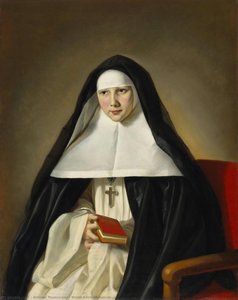
Artist Biography
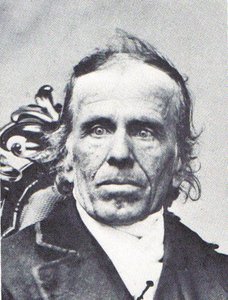
Antoine-Sébastien Plamondon: A Pioneer of Quebec Portraiture
Early Life and Training
- Born: 1804 in L'Ancienne-Lorette, Lower Canada (present-day Quebec).
- Plamondon began his artistic journey at the age of fifteen as an apprentice to Joseph Légaré, a prominent religious painter and restorer.
- His initial training focused on restoration work, specifically a large collection of European paintings assembled by Abbé Louis-Joseph Desjardins and his associates. This exposure provided invaluable experience with Old Master techniques.
- By age twenty-one, he had established himself as a skilled artist with a particular aptitude for portraiture.
Artistic Development & Parisian Studies
- In 1825, Plamondon opened his own studio in Montreal and began accepting commissions for churches in Beaumont, Bécancour, and Cap Santé.
- Recognizing his talent, Vicar-General Descheneaux secured funding for him to study painting in Paris from 1826 to 1830.
- In Paris, he became a pupil of Jean-Baptiste Paulin Guérin, a portrait painter and follower of Jacques-Louis David. This mentorship instilled in Plamondon a classical approach to painting.
- His Parisian studies exposed him to the prevailing Neo-classical style, which would become a defining characteristic of his work.
Career & Major Works
- Upon returning to Quebec in 1830, Plamondon quickly established himself as a leading portraitist.
- Notable works include:
- Louis-Joseph Papineau (1836), now housed at the National Gallery of Canada.
- Sister Saint-Alphonse, showcasing his mastery of early Canadian art.
- Portrait of Grand Duchess Maria Alexandrovna, a demonstration of his refined portrait skills.
- He painted over fifty portraits of prominent figures in Quebec City society – bishops, clerics, politicians, doctors, merchants, and their families.
- Plamondon also created numerous religious paintings for churches throughout the region, often based on engravings of European Old Masters.
Style & Influences
- Plamondon’s style is characterized by its Neo-classical precision and formality. His portraits typically feature full-face poses, close compositions, and meticulous attention to detail.
- Influences:
- Jean-Baptiste Paulin Guérin: Provided formal training in Neo-classical portraiture.
- Jacques-Louis David: Inspired his classical approach to composition and form.
- European Old Masters: Influenced his religious paintings through the study of engravings.
- His later portraits exhibited a greater sense of roundness in modeling and more expansive compositions.
Legacy & Historical Significance
- Plamondon is considered one of the most important portraitists in 19th-century Quebec.
- His work provides valuable insights into the social and cultural life of the period, capturing the likenesses of influential individuals.
- He played a crucial role in establishing a distinctly Canadian artistic identity, blending European training with local subject matter.
- His paintings are held in prominent collections, including the National Gallery of Canada and the Musée des beaux-arts du Canada, ensuring his enduring legacy.
antoine plamondon
1895 , Canada
Quick Facts
- Birth Date: 1804
- Birth Place: L'Ancienne-Lorette, Canada
- Death Date: 1895
- Influenced By:
- Jean-Baptiste Paulin Guérin
- Jacques-Louis David
- Movement: Neo-classicism
- Name: Antoine-Sébastien Plamondon
- Nationality: Canadian
- Notable Works:
- Louis-Joseph Papineau
- Sister Saint-Alphonse
Related Articles
Neo-Classicism's Greatest Hits: 10 Masterpieces for Your Home |
Journey through Neo-Classicism's finest! Explore 10 iconic masterpieces by David, Ingres & Canova. Discover art history, techniques & timeless beauty – perfect for inspiring your home decor. Find museum-quality reproductions at
Morris Louis: Pioneering Color Field Painting & Abstract Expressionism's Legacy
Explore the groundbreaking abstract expressionism of Morris Louis, a pioneer of Color Field painting. Discover his innovative techniques, influential series & lasting legacy in post-war American art. Learn more at ArtsDot.
Antoine Blanchard (Marcel Masson): Parisian Abstraction & the Legacy of Automatism
Explore the captivating world of Antoine Blanchard (Marcel Masson) and his nostalgic Parisian scenes. Discover his artistic influences, unique style, and the challenges of authentication. Expert insights & art appraisal information.
Anne-Louis Girodet: Bridging Neoclassicism & Romanticism with Emotional Truth
Explore the captivating world of Anne-Louis Girodet, a pivotal figure bridging Neoclassicism & Romanticism. Discover his masterpieces and unique artistic vision with ArtsDot.
Jean-Michel Basquiat: Deconstructing Identity & Power Through Neo-Expressionist Graffiti
Explore the powerful work of Jean-Michel Basquiat & his impact on Neo-Expressionism. Discover how he deconstructed identity, challenged power structures, and left an enduring legacy in contemporary art. Expert analysis for collectors.