The Enigmatic Identity: Marcel Masson and the Birth of Antoine Blanchard
Antoine Blanchard is the pseudonym under which the French painter Marcel Masson (15 November 1910 – 10 August 1988) painted his immensely popular Parisian street scenes. He was born in a small village near the banks of the Loire. == Education and c...
The name Antoine Blanchard conjures images of rain-slicked Parisian boulevards, bustling café life, and a romanticized vision of a bygone era. Yet, behind this evocative pseudonym lies the story of Marcel Masson, a French painter who deliberately crafted an artistic persona to capture a specific mood and market. Born in 1910 near the Loire River, Masson’s early life offered little hint of the prolific career that awaited him under his adopted name. He received foundational training at the Beaux-Arts in Rennes, honing skills in sculpture and drawing before relocating to Paris in 1932 – a pivotal moment that would shape his artistic trajectory. The decision to paint as “Antoine Blanchard” wasn’t merely a matter of preference; it was a strategic act, allowing him to distance himself from contemporary trends and embrace a nostalgic aesthetic that resonated with a growing audience seeking comfort and beauty in the aftermath of war.
Echoes of Belle Époque Paris: Inspiration & Artistic Training
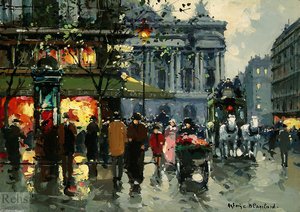
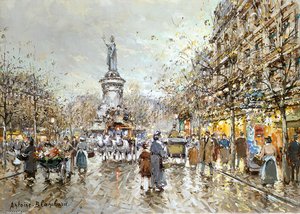 Place de la Republique
Discover "Place de la Republique" by Antoine Blanchard (Marcel Masson). An impressionistic oil painting of Parisian street life, showcasing textured brushwork & a monumental scene.
Masson’s artistic education provided a solid technical base, but it was his fascination with 19th-century Paris that truly defined his work. Like many artists of his generation, he found inspiration in the paintings of Édouard Cortès and Eugène Galien-Laloue – masters of depicting Parisian street life. However, Blanchard didn’t simply imitate these predecessors; he absorbed their techniques while forging his own distinct style. He meticulously researched the Belle Époque period, poring over vintage postcards and photographs to recreate a Paris that existed primarily in memory. This dedication to historical accuracy, combined with his innate artistic talent, allowed him to create scenes that felt both authentic and deeply evocative. His training at the École des Beaux-Arts instilled in him a respect for classical composition and form, which he subtly integrated into his impressionistic renderings of Parisian life.
A Brush with Nostalgia: Defining Characteristics of Blanchard’s Style
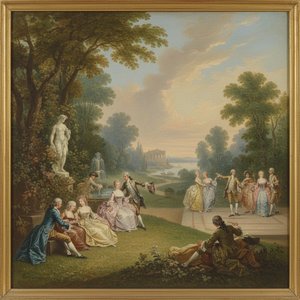
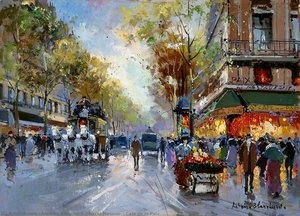
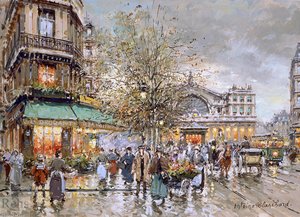 Gare de Lest
Discover 'Gare de Lest' by Antoine Blanchard (Marcel Masson), an evocative impressionistic painting of Parisian street life. Explore its muted tones & dynamic brushwork.
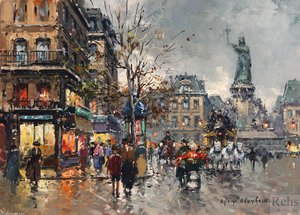
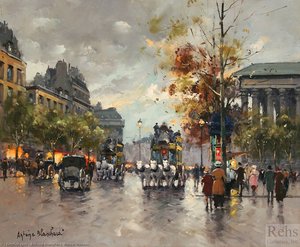
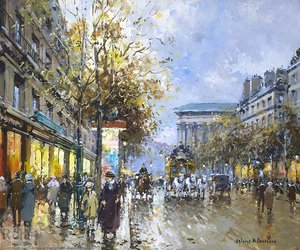
Blanchard's paintings are instantly recognizable for their soft palette, dynamic brushwork, and atmospheric depictions of Paris. He favored scenes bathed in muted tones – grays, blues, and ochres – capturing the subtle nuances of light and shadow on rain-washed streets. His technique involved layering thin washes of oil paint to create a sense of depth and luminosity. Unlike the bold strokes of some Impressionists, Blanchard employed a more delicate approach, using small, feathery brushstrokes to convey texture and movement. The result is a style that feels both intimate and grand, inviting viewers to step into his romanticized vision of Paris. His compositions often feature bustling crowds, horse-drawn carriages, and the elegant architecture of iconic landmarks like the Arc de Triomphe and Notre Dame – all rendered with meticulous detail and a palpable sense of atmosphere. The artist’s focus wasn't on precise realism but rather on capturing the *feeling* of Paris—the energy, the romance, and the timeless beauty of the city.
Automatism and Influence: Placing Blanchard within Post-War Parisian Abstraction
Antoine Blanchard is the pseudonym under which the French painter Marcel Masson (15 November 1910 – 1988) painted his immensely popular Parisian street scenes.Missing: Automatism , Study War Abstraction Legacy Automatism)
While often categorized as a Neo-Impressionist, Blanchard’s work also reveals subtle connections to the broader currents of post-war Parisian abstraction. The period following World War II saw a surge in artistic experimentation, with movements like Tachisme and Informel challenging traditional notions of representation. Although Blanchard didn't explicitly embrace these styles, his emphasis on spontaneous brushwork and atmospheric effects can be seen as a reflection of this wider artistic climate. There’s an element of *automatism* – the subconscious creation of art without conscious control – in his dynamic compositions. The rapid application of paint, the blurring of forms, and the overall sense of movement suggest a painterly process driven by intuition rather than strict planning. This connection to abstraction adds another layer of complexity to Blanchard’s work, elevating it beyond mere nostalgia and positioning him as a significant figure within the broader context of post-war Parisian art.
The Market for Memory: Popularity, Forgeries, and Authentication Challenges
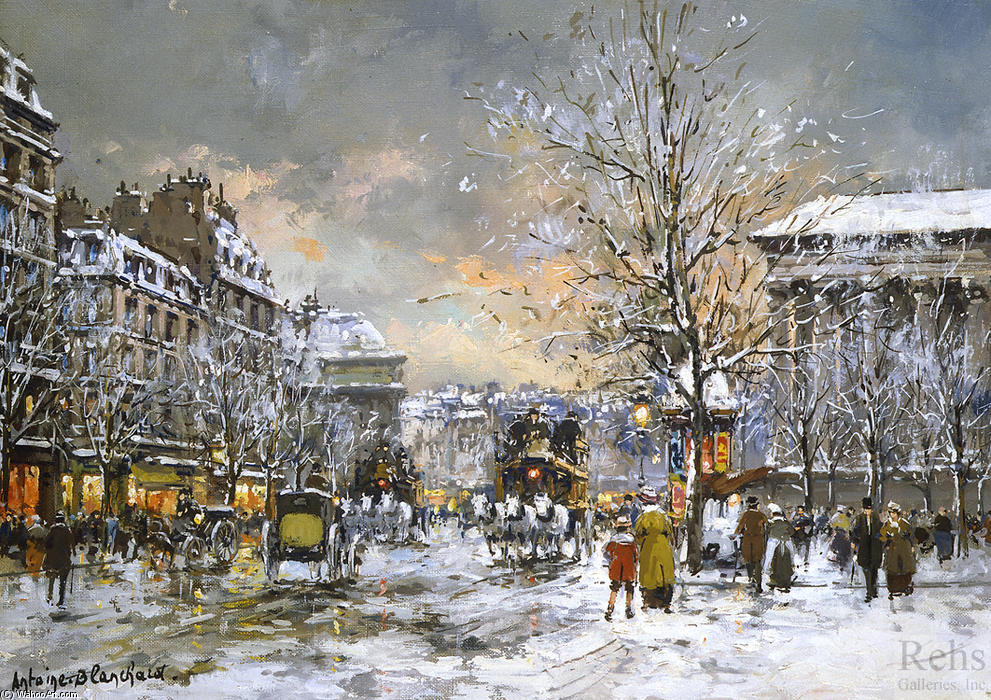 antoine blanchard (marcel masson)
Explore the art of Antoine Blanchard (Marcel Masson)! French sculptor known for his expressive figures & innovative techniques. Discover his legacy at museums in Paris & beyond.
Antoine Blanchard achieved considerable commercial success in the 1960s, particularly in the United States and the United Kingdom. His paintings resonated with a public eager to embrace a romanticized vision of Paris – a city often associated with art, culture, and sophistication. However, this popularity also led to a proliferation of forgeries and imitations. Blanchard’s relatively limited production, combined with high demand, created an ideal environment for unscrupulous artists to capitalize on his name. Identifying authentic works requires careful scrutiny, as forgers skillfully replicated his technique and subject matter. Experts rely on subtle clues – brushstroke analysis, pigment composition, canvas texture, and signature details – to distinguish genuine Blanchards from imitations. The challenge of authentication underscores the importance of provenance and expert appraisal when acquiring paintings attributed to this beloved artist.
Blanchard's Enduring Appeal: A Legacy Revisited
Despite the challenges surrounding authentication, Antoine Blanchard’s work continues to captivate art lovers around the world. His paintings offer a glimpse into a romanticized past—a Paris that exists more in the imagination than in reality. The enduring appeal of his scenes lies in their ability to evoke a sense of nostalgia, beauty, and timeless elegance. While he may have deliberately crafted an artistic persona, Blanchard’s talent and dedication to his craft are undeniable. His legacy extends beyond mere commercial success; he created a body of work that continues to inspire and delight viewers, offering a poignant reminder of the enduring power of art to transport us to another time and place. ArtsDot.com offers a curated selection of high-quality reproductions of Antoine Blanchard’s iconic Parisian scenes, allowing you to bring a touch of *la ville des lumières* into your own home.