 Preview
 Send
Send Share
Share
 Details

 Download
 Similars
 X-Ray
X-Ray Diaporama
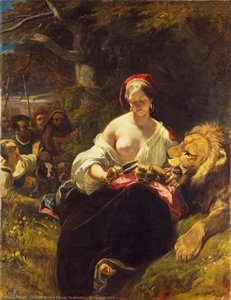
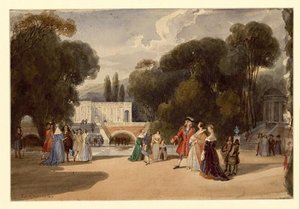
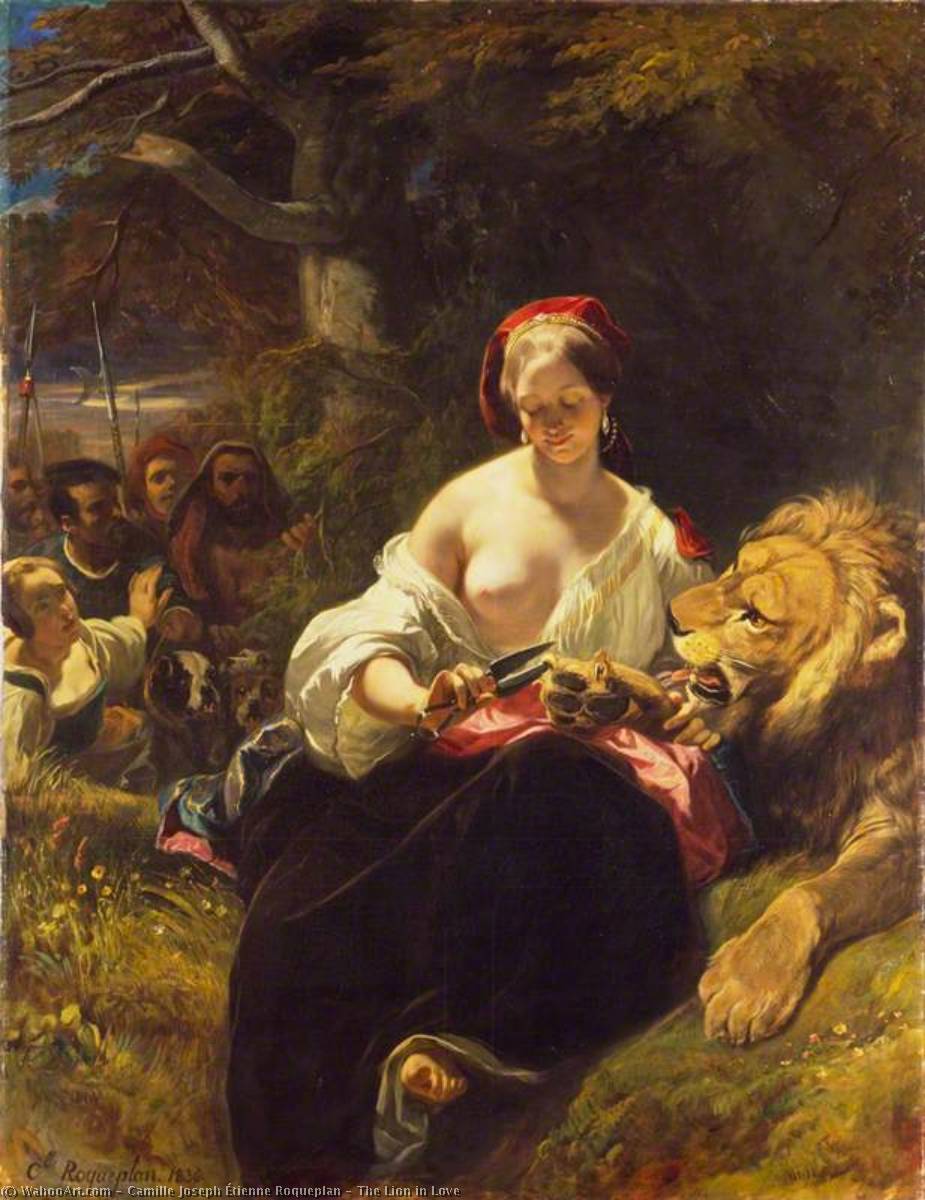
The Lion in Love
 1836
1836 196.0 x 153.0 cm
 The Wallace Collection
 Read More
Giclée / Art Print
Museum-quality giclée or canvas print with fast production and flexible finish options. ( Buy Hand Made Painting Buy Image)




































Pick from our preset sizes that match the artwork's original proportions.

You may enter your own dimensions to fit a specific frame or space. If your selected size does not match the original image's proportions, we will either crop the artwork or extend the image with a mirrored or solid-fill edge. A digital mockup will be sent for your approval before production begins.
Please note that the on-screen preview does not reflect the actual cropping or extension. Only the mockup will accurately show the final composition.
While custom sizes are available, we recommend selecting a dimension from the predefined list to preserve the original proportions.
Worldwide Delivery () in 2 weeks instead of standard 4/5 weeks. (24 August)

Free Worldwide Express Shipping

High-Quality Linen Canvas

Full Shipping Insurance

Customs Tax Refund Guarantee

True Color Matching Guarantee

60-Day Return Policy (Defects Only)

100% Money-Back Guarantee

Bulk Discount Offer
 Glass option is only available in size under 110 CM

The Lion in Love
Giclée / Art Print
Reproduction Size
-


Total Price
$ 63
Related Artworks








Artist Biography
The Romantic Soul of the Dauphiné: The Life of Camille Roqueplan
In the heart of the nineteenth century, a period defined by the turbulent beauty of Romanticism, the works of Camille Joseph Etienne Roqueplan emerged as a serene sanctuary for the wandering eye. Born in Mallemort around 1802 or 1803, Roqueplan possessed an innate, almost precocious talent for drawing that often saw him correcting the sketches of his fellow students. Yet, his path to artistic mastery was far from a straight line. Driven by a youthful desire to keep art as a mere pleasant pastime rather than a professional burden, he briefly wandered into the rigorous and unappealing world of medicine. After failing his anatomy examinations—a subject that offered him no joy—and experiencing the mundane life of a clerk in the Ministry of Finance, the magnetic pull of the canvas proved irresistible. He returned to his true calling, not as a reluctant student, but as a man destined to translate the light and atmosphere of France onto linen.
Roqueplan’s artistic development was shaped by a series of encounters with masters that were as challenging as they were formative. His time in the studios of Abel de Pujol at the École des Beraux-Arts was marked by moments of profound discouragement, particularly when confronted with the overwhelming brilliance of established works. However, it was through his subsequent studies with Antoine Gros that he found a steadier footing. While Gros provided little in the way of overt praise, the three years spent under his tutelage allowed Roqueplan to refine his technique away from the intense pressures of academic perfectionism. This period of quiet cultivation prepared him for his true inspiration: the rugged, evocative landscapes of the Dauphiné region. It was here that his brush found its voice, capturing the interplay of light, shadow, and the pastoral rhythms of rural life.
A Tapestry of Landscape, Genre, and Light
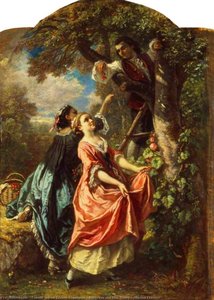
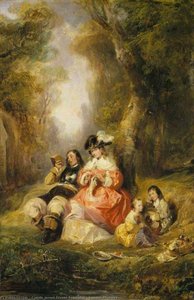
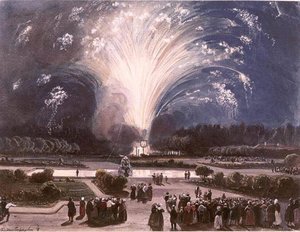
The oeuvre of Roqueplan is a masterful blend of landscape, genre, and historical scenes, each unified by a Romantic sensibility that seeks emotion within nature. His paintings are rarely mere topographical records; instead, they are atmospheric explorations of feeling. Whether depicting the idyllic charm of Rousseau and Mlle. Galley Gathering Cherries or the grand, ephemeral spectacle of Fireworks at Fontainebleau, Roqueplan utilized color and composition to evoke a sense of nostalgia and wonder. His landscapes often feature the rolling hills and serene vistas of his beloved Dauphiné, where he could explore themes of familial affection and the quiet dignity of the countryside. Through his use of light, he was able to imbant even the simplest rural scene with a sense of poetic significance.
Beyond his individual compositions, Roqueplan’s legacy is cemented by his profound influence on the next generation of French painters. Despite the early difficulties he faced as a student, he eventually returned to the École des Beaux-Arts, not as a struggling pupil, but as an esteemed teacher. His pedagogical impact can be traced through several notable artists who carried forward his sensitivity to landscape and light, including:
- Charles-Théodore Frère, who expanded upon the traditions of landscape painting.
- Prosper Marilhat, a master of atmospheric effects.
- Marie-Alexandre Alophe, known for his refined technique.
- Constant Troyon, a significant figure in the development of animalier and pastoral art.
Ultimately, Camille Roqueplan remains a vital figure of the French Romantic movement. His ability to navigate the tension between academic discipline and personal creative freedom allowed him to create a body of work that is both technically accomplished and deeply emotive. He transformed the landscape from a mere backdrop into a living, breathing protagonist, ensuring that his vision of the French countryside would endure long after his passing in 1855.
camille joseph étienne roqueplan
1803 - 1855
Quick Facts
- Artistic Movement Or Style: Romanticism
- Artists Or Movements Influenced By This Artist: ['Antoine Gros']
- Artists Who Influenced This Artist: ['Abel de Pujol']
- Date Of Birth: 1802/03
- Date Of Death: 1855
- Full Name: Camille Joseph Etienne Roqueplan
- Nationality: French
- Notable Artworks:
- Rousseau and Mlle. Galley Gathering Cherries
- Summer Pleasures
- Peasants of Béarn
- Place Of Birth: Mallemort