 Preview
 Send
Send Share
Share
 Details

 Download
 Similars
 X-Ray
X-Ray Diaporama
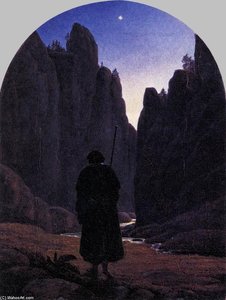
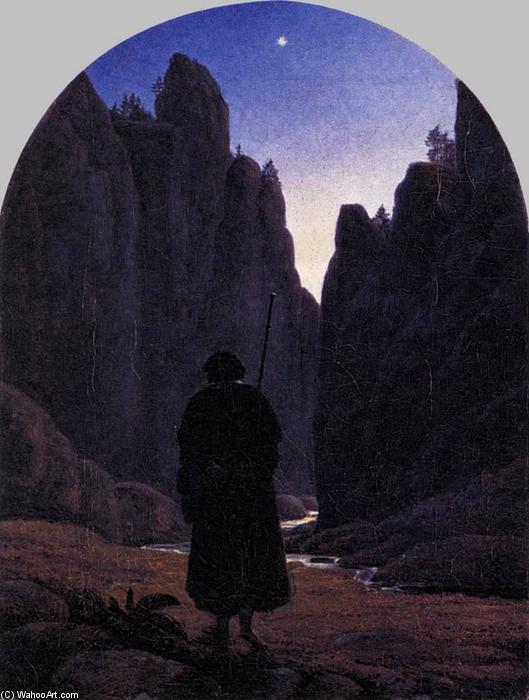
Pilgrim in a Rocky Valley
 Acrylic On Canvas
- WallArt
- Romanticism
 1820
1820- 19th Century
 28.0 x 22.0 cm
 Nationalgalerie
 Read More
Hand Made Oil Reproduction
Hand-painted oil on canvas in your size and frame, made to order by our artists. ( Buy Print Buy Image)




P118B $10

P118H $10

P118W $10

P438Z $10

P508JH $12

P508YH $12

P805H $10

P805Z $10

P919BZ $10

P919G $10

P919XJ $10

P959ZH $10

P968JZ $12

W106C $8

W218G $10

W218JH $8

W218Y $10

W307PJ $10

W316G $10

W316PJ $8

W316Y $10

W398PJ $8

W4111J $10

W500HY $15

W500JH $15

W692G $12

W849H $8

W940BG $15

W953PJ $8




Pick from our preset sizes that match the artwork's original proportions.

You may enter your own dimensions to fit a specific frame or space. If your selected size does not match the original image's proportions, we will either crop the artwork or extend the painting with additional hand-painted elements. A digital mockup will be sent for your approval before production begins.
Please note that the on-screen preview does not reflect the actual cropping or extension. Only the mockup will accurately show the final composition.
While custom sizes are available, we recommend selecting a dimension from the predefined list to preserve the original proportions.
After order, ArtsDot.com team will email client for instructions and provide a mockup preview
Worldwide Delivery () in 3/4 weeks instead of standard 5 weeks. (17 August). No compromise on quality.

Free Worldwide Express Shipping

High-Quality Linen Canvas

Full Shipping Insurance

Customs Tax Refund Guarantee

True Color Matching Guarantee

60-Day Return Policy (Defects Only)

100% Money-Back Guarantee

Bulk Discount Offer
 Glass option is only available in size under 110 CM

Pilgrim in a Rocky Valley
Reproduction Medium
Reproduction Size
-


Total Price
$ 263
Artwork Description
The Sublime Landscape: Carl Gustav Carus’s “Pilgrim in a Rocky Valley”
Carl Gustav Carus's "Pilgrim in a Rocky Valley," painted in 1820, isn’t merely a depiction of a mountain scene; it’s a profound meditation on the relationship between humanity and nature, a cornerstone of German Romanticism. The painting immediately draws the viewer into a dramatic vista – a solitary figure, cloaked and weathered, traversing a rugged, almost menacing, rocky valley towards a distant, hopeful sunrise. This isn't a picturesque landscape designed for simple pleasure; it’s imbued with an atmosphere of solemnity, introspection, and a yearning for something beyond the immediate earthly realm. The composition is carefully orchestrated to evoke a sense of vastness and isolation, mirroring the Romantic ideal of confronting the sublime – that overwhelming experience of nature that simultaneously inspires awe and humility.
- Subject Matter: A lone pilgrim journeying through a challenging mountain landscape.
- Style: Strongly influenced by Caspar David Friedrich, a key figure in Romantic landscape painting, Carus captures the essence of the movement’s focus on emotional response and spiritual significance within nature.
A Scientific Eye Meets Artistic Soul
Carus was far more than just an artist; he was a physician, botanist, geologist, and a dedicated student of science. This intellectual background profoundly shaped his approach to landscape painting. He wasn’t simply recording what he saw but attempting to visualize the underlying geological processes that formed the mountains themselves – a concept he termed “Erdlebenbildkunst” (pictorial art of the life of the earth). The rugged terrain, the dramatic lighting, and the sense of scale all suggest an understanding of the forces shaping the landscape. Yet, this scientific observation is seamlessly blended with a deeply felt emotional response, reflecting the core tenet of Romanticism: that nature possesses a spiritual power capable of profoundly affecting human consciousness.
Technique & Materials: The painting is executed in oil on canvas, utilizing a rich palette of browns, grays, and ochres to create a sense of depth and texture. Carus’s masterful use of light and shadow emphasizes the ruggedness of the terrain and the vulnerability of the solitary figure.Symbolism and the Romantic Quest
The pilgrim himself is laden with symbolic weight. He represents humanity's journey, not just through a physical landscape but also through life itself – a quest for meaning, purpose, and connection to something greater than oneself. The distant sunrise symbolizes hope, renewal, and perhaps even spiritual enlightenment. Notice the dog at the base of the composition; it’s a subtle detail that adds an element of companionship and loyalty to this solitary journey. The painting resonates with themes prevalent in Romantic literature – the importance of individual experience, the power of intuition, and the search for transcendence within nature.
Historical Context & Legacy
Created during a period of significant intellectual and artistic ferment in Germany, “Pilgrim in a Rocky Valley” embodies the spirit of the early 19th century. It reflects the growing interest in science, philosophy, and the power of emotion – all hallmarks of the Romantic movement. Carus’s work was highly influential on later artists, particularly Caspar David Friedrich, who further developed the themes of solitude, contemplation, and the sublime in his own landscapes. Reproductions of this iconic painting continue to captivate viewers today, offering a timeless reminder of humanity's enduring fascination with the beauty and mystery of the natural world.
Related Artworks
Artist Biography
The Polymath of the Romantic Soul
Carl Gustav Carus stands as a singular, luminous figure in the tapestry of German history, a man whose intellect refused to be confined by the boundaries of a single discipline. Born in Leipzig in 1789, Carus was far more than a mere painter; he was a true polymath, navigating the intricate intersections of medicine, botany, geology, and psychology with equal mastery. His life unfolded during an era of profound intellectual ferment, a time when the scientific rigor of the Enlightenment began to dance with the emotional depth of Romanticism. To look upon a Carus landscape is to witness more than just scenery; it is to see the world through the eyes of a scientist who found the divine in the anatomical precision of a leaf and the spiritual sublime in the shifting mists of a riverbank.
His early education in Leipzig provided him with a formidable foundation in mathematics and the natural sciences, disciplines that would forever inform his artistic eye. This scientific grounding allowed him to approach the canvas with a unique clarity, observing the physical world not just as a subject for beauty, but as a complex, living organism. As he moved toward Jena University, he found himself immersed in the philosophical currents of his time, studying alongside the legendary Goethe. This connection was pivotal, as it placed Carus at the very heart of the German Romantic movement, where the contemplation of nature served as a gateway to understanding the human psyche and the infinite mysteries of the universe.
A Symbiosis of Science and Artistry
While his brush captured the ethereal, his hands practiced the healing arts. Carus established a distinguished medical career in Dresden, serving as a Professor of Obstetrics and the Director of the Maternity Clinic. This dual identity—physician and artist—created a fascinating tension in his work. His deep understanding of human anatomy and physiology lent an unparalleled realism to his depictions of the natural world; he understood the structural integrity of a tree trunk and the delicate translucency of light through fog as intimately as he understood the pulse of a living patient. This meticulous observation allowed him to bridge the gap between the tangible, physical reality of nature and its intangible, emotional resonance.
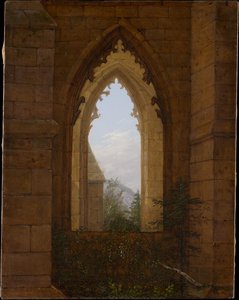
The trajectory of his artistic development was profoundly shaped by his close friendship and collaboration with Caspar David Friedrich. Together, these two masters of German Romanticism explored the concept of the sublime—that overwhelming sense of awe and terror inspired by the vastness of nature. While Friedrich often focused on the spiritual isolation of the individual, Carus brought a unique atmospheric precision to the movement. His works, such as the hauntingly beautiful Gothic Windows in the Ruins of the Monastery at Oybin, utilize light and shadow to evoke a sense of historical weight and melancholic beauty, capturing the way ruins become part of the organic landscape over time.
Legacy of Light and Thought
The enduring significance of Carl Gustav Carus lies in his ability to synthesize seemingly disparate worlds. His paintings are not merely static images but are imbued with a psychological depth that foreshadowed much of modern thought. His explorations into the relationship between the external environment and internal perception have drawn comparisons to the later psychological insights of figures like Carl Jung, and his scientific observations contributed to the broader intellectual climate that influenced Charles Darwin. He saw no conflict between the empirical study of the earth and the poetic interpretation of its beauty.
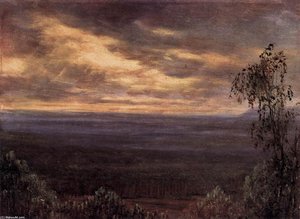
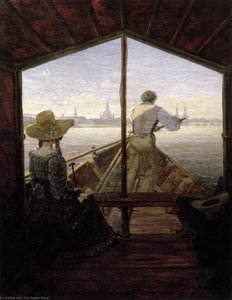
Even in his more tranquil compositions, such as Morning Fog or A Gondola on the Elbe near Dresden, one can sense this profound harmony. In these works, the subtle gradations of color and the soft, ethereal light evoke a sense of peace and cosmic connection. Carus leaves behind a legacy that challenges us to view the world with both a keen, analytical eye and an open, feeling heart. He remains a testament to the idea that true understanding comes from the marriage of observation and imagination, making him one of the most intellectually complete artists to ever grace the Romantic era.
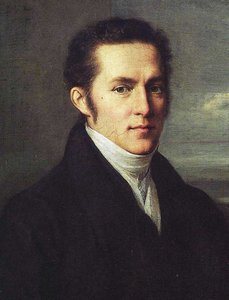
Carl Gustav Carus
1789 - 1869 , Germany
Quick Facts
- Artistic Movement Or Style: Romanticism
- Artists Or Movements Influenced By This Artist: ['Jung']
- Artists Who Influenced This Artist: ['Caspar David Friedrich']
- Date Of Birth: January 3, 1789
- Date Of Death: July 28, 1869
- Full Name: Carl Gustav Carus
- Nationality: German
- Notable Artworks:
- Morning Fog
- Gothic Windows in the Ruins of the Monastery at Oybin
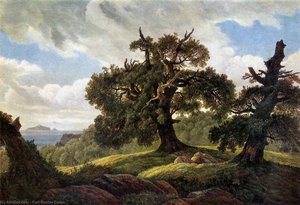
- Oaks at the Sea Shore
- Place Of Birth: Leipzig, Germany
Related Articles
25 Klimt Masterpieces: A Journey Through Iconic Art & Decor
Delve into the world of Gustav Klimt with our top 25 masterpieces! Explore his iconic paintings – 'The Kiss,' 'Portrait of Adele,' and more. Discover museum-quality reproductions & curated decor ideas. Explore the full collection online at ArtsDot.com.

Beyond the Horizon: 10 Landscape Masterpieces for Your Home Decor
Journey through 10 breathtaking landscape paintings by Monet, Van Gogh & more! Explore iconic artworks, artistic techniques & find inspiration for your home decor. Museum-quality reproductions at ArtsDot.com. Discover all masterpieces on ArtsDot.com

Romantic Landscapes: 10 Masterpieces for Your Home | ArtsDot
Journey through 10 Romantic landscape masterpieces by Friedrich, Turner & Cole. Explore emotional art, sublime nature scenes & iconic 19th-century paintings. Find museum-quality reproductions for your home at ArtsDot.com – discover the full collection online!

John Constable's Masterpieces: Explore 25 Iconic Landscapes for Your Home
Journey through John Constable's 25 most celebrated landscapes. Explore Romanticism, Dedham Vale & his masterful use of light in iconic paintings like 'Hay Wain'. Find museum-quality art reproductions and elevate your home decor on ArtsDot.com.

Evocations of Place: A Historical Journey Through Landscape Art
Explore the rich history of landscape art with ArtsDot. Discover renowned artists, movements like Impressionism & Romanticism, and expert guidance for collecting timeless pieces. Find your perfect serene escape today!