 Preview
 Send
Send Share
Share
 Details

 Download
 Similars
 X-Ray
X-Ray Diaporama
 Stats
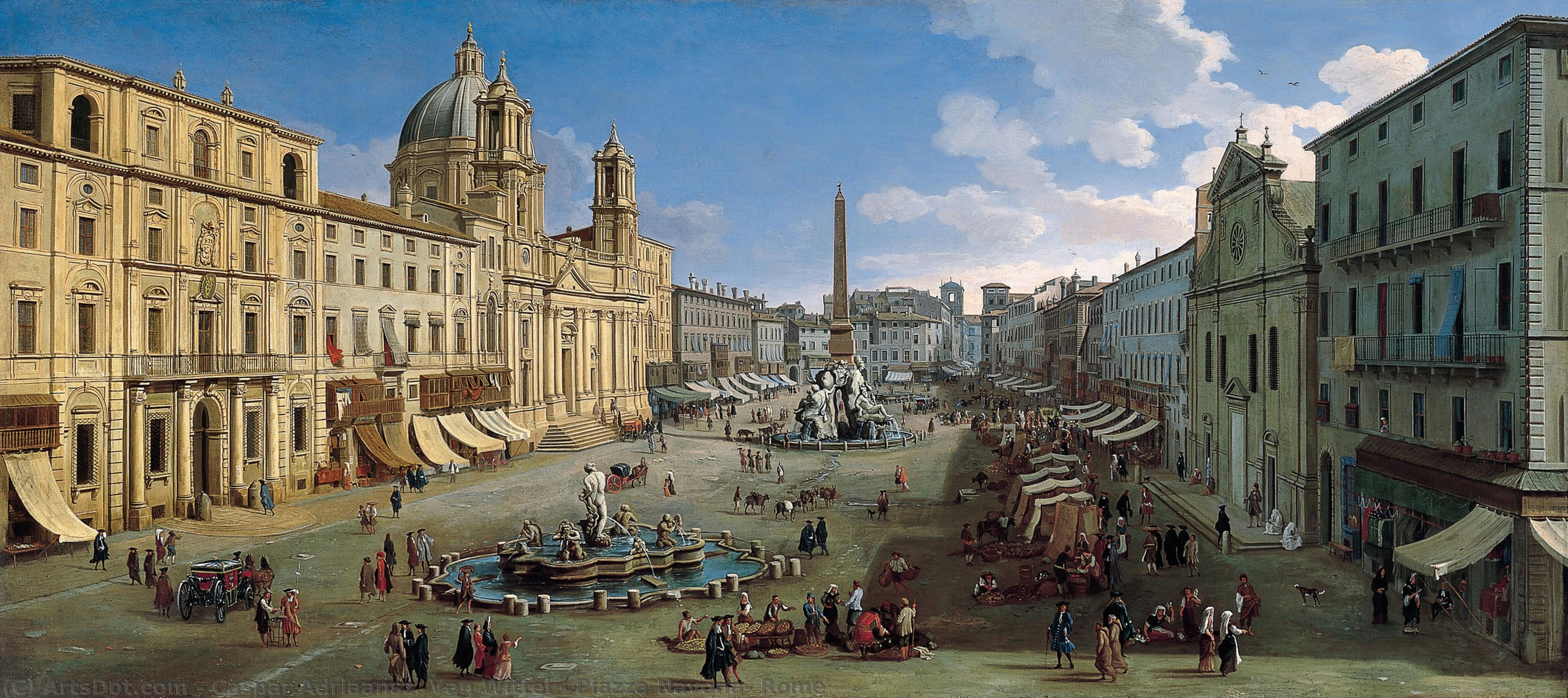
StatsPiazza Navona, Rome
 1699
1699 16.0 x 96.0 cm
 Read More
Hand Made Oil Reproduction
Hand-painted oil on canvas in your size and frame, made to order by our artists. ( Switch to Print Switch to Digital Image)




































Pick from our preset sizes that match the artwork's original proportions.

You may enter your own dimensions to fit a specific frame or space. If your selected size does not match the original image's proportions, we will either crop the artwork or extend the painting with additional hand-painted elements. A digital mockup will be sent for your approval before production begins.
Please note that the on-screen preview does not reflect the actual cropping or extension. Only the mockup will accurately show the final composition.
While custom sizes are available, we recommend selecting a dimension from the predefined list to preserve the original proportions.
After order, ArtsDot.com team will email client for instructions and provide a mockup preview
Worldwide Delivery () in 3/4 weeks instead of standard 5 weeks. (9 September). No compromise on quality.

Free Worldwide Express Shipping

High-Quality Linen Canvas

Full Shipping Insurance

Customs Tax Refund Guarantee

True Color Matching Guarantee

100-Day Return Policy (Defects Only)

100% Money-Back Guarantee

Bulk Discount Offer
 Glass option is only available in size under 110 CM

Piazza Navona, Rome
Reproduction Medium
Reproduction Size
-


Total Price
$ 263
Related Artworks








Artist Biography
Caspar van Wittel: The Architect of Roman Visions
Born Jasper Adriaensz van Wittel in Amersfoort, Netherlands, in 1653, Caspar – later known as Gaspare Vanvitelli in Italy – wasn’t merely a painter; he was an architect of perception. His legacy rests not just on the canvases he created, but on his pioneering role in establishing *veduta* painting—the detailed depiction of urban landscapes—as a distinct and highly valued genre within Italian art. For decades, his work remained largely obscure outside Italy, a poignant testament to the biases of patronage and the slow recognition afforded to artistic genius. This article seeks to illuminate the life, artistry, and profound influence of this often-overlooked master, revealing him as a pivotal figure in shaping our understanding of the Renaissance and Baroque cities.
Van Wittel’s early years were steeped in the traditions of Dutch landscape painting, yet his trajectory shifted dramatically upon relocating to Rome in 1675. This move proved transformative, exposing him to the vibrant artistic milieu of the Italian capital and igniting a passion for capturing its intricate beauty. Crucially, he found himself immersed in the work of Gaspar van Wittel – no relation, though sharing a similar name and a dedication to topographical accuracy – whose earlier paintings had already begun to establish the *veduta* as a respected art form. This encounter profoundly influenced Van Wittel’s style, solidifying his commitment to meticulously rendered cityscapes that prioritized architectural precision and atmospheric depth.
The Art of *Veduta*: Technique and Vision
Van Wittel's paintings are characterized by an almost obsessive attention to detail. He wasn’t simply recording a scene; he was dissecting it, analyzing its geometry, and translating that understanding onto the canvas with remarkable skill. His technique involved extensive preparatory work – numerous sketches and studies were created before embarking on the final painting. These preliminary drawings reveal his methodical approach, documenting not just the facades of buildings but also their proportions, angles, and relationships to one another.
Light and color played a crucial role in Van Wittel’s compositions. He masterfully employed chiaroscuro – the dramatic contrast between light and shadow – to create a sense of depth and atmosphere. His use of atmospheric perspective—making distant objects appear paler and less distinct—was particularly effective, lending his cityscapes an illusionistic realism that captivated viewers. He wasn't afraid to experiment with unusual viewpoints, often elevating himself above the streets to capture sweeping vistas, techniques he likely honed through careful observation and perhaps even utilizing rudimentary optical aids like a camera obscura – though this remains a subject of scholarly debate.
Notable Works and Patronage
Several of Van Wittel’s most celebrated works are housed in prestigious institutions worldwide. The Mauritshuis Museum in The Hague boasts “Rome, Piazza della Bocca della Verità, with Santa Maria in Cosmedin and the Temple of Hercules Victorious,” a masterpiece that exemplifies his ability to capture the essence of Roman urban life. His paintings have also found their way into the Biennale Internazionale dell’Antiquariato di Firenze (Florence, Italy) and the Maxxi National Museum of 21st Century Arts (Rome, Italy), demonstrating the enduring appeal of his work across centuries.
Van Wittel's success was largely due to his ability to cater to the tastes of wealthy Roman patrons. He secured commissions from prominent figures, including the Duke of Medinaceli, who served as godfather to his son, and later benefited from the patronage of Lord Burlington and Thomas Coke, Earl of Leicester, influential figures in the burgeoning English art scene. These connections not only provided him with financial support but also exposed his work to a wider European audience.
Influence and Legacy
Caspar van Wittel’s impact on the development of landscape painting in Europe was profound. He is widely considered one of the first artists to systematically document Italian cities through *veduta* paintings, elevating the genre from mere decorative subject matter to a respected form of artistic expression. His meticulous attention to detail and his innovative use of perspective influenced generations of artists, including Canaletto, Bellotto, and Guardi.
Beyond his technical skill, Van Wittel’s work offered a unique window into the social and cultural life of Renaissance and Baroque Italy. His paintings capture not just the physical appearance of cities but also their bustling streets, vibrant markets, and grand public spaces—providing invaluable insights for historians and art enthusiasts alike. While initially overlooked in his homeland, Caspar van Wittel’s legacy as a master of *veduta* painting is now firmly established, securing his place among the most important artists of the Roman School.

caspar adriaansz. van wittel
1653 - 1736 , Netherlands
Quick Facts
- Artistic Movement Or Style: Veduta painting
- Artists Or Movements Influenced By This Artist:
- Canaletto
- Bellotto
- Artists Who Influenced This Artist:
- Gaspar van Wittel
- Matthias Withoos
- Date Of Birth: 1653-08-24 (Amersfoort)
- Date Of Death: 1736-09-13 (Rome)
- Full Name: Caspar Adriaansz. van Wittel
- Nationality: Dutch
- Notable Artworks:
- Rome, piazza della bocca verità
- View of Amersfoort
- Place Of Birth: Amersfoort, Netherlands