 Preview
 Send
Send Share
Share
 Details

 Download
 Similars
 X-Ray
X-Ray Diaporama
Sound Texts #1: All on Account of the Tariffs


 Read More
Giclée / Art Print
Museum-quality giclée or canvas print with fast production and flexible finish options. ( Buy Hand Made Painting Buy Image)




P118B $10

P118H $10

P118W $10

P438Z $10

P508JH $12

P508YH $12

P805H $10

P805Z $10

P919BZ $10

P919G $10

P919XJ $10

P959ZH $10

P968JZ $12

W106C $8

W218G $10

W218JH $8

W218Y $10

W307PJ $10

W316G $10

W316PJ $8

W316Y $10

W398PJ $8

W4111J $10

W500HY $15

W500JH $15

W692G $12

W849H $8

W940BG $15

W953PJ $8




Pick from our preset sizes that match the artwork's original proportions.

You may enter your own dimensions to fit a specific frame or space. If your selected size does not match the original image's proportions, we will either crop the artwork or extend the image with a mirrored or solid-fill edge. A digital mockup will be sent for your approval before production begins.
Please note that the on-screen preview does not reflect the actual cropping or extension. Only the mockup will accurately show the final composition.
While custom sizes are available, we recommend selecting a dimension from the predefined list to preserve the original proportions.
Worldwide Delivery () in 2 weeks instead of standard 4/5 weeks. (25 August)

Free Worldwide Express Shipping

High-Quality Linen Canvas

Full Shipping Insurance

Customs Tax Refund Guarantee

True Color Matching Guarantee

60-Day Return Policy (Defects Only)

100% Money-Back Guarantee

Bulk Discount Offer
 Glass option is only available in size under 110 CM

Sound Texts #1: All on Account of the Tariffs
Giclée / Art Print
Reproduction Size
-


Total Price
$ 63
Collectible Description
Charles Gaines’s “Sound Texts #1: All on Account of the Tariffs” – A Sonic Manifestation of Political Ideology
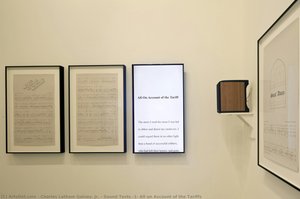
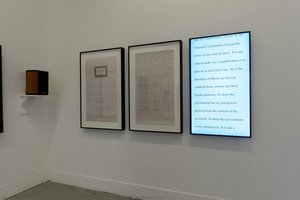
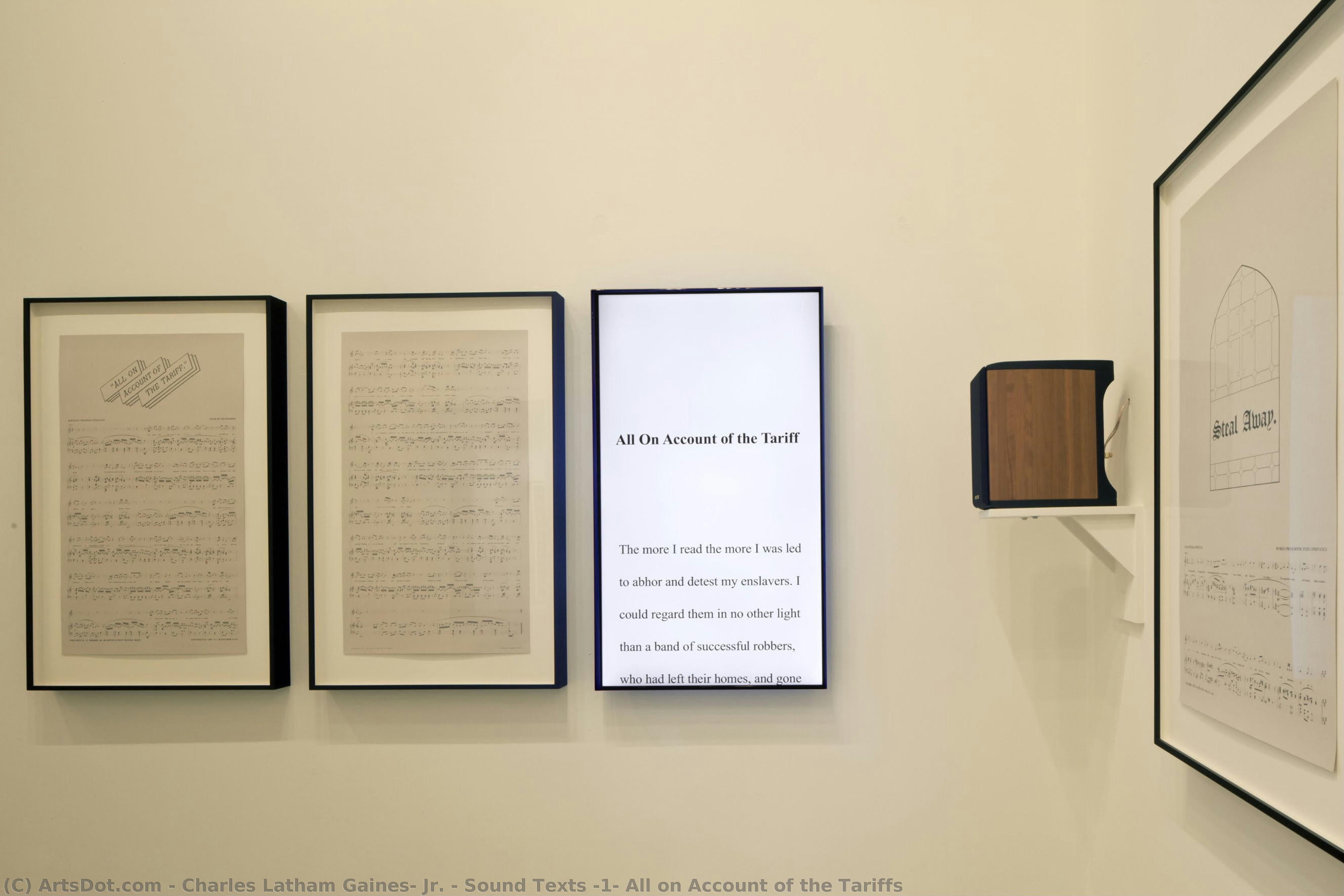
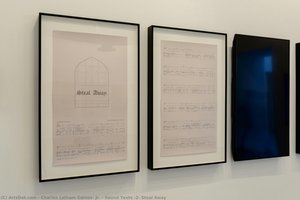
Charles Gaines’s 2015 work, "Sound Texts #1: All on Account of the Tariffs," is not merely a painting; it's an immersive experience, a meticulously constructed dialogue between text and sound. Born in Charleston, South Carolina, in 1944, Gaines has long been a pioneer in conceptual art, utilizing rule-based systems to explore complex political themes with a detached yet profoundly affecting perspective. This particular piece, housed at la Biennale di Venezia, exemplifies his signature approach – translating the essence of written words into an auditory landscape, forcing viewers to confront the emotive power embedded within seemingly objective data.
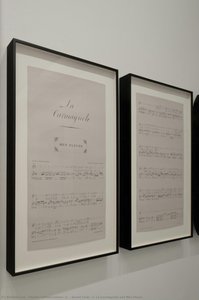
The artwork itself is deceptively simple: a graphite-based painting dominated by a dense field of text. It’s derived from two seminal texts – Olympe de Gouges' "The Declaration of the Rights of Woman and the Female Citizen" (1791) and Malcolm X’s final public speech (1964). Gaines, in his systematic approach, meticulously assigned each letter within these documents to a corresponding musical note on the piano – C, D, E, F, G, A, B. Any letter absent of an equivalent note was treated as a rest, creating a deliberately atonal composition. This translation isn’t arbitrary; it's a deliberate attempt to expose the underlying emotional resonance of these powerful statements, stripping away their literal meaning and revealing their sonic architecture.
The Mechanics of Manifestation: A Rule-Based System
Gaines’s methodology is rooted in his belief that impersonal structures can illuminate personal concerns. He deliberately avoids subjective expression, opting instead for a systematic approach to dissecting ideologies. The creation of the “Manifestos,” as he termed them, involved translating each letter into a musical note – a process designed to reveal the inherent rhythm and emotional weight within the texts. This isn’t simply transcription; it's an act of reimagining, transforming political discourse into a tangible, auditory experience. The resulting installations, often utilizing atonal piano compositions, invite viewers to contemplate how these sonic landscapes affect their interpretation of the original texts – prompting a deeper engagement with the ideas being presented.
Further research reveals that Gaines collaborated with Sean Griffin, composer and founding director of the Opera Povera consortium, to arrange scores for a live performance by a quartet. This collaborative effort highlights the artist’s commitment to exploring the intersection of art forms – blending conceptual frameworks with musical expression. The work's placement at la Biennale di Venezia underscores its significance within contemporary art discourse, positioning it alongside other groundbreaking works that challenge traditional notions of artistic representation.
Symbolism and Emotional Resonance
While seemingly abstract, “Sound Texts #1” is deeply layered with symbolism. The choice of texts – de Gouges’s declaration advocating for women's rights and Malcolm X’s impassioned speech challenging racial injustice – immediately establishes a political context. The use of atonal music deliberately disrupts conventional expectations, mirroring the disruptive nature of these historical documents. The graphite medium itself contributes to the artwork’s somber tone, evoking a sense of quiet contemplation and understated urgency.
More than just a visual representation of text, Gaines's work is an invitation to listen – to hear the unspoken anxieties and aspirations embedded within political rhetoric. It’s a testament to the power of art to transform information into experience, prompting viewers to confront uncomfortable truths and consider alternative perspectives. The piece lingers in the mind long after viewing, its sonic architecture resonating with the weight of history and the enduring struggle for social justice.
A Legacy of Conceptual Innovation
Charles Gaines’s work has been recognized for its pioneering approach to conceptual art, particularly his deployment of rule-based systems to address political issues. His early rejection from the MFA program at Rochester Institute of Technology, followed by a successful petition for admission, speaks volumes about his determination and artistic vision. His collaboration with Sean Griffin on “Notes on Social Justice” further demonstrates his commitment to exploring the intersection of art and activism. Today, "Sound Texts #1: All on Account of the Tariffs" stands as a powerful example of Gaines’s enduring legacy – a testament to the transformative potential of conceptual art and its ability to provoke critical reflection.
Related Artworks




Artist Biography
Charles Latham Gaines Jr.: A Life Bridging Words, Nature, and Art
- Born: Charleston, United States of America (1942)
- Status: Living
Charles Latham Gaines Jr., often known as Charles Gaines, is a multifaceted American figure celebrated for his contributions as a writer, outdoorsman, and conservationist. His career spans diverse fields, leaving an indelible mark on literature, bodybuilding culture, and environmental stewardship. Born in 1942, Gaines’s work consistently explores the intersection of human experience with the natural world, often infused with intellectual depth and philosophical inquiry.
Early Life and Literary Beginnings
Gaines was born in Charleston, South Carolina, later moving to Birmingham, Alabama as a child. He pursued higher education at Washington and Lee University before transferring to Birmingham-Southern College, where he earned his BA and an MFA in writing from the University of Iowa. His early life experiences fostered a deep appreciation for the outdoors, which would become a recurring theme throughout his literary career.
"Pumping Iron" and Bodybuilding's Golden Age
- Notable Work: Pumping Iron: The Art and Sport of Bodybuilding (1974)
Gaines achieved widespread recognition as the co-author, alongside George Butler, of "Pumping Iron." This groundbreaking journalistic work provided an unprecedented look into the world of competitive bodybuilding during its “Golden Age.” The book not only brought this specialized subculture to a broader audience but also played a pivotal role in launching the career of Arnold Schwarzenegger. Gaines's narration and contribution to the documentary film adaptation further solidified his influence, capturing the intensity, dedication, and artistry inherent in the sport.
Conservation Efforts and Environmental Advocacy
Beyond his literary achievements, Gaines is deeply committed to environmental conservation. He has been actively involved in the stewardship of North American Atlantic salmon fisheries, demonstrating a profound concern for ecological preservation. His service on the board of directors of the Atlantic Salmon Federation underscores his dedication to protecting natural resources and promoting sustainable practices.
Artistic Exploration and Intellectual Legacy
While not primarily known as a visual artist himself, Gaines’s work frequently intersects with artistic realms, particularly through its exploration of the human relationship with nature. His writings offer a unique perspective on how we perceive and interact with the environment, prompting reflection on our place within the natural world. His "Sound Texts" series, utilizing musical scores derived from political texts, exemplifies his conceptual approach to art, transforming language into auditory experiences that challenge conventional modes of understanding. Gaines’s legacy lies in his ability to bridge seemingly disparate fields—literature, sports, conservation, and art—creating a rich tapestry of intellectual inquiry and practical engagement.

charles latham gaines, jr.
1942 - , United States of America
Quick Facts
- Date Of Birth: January 6, 1942
- Full Name: Charles Latham Gaines Jr.
- Nationality: American
- Notable Artworks:
- Pumping Iron: The Art and Sport
- Sound Texts #1
- Sound Texts #2
- Sound Texts #4
- Place Of Birth: Charleston, United States
Related Articles
Harmonies on Canvas: Exploring the Visual Representation of Music in Art History
Explore the fascinating history of music's visual representation in art! From ancient symbolism to modern abstraction, discover how artists have captured sound and emotion on canvas. Expert insights & stunning examples.
La Biennale's Masterpieces: 25 Artworks to Inspire Your Home | ArtsDot
Explore 25 iconic artworks from La Biennale di Venezia! Discover the stories behind masterpieces of Italian art, modernism & Renaissance paintings. Find museum-quality reproductions and elevate your home decor with ArtsDot.com. Explore the full collection online.
The Nuances of Graphite: Exploring Emotional Depth & Technical Mastery in Pencil Drawing
Explore the captivating world of graphite drawing! Discover its rich history, master essential techniques like chiaroscuro, and learn how artists evoke emotion through this timeless medium. Expert insights for art enthusiasts.
Resonant Spaces: Art, Acoustics & Wellbeing for Hotel Design
Discover how art & acoustics synergize to elevate hotel design. Explore expert insights on creating immersive, wellbeing-focused spaces that resonate with guests. Learn about material selection, psychoacoustics & case studies.
Graphite Masters: 10 Iconic Paintings & Timeless Art for Your Home
Explore 10 iconic paintings dominated by graphite tones – from Rembrandt's chiaroscuro to Goya’s drama. Discover art history, techniques & find museum-quality reproductions for your home at . Explore the full collection online.