 Preview
 Send
Send Share
Share
 Details

 Download
 Similars
 X-Ray
X-Ray Diaporama
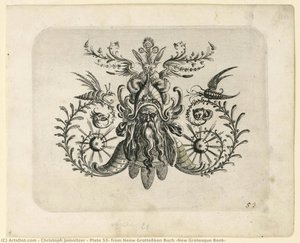
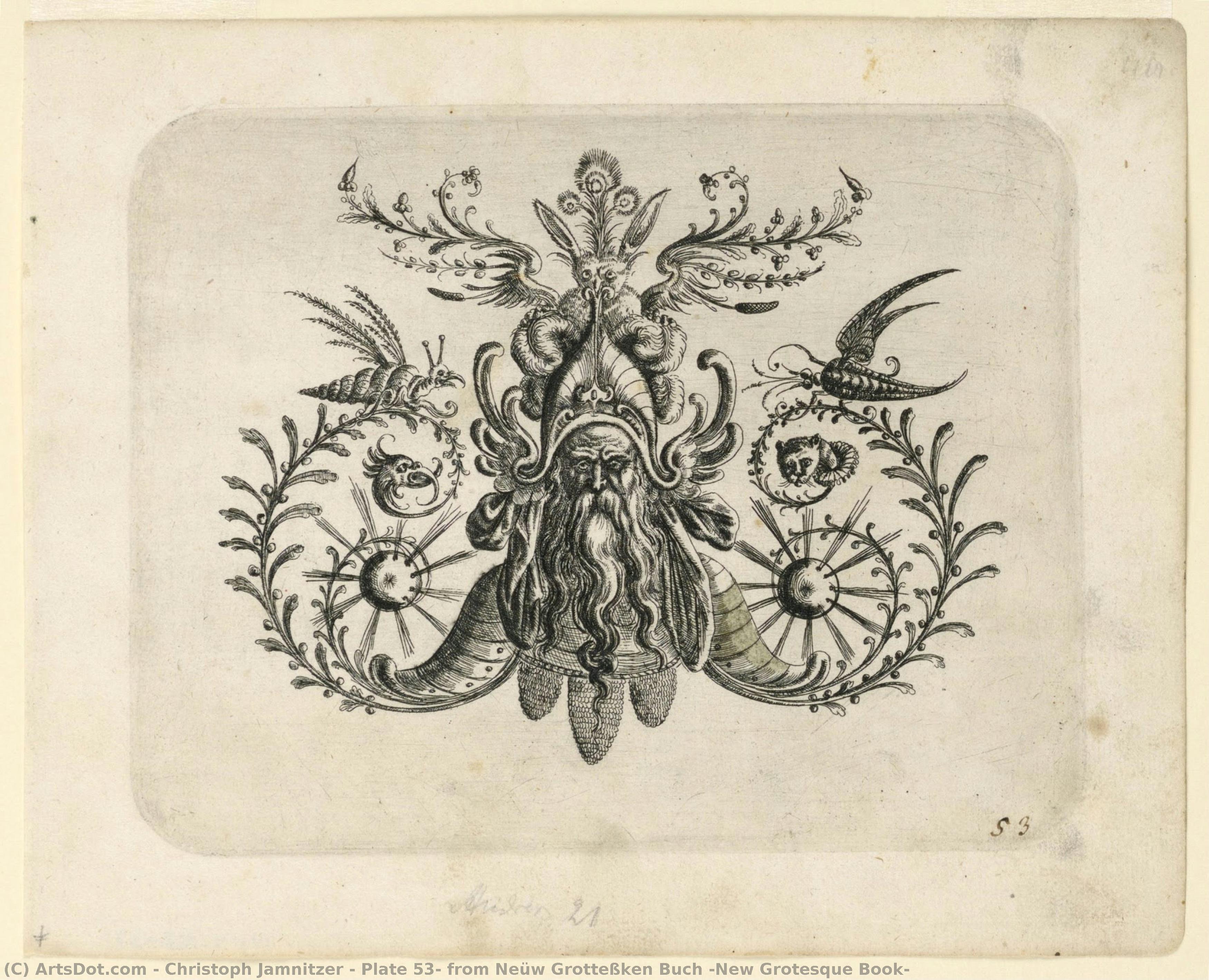
Plate 53, from Neüw Grotteßken Buch (New Grotesque Book)

 Read More
Giclée / Art Print
Museum-quality giclée or canvas print with fast production and flexible finish options. ( Buy Hand Made Painting Buy Image)




































Pick from our preset sizes that match the artwork's original proportions.

You may enter your own dimensions to fit a specific frame or space. If your selected size does not match the original image's proportions, we will either crop the artwork or extend the image with a mirrored or solid-fill edge. A digital mockup will be sent for your approval before production begins.
Please note that the on-screen preview does not reflect the actual cropping or extension. Only the mockup will accurately show the final composition.
While custom sizes are available, we recommend selecting a dimension from the predefined list to preserve the original proportions.
Worldwide Delivery () in 2 weeks instead of standard 4/5 weeks. (26 August)

Free Worldwide Express Shipping

High-Quality Linen Canvas

Full Shipping Insurance

Customs Tax Refund Guarantee

True Color Matching Guarantee

60-Day Return Policy (Defects Only)

100% Money-Back Guarantee

Bulk Discount Offer
 Glass option is only available in size under 110 CM

Plate 53, from Neüw Grotteßken Buch (New Grotesque Book)
Giclée / Art Print
Reproduction Size
-


Total Price
$ 63
Related Artworks









Artist Biography
The Nuremberg Manner’s Master: The Life and Legacy of Christoph Jamnitzer
In the heart of Renaissance Germany, where the industrious spirit of Nuremberg met the burgeoning intellectual currents of the late sixteenth century, Christoph Jamnitzer (1563–1618) emerged as a transformative force. To understand Jamnitzer is to understand the very essence of the Nuremberg Manner, an aesthetic movement defined by its exquisite complexity and a seamless marriage of technical precision with imaginative ornamentation. Born into a lineage of profound artistic significance, he was the descendant of the legendary Wenzel Jamnitzer, whose reputation in sculptural and architectural design provided Christoph with more than just a name; it provided him with a foundational language of form and metalwork that would later be expanded through his own unique scholarly and creative pursuits.
Jamnitzer’s existence was not confined to the singular role of a craftsman. While many of his contemporaries remained tethered to the anvil or the etching needle, he navigated a multidisciplinary landscape that bridged the gap between manual artistry and theoretical science. His career flourished across several demanding disciplines, including goldsmithing, metalworking, printmaking, and art theory. This breadth allowed him to approach the creation of objects not merely as decorative tasks, but as exercises in mathematical harmony and spatial exploration. His workshop became a crucible of innovation, producing works that ranged from the intimate beauty of jewelry adorned with intricate enamelwork to the grand, imposing scale of architectural models designed for civic splendor.
A Symphony of Detail and Theory
The true brilliance of Jamnitzer lay in his ability to imbue physical objects with a sense of intellectual depth. His creations embodied the stylistic hallmarks of his era—a meticulous attention to detail and a stylized ornamentation that drew heavily from classical influences while remaining rooted in regional German traditions. However, it was perhaps his contribution to the science of sight that secured his place in the annals of art history. In 1594, he published his groundbreaking treatise, Perspectiva Corporum Regularium, a work that transcended simple instruction to become a significant advancement in geometrical optics.
Through this publication, Jamnitzer offered a rigorous analysis of the principles governing spatial representation. By providing precise mathematical formulas and complex diagrams, he sought to decode the very mechanics of how the human eye perceives depth and volume. This scholarly endeavor profoundly impacted subsequent generations of artists, as it provided them with the tools to translate the three-dimensional world onto two-dimensional surfaces with unprecedented accuracy. His work in printmaking, particularly his engravings and etchings found in collections such as the Neuw: Grotteßken Buch, serves as a visual testament to this mastery of line and light, showcasing a rhythmic complexity that remains captivating to the modern eye.
Historical Significance and Enduring Influence
The legacy of Christoph Jamnitzer is woven into the very fabric of European Renaissance art. He represents a moment in history when the boundaries between the artisan and the academic were fluid, allowing for a unique synthesis of technical skill and theoretical insight. His ability to shape the aesthetic sensibilities of his time through both tangible objects and written theory ensured that his influence would endure long after the Nuremberg Manner had passed from its peak.
Today, the importance of his contributions can be observed through several key achievements:
- The Advancement of Perspective: His treatise provided a mathematical foundation for spatial representation that influenced both artists and scientists.
- Mastery of the Nuremberg Manner: He refined a style characterized by intricate detail and a harmonious blend of classical and regional motifs.
- Multidisciplinary Innovation: His ability to excel in goldsmithing, printmaking, and theoretical scholarship set a precedent for the polymathic artist of the late Renaissance.
- Cultural Preservation: Through his published works and engravings, he documented and disseminated the sophisticated design language of 16th-century Germany to the wider European community.
As we reflect on the life of Christoph Jamnitzer, we see more than a master of metal and ink; we see an architect of perception whose work helped define the visual vocabulary of an era.
christoph jamnitzer
1563 - 1618 , Germany
Quick Facts
- Artistic Movement Or Style: Nuremberg Manner
- Artists Or Movements Influenced By This Artist: ['Renaissance']
- Artists Who Influenced This Artist: ['Wenzel Jamnitzer']
- Date Of Death: 1618
- Full Name: Christoph Jamnitzer
- Nationality: German
- Notable Artworks: ['Plate 53, from Neüw Grotteßken Buch']
- Place Of Birth: Nuremberg, Germany