 Preview
 Send
Send Share
Share
 Details

 Download
 Similars
 X-Ray
X-Ray Diaporama
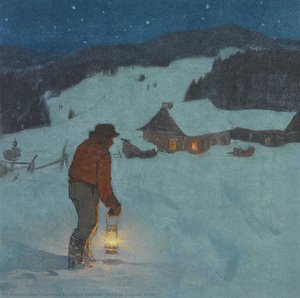
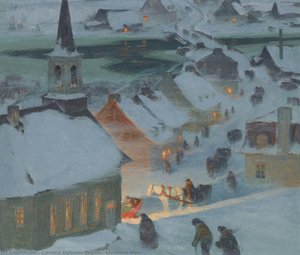
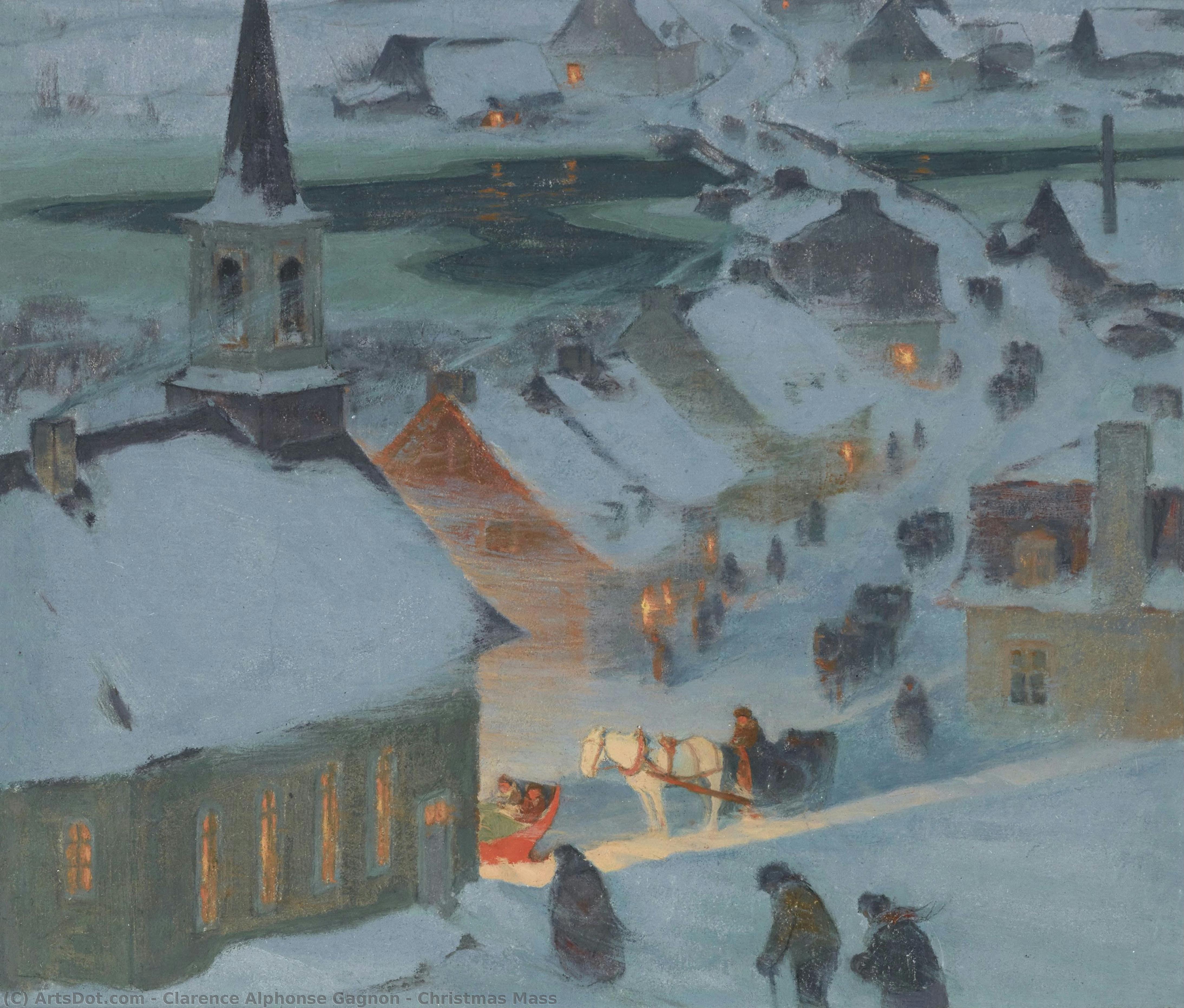
Christmas Mass
 Acrylic On Canvas
- WallArt
- Impressionist Winter Landscapes
 1933
1933 21.0 x 23.0 cm
 McMichael Canadian Art Collection
 Read More
Hand Made Oil Reproduction
Hand-painted oil on canvas in your size and frame, made to order by our artists. ( Buy Print Buy Image)




P118B $10

P118H $10

P118W $10

P438Z $10

P508JH $12

P508YH $12

P805H $10

P805Z $10

P919BZ $10

P919G $10

P919XJ $10

P959ZH $10

P968JZ $12

W106C $8

W218G $10

W218JH $8

W218Y $10

W307PJ $10

W316G $10

W316PJ $8

W316Y $10

W398PJ $8

W4111J $10

W500HY $15

W500JH $15

W692G $12

W849H $8

W940BG $15

W953PJ $8




Pick from our preset sizes that match the artwork's original proportions.

You may enter your own dimensions to fit a specific frame or space. If your selected size does not match the original image's proportions, we will either crop the artwork or extend the painting with additional hand-painted elements. A digital mockup will be sent for your approval before production begins.
Please note that the on-screen preview does not reflect the actual cropping or extension. Only the mockup will accurately show the final composition.
While custom sizes are available, we recommend selecting a dimension from the predefined list to preserve the original proportions.
After order, ArtsDot.com team will email client for instructions and provide a mockup preview
Worldwide Delivery () in 3/4 weeks instead of standard 5 weeks. (17 August). No compromise on quality.

Free Worldwide Express Shipping

High-Quality Linen Canvas

Full Shipping Insurance

Customs Tax Refund Guarantee

True Color Matching Guarantee

60-Day Return Policy (Defects Only)

100% Money-Back Guarantee

Bulk Discount Offer
 Glass option is only available in size under 110 CM

Christmas Mass
Reproduction Medium
Reproduction Size
-


Total Price
$ 263
Artwork Description
A Winter's Embrace: Exploring Clarence Alphonse Gagnon’s “Christmas Mass”
The Laurentian landscape holds an enduring fascination for Canadian artists—a realm of snow-laden pines, frozen lakes reflecting the twilight sky, and a palpable sense of quiet contemplation. Among those who captured this ethereal beauty with unparalleled skill was Clarence Alphonse Gagnon (1881-1942), whose masterpiece “Christmas Mass” exemplifies the Impressionist spirit while simultaneously grounding itself in Quebec’s cultural heritage. Painted in 1933, this artwork transcends mere depiction; it strives to convey a profound emotional resonance rooted in both artistic innovation and deeply held spiritual beliefs.Style and Technique: Impressionistic Luminosity
Gagnon's approach aligns squarely with the tenets of Impressionism—a movement that prioritized capturing fleeting moments of light and color over meticulous realism. Unlike academic painters who sought to reproduce visual reality with painstaking detail, Gagnon embraced a looser brushstroke technique, layering translucent pigments onto canvas to achieve an atmospheric luminescence characteristic of winter landscapes. The artist skillfully employed complementary colors—primarily blues and oranges—to heighten the vibrancy of the scene and create a sense of depth that draws the viewer into the wintry tableau. Notice how the snow itself isn’t rendered as a uniform white but rather infused with subtle shades of lavender and pale pink, mirroring the diffused light filtering through the branches overhead.Historical Context: Quebec's Artistic Renaissance
“Christmas Mass” emerged during Quebec’s artistic renaissance—a period marked by renewed interest in Impressionist aesthetics and a celebration of Canadian identity. Gagnon’s work reflects the broader cultural currents of his time, aligning with a desire to portray Quebec’s rural traditions and spiritual values on par with European artistic achievements. The painting commemorates the Christmas Mass celebrated in a small village nestled amongst the Laurentian mountains—a scene imbued with symbolism reflecting Christian piety and communal harmony.Symbolism: Light, Faith, and Rural Tranquility
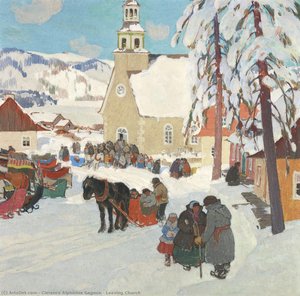
The composition itself speaks volumes about Gagnon’s intentions. Dominating the canvas is the radiant glow emanating from the church windows—representing divine illumination and spiritual enlightenment. Surrounding this focal point are snow-covered pines and fir trees—symbols of resilience and enduring faith—while a horse-drawn carriage traversing a snowy road embodies the passage of time and the continuity of tradition. The inclusion of a dog adds an element of warmth and companionship, underscoring the importance of human connection within the rural setting.Emotional Impact: Capturing Winter's Soul
Ultimately, “Christmas Mass” succeeds in evoking a powerful emotional response—a feeling of serene beauty mingled with nostalgic longing for simpler times. The painting’s luminous palette and expressive brushstrokes transport the viewer to a winter landscape imbued with spiritual significance. It is precisely this ability to capture the essence of Quebec's cultural heritage and convey profound emotion that secures Gagnon’s place as one of Canada’s most beloved artists—a testament to his unwavering dedication to portraying the sublime grandeur of the Laurentian wilderness.- Artist: Clarence Alphonse Gagnon
- Year Painted: 1933
- Medium: Oil on Canvas
- Dimensions: 21 x 23 cm
Related Artworks
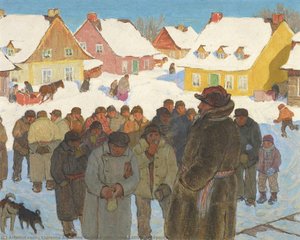
Artist Biography
A Life Immersed in the Canadian Landscape
Clarence Alphonse Gagnon, born in Montreal on November 8th, 1881, stands as a pivotal figure in Canadian art history—a painter who dedicated his life to capturing the ethereal beauty and rugged spirit of Quebec’s Laurentians and Charlevoix regions. His journey began with encouragement from his cultured English mother, fostering an early passion for drawing that would eventually blossom into a celebrated career. While his father envisioned a more conventional path, Gagnon's artistic inclinations were nurtured by figures like William Brymner at the Art Association of Montreal in 1897, who recognized his talent and urged him to seek further training abroad. This mentorship proved crucial, setting the stage for Gagnon’s formative years in Paris.Parisian Influences and Artistic Development
The allure of Paris beckoned, and from 1904 to 1905, Gagnon immersed himself in the vibrant artistic milieu of the Académie Julian, studying under Jean-Paul Laurens. This period was transformative, exposing him to Impressionism and Post-Impressionism—movements that would profoundly shape his aesthetic vision. He absorbed the techniques of capturing light and atmosphere, experimenting with color palettes and brushstrokes while painting *en plein air* across France. The influence of artists like Eugène Boudin and James Wilson Morrice became apparent in his evolving style, a delicate balance between observation and emotional expression. Before returning to Canada in 1909, Gagnon broadened his horizons further through travels in Spain, Italy, and Norway, sketching landscapes that would later inform his canvases. He initially gained recognition as an etcher but soon gravitated towards painting, recognizing its greater potential for conveying the nuances of light and color he so admired.The Charlevoix Years: A Defining Chapter
Gagnon’s return to Canada in 1907 marked a turning point, leading him to settle in the picturesque region of Baie-Saint-Paul in Charlevoix. This landscape—with its rolling hills, snow-dusted mountains, and rustic villages—became his muse, inspiring some of his most iconic works. He wasn’t merely documenting scenery; he was capturing a way of life, the essence of rural Quebec. The winter months proved particularly captivating, offering dramatic contrasts between light and shadow, and allowing him to explore the emotional resonance of solitude and resilience. In 1913, Gagnon achieved international acclaim with his solo exhibition at Galerie A. M. Reitlinger in Paris—a landmark event as the first such showcase for a living Canadian artist in the French capital. This success solidified his reputation and paved the way for further recognition.Legacy and Enduring Significance
Clarence Alphonse Gagnon’s contribution to Canadian art extends beyond his captivating landscapes. He was a champion of preserving traditional Quebecois crafts, collaborating with local artisans on designs for hooked rugs and *ceintures fléchées* (arrow sashes), thereby supporting their livelihoods and celebrating their cultural heritage. His illustrations for Louis Hémon's novel *Maria Chapdelaine* in 1933 are considered a masterpiece of Canadian book illustration, beautifully complementing the story’s themes of hardship and resilience. Gagnon was also an influential teacher, mentoring artists like René Richard and passing on his knowledge and passion for painting. He became a member of the Royal Canadian Academy of Arts, further solidifying his position within the artistic community. Though he passed away in Montreal on January 5th, 1942, his legacy endures through his evocative paintings, which continue to resonate with audiences today—a testament to his profound connection to the land and its people. His work remains a vital part of Canada’s cultural identity, offering a glimpse into a bygone era and celebrating the enduring beauty of the Canadian landscape.Key Characteristics of Gagnon's Work
- Impressionistic Style: Gagnon masterfully employed Impressionistic techniques, focusing on capturing fleeting moments of light and atmosphere.
- Winter Landscapes: He is particularly renowned for his depictions of winter scenes in the Laurentians and Charlevoix regions, showcasing snow-covered mountains, valleys, and villages.
- Vibrant Color Palette: Despite often painting snowy landscapes, Gagnon utilized a rich and vibrant color palette to evoke emotion and create visual interest.
- Sinuous Lines: His compositions are characterized by flowing, sinuous lines that add movement and dynamism to his paintings.
- Emotional Resonance: Gagnon’s work is not merely representational; it conveys a deep emotional connection to the land and its people, capturing a sense of solitude, resilience, and beauty.
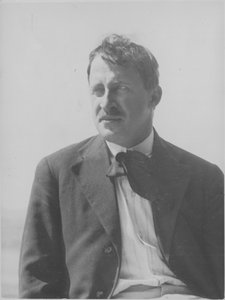
Clarence Alphonse Gagnon
1881 - 1942 , Canada
Quick Facts
- Artistic Movement Or Style: Impressionism
- Artists Or Movements Influenced By This Artist:
- Réné Richard
- Modernist painting in Canada
- Artists Who Influenced This Artist:
- William Brymner
- Jean-Paul Laurens
- Eugène Boudin
- James W. Morrice
- Date Of Birth: November 8, 1881
- Date Of Death: January 5, 1942
- Full Name: Clarence Alphonse Gagnon
- Nationality: Canadian
- Notable Artworks:
- Mont Saint Michel, Morning
- Lac de Charlevoix
- Golden Autumn, Laurentians
- Day
- Place Of Birth: Montreal, Canada
Related Articles

Beyond the Horizon: 10 Landscape Masterpieces for Your Home Decor
Journey through 10 breathtaking landscape paintings by Monet, Van Gogh & more! Explore iconic artworks, artistic techniques & find inspiration for your home decor. Museum-quality reproductions at ArtsDot.com. Discover all masterpieces on ArtsDot.com

Evocations of Place: A Historical Journey Through Landscape Art
Explore the rich history of landscape art with ArtsDot. Discover renowned artists, movements like Impressionism & Romanticism, and expert guidance for collecting timeless pieces. Find your perfect serene escape today!

Cézanne's Masterpieces: 25 Iconic Artworks to Transform Your Space
Journey through 25 iconic artworks by Paul Cézanne – a master of Impressionism and Post-Impressionism. Explore his landscapes, still lifes, and the stories behind these timeless masterpieces. Discover museum-quality reproductions & curated decor at ArtsDot.com.
George Agnew Reid: A Canadian Impressionist's Pursuit of Light, Colour, and National Identity
Explore the life & work of George Agnew Reid, a pivotal figure in Canadian Impressionism. Discover his genre paintings, mural commissions, and lasting influence on art education & national identity. A comprehensive guide for collectors & enthusiasts.
Evocations of Place: A Historical Journey Through Landscape Art
Explore the rich history of landscape art with ArtsDot. Discover renowned artists, movements like Impressionism & tonalism, and expert guidance for collecting timeless pieces. Find your perfect serene escape today!