 Preview
 Send
Send Share
Share
 Details

 Download
 Similars
 X-Ray
X-Ray Diaporama
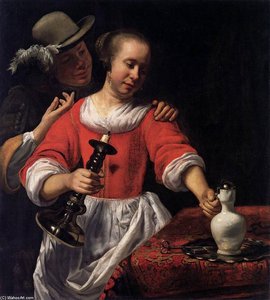
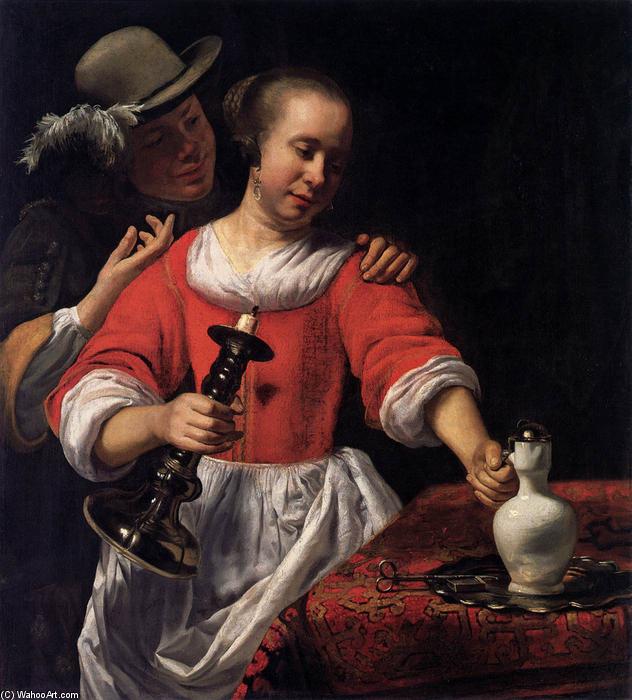
A Young Woman and a Cavalier
 Oil On Panel
- Baroque Realism
 1661
1661- Early Modern
 98.0 x 88.0 cm
 Metropolitan Museum of Art
 Read More
Hand Made Oil Reproduction
Hand-painted oil on canvas in your size and frame, made to order by our artists. ( Buy Print Buy Image)




P118B $10

P118H $10

P118W $10

P438Z $10

P508JH $12

P508YH $12

P805H $10

P805Z $10

P919BZ $10

P919G $10

P919XJ $10

P959ZH $10

P968JZ $12

W106C $8

W218G $10

W218JH $8

W218Y $10

W307PJ $10

W316G $10

W316PJ $8

W316Y $10

W398PJ $8

W4111J $10

W500HY $15

W500JH $15

W692G $12

W849H $8

W940BG $15

W953PJ $8




Pick from our preset sizes that match the artwork's original proportions.

You may enter your own dimensions to fit a specific frame or space. If your selected size does not match the original image's proportions, we will either crop the artwork or extend the painting with additional hand-painted elements. A digital mockup will be sent for your approval before production begins.
Please note that the on-screen preview does not reflect the actual cropping or extension. Only the mockup will accurately show the final composition.
While custom sizes are available, we recommend selecting a dimension from the predefined list to preserve the original proportions.
After order, ArtsDot.com team will email client for instructions and provide a mockup preview
Worldwide Delivery () in 3/4 weeks instead of standard 5 weeks. (17 August). No compromise on quality.

Free Worldwide Express Shipping

High-Quality Linen Canvas

Full Shipping Insurance

Customs Tax Refund Guarantee

True Color Matching Guarantee

60-Day Return Policy (Defects Only)

100% Money-Back Guarantee

Bulk Discount Offer
 Glass option is only available in size under 110 CM

A Young Woman and a Cavalier
Reproduction Medium
Reproduction Size
-


Total Price
$ 263
Artwork Description
A Portrait of Intimacy: Cornelis Bisschop’s “A Young Woman and a Cavalier”
Cornelis Bisschop (1630-1674), a pivotal figure in the Dutch Golden Age, gifted us with “A Young Woman and a Cavalier,” a painting that transcends mere representation to embody the spirit of its era. Executed around 1661, this artwork resides within the Spencer Collection at Althorp Estate, offering a glimpse into the refined tastes and artistic sensibilities of aristocratic society during Rembrandt’s time. The painting's allure lies not only in its visual beauty but also in the subtle complexities woven into its composition—a testament to Bisschop’s mastery of Baroque realism and his pioneering use of trompe l'oeil.The Illusion of Depth: Trompe l'Oeil Technique
Bisschop distinguishes himself as one of the foremost practitioners of trompe l'oeil, a technique that deliberately deceives the eye into perceiving three-dimensional space on a two-dimensional surface. As evidenced by the meticulous rendering of the wooden panel itself—appearing to seamlessly merge with the surrounding architectural setting—the artist skillfully employs illusionistic brushstrokes and shading to create an astonishing sense of depth. This innovative approach reflects the broader artistic currents of the period, where artists sought to elevate painting beyond mere imitation of reality, striving instead for a heightened emotional impact. The meticulous detail extends to the depiction of textures – the smooth sheen of varnished wood contrasting with the subtle folds of fabric—further reinforcing the illusionary effect.A Scene Steeped in Symbolism: Gesture and Expression
Beyond its technical brilliance, “A Young Woman and a Cavalier” resonates with symbolic significance. The woman’s posture exudes quiet contemplation, her gaze directed inward as she holds a vase – a motif frequently associated with purity and receptivity—suggesting an inner life rich in emotion and thought. Conversely, the cavalier stands behind her, engaging in animated conversation, embodying outward confidence and social engagement. These contrasting gestures contribute to the painting’s narrative power, inviting viewers to contemplate themes of courtship, affection, and intellectual discourse. The inclusion of objects like a bottle and wine glass subtly reinforces the setting as an aristocratic gathering—a space for convivial exchange and refined entertainment.Historical Context: Rembrandt's Influence
Bisschop’s artistic development was profoundly shaped by his apprenticeship under Ferdinand Bol, Rembrandt’s protégé, marking him as part of a lineage dedicated to capturing human emotion with unflinching realism. Like Rembrandt before him, Bisschop prioritized conveying psychological states over mere physical likeness, prioritizing expressive brushwork and tonal modulation to evoke feeling within the viewer. The painting's stylistic kinship with Bol’s oeuvre underscores the pervasive influence of Rembrandt’s artistic vision on Dutch painters during this period—a legacy characterized by dramatic lighting, nuanced character portrayals, and a commitment to portraying the complexities of human experience.Emotional Resonance: Capturing Transient Beauty
Ultimately, “A Young Woman and a Cavalier” succeeds in capturing a fleeting moment of intimacy—a tableau vivant that encapsulates the elegance and sophistication of its time. Bisschop’s masterful handling of color and light imbues the scene with warmth and luminosity, conveying not just visual splendor but also an underlying sense of melancholy beauty. It is precisely this ability to evoke emotion that elevates the painting beyond a mere decorative object, transforming it into a poignant reminder of human connection and the ephemeral nature of artistic expression. Reproductions of this artwork offer collectors and interior designers alike the opportunity to experience firsthand the enduring power of Baroque art—a testament to Bisschop’s genius and his contribution to Dutch cultural heritage.Related Artworks


Artist Biography
Cornelis Bisschop: A Life in Dutch Golden Age Painting
Early Life and Education
Cornelis Bisschop (February 12, 1630 – January 21, 1674) was a prominent painter of the Dutch Golden Age. Born in Dordrecht, Netherlands, he came from a family with artistic inclinations, foreshadowing the creative path he would pursue. Around 1650, Bisschop traveled to Amsterdam to study under the tutelage of Ferdinand Bol, a leading pupil of Rembrandt. This apprenticeship proved crucial in shaping his style and technique.
Artistic Development and Style
Bisschop’s artistic development was marked by versatility. He excelled in various genres including historical allegories, portraits, still lifes, and genre scenes. However, he is particularly celebrated for his mastery of trompe l'oeil – a technique that creates the illusion of three-dimensional reality on a two-dimensional surface. He became renowned as one of the first to paint carved wooden panels with such ingenuity, popularizing this style.
Key Works and Themes
- Allegory on the Raid on the Medway: A significant historical painting reflecting a contemporary event.
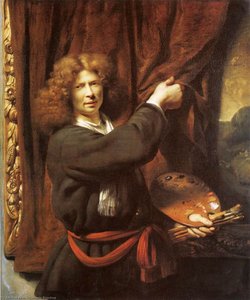
- Self-Portrait: Demonstrates his skill in portraiture and provides insight into his persona.
- Woman Peeling Apple: Exemplifies his talent for capturing everyday life with meticulous detail.
- A Young Woman and a Cavalier: Showcases his ability to portray figures within elegant settings.
His works often feature rich colors, dramatic lighting (influenced by Bol and Rembrandt), and a keen attention to texture and detail. Bisschop’s paintings frequently explore themes of morality, history, and the beauty of everyday life.
Influences and Legacy
Ferdinand Bol was undoubtedly the most significant influence on Bisschop's artistic style. He absorbed Bol’s use of chiaroscuro – the dramatic contrast between light and dark – and his compositional techniques. However, Bisschop developed a unique voice within this framework.
Bisschop’s legacy extends beyond his own paintings. He actively involved his children in his workshop, with two sons (Abraham and Jacobus) and three daughters becoming painters themselves. This familial artistic tradition ensured the continuation of his style and techniques.
Historical Significance
Cornelis Bisschop’s work provides valuable insight into 17th-century Dutch society, culture, and artistic tastes. His innovative use of trompe l'oeil pushed the boundaries of realism in painting, influencing subsequent generations of artists. Although he died unexpectedly at the age of 43, leaving behind a large family, his contributions to the Dutch Golden Age remain significant. He was even invited to paint for the Danish court, highlighting his international recognition.
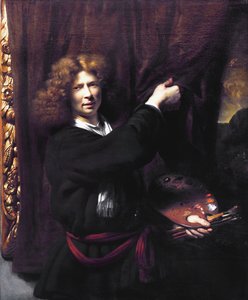
Cornelis Bisschop
1630 - 1674 , Netherlands
Quick Facts
- Birth Date: 1630-02-12
- Birth Place: Dordrecht, Netherlands
- Death Date: 1674-01-21
- Influenced:
- Abraham Bisschop
- Jacobus Bisschop
- Influenced By: Ferdinand Bol
- Movement: Dutch Golden Age painting, Baroque
- Name: Cornelis Bisschop
- Nationality: Dutch
- Notable Works:
- Allegory on the Raid on the Medway
- Self-Portrait
- Woman Peeling Apple
- A Young Woman and a Cavalier
Related Articles

Golden Age Reflections: Dutch Baroque Painting & Cultural Innovation
Explore the Dutch Golden Age of painting! Discover key artists like Vermeer & ter Borch, their innovative techniques, and the rich cultural context behind these Baroque masterpieces. Learn about collecting & appreciating this iconic art period.

Dutch Masters: 10 Golden Age Paintings That Still Inspire |
Journey into the Dutch Golden Age! Explore 10 iconic paintings by Rembrandt, Vermeer & Hals. Discover the stories behind these Baroque masterpieces and find museum-quality art reproductions to elevate your home decor on .

Dutch Baroque Masters: 10 Paintings That Shaped an Era | ArtsDot
Journey through the Golden Age with our guide to the Top 10 Dutch Baroque masterpieces! Explore iconic paintings by Rembrandt, Vermeer & Frans Hals. Find museum-quality art reproductions and elevate your home decor at ArtsDot.com.

Illuminating Innovation: Exploring the Dutch Golden Age of Painting
Explore the Dutch Golden Age of painting with ArtsDot. Discover Rembrandt, Vermeer & other Masters. Learn about key characteristics, iconic artworks, and lasting influence. Expert insights for collectors & enthusiasts.
Illuminating Realism: Exploring the Dutch Golden Age of Painting (1600-1700)
Explore the Dutch Golden Age of painting (1600-1700) with ArtsDot. Discover Rembrandt, Vermeer & other masters. Learn about techniques, history & find museum-quality reproductions.