 Preview
 Send
Send Share
Share
 Details

 Download
 Similars
 X-Ray
X-Ray Diaporama
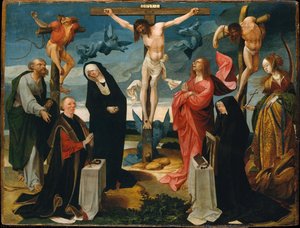
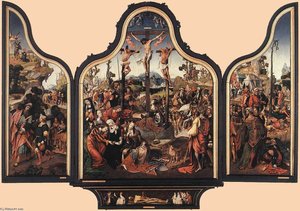
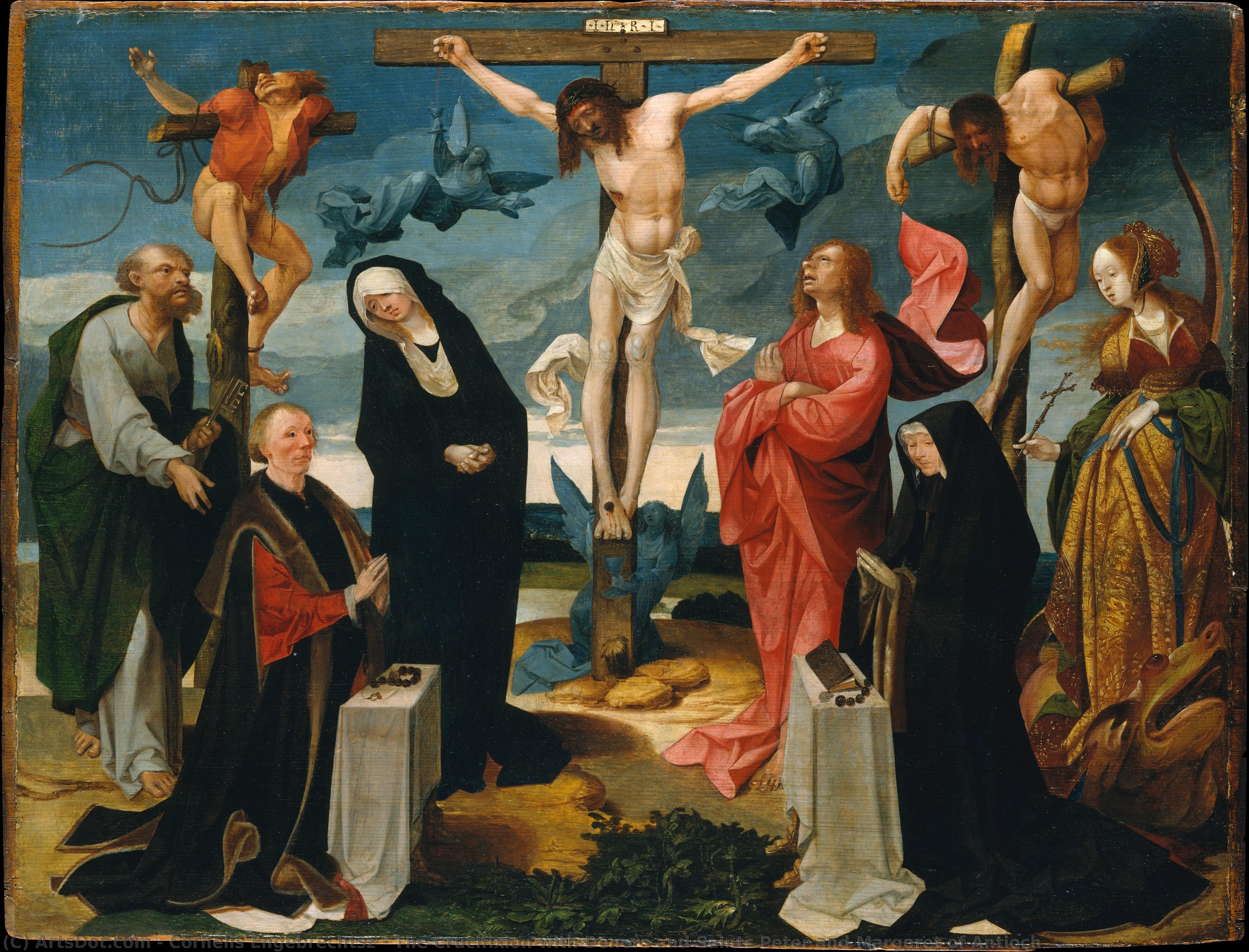
The Crucifixion with Donors and Saints Peter and Margaret of Antioch
 Oil On Canvas
- WallArt
- Renaissance Humanism
 1525
1525- Renaissance
 62.0 x 90.0 cm
 Metropolitan Museum of Art
 Read More
Giclée / Art Print
Museum-quality giclée or canvas print with fast production and flexible finish options. ( Buy Hand Made Painting Buy Image)




P118B $10

P118H $10

P118W $10

P438Z $10

P508JH $12

P508YH $12

P805H $10

P805Z $10

P919BZ $10

P919G $10

P919XJ $10

P959ZH $10

P968JZ $12

W106C $8

W218G $10

W218JH $8

W218Y $10

W307PJ $10

W316G $10

W316PJ $8

W316Y $10

W398PJ $8

W4111J $10

W500HY $15

W500JH $15

W692G $12

W849H $8

W940BG $15

W953PJ $8




Pick from our preset sizes that match the artwork's original proportions.

You may enter your own dimensions to fit a specific frame or space. If your selected size does not match the original image's proportions, we will either crop the artwork or extend the image with a mirrored or solid-fill edge. A digital mockup will be sent for your approval before production begins.
Please note that the on-screen preview does not reflect the actual cropping or extension. Only the mockup will accurately show the final composition.
While custom sizes are available, we recommend selecting a dimension from the predefined list to preserve the original proportions.
Worldwide Delivery () in 2 weeks instead of standard 4/5 weeks. (24 August)

Free Worldwide Express Shipping

High-Quality Linen Canvas

Full Shipping Insurance

Customs Tax Refund Guarantee

True Color Matching Guarantee

60-Day Return Policy (Defects Only)

100% Money-Back Guarantee

Bulk Discount Offer
 Glass option is only available in size under 110 CM

The Crucifixion with Donors and Saints Peter and Margaret of Antioch
Giclée / Art Print
Reproduction Size
-


Total Price
$ 63
Collectible Description
A Moment Frozen in Agony: The Drama of the Crucifixion
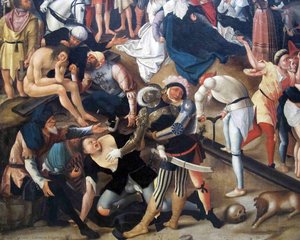
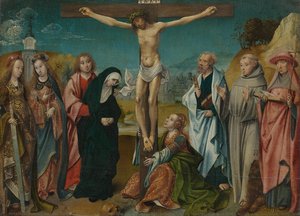
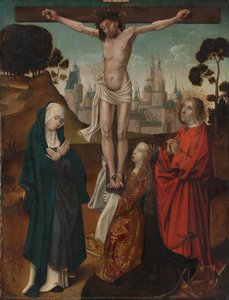
To stand before this depiction of The Crucifixion with Donors and Saints Peter and Margaret of Antioch is to be enveloped by an atmosphere thick with profound piety and dramatic, almost unbearable energy. Painted around 1525 by Cornelis Engbrechtsz, this work from the heart of Leiden captures not merely a historical event, but the very zenith of human suffering transmuted into sacred art. The composition itself is a masterclass in controlled chaos; everything seems to strain toward the central figure of Christ, whose lifeless body hangs suspended against a darkened, brooding sky. This isolation serves only to amplify the weight of his sacrifice, drawing the viewer into an immediate, empathetic confrontation with mortality and redemption.
Mastery of Form and Emotional Resonance
Engbrechtsz employs a technique that pushes emotional effects to their absolute extreme. Observe the contortions of the crucified thieves flanking Christ—their forms are rendered with visceral agony, each muscle group screaming silently against the wood. This dramatic tension is echoed in the surrounding figures. The Virgin Mary’s posture, mirroring her son's own suffering, speaks volumes of maternal empathy, while Saint John gazes upward, his grief palpable and directed solely at the divine sacrifice. It is a study in empathetic witnessing; every face is a carefully modulated expression of sorrow, awe, or detached contemplation.
Symbolism Woven into the Scene
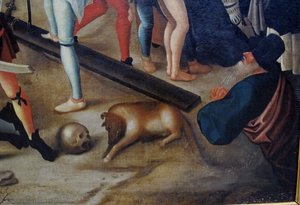
Beyond the central narrative, the painting rewards close inspection with layers of symbolism that invite scholarly meditation. The presence of the two unidentified donors, positioned near the action yet psychologically separated from it, speaks to the complex relationship between the devout observer and the sacred mystery—they are physically present but spiritually engaged in their own act of devotion. Furthermore, the inclusion of details such as the dog near the lower right corner, perhaps symbolizing fidelity, or the book suggesting scripture's eternal word, grounds the divine drama within a tangible, symbolic reality. These elements transform the canvas from a mere depiction into a rich theological dialogue.
A Legacy for Modern Adoration
For those who seek to bring the profound depth of Renaissance spirituality into a contemporary space, this piece offers unparalleled dramatic impact. The striking symmetry, combined with the intense emotional palette, ensures that it functions not just as decoration, but as a powerful focal point for contemplation. Owning a reproduction of this work allows one to connect directly with the technical brilliance and spiritual fervor of early sixteenth-century Dutch painting. It is an heirloom piece designed to inspire awe, prompting quiet reflection on themes of sacrifice, faith, and enduring human connection.
Related Artworks



Artist Biography
Piero di Cosimo: A Renaissance Visionary of Myth and Landscape
Born in Florence in 1462, Piero di Lorenzo, later known as Piero di Cosimo, stands as a singular figure within the Italian Renaissance. Unlike many of his contemporaries who rigidly adhered to established artistic lineages, Piero forged his own distinctive path—a journey marked by eccentric character, imaginative storytelling, and a profound engagement with both classical mythology and the burgeoning beauty of the natural world. He wasn’t a member of any specific school, but rather absorbed techniques from various masters, weaving them into a uniquely personal style that continues to fascinate art historians today.
Piero's early artistic development was inextricably linked to Cosimo Rosselli, a prominent painter and his teacher. From 1480, Piero worked alongside Rosselli in his workshop, gaining invaluable experience during the latter’s involvement in monumental frescoes like those adorning the Sistine Chapel in Rome—the *Sermon on the Mount* and possibly *Crossing of the Red Sea*. This immersion within the Vatican's artistic heart exposed Piero to the groundbreaking works of Sandro Botticelli and Domenico Ghirlandaio, whose vibrant colors and dynamic compositions would profoundly influence his own evolving style. The enamel-like surfaces and dramatic lighting observed in Botticelli’s work, particularly evident in *The Visitation*, became a crucial element in Piero’s early experimentation with color and form.
A Style Forged from Diverse Influences
Piero's mature artistic voice is most powerfully expressed through his mythological paintings. These aren’t simple reproductions of classical narratives; instead, they are vibrant, often fantastical interpretations brimming with a romantic sensibility. Drawing heavily on the writings of Vitruvius, particularly his account of human evolution and the interconnectedness of all things, Piero constructed elaborate scenes populated by hybrid creatures—a testament to his boundless imagination. Works like *The Misfortunes of Silenus*, *The Fight Between the Lapiths and the Centaurs*, and *Vulcan and Aeolus* depict a world where humans and animals coexist in a state of playful chaos, reflecting Piero’s fascination with the boundaries between the natural and the supernatural.
His early works demonstrate a clear debt to Hugo van der Goes' *Portinari Altarpiece*, evident in the use of rich, glossy skin tones. However, Piero quickly moved beyond mere imitation, developing his own distinctive approach. The *Liberation of Andromeda*, for example, showcases a masterful command of sfumato—the subtle blending of light and shadow pioneered by Leonardo da Vinci—creating an atmospheric depth previously unseen in Italian painting. This technique, combined with the soft modeling of figures, imbues Piero’s later works with a luminous quality that distinguishes them from the more rigid styles prevalent at the time.
Key Works and Notable Characteristics
Several paintings stand as particularly compelling examples of Piero's unique vision. *The Discovery of Honey by Bacchus* retains elements of Signorelli’s figure types, but introduces a softer modeling and warmer light—a clear indication of Piero’s mastery of the burgeoning oil painting technique. *Jason and Queen Hypsipyle with the Women of Lemnos* (1499) is a prime example of his mythological storytelling, depicting a scene of revelry and sensual abandon that reflects his interest in human nature and its potential for both beauty and excess. *The Forest Fire* (c. 1505), and *The Fight Between the Lapiths and the Centaurs* (c. 1500-15) further showcase his ability to depict dramatic action and complex narratives with a captivating sense of dynamism.
Legacy and Historical Significance
Piero di Cosimo’s legacy is one of innovation and individuality. He wasn't bound by the conventions of any particular school, instead drawing inspiration from a diverse range of sources—from the frescoes of Botticelli and Ghirlandaio to the techniques of Hugo van der Goes and Leonardo da Vinci. His willingness to experiment with color, composition, and technique paved the way for future generations of Renaissance artists. Giorgio Vasari, in his *Lives of the Most Excellent Painters, Sculptors, and Architects*, famously described Piero as an eccentric loner, a man who lived on hard-boiled eggs—a testament to his unconventional nature and unwavering commitment to his artistic vision. Piero di Cosimo’s paintings continue to be admired for their imaginative power, technical brilliance, and enduring appeal, solidifying his place as a pivotal figure in the development of Renaissance art.
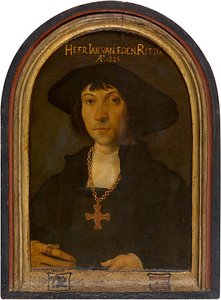
cornelis engebrechtsz
1462 - 1527 , Netherlands
Quick Facts
- Artistic Movement Or Style: Early Renaissance
- Artists Or Movements Influenced By This Artist:
- Fra Bartolommeo
- Mariotto Albertinelli
- Jacopo Pontormo
- Andrea del Sarto
- Artists Who Influenced This Artist:
- Cosimo Rosselli
- Sandro Botticelli
- Hugo van der Goes
- Luca Signorelli
- Leonardo da Vinci
- Date Of Birth: January 2, 1462
- Date Of Death: April 12, 1527
- Full Name: Piero di Cosimo
- Nationality: Italian Renaissance
- Notable Artworks:
- Jason and Queen Hypsipyle
- The Visitation
- The Misfortunes of Silenus
- The Fight Lapiths/Centaurs
- Forest Fire
- Vulcan and Aeolus
- Liberation Andromeda
- Place Of Birth: Florence, Italy
Related Articles

Giclée Prints: Archival Quality & Aesthetic Nuances for the Discerning Collector
Explore the world of giclée prints with ArtsDot. Learn about archival quality, aesthetic nuances & investment potential. Expert guidance for discerning art collectors seeking museum-quality reproductions and lasting value.
Cornelis Springer: A Dutch Master of Cityscapes & Intimate Reflections
Explore the captivating world of Cornelis Springer (1817-1891), a Dutch master renowned for his detailed cityscapes and atmospheric paintings. Discover his life, style & available artworks at ArtsDot.

The Enduring Legacy of Fine Art Prints: Technique, History & Aesthetic Impact
Explore the rich history & techniques of fine art prints. Discover investment potential, assess authenticity, and learn how to preserve your collection with expert guidance. Trusted insights for discerning collectors.

Echoes of Time: Exploring the Enduring Appeal & Historical Context of Vintage Art Prints
Explore the captivating world of vintage art prints! Discover their history, collecting tips & enduring appeal. Expert insights on chromolithography and building a legacy collection with ArtsDot.

Golden Age Reflections: Dutch Baroque Painting & Cultural Innovation
Explore the Dutch Golden Age of painting! Discover key artists like Vermeer & ter Borch, their innovative techniques, and the rich cultural context behind these Baroque masterpieces. Learn about collecting & appreciating this iconic art period.