 Preview
 Send
Send Share
Share
 Details

 Download
 Similars
 X-Ray
X-Ray Diaporama
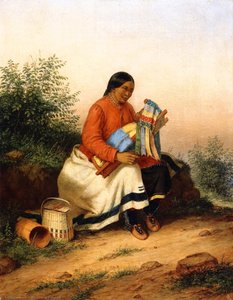
A Caughnawage Woman


 Read More
Hand Made Oil Reproduction
Hand-painted oil on canvas in your size and frame, made to order by our artists. ( Buy Print Buy Image)




































Pick from our preset sizes that match the artwork's original proportions.

You may enter your own dimensions to fit a specific frame or space. If your selected size does not match the original image's proportions, we will either crop the artwork or extend the painting with additional hand-painted elements. A digital mockup will be sent for your approval before production begins.
Please note that the on-screen preview does not reflect the actual cropping or extension. Only the mockup will accurately show the final composition.
While custom sizes are available, we recommend selecting a dimension from the predefined list to preserve the original proportions.
After order, ArtsDot.com team will email client for instructions and provide a mockup preview
Worldwide Delivery () in 3/4 weeks instead of standard 5 weeks. (17 August). No compromise on quality.

Free Worldwide Express Shipping

High-Quality Linen Canvas

Full Shipping Insurance

Customs Tax Refund Guarantee

True Color Matching Guarantee

60-Day Return Policy (Defects Only)

100% Money-Back Guarantee

Bulk Discount Offer
 Glass option is only available in size under 110 CM

A Caughnawage Woman
Reproduction Medium
Reproduction Size
-


Total Price
$ 263
Artwork Description
A Glimpse into the Heart of 19th-Century Canada
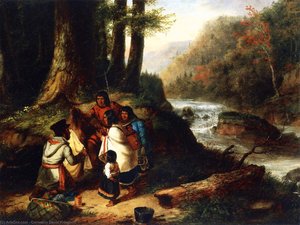
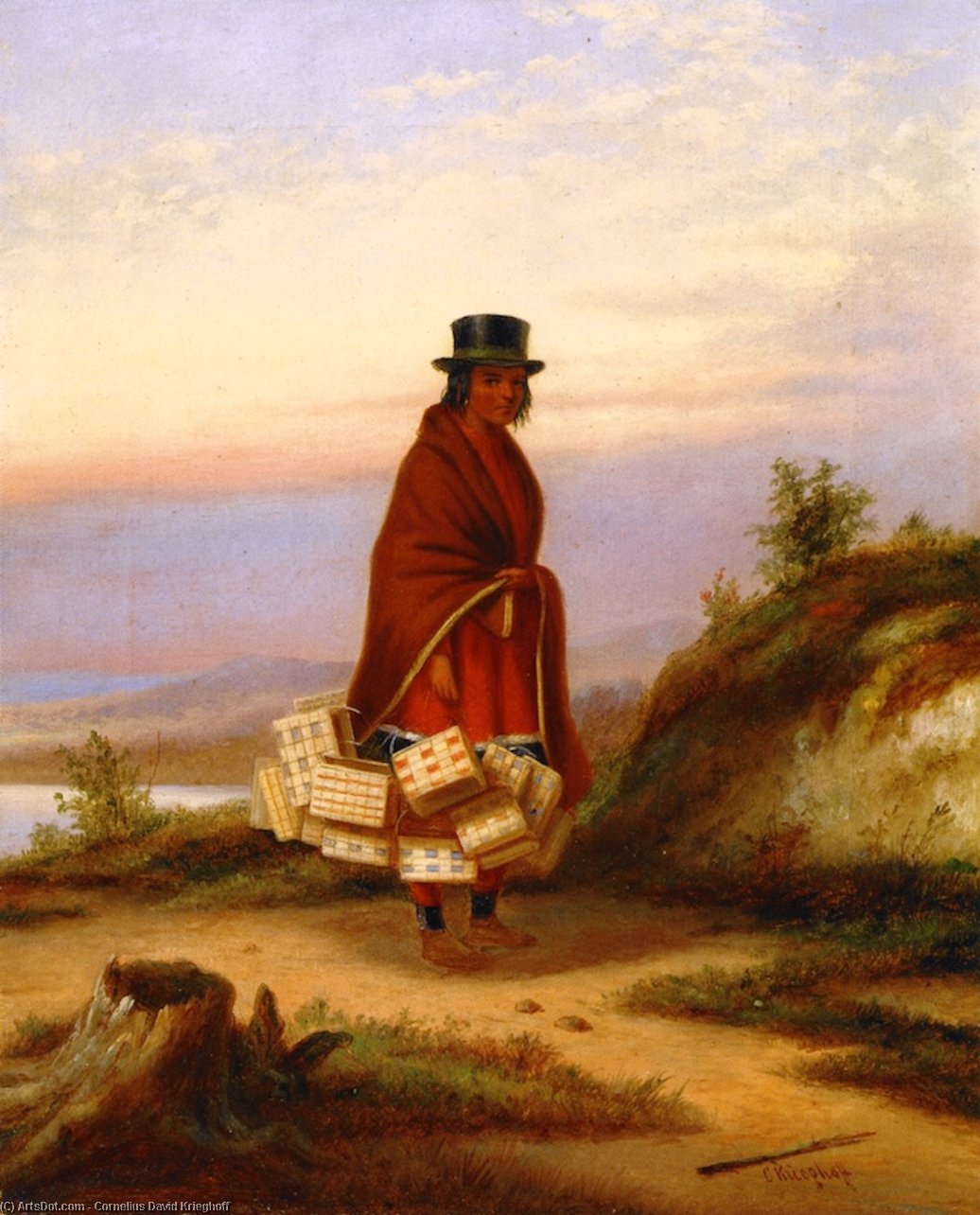
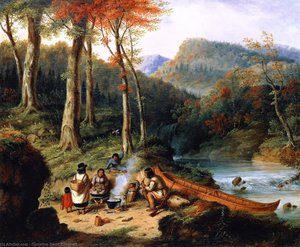
In the quiet, evocative strokes of Cornelius David Krieghoff’s A Caughnawage Woman, we are transported back to the year 1855, a period when the Canadian landscape was as much a character in its own right as the people inhabiting it. This masterful oil on canvas serves as a profound window into the genre scenes of the mid-19th century, capturing a moment of serene yet purposeful existence. The painting presents us with a woman navigating a rugged path, her presence anchored by the vibrant red of a blanket draped over her shoulders—a striking splash of warmth against the more muted, earthy tones of the wilderness. As she carries a basket upon her head, there is an undeniable sense of rhythm and tradition, a silent narrative of daily life and the enduring connection between the Indigenous people and the vast, untamed terrain of Canada.
Krieghoff, a Dutch-born artist who found his true calling in the New World, brings a European technical precision to North American subject matter. His ability to blend the meticulousness of his academic training with the raw, atmospheric beauty of the Canadian landscape creates a tension that is both captivating and deeply moving. In this piece, the viewer can observe the delicate play of light as it filters through the atmosphere, illuminating the textures of the woman's attire and the ruggedness of the distant mountains. The composition is masterfully balanced; while the figure provides a central focus, the inclusion of a boat on the periphery and a solitary bird in the sky expands the world beyond the immediate path, suggesting a larger, interconnected ecosystem of life and movement.
Technique, Texture, and the Romantic Spirit
The technical execution of A Caughsebawage Woman is a testament to Krieghoff’s mastery of the oil medium. Through deliberate brushwork, he achieves a remarkable sense of depth and tactile reality. One can almost feel the weight of the woven basket, the coarse texture of the rocky path, and the soft, heavy drape of the red fabric. The artist utilizes atmospheric perspective with great skill, allowing the distant peaks to recede into a pale, hazy blue, which creates an immense sense of scale and grandeur. This technique does more than just provide depth; it evokes a feeling of nostalgia and reverence for the natural world, a hallmark of the Romantic movement that sought to find the sublime within the landscape.
For the discerning collector or interior designer, this painting offers much more than mere decoration. It is an invitation to contemplate themes of resilience, identity, and the quiet dignity of labor. The soft, diffused lighting—reminiscent of the golden hour during dawn or dusk—bathes the scene in a nostalgic glow, making it an ideal centerpiece for spaces that value warmth, history, and storytelling. Whether placed in a sophisticated gallery setting or as a focal point in a curated residential collection, a high-quality reproduction of this work brings with it a sense of timelessness and a profound respect for the cultural heritage of the Canadian landscape.
Related Artworks

Artist Biography
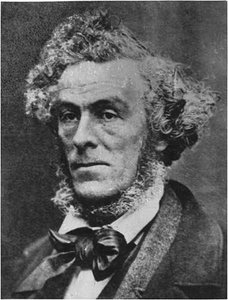
A Life Bridging Worlds: The Story of Cornelius David Krieghoff
Cornelius David Krieghoff, a name intrinsically linked to the vibrant portrayal of 19th-century Canadian life, was an artist whose journey mirrored the evolving identity of a nation. Born in Amsterdam in 1815 to Johann Ernst Krieghoff and Isabella Ludivica Wauters, his early years were steeped in artistic influence; his father instilled within him both a love for music and painting – foundational elements that would later lead him towards formal training at the Academy of Fine Arts in Germany around 1830. Details from this period remain somewhat elusive, yet a fortunate connection through family—accommodations provided by Sattler, a wallpaper factory owner at Schloss Mainberg—offered a stable environment during his formative artistic development. However, Krieghoff’s path was not destined to remain within the confines of European tradition; adventure and a new life beckoned across the Atlantic. The seeds of a restless spirit were sown early, hinting at a destiny that would unfold far from his Dutch origins.From Soldier to Scenery: An Artistic Awakening
In 1836, Krieghoff embarked on a significant chapter by emigrating to New York. The following year saw him enlist in the United States Army, participating in the Second Seminole War. This experience proved pivotal, not for military glory, but for the sketches he diligently produced—early glimpses of his observational skills and nascent artistic voice. These weren’t merely battlefield studies; they were explorations of a new landscape, a different culture, and the beginnings of a unique visual language. Discharged as a corporal in 1840, Krieghoff's wanderlust continued to pull him towards cultural centers. A sojourn to Paris in 1844 provided invaluable exposure; under the tutelage of Michel Martin Drolling at the Louvre, he honed his technique by meticulously copying masterpieces. This period was crucial in solidifying his understanding of composition, color, and form—skills that would later define his distinctive style. It wasn’t merely imitation, however, but a process of absorption and adaptation, preparing him for the landscapes and people he would soon encounter in Canada. He absorbed the lessons of the Old Masters, not to replicate them, but to forge his own path.Finding a Home: Artistic Flourishing in Quebec
Around 1846, Krieghoff settled with his wife, Louise Gauthier (dit Saint-Germain), and daughter Emily in Longueuil, Quebec. This marked the beginning of his most prolific period and his deep connection to Canadian identity. He quickly became a founding member of the Montreal Society of Artists in 1847, demonstrating his commitment to fostering an artistic community. Yet, Krieghoff’s approach was unconventional; rather than relying on galleries or patronage, he famously sold his paintings door-to-door for modest sums—between $5 and $10. This direct engagement with the public allowed him to connect with a broad audience and capture the essence of everyday Canadian life. His subjects were diverse: local scenery, portraits, and particularly compelling depictions of Indigenous life, especially through interactions with the Mohawk community at Kahnawake. A move to Quebec City in 1853 ushered in an era of intense artistic output, solidifying his reputation as a chronicler of the Canadian landscape and its people. He briefly returned to Europe between 1863-1868 before finally settling in Chicago for retirement in 1870. This constant movement reflects not only a search for artistic inspiration but also a deep engagement with the changing world around him.Style, Legacy, and Enduring Appeal
Krieghoff’s style is characterized by a remarkable realism combined with an attention to detail that brings his scenes to life. His winter landscapes are particularly renowned—snow-covered fields, frozen rivers, and figures bundled against the cold rendered with a masterful understanding of light and atmosphere. Influences from German genre painting, notably Wilhelm von Schadow, are evident in his focus on everyday scenes, while echoes of the Hudson River School landscape tradition can be seen in his expansive vistas and dramatic skies. Indian Trapper on Snowshoes, Caughnawaga Indian Encampment at a Portage, A Caughnawage Woman, and various versions of The Toll Gate exemplify his dedication to capturing the spirit of Canada. Krieghoff is now rightfully considered one of Canada’s most important 19th-century artists, not merely for his technical skill but also for his contribution to a distinctly Canadian artistic identity. His paintings offer invaluable insights into the social, cultural, and geographical landscape of a nation undergoing profound change in the pre-Confederation era. He moved beyond purely European influences, forging a visual language that resonated with Canadians and continues to captivate audiences today. His work stands as a testament to the power of art to document history, celebrate culture, and evoke a sense of place.Major Works
- Indian Trapper on Snowshoes: A quintessential Krieghoff scene showcasing the rugged beauty of the Canadian wilderness and the resilience of its inhabitants.
- Caughnawaga Indian Encampment at a Portage: A detailed depiction of Mohawk life, offering a glimpse into their traditions and connection to the land.
- A Caughnawage Woman: A sensitive portrait capturing the dignity and grace of an Indigenous woman.
- The Toll Gate (various versions): A recurring motif representing a common scene in 19th-century Canada, often depicted with lively figures and atmospheric detail.
Cornelius David Krieghoff
1815 - 1872 , Netherlands
Quick Facts
- Artistic Movement Or Style: Genre painting, Realism
- Artists Who Influenced This Artist: ['Wilhelm von Schadow']
- Date Of Birth: June 19, 1815
- Date Of Death: March 5, 1872
- Full Name: Cornelius David Krieghoff
- Nationality: Dutch-Canadian
- Notable Artworks:
- Indian Trapper on Snowshoes
- Caughnawaga Encampment
- A Caughnawage Woman
- The Toll Gate
- Place Of Birth: Amsterdam, Netherlands
Related Articles
Cornelius Krieghoff: Capturing the Soul of 19th-Century Canada
Explore the captivating world of Cornelius Krieghoff, Canada's beloved 19th-century painter. Discover his iconic winter scenes, Indigenous portraits & lasting legacy with our expert guide. Learn about collecting and appreciating this master artist.

The Enduring Legacy of Oil on Canvas: Technique, History & Aesthetic Impact
Explore the rich history & techniques of oil painting – from Renaissance masters to Impressionism. Discover pigments, layering methods, and why this timeless medium endures. Expert insights for artists & art enthusiasts.

Oil on Canvas: A Historical & Technical Exploration of a Timeless Artistic Medium
Explore the rich history & enduring techniques of oil painting on canvas. Discover the science behind its longevity, conservation practices, and contemporary relevance. Expert insights for art enthusiasts.

The Enduring Legacy of Oil on Canvas: Technique, History & Contemporary Practice
Explore the rich history & enduring techniques of oil painting on canvas. Discover the science behind its longevity, conservation practices, and contemporary relevance. Expert insights for art enthusiasts.
Oil on Canvas Masters: 10 Paintings That Redefined Art History |
Journey through art history with our guide to 10 legendary oil on canvas masterpieces! Explore iconic works by Van Gogh, Monet & Rembrandt. Find museum-quality reproductions and elevate your home decor at . Discover all masterpieces online.