 Preview
 Send
Send Share
Share
 Details

 Download
 Similars
 X-Ray
X-Ray Diaporama
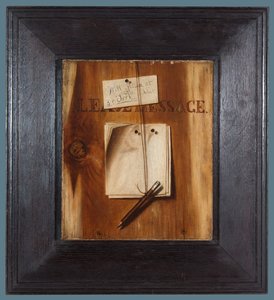
Still Life with Pears


 Read More
Hand Made Oil Reproduction
Hand-painted oil on canvas in your size and frame, made to order by our artists. ( Buy Print Buy Image)




P118B $10

P118H $10

P118W $10

P438Z $10

P508JH $12

P508YH $12

P805H $10

P805Z $10

P919BZ $10

P919G $10

P919XJ $10

P959ZH $10

P968JZ $12

W106C $8

W218G $10

W218JH $8

W218Y $10

W307PJ $10

W316G $10

W316PJ $8

W316Y $10

W398PJ $8

W4111J $10

W500HY $15

W500JH $15

W692G $12

W849H $8

W940BG $15

W953PJ $8




Pick from our preset sizes that match the artwork's original proportions.

You may enter your own dimensions to fit a specific frame or space. If your selected size does not match the original image's proportions, we will either crop the artwork or extend the painting with additional hand-painted elements. A digital mockup will be sent for your approval before production begins.
Please note that the on-screen preview does not reflect the actual cropping or extension. Only the mockup will accurately show the final composition.
While custom sizes are available, we recommend selecting a dimension from the predefined list to preserve the original proportions.
After order, ArtsDot.com team will email client for instructions and provide a mockup preview
Worldwide Delivery () in 3/4 weeks instead of standard 5 weeks. (16 August). No compromise on quality.

Free Worldwide Express Shipping

High-Quality Linen Canvas

Full Shipping Insurance

Customs Tax Refund Guarantee

True Color Matching Guarantee

60-Day Return Policy (Defects Only)

100% Money-Back Guarantee

Bulk Discount Offer
 Glass option is only available in size under 110 CM

Still Life with Pears
Reproduction Medium
Reproduction Size
-


Total Price
$ 263
Artwork Description
A Masterclass in Light and Texture
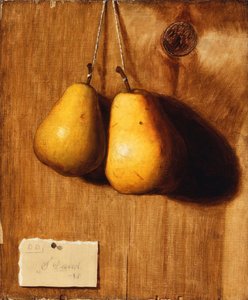
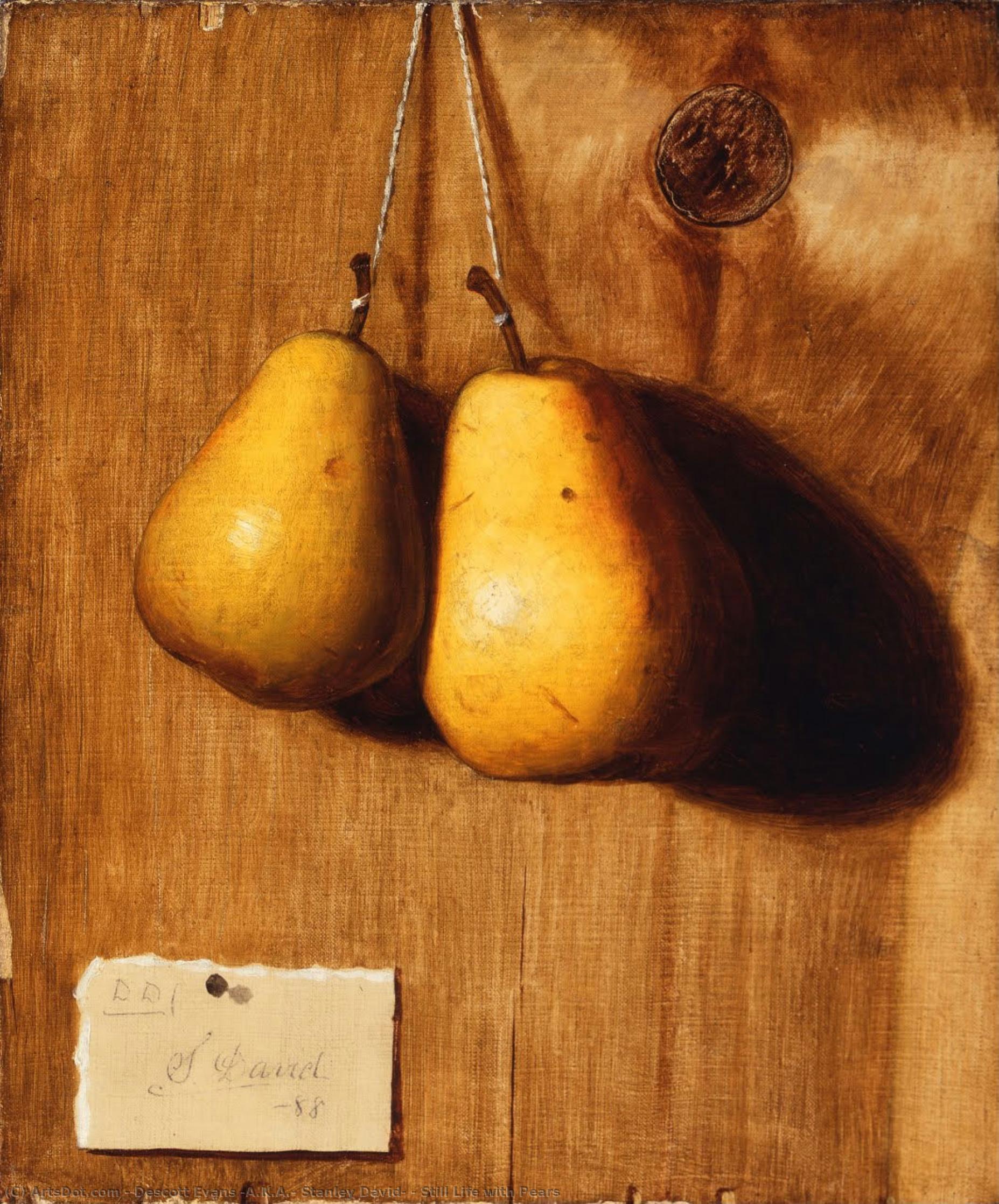
In the quietude of Descott Evans’ Still Life with Pears, dated 1888, we are invited into a moment of profound stillness. This exquisite oil painting serves as a breathtaking study of Baroque realism, where the simple arrangement of fruit is elevated to a high art form through meticulous attention to detail. Two ripe pears, suspended by delicate strings, dominate the composition, their heavy, succulent forms resting against the rugged, honest grain of a wooden surface. The artist employs a dramatic use of light—reminiscent of the chiaroscuro masters—to carve these subjects out of the shadows, creating a palpable sense of volume and weight that feels almost tactile to the viewer.
The technique displayed in this work is nothing short of masterful. Every brushstroke serves a purpose, contributing to the rich, waxy sheen of the pear skins and the taut, fibrous texture of the hanging strings. The interplay between light and shadow creates a rhythmic movement across the canvas, guiding the eye from the bright highlights on the fruit's crest to the deep, velvety recesses of the wooden backdrop. This careful manipulation of value not only defines the physical presence of the objects but also imbues the scene with a sense of atmospheric depth, making the shallow perspective feel intimate and immersive.
Symbolism and the Beauty of Abundance
Beyond its technical brilliance, Still Life with Pears carries a weight of symbolic meaning that resonates with the soul. In the tradition of classical still life, pears have long been celebrated as emblems of abundance, prosperity, and the sweetness of wisdom. By presenting these fruits in such a grounded, realistic manner, Evans connects the viewer to the cyclical beauty of nature and the fleeting perfection of ripeness. The small piece of paper tucked beneath the fruit, bearing subtle text and an initial, adds a layer of human narrative, suggesting a moment captured in a lived-in space, perhaps a quiet corner of a scholar's study or a rustic kitchen.
The color palette is a warm, harmonious blend of earthy tones, golds, and deep ochres, which evokes a sense of comfort and timelessness. This warmth, combined with the dramatic lighting, creates an emotional landscape of quiet contemplation. It is a painting that does not shout for attention but rather commands it through its dignified presence. For the collector or the interior designer, this piece offers more than mere decoration; it provides a focal point of sophisticated elegance, capable of anchoring a room with its profound sense of peace and historical gravity.
An Essential Addition to the Refined Collection
For those seeking to curate an environment of distinction, a high-quality reproduction of this work offers an unparalleled opportunity to introduce classical grandeur into a modern setting. Whether placed in a sunlit gallery or a moody, contemporary study, the painting’s ability to play with light makes it a versatile masterpiece. It speaks to a refined taste that appreciates the intersection of technical skill and emotional depth, making it an ideal choice for anyone looking to surround themselves with art that celebrates the enduring beauty of the natural world.
Related Artworks
Artist Biography
Albert Pinkham Ryder: A Visionary of American Isolation
Born in New Bedford, Massachusetts, on March 19, 1847, Albert Pinkham Ryder remains one of the most enigmatic and intensely private figures in American art. His life was a tapestry woven with contradictions – a celebrated artist largely unknown to the public during his lifetime, a recluse who nonetheless maintained connections within the New York art world, and a painter whose deeply personal and often unsettling visions continue to captivate viewers today. Ryder’s work defies easy categorization, blending elements of tonalism, realism, and Symbolism into a uniquely expressive style that prioritized mood and atmosphere over precise representation.
Ryder's early life offered little indication of the artistic path he would eventually forge. He received limited formal training, initially studying at the National Academy of Design in New York City but finding its rigid academic approach unsuited to his temperament. Instead, he honed his skills through independent study and observation, absorbing influences from European masters like Jean-François Millet and the Barbizon School painters who favored atmospheric landscapes and a rejection of idealized forms. This exposure to the French tradition is particularly evident in his later works, characterized by muted colors, soft brushstrokes, and a focus on capturing fleeting moments of light and shadow.
- Early Years & New York City: Ryder’s family moved to New York City in 1867, where his brother managed the Hotel Albert, a bustling Greenwich Village establishment. This environment provided him with a constant stream of subjects – street scenes, patrons, and the everyday lives of city dwellers – which he meticulously observed and rendered in numerous paintings and sketches.
- European Journeys: Ryder undertook four extended trips to Europe between 1877 and 1893, immersing himself in the art and culture of France and Belgium. These journeys were crucial to his artistic development, exposing him to new techniques and inspiring a shift towards greater abstraction and emotional intensity in his work.
- Isolation & Studio Life: Despite his connections with other artists, Ryder largely retreated from public life, establishing a studio in Greenwich Village where he lived and worked in relative seclusion for much of his career. He famously refused to exhibit his paintings publicly, preferring to sell them directly to collectors through word-of-mouth.
The Language of Dreams: Ryder’s Distinctive Style
Ryder's artistic style is instantly recognizable by its distinctive qualities. He eschewed traditional techniques of perspective and realism in favor of creating intensely personal and evocative images that often felt like glimpses into a dreamscape. His palette was typically subdued, dominated by muted blues, grays, browns, and greens, which he used to create a sense of atmosphere and mood rather than to accurately depict the world around him. Ryder’s brushwork was loose and expressive, characterized by short, broken strokes that conveyed movement and texture.
A key element of Ryder's style is his use of light. He rarely depicted direct sunlight, instead favoring diffused or reflected light sources that cast long shadows and created a sense of mystery and introspection. His paintings often feature solitary figures – fishermen, travelers, or children – immersed in quiet contemplation, suggesting a profound connection to the natural world and an awareness of mortality.
- Tonalism: Ryder’s work aligns with the principles of tonalism, emphasizing the use of value (lightness and darkness) to create mood and form.
- Symbolic Imagery: Many of Ryder's paintings are laden with symbolic meaning, though he rarely offered explicit explanations for their interpretation. Recurring motifs include boats, bridges, windows, and solitary figures, which can be read as symbols of isolation, longing, and the passage of time.
- Emphasis on Atmosphere: Ryder prioritized creating a specific atmosphere or mood over precise representation, often sacrificing detail in favor of capturing the essence of a scene or emotion.
Major Works & Lasting Legacy
Despite his reluctance to exhibit publicly, Ryder produced a substantial body of work during his lifetime, including numerous paintings, watercolors, and drawings. Some of his most celebrated works include *The Docks at New York* (1882), *The Old Bridge at Pellucida* (1886), *The Boatbuilder* (1888), and *The Lighthouse* (1895). These paintings exemplify Ryder’s unique style, characterized by their atmospheric quality, symbolic imagery, and emotional intensity.
Ryder's work received belated recognition after his death in 1917. Today, he is considered a significant figure in American art, admired for his originality, his evocative vision, and his ability to capture the complexities of human experience. His paintings continue to be exhibited in museums and private collections around the world, offering viewers a rare glimpse into the mind of a truly singular artist.
Albert Pinkham Ryder died on March 28, 1917, leaving behind a legacy of enigmatic beauty and enduring mystery. His art remains a testament to the power of individual vision and the profound impact that isolation can have on creativity.
descott evans (a.k.a., stanley david)
1847 - 1898 , United States of America
Quick Facts
- Artistic Movement Or Style: Tonalism, Symbolism
- Artists Or Movements Influenced By This Artist: ['Early Modernism']
- Artists Who Influenced This Artist:
- William Merritt Chase
- John Singer Sargent
- Date Of Birth: March 19, 1847
- Date Of Death: March 28, 1917
- Full Name: Albert Pinkham Ryder
- Nationality: American
- Notable Artworks:
- The Music-Harpers
- The Dives of Pompeii
- The Old Window
- The Fisherman's Wife
- Place Of Birth: New Bedford, Massachusetts
Related Articles

Baroque Masterpieces: 10 Paintings That Defined an Era |
Journey through the drama & grandeur of Baroque art! Explore 10 masterpieces by Caravaggio, Rembrandt, Rubens & more. Discover stunning oil paintings, rich colors & timeless stories. Find museum-quality reproductions at .

The Dramatic Flourish: Exploring the Baroque Movement's Enduring Legacy in Art History
Explore the dramatic world of Baroque art! Discover iconic artists like Caravaggio & Rubens, defining techniques, and its lasting impact on art history. Expert insights for collectors & enthusiasts at ArtsDot.
Silent Narratives: Exploring the Enduring Appeal of Still Life Painting Across Centuries
Explore the rich history of still life painting with ArtsDot. Discover Dutch Masters, decode vanitas symbolism & learn about collecting timeless art. Expert insights and museum-quality reproductions.

Oil on Canvas: A Historical & Technical Exploration of a Timeless Artistic Medium
Explore the rich history & enduring techniques of oil painting on canvas. Discover the science behind its longevity, conservation practices, and contemporary relevance. Expert insights for art enthusiasts.

The Enduring Power of Painting: A Historical & Contemporary Exploration of Form and Emotion
Explore the rich history & enduring techniques of oil painting with ArtsDot. Discover masterpieces, learn about art collecting, and find authentic handmade reproductions crafted by skilled artists.