


 Preview
 Send
Send Share
Share
 Details

 Download
 Similars
 X-Ray
X-Ray Diaporama
The Clown Portrait of a Lady (double sided)
 60.0 x 46.0 cm
 Read More
Purchase a high-resolution, enhanced digital image, far superior to the online preview.
Each file is meticulously prepared by our in-house specialists using advanced tools and expert manual retouching. We ensure every image has exceptional clarity, precise color accuracy, and fine detail.
The final file is delivered via email within 72 hours, optimized for immediate use in professional, editorial, and print environments. This is the same quality trusted by top-tier design studios, publishers, and galleries.
Digital Image
Download a high-resolution file for personal display, printing, and creative projects. ( Buy Print Buy Hand Made Painting)
Included in Every Digital Image Order
Expert Digital Delivery, Guaranteed
When you choose ArtsDot.com, you're not just getting an image - you're receiving a professionally enhanced digital artwork, crafted with precision and backed by a satisfaction guarantee. Here's everything that comes with your order, automatically:

Fast Email Delivery
Your high-resolution digital image file will be emailed to you within 72 hours of ordering - ready for immediate use.

AI-Enhanced Digital File
Your artwork is professionally optimized using advanced AI tools and manual editing, ensuring maximum detail, clarity, and color accuracy.

Free Lifetime Re-Delivery
Accidentally deleted or lost your file? No worries - we'll resend it to you anytime, free of charge.

No Import Fees - Ever
Enjoy your artwork instantly with zero customs, duties, or delivery fees - digital downloads are always tax-free.

Color Accuracy Guarantee
We ensure your digital image reflects the original colors as closely as possible using professional tools and color management.

60-Day Satisfaction Guarantee
If you're not satisfied with your digital image, we'll revise it or refund 100% within 60 days - no questions asked.

100% Money-Back Guarantee
Not satisfied? Get a full refund within 60 days of receiving your digital file - no questions asked.

Bulk Order Discounts
Buy 3 images, save 10% - Buy 5, save 15% - Buy 10+, save 20%. Great for creative projects, galleries, and agencies.
Related Artworks



Artist Biography
A Bridge Between Worlds: The Life and Art of Ding Yanyong
Ding Yanyong (1902-1978) occupies a unique position in 20th-century Chinese art history, a figure celebrated as the “Matisse of the East” and hailed for his ability to synthesize Western modernism with deeply rooted Chinese traditions. Born in Guangdong province, Ding’s journey was one of constant exploration and innovation, driven by a desire to revitalize Chinese painting while embracing the expressive possibilities offered by European artistic movements. His early exposure to art came through traditional channels, but a pivotal moment arrived when he traveled to Japan in 1919 to study at the Tokyo School of Fine Arts. There, immersed in the vibrant world of Fauvism and Expressionism, Ding discovered a new visual language that would profoundly shape his artistic vision. He wasn’t merely adopting Western styles; he was seeking a way to infuse them with the spirit and philosophy inherent in Chinese aesthetics.Early Career and the New Art Movement
Upon returning to China in the mid-1920s, Ding Yanyong became a leading force in the burgeoning New Art Movement. He taught Western painting in Shanghai, Guangzhou, and Chongqing, actively promoting modern techniques and encouraging his students to break away from conventional approaches. This period was marked by experimentation – he sought to introduce oil painting as a viable medium within the Chinese art landscape, but also began a deeper engagement with traditional ink painting around 1928. It wasn’t simply about replacing one form with another; Ding believed that the essence of Chinese art lay in its calligraphic rhythm and expressive simplicity. He started collecting ancient calligraphy and paintings, particularly those of Bada Shanren, a 17th-century individualist painter whose work resonated deeply with his own artistic sensibilities. This marked a turning point, as he began to consciously integrate elements of literati painting into his Western-influenced compositions.Fusion of East and West: A Distinctive Style
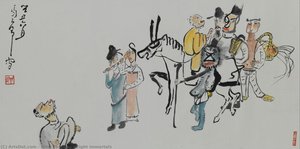
Ding Yanyong’s mature style is characterized by a remarkable fusion of Eastern and Western aesthetics. His oil paintings often feature bold colors and simplified forms reminiscent of Fauvism, yet they are imbued with the lyrical quality and philosophical depth of Chinese art. He masterfully employed line and composition to create works that were both visually striking and emotionally resonant. Simultaneously, his ink paintings demonstrate a profound understanding of traditional techniques, but are infused with a modern sensibility – a playful energy and a willingness to experiment with form and subject matter. His subjects ranged from landscapes and flowers to figures and clowns, each rendered with a unique blend of naiveté and sophistication. The clown motif, in particular, became a recurring theme, serving as a vehicle for social commentary and self-reflection. He wasn’t interested in realistic representation; rather, he sought to capture the essence of his subjects through expressive brushwork and evocative imagery.Later Life and Legacy
In 1949, Ding Yanyong relocated to Hong Kong, where he continued to teach and create art until his death in 1978. He was a founding member of the Fine Arts Department at New Asia College (later part of The Chinese University of Hong Kong), playing a crucial role in shaping generations of artists. His influence extended far beyond the classroom; exhibitions of his work were held internationally, introducing his unique style to audiences worldwide. The establishment of awards and societies bearing his name – the “Ding Yanyong Academic Achievement Award” and the “Ding Yanyong Painting Society” – further cemented his legacy as a pioneer in Chinese art.- Key Influences: Matisse, Bada Shanren, traditional Chinese calligraphy and painting.
- Major Themes: Fusion of Eastern and Western aesthetics, the expressive power of line, social commentary through symbolism (particularly the clown motif), revitalization of Chinese art traditions.
- Historical Significance: Ding Yanyong played a pivotal role in introducing modern Western art to China and bridging the gap between traditional Chinese painting and contemporary artistic movements. His work continues to inspire artists today, serving as a testament to the power of cross-cultural dialogue and innovation.
Quick Facts
- Artistic Movement Or Style: Modern Chinese Art
- Artists Who Influenced This Artist:
- Matisse
- Bada Shanren
- Date Of Birth: 1902
- Date Of Death: Living
- Full Name: Ding Yanyong
- Nationality: Chinese
- Notable Artworks:
- Eight Immortals
- Summer Mountains
- Clown Portrait
- Place Of Birth: Guangdong, China

