Preview
 Send
Send Share
Share
 Details

 Download
 Similars
 X-Ray
X-Ray Diaporama
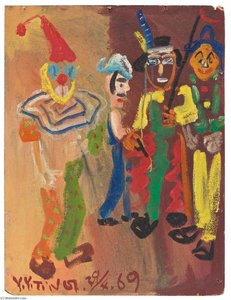
The Clown Portrait of a Lady (double sided)
 60.0 x 46.0 cm
 Read More
Giclée / Art Print
Museum-quality giclée or canvas print with fast production and flexible finish options. ( Buy Hand Made Painting Buy Image)




































Pick from our preset sizes that match the artwork's original proportions.

You may enter your own dimensions to fit a specific frame or space. If your selected size does not match the original image's proportions, we will either crop the artwork or extend the image with a mirrored or solid-fill edge. A digital mockup will be sent for your approval before production begins.
Please note that the on-screen preview does not reflect the actual cropping or extension. Only the mockup will accurately show the final composition.
While custom sizes are available, we recommend selecting a dimension from the predefined list to preserve the original proportions.
Worldwide Delivery () in 2 weeks instead of standard 4/5 weeks. (28 August)

Free Worldwide Express Shipping

High-Quality Linen Canvas

Full Shipping Insurance

Customs Tax Refund Guarantee

True Color Matching Guarantee

60-Day Return Policy (Defects Only)

100% Money-Back Guarantee

Bulk Discount Offer
 Glass option is only available in size under 110 CM

The Clown Portrait of a Lady (double sided)
Giclée / Art Print
Reproduction Size
-


Total Price
$ 63
Related Artworks



Artist Biography
A Bridge Between Worlds: The Life and Art of Ding Yanyong
Ding Yanyong (1902-1978) occupies a unique position in 20th-century Chinese art history, a figure celebrated as the “Matisse of the East” and hailed for his ability to synthesize Western modernism with deeply rooted Chinese traditions. Born in Guangdong province, Ding’s journey was one of constant exploration and innovation, driven by a desire to revitalize Chinese painting while embracing the expressive possibilities offered by European artistic movements. His early exposure to art came through traditional channels, but a pivotal moment arrived when he traveled to Japan in 1919 to study at the Tokyo School of Fine Arts. There, immersed in the vibrant world of Fauvism and Expressionism, Ding discovered a new visual language that would profoundly shape his artistic vision. He wasn’t merely adopting Western styles; he was seeking a way to infuse them with the spirit and philosophy inherent in Chinese aesthetics.Early Career and the New Art Movement
Upon returning to China in the mid-1920s, Ding Yanyong became a leading force in the burgeoning New Art Movement. He taught Western painting in Shanghai, Guangzhou, and Chongqing, actively promoting modern techniques and encouraging his students to break away from conventional approaches. This period was marked by experimentation – he sought to introduce oil painting as a viable medium within the Chinese art landscape, but also began a deeper engagement with traditional ink painting around 1928. It wasn’t simply about replacing one form with another; Ding believed that the essence of Chinese art lay in its calligraphic rhythm and expressive simplicity. He started collecting ancient calligraphy and paintings, particularly those of Bada Shanren, a 17th-century individualist painter whose work resonated deeply with his own artistic sensibilities. This marked a turning point, as he began to consciously integrate elements of literati painting into his Western-influenced compositions.Fusion of East and West: A Distinctive Style
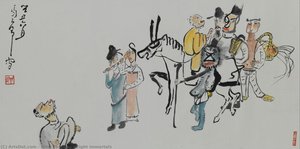
Ding Yanyong’s mature style is characterized by a remarkable fusion of Eastern and Western aesthetics. His oil paintings often feature bold colors and simplified forms reminiscent of Fauvism, yet they are imbued with the lyrical quality and philosophical depth of Chinese art. He masterfully employed line and composition to create works that were both visually striking and emotionally resonant. Simultaneously, his ink paintings demonstrate a profound understanding of traditional techniques, but are infused with a modern sensibility – a playful energy and a willingness to experiment with form and subject matter. His subjects ranged from landscapes and flowers to figures and clowns, each rendered with a unique blend of naiveté and sophistication. The clown motif, in particular, became a recurring theme, serving as a vehicle for social commentary and self-reflection. He wasn’t interested in realistic representation; rather, he sought to capture the essence of his subjects through expressive brushwork and evocative imagery.Later Life and Legacy
In 1949, Ding Yanyong relocated to Hong Kong, where he continued to teach and create art until his death in 1978. He was a founding member of the Fine Arts Department at New Asia College (later part of The Chinese University of Hong Kong), playing a crucial role in shaping generations of artists. His influence extended far beyond the classroom; exhibitions of his work were held internationally, introducing his unique style to audiences worldwide. The establishment of awards and societies bearing his name – the “Ding Yanyong Academic Achievement Award” and the “Ding Yanyong Painting Society” – further cemented his legacy as a pioneer in Chinese art.- Key Influences: Matisse, Bada Shanren, traditional Chinese calligraphy and painting.
- Major Themes: Fusion of Eastern and Western aesthetics, the expressive power of line, social commentary through symbolism (particularly the clown motif), revitalization of Chinese art traditions.
- Historical Significance: Ding Yanyong played a pivotal role in introducing modern Western art to China and bridging the gap between traditional Chinese painting and contemporary artistic movements. His work continues to inspire artists today, serving as a testament to the power of cross-cultural dialogue and innovation.
Quick Facts
- Artistic Movement Or Style: Modern Chinese Art
- Artists Who Influenced This Artist:
- Matisse
- Bada Shanren
- Date Of Birth: 1902
- Date Of Death: Living
- Full Name: Ding Yanyong
- Nationality: Chinese
- Notable Artworks:
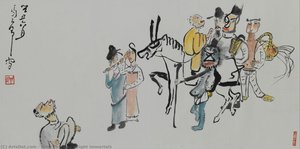
- Eight Immortals
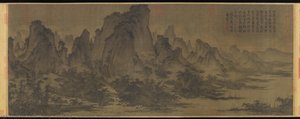
- Summer Mountains
- Clown Portrait
- Place Of Birth: Guangdong, China