 Preview
 Send
Send Share
Share
 Details

 Download
 Similars
 X-Ray
X-Ray Diaporama
Apse and tribune


 Read More
Hand Made Oil Reproduction
Hand-painted oil on canvas in your size and frame, made to order by our artists. ( Buy Print Buy Image)




P118B $10

P118H $10

P118W $10

P438Z $10

P508JH $12

P508YH $12

P805H $10

P805Z $10

P919BZ $10

P919G $10

P919XJ $10

P959ZH $10

P968JZ $12

W106C $8

W218G $10

W218JH $8

W218Y $10

W307PJ $10

W316G $10

W316PJ $8

W316Y $10

W398PJ $8

W4111J $10

W500HY $15

W500JH $15

W692G $12

W849H $8

W940BG $15

W953PJ $8




Pick from our preset sizes that match the artwork's original proportions.

You may enter your own dimensions to fit a specific frame or space. If your selected size does not match the original image's proportions, we will either crop the artwork or extend the painting with additional hand-painted elements. A digital mockup will be sent for your approval before production begins.
Please note that the on-screen preview does not reflect the actual cropping or extension. Only the mockup will accurately show the final composition.
While custom sizes are available, we recommend selecting a dimension from the predefined list to preserve the original proportions.
After order, ArtsDot.com team will email client for instructions and provide a mockup preview
Worldwide Delivery () in 3/4 weeks instead of standard 5 weeks. (17 August). No compromise on quality.

Free Worldwide Express Shipping

High-Quality Linen Canvas

Full Shipping Insurance

Customs Tax Refund Guarantee

True Color Matching Guarantee

60-Day Return Policy (Defects Only)

100% Money-Back Guarantee

Bulk Discount Offer
 Glass option is only available in size under 110 CM

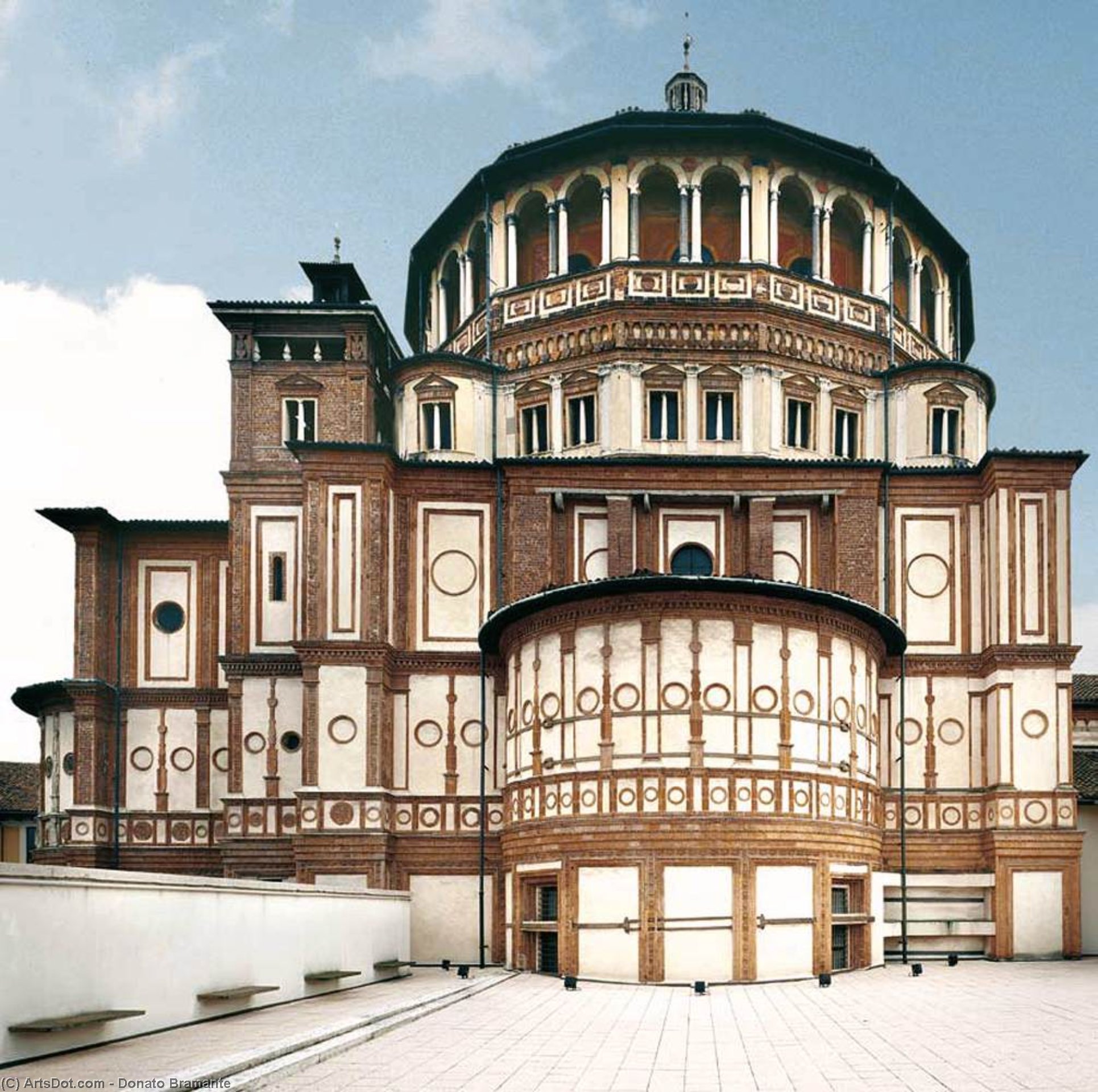
Apse and tribune
Reproduction Medium
Reproduction Size
-


Total Price
$ 263
Artwork Description
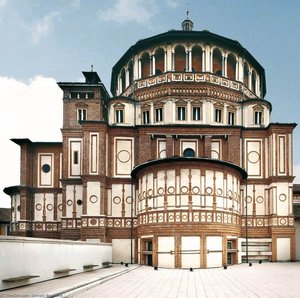
The Enigmatic Majesty of “Apse and Tribune”
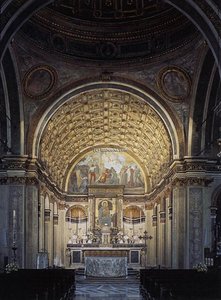
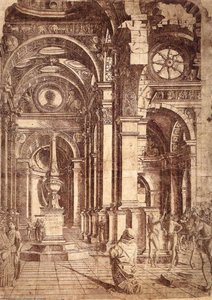
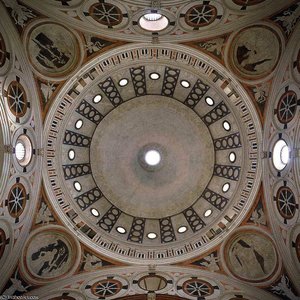
Donato Bramante’s “Apse and Tribune,” conceived in 1492 for the Santa Maria delle Grazie church in Milan, stands as a pivotal moment in the transition from the somber formality of late Gothic architecture to the burgeoning optimism and classical ideals of the High Renaissance. More than just a structural element within a grand church, it’s a carefully orchestrated dialogue between tradition and innovation—a testament to Bramante's profound understanding of both Roman precedents and the evolving spirit of his time. The design itself is rooted in the architectural principles established by Filippo Brunelleschi for the Medici sacristy at San Lorenzo in Florence, yet imbued with Bramante’s distinctly personal vision, a synthesis that would profoundly influence the course of Italian architecture for decades to come. The piece isn't merely about building; it’s about crafting an experience—a sense of awe and contemplation within a sacred space.A Fusion of Forms: Architectural Significance
At first glance, “Apse and Tribune” presents a striking visual paradox. The circular apse, reminiscent of Roman basilicas and early Christian chapels, is dramatically juxtaposed with the soaring dome-like structure above—a bold departure from the predominantly horizontal forms favored in Gothic design. This deliberate contrast speaks volumes about Bramante’s ambition: he sought to elevate the church's interior to a realm of classical grandeur while simultaneously retaining elements of its spiritual heritage. The use of brickwork, primarily in earthy tones of brown and beige, creates a sense of warmth and solidity, grounding the structure in the practical realities of construction. However, it’s not simply about practicality; Bramante masterfully employs classical elements – columns, arches, and decorative moldings – to imbue the design with an air of timeless elegance and intellectual sophistication. The careful arrangement of these components generates a powerful sense of harmony and balance, reflecting the Renaissance ideal of *proportio*—a belief that beauty arises from perfect mathematical relationships.The Symbolism of Light and Space
Beyond its architectural merits, “Apse and Tribune” is rich in symbolic meaning. The circular apse, a traditional space for contemplation and communion with the divine, represents the cyclical nature of life and death—a concept central to Christian theology. The dome, echoing the Pantheon’s magnificent oculus, symbolizes heaven and the connection between earth and the celestial realm. Bramante's innovative use of pendentives – triangular sections of a sphere that support the dome – was revolutionary at the time, allowing for greater height and openness within the interior space. The multiple levels of windows and decorative elements further enhance this sense of light and airiness, creating an atmosphere of spiritual transcendence. The careful manipulation of light is particularly noteworthy; it’s not merely illumination but a carefully orchestrated drama that guides the viewer's eye and evokes a profound emotional response.A Legacy in Reproduction: Bringing Bramante to Life
Today, “Apse and Tribune” continues to inspire artists and designers alike. Reproductions of this iconic masterpiece offer an unparalleled opportunity to experience its beauty and complexity firsthand—to appreciate the genius of Donato Bramante and his pivotal role in shaping the Renaissance aesthetic. When commissioning a hand-painted reproduction, one can select from a range of artistic styles and techniques, ensuring that the final product faithfully captures the essence of the original while reflecting the individual’s personal taste. The meticulous detail and vibrant colors of a high-quality reproduction will transform any space into a sanctuary—a place of contemplation, beauty, and enduring inspiration. The piece serves as a reminder that art transcends time, connecting us to the creative spirit of generations past.Related Artworks
Artist Biography
Petrus Christus: Bridging the Gap Between Medieval and Renaissance
Petrus Christus, a name largely unknown for centuries, stands as a pivotal figure in the transition between the late Gothic and early Renaissance art of Northern Europe. Born around 1410/1420 in Baarle, near Antwerp, and active primarily in Bruges from 1444 until his death circa 1475/1476, Christus’s legacy rests not on grand, revolutionary works but rather on a quietly innovative approach to painting—one that combined meticulous detail with an emerging sense of volume and perspective. He represents a crucial bridge between the highly stylized, illuminated manuscripts of the medieval period and the burgeoning naturalism of the Renaissance, demonstrating a remarkable ability to absorb and adapt influences from various sources.
Christus’s early life remains somewhat shrouded in mystery. He is believed to have been apprenticed to Jan van Eyck, the most celebrated painter of his time, though the exact nature of this relationship—whether as a true pupil or simply a student working in van Eyck's workshop—is still debated by scholars. The meticulous detail and precise rendering evident in Christus’s work strongly suggest an influence from van Eyck’s groundbreaking realism, particularly in his masterful use of oil paint. However, unlike van Eyck, who often focused on grand narratives and religious scenes, Christus quickly developed a distinctive style, characterized by a remarkable attention to the textures and surfaces of his subjects—from the velvet robes of wealthy patrons to the delicate folds of fabric. His early works were largely commissioned by Bruges’s burgeoning merchant class, reflecting the city's growing wealth and international trade.
A Master of Detail: Technique and Innovation
What immediately distinguishes Christus’s paintings is his extraordinary level of detail. He meticulously rendered every element—every stitch in a garment, every glint of metal, every strand of hair—with an almost obsessive precision. This approach echoes the techniques employed in manuscript illumination, where intricate details were essential for conveying information and beauty. However, unlike the flat, decorative style of illuminated manuscripts, Christus used his meticulous detail to create a sense of three-dimensionality – a crucial step towards Renaissance naturalism. He was among the first artists to convincingly depict volume and space on a two-dimensional surface, employing techniques such as careful observation of light and shadow and an increasingly sophisticated understanding of perspective.
Christus’s development is particularly fascinating when viewed through the lens of scientific analysis. Modern investigations using X-radiography, infrared reflectography, and dendochronological dating have revealed a gradual evolution in his technique. Early works show evidence of underdrawings—a common practice at the time—but later paintings demonstrate an increasingly refined approach to composition and perspective. This suggests that Christus was not simply copying existing styles but actively experimenting with new methods of representation, pushing the boundaries of what was possible within the constraints of medieval painting conventions.
Influences and Patronage
Christus’s artistic journey was shaped by a complex interplay of influences. As mentioned earlier, Jan van Eyck undoubtedly played a significant role in his early development. However, he also drew inspiration from Rogier van der Weyden, another prominent Flemish painter known for his dramatic compositions and expressive figures. Furthermore, Christus's work reveals a strong connection to the artistic traditions of Italy, particularly those of Antonello da Messina and other artists working in the Mediterranean region. Many of his commissions were undertaken by Italian merchants and bankers who had established thriving trade links with Bruges, resulting in paintings that often feature Italian or Spanish provenance. This exposure to Italian art—with its emphasis on color, light, and naturalism—clearly influenced Christus’s style.
The patronage of wealthy Bruges citizens, including the Burgundian dukes, provided Christus with a steady stream of commissions. The Dukes' frequent visits to Bruges created a vibrant artistic environment, attracting artists from across Europe. Christus’s ability to adapt his style to suit the tastes of his patrons—whether they desired a formal portrait or a more intimate devotional scene—demonstrates his versatility and responsiveness to market demands. His portraits, in particular, are notable for their psychological depth and subtle expressions of personality.
Legacy and Rediscovery
For centuries after his death, Petrus Christus remained largely forgotten by art historians. His work was dismissed as eclectic and derivative, overshadowed by the more celebrated figures of Jan van Eyck and Hans Memling. However, in the late 19th century, a renewed interest in Northern Renaissance painting led to a reassessment of Christus’s oeuvre. Scholars began to recognize his innovative techniques and his crucial role in bridging the gap between medieval and Renaissance art. Today, Petrus Christus is increasingly appreciated as one of the most important and influential painters of the early Netherlandish school—a master whose meticulous detail and subtle innovations paved the way for the artistic achievements of subsequent generations.
His surviving works, including the *Portrait of a Carthusian*, the *Portrait of a Young Girl*, and several devotional panels, offer a compelling glimpse into the artistic world of 15th-century Bruges—a city that served as a vital crossroads between Europe and the Mediterranean. Christus’s legacy lies not in grand monuments but in the quiet brilliance of his paintings, which continue to captivate viewers with their remarkable detail, subtle beauty, and profound sense of human presence.
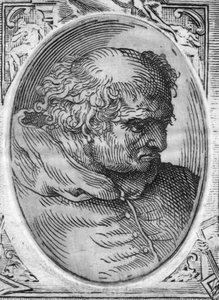
donato bramante
1444 - 1514 , Italy
Quick Facts
- Artistic Movement Or Style: Early Netherlandish
- Artists Or Movements Influenced By This Artist: ['Sandro Botticelli']
- Artists Who Influenced This Artist:
- Jan van Eyck
- Rogier van der Weyden
- Date Of Death: 1475/76
- Full Name: Petrus Christus
- Nationality: Flemish
- Notable Artworks:
- Portrait of a Carthusian
- Portrait of a Young Girl
- Place Of Birth: Baarle, Belgium
Related Articles
The Sublime American Landscape: Frederic Edwin Church & the Dawn of Luminism
Explore the captivating world of Frederic Edwin Church and the Luminist movement. Discover the history, techniques & enduring legacy of America’s first great landscape painters with ArtsDot.
Illuminating Faith & Power: A Journey Through Medieval Art (c. 500 – c. 1500)
Explore the rich history of Medieval Art (c. 500 – c. 1500) with ArtsDot. Discover Byzantine mosaics, Gothic cathedrals & Renaissance masterpieces. Expert insights & museum-quality reproductions.

Hudson River School: 10 Masterpieces That Capture America's Wild Beauty | ArtsDot
Journey through America's breathtaking landscapes with our guide to the Top 10 Hudson River School masterpieces. Explore Thomas Cole, Frederic Church & more! Find museum-quality art reproductions and elevate your home decor at ArtsDot.com.
Johannes Bosboom: Light, Landscape & the Dutch Realist Tradition
Explore the captivating world of Johannes Bosboom, a master of Dutch Realism renowned for his evocative church interiors & landscapes. Discover his life, techniques, and enduring legacy with ArtsDot.
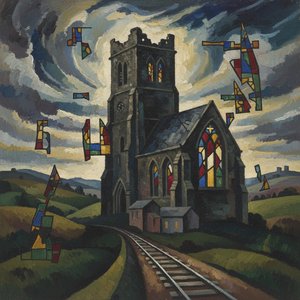
John Piper: A Spiritual Vision of British Landscape & Modernism's Embrace
Explore the captivating world of John Piper, a celebrated British painter whose evocative landscapes & iconic church art captured the spirit of his time. Discover his legacy and find high-quality reproductions at ArtsDot.