 Preview
 Send
Send Share
Share
 Details

 Download
 Similars
 X-Ray
X-Ray Diaporama
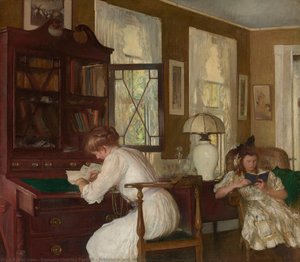
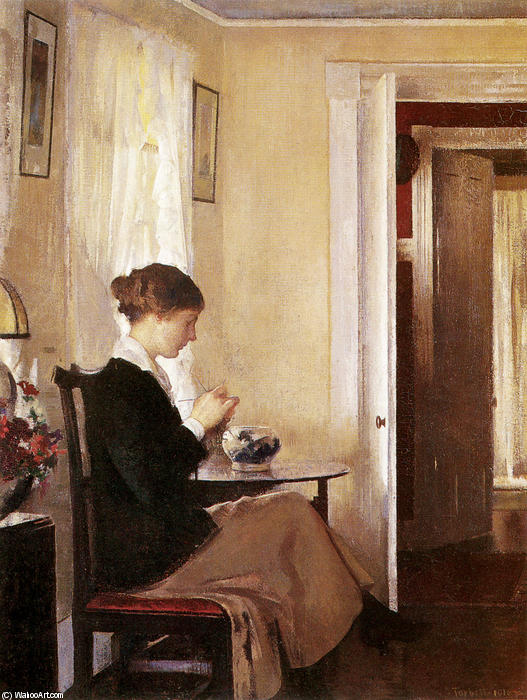
Josephine Knitting
 Oil On Canvas
- WallArt
- Impressionism
 1916
1916- 19th Century
 66.0 x 51.0 cm
 Read More
Hand Made Oil Reproduction
Hand-painted oil on canvas in your size and frame, made to order by our artists. ( Buy Print Buy Image)




P118B $10

P118H $10

P118W $10

P438Z $10

P508JH $12

P508YH $12

P805H $10

P805Z $10

P919BZ $10

P919G $10

P919XJ $10

P959ZH $10

P968JZ $12

W106C $8

W218G $10

W218JH $8

W218Y $10

W307PJ $10

W316G $10

W316PJ $8

W316Y $10

W398PJ $8

W4111J $10

W500HY $15

W500JH $15

W692G $12

W849H $8

W940BG $15

W953PJ $8




Pick from our preset sizes that match the artwork's original proportions.

You may enter your own dimensions to fit a specific frame or space. If your selected size does not match the original image's proportions, we will either crop the artwork or extend the painting with additional hand-painted elements. A digital mockup will be sent for your approval before production begins.
Please note that the on-screen preview does not reflect the actual cropping or extension. Only the mockup will accurately show the final composition.
While custom sizes are available, we recommend selecting a dimension from the predefined list to preserve the original proportions.
After order, ArtsDot.com team will email client for instructions and provide a mockup preview
Worldwide Delivery () in 3/4 weeks instead of standard 5 weeks. (17 August). No compromise on quality.

Free Worldwide Express Shipping

High-Quality Linen Canvas

Full Shipping Insurance

Customs Tax Refund Guarantee

True Color Matching Guarantee

60-Day Return Policy (Defects Only)

100% Money-Back Guarantee

Bulk Discount Offer
 Glass option is only available in size under 110 CM

Josephine Knitting
Reproduction Medium
Reproduction Size
-


Total Price
$ 263
Artwork Description
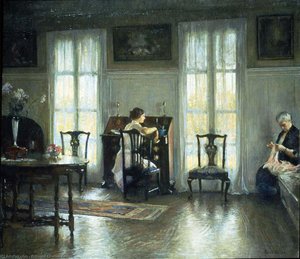
A Moment of Quietude: The Essence of Josephine Knitting
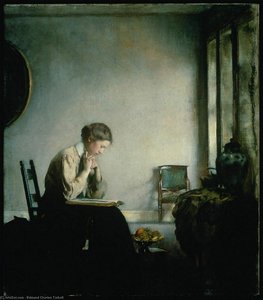
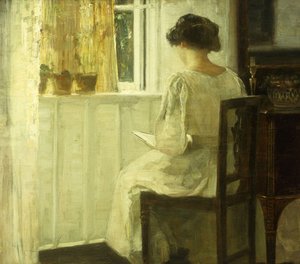
In the soft, amber glow of a quiet afternoon, Edmund Charles Tarbell invites us into a sanctuary of domestic peace. Josephine Knitting is not merely a depiction of a woman engaged in a simple pastime; it is a profound meditation on tranquility and the beauty found within the mundane. Created in 1916, this oil on canvas masterpiece captures a singular, breathless moment where time seems to suspend itself. The subject, Josephine, sits enveloped by the warmth of a dining room, her hands moving with a rhythmic, meditative grace as she works her needles. There is an intimate stillness to the scene, a sense that the world outside has ceased to exist, leaving only the soft click of knitting needles and the gentle play of light upon the surfaces of her home.
The painting serves as a quintessential triumph of American Impressionism. Tarbell, a prominent figure of his era, moves away from the stark realism of previous generations to embrace a style defined by luminosity and atmosphere. His technique is masterful, utilizing soft, feathery brushstrokes that allow light to dance across the canvas. The use of warm, golden tones creates an inviting, cozy atmosphere that wraps around the viewer like a familiar blanket. This mastery of light does more than illuminate the room; it imbues the very air with a sense of nostalgia and comfort, making the domestic space feel both sacred and deeply human.
The Artistry of Light and Domesticity
Beyond the central figure, every element within the composition contributes to the painting's narrative of comfort. The dining table, positioned thoughtfully against the wall, and the delicate vase resting upon it, act as anchors of stability and domestic order. These subtle details suggest a life lived with intention and care. Tarbell’s ability to capture the interplay between shadow and light—the way the sun might filter through a nearby window to touch the edge of a chair or the texture of the knitting wool—demonstrates his profound connection to the Impressionist tradition of capturing fleeting, ephemeral moments.
For the discerning collector or interior designer, Josephine Knitting offers much more than visual appeal; it offers an emotional resonance. The painting possesses a unique ability to transform a space, bringing a sense of calm, sophistication, and timelessness to any room. Whether placed in a sunlit study or a quiet corner of a living area, the work acts as a window into a more serene era. It is an ideal piece for those seeking to infuse their surroundings with the quiet dignity of the American Impressionist movement, providing a focal point that encourages reflection and provides a respite from the frenetic pace of modern life.
Owning a high-quality reproduction of this work allows one to preserve this sense of peace within the home. As an homage to Tarbell's legacy, such a piece serves as a constant reminder of the artistry found in everyday tasks and the enduring power of light to transform the ordinary into the extraordinary.
Related Artworks
Artist Biography
Early Life and Education
- Born: Groton, United States of America (1862)
- Died: 1938
- Edmund Charles Tarbell was born into a family with deep American roots. His father, Edmund Whitney, passed away when Tarbell was young, leaving his mother, Mary Sophia Fernald, to remarry and raise him and his sister in West Groton, Massachusetts.
- His early artistic training began at the Massachusetts Normal Art School.
- He further honed his skills through an apprenticeship at Forbes Lithographic Company in Boston.
- From 1879 to 1880, he studied under Otto Grundmann at the School of the Museum of Fine Arts in Boston, a pivotal period shaping his artistic foundation.
Artistic Career and Style
- Tarbell's career encompassed illustration, private art instruction, and portrait painting. He married Emeline Souther in 1888, who also studied art.
- His style is characterized as American Impressionism, reflecting a focus on capturing fleeting moments of light and atmosphere.
- He was known for his luminous portraits, intimate domestic scenes, and depictions of Colonial Revival interiors.
- Notable works include Self Portrait, Benjamin Rush, and After the Ball.
- In the Orchard (1891) is considered a defining work, showcasing his ability to portray everyday life with sensitivity and skill.
Membership in "Ten American Painters" and Guild of Boston Artists
- Tarbell was a founding member of the influential group known as “Ten American Painters,” formed in 1897. This collective aimed to promote American art and provide an alternative exhibition venue to established institutions.
- The group included prominent artists like John H. White, Joseph Penway Dodge, and others who shared a commitment to portraying contemporary life with realism and Impressionistic techniques.
- In 1914, he co-founded the Guild of Boston Artists and served as its first president until 1924, further demonstrating his dedication to supporting fellow artists and fostering an artistic community.
Major Achievements and Legacy
- Tarbell's works are held in prestigious collections including the Smithsonian American Art Museum, the Corcoran Gallery of Art, the National Academy of Design, and even the White House.
- His ability to capture the essence of domestic life and portray individuals with warmth and authenticity earned him widespread recognition during his lifetime.
- He is remembered as a significant figure in American Impressionism, contributing to the development of a distinctly American artistic voice.
- Tarbell's influence can be seen in subsequent generations of artists who embraced his focus on everyday subjects and his commitment to portraying life with honesty and sensitivity.
Historical Significance
- As a member of "Ten American Painters," Tarbell played a crucial role in challenging the dominance of European artistic styles and promoting a uniquely American aesthetic.
- His work reflects the changing social landscape of late 19th and early 20th century America, capturing the values and aspirations of a burgeoning middle class.
- Tarbell's legacy extends beyond his individual paintings; he helped to establish Boston as a center for artistic innovation and contributed to the growth of American art on a national stage.
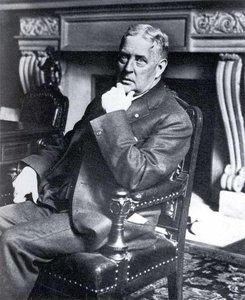
Edmund Charles Tarbell
1862 - 1938 , United States of America
Quick Facts
- Artistic Movement Or Style: American Impressionism
- Date Of Birth: April 26, 1862
- Date Of Death: 1938
- Full Name: Edmund Charles Tarbell
- Nationality: American
- Notable Artworks:
- In the Orchard
- In a Garden
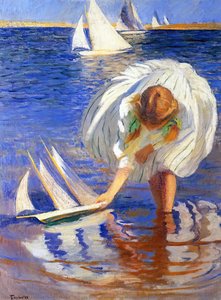
- Girl with Sailboat
- Mercie Cutting Flowers
- Place Of Birth: West Groton, USA
Related Articles
Capturing a Nation's Light: Exploring the American Impressionist Movement
Explore the captivating world of American Impressionism! Discover key artists, techniques & its lasting impact on art history. Find museum-quality reproductions and expert guidance at ArtsDot.
Frederick Childe Hassam: American Impressionism's Chronicler of Light & Modern Life
Explore the captivating world of Frederick Childe Hassam, a pioneer of American Impressionism. Discover his iconic paintings capturing light, urban life & coastal beauty. Learn about his legacy and influence on American art history.

Cézanne's Masterpieces: 25 Iconic Artworks to Transform Your Space
Journey through 25 iconic artworks by Paul Cézanne – a master of Impressionism and Post-Impressionism. Explore his landscapes, still lifes, and the stories behind these timeless masterpieces. Discover museum-quality reproductions & curated decor at ArtsDot.com.

Grant Wood & American Regionalism: Identity, Myth & the Rural Landscape
Explore the world of Grant Wood & American Regionalism with ArtsDot. Discover the symbolism behind 'American Gothic', recurring themes, and the movement's lasting impact on art history. High-quality reproductions available.
Herman Armour Webster: Capturing Atmospheric Light in American Impressionism
Explore the captivating world of Herman Armour Webster, an American Impressionist master. Discover his Parisian influences, unique style, and lasting legacy with ArtsDot.