Preview
 Send
Send Share
Share
 Details

 Download
 Similars
 X-Ray
X-Ray Diaporama
Artists who do books

 Read More
Giclée / Art Print
Museum-quality giclée or canvas print with fast production and flexible finish options. ( Buy Hand Made Painting Buy Image)




































Pick from our preset sizes that match the artwork's original proportions.

You may enter your own dimensions to fit a specific frame or space. If your selected size does not match the original image's proportions, we will either crop the artwork or extend the image with a mirrored or solid-fill edge. A digital mockup will be sent for your approval before production begins.
Please note that the on-screen preview does not reflect the actual cropping or extension. Only the mockup will accurately show the final composition.
While custom sizes are available, we recommend selecting a dimension from the predefined list to preserve the original proportions.
Worldwide Delivery () in 2 weeks instead of standard 4/5 weeks. (17 August)

Free Worldwide Express Shipping

High-Quality Linen Canvas

Full Shipping Insurance

Customs Tax Refund Guarantee

True Color Matching Guarantee

60-Day Return Policy (Defects Only)

100% Money-Back Guarantee

Bulk Discount Offer
 Glass option is only available in size under 110 CM

Artists who do books
Giclée / Art Print
Reproduction Size
-


Total Price
$ 63
Collectible Description
A Minimalist Statement: Edward Ruscha's "Artists Who Do Books"
Edward Ruscha’s “Artists Who Do Books” is a striking example of Conceptual Art and Pop Art sensibilities, offering a deceptively simple yet profoundly layered visual statement. Created in 1970, this artwork transcends traditional artistic representation by focusing solely on language as its primary medium. It's not about depicting a scene or object; it’s about the power and presence of words themselves.
Conceptual Roots & Pop Art Influence
The piece emerged during a pivotal period in art history, when Conceptual Art was challenging established notions of what constituted "art." Artists began prioritizing ideas and concepts over traditional aesthetic concerns. Simultaneously, Ruscha’s work reflects the Pop Art movement's embrace of everyday imagery and mass culture. Ruscha, alongside figures like Andy Warhol and Ed Moses, helped redefine artistic boundaries by incorporating commonplace elements—in this case, a straightforward phrase—into high art.
- Historical Context: The late 1960s and early 1970s saw a shift away from Abstract Expressionism's emotional intensity towards a more detached, intellectual approach to art.
- Pop Art Connection: Ruscha’s use of bold typography and graphic design echoes Pop Art’s fascination with commercial aesthetics and popular culture.
- Conceptual Emphasis: The work prioritizes the *idea*—the relationship between artists and books—over any representational imagery, a hallmark of Conceptualism.
Composition & Technique
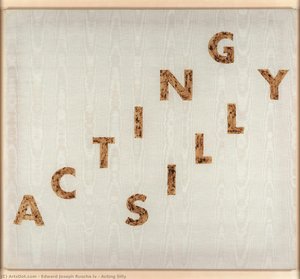
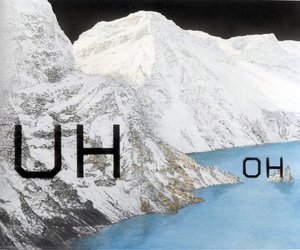
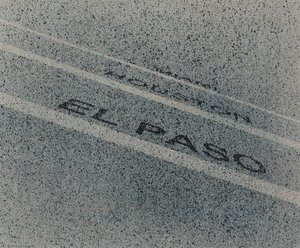
The artwork's visual impact stems from its stark simplicity. “Artists Who Do Books” presents the phrase centered on a dark gray background in three lines of capital letters. The composition is rigorously symmetrical and balanced, creating a sense of order and clarity. Ruscha’s technique likely involved screen printing, a process well-suited to producing clean, graphic images with flat colors. This method aligns with his broader artistic practice, which often incorporates photography, printmaking, and book arts.
- Color Palette: The limited palette of grays emphasizes the text itself, preventing visual distractions.
- Typography: The use of a clean, sans-serif typeface contributes to the work’s modern and impersonal feel.
- Screen Printing: This technique allows for precise application of ink, resulting in sharp lines and uniform color coverage.
Emotional Resonance & Symbolic Meaning
Despite its minimalist aesthetic, “Artists Who Do Books” evokes a quiet contemplation and intellectual engagement. The work’s simplicity can be interpreted as a rejection of traditional artistic conventions, emphasizing language and concept over visual representation. It prompts viewers to consider the role of books in artistic creation—a reflection on the intersection of art, literature, and creative process. The phrase itself is open-ended, inviting interpretation about the diverse ways artists engage with books, whether through illustration, design, or simply as a source of inspiration.
This piece isn't merely a visual statement; it’s an invitation to reflect on the nature of art and its relationship to language. It is a testament to Ruscha's ability to transform ordinary elements into profound artistic statements.

Artist Biography
Edward Joseph Ruscha IV: A Pioneer of Pop Art
Early Life and Education
- Born on December 16, 1937, in Omaha, Nebraska, Edward Joseph Ruscha IV grew up in a Roman Catholic family.
- He showed an early interest in art, particularly cartooning, nurtured by his mother’s support.
- Ruscha moved to Los Angeles in 1956 and studied at the Chouinard Art Institute (now CalArts) from 1956-1960 under Robert Irwin and Emerson Woelffer.
- During his time at Chouinard, he co-edited the journal *Orb*, a precursor to alternative newspapers.
Artistic Development and Influences
- Ruscha’s artistic journey began in the early 1960s, aligning him with the Ferus Gallery group in Los Angeles.
- He was influenced by a diverse range of artists including Jasper Johns, John McLaughlin, H.C. Westermann, Arthur Dove, Alvin Lustig, and Marcel Duchamp.
- The work of Edward Hopper, particularly his painting *Gas* (1940), also resonated with Ruscha’s developing style.
- His early works explored the visual language of commercialism and everyday American life.
Key Themes and Style
- Ruscha is renowned for his incorporation of text and phrases into paintings, often presented in a flat, deadpan aesthetic.
- He frequently depicted commonplace subjects like gas stations, motels, and landscapes of Southern California.
- His photographic books, such as Every Building on the Sunset Strip (1966), are iconic examples of his conceptual approach to art.
- A key theme in Ruscha’s work is the exploration of vernacular language and the visual culture of Los Angeles.
Major Achievements and Notable Works
- Some of his most celebrated works include:
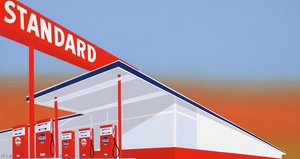
- Standard Station (1966): A quintessential representation of American roadside architecture.
- Large Trademark (1962): An early example of his word-based paintings.
- Hollywood (1982): Reflecting the iconic imagery of Los Angeles.
- Every Building on the Sunset Strip (1966): A groundbreaking photographic book documenting a stretch of Sunset Boulevard.
- Ruscha’s work challenged traditional notions of painting and photography, blurring the boundaries between art forms.
Historical Significance and Legacy
- Ruscha is considered a pivotal figure in the Pop Art movement, though his style often transcends easy categorization.
- His influence extends to contemporary artists working with language, photography, and conceptual art.
- He helped establish Los Angeles as a significant center for artistic innovation during the 1960s.
- Ruscha continues to live and work in Culver City, California, remaining an active and influential force in the art world.

edward joseph ruscha iv
1937 - , United States of America
Quick Facts
- Birth Date: December 16, 1937
- Birth Place: Omaha, Nebraska, United States
- Influenced By:
- Jasper Johns
- John McLaughlin
- H.C. Westermann
- Arthur Dove
- Alvin Lustig
- Marcel Duchamp
- Edward Hopper
- Movement: Pop Art
- Name: Edward Joseph Ruscha IV
- Nationality: American
- Notable Works:
- Standard Station (1966)
- Large Trademark (1962)
- Hollywood (1982)
- Every Building on the Sunset Strip (1966)
Related Articles
Embodied Ideologies: Conceptual Custom Art & the Power of Personal Narratives
Explore the power of conceptual custom art. Discover how hand-painted oil paintings embody personal & political narratives. Expert guidance for collectors seeking meaningful, impactful artwork.
Pop Art 2.0: Recontextualizing Appropriation & Consumerism for a Digital Native Generation
Explore the evolution of Pop Art for today's digital world! Discover how appropriation & consumerism are reimagined by a new generation of artists. Expert insights & collecting tips.
Pavlo Makov: Deconstructing Soviet Legacy Through Conceptual Photography & Installation Art
Explore the compelling work of Ukrainian artist Pavlo Makov, renowned for his conceptual photography deconstructing Soviet legacy. Discover his unique artistic process and investment potential.
Pop Art Icons: 10 Masterpieces That Revolutionized Modern Decor |
Explore 10 defining Pop Art masterpieces – from Warhol’s iconic Marilyn to Lichtenstein's bold dots. Discover the stories behind these revolutionary artworks & find museum-quality reproductions for your home at .
Beyond Ephemeral Trends: Cultivating Enduring Interior Aesthetics Through Renaissance Reverie, Impressionist Light, and Pop Art Vibrancy
Discover enduring interior aesthetics inspired by Renaissance artistry, Impressionist light & Pop Art vibrancy. Expert guidance for creating timeless, luxury homes. Explore art curation & design principles.