 Send
Send Share
Share
 Details

 Download
 Similars
 Diaporama
 Stats
Stats# 99 (Materialização de um quadrado imaginário)
 Digital Photography
- Photo
- Conceptual Photography
 1974
1974- Modern
 20.0 x 28.0 cm
 Serralves Foundation
 Read More
Giclée / Art Print
Museum-quality giclée or canvas print with fast production and flexible finish options. ( Buy Hand Made Painting Switch to Digital Image)




































Pick from our preset sizes that match the artwork's original proportions.

You may enter your own dimensions to fit a specific frame or space. If your selected size does not match the original image's proportions, we will either crop the artwork or extend the image with a mirrored or solid-fill edge. A digital mockup will be sent for your approval before production begins.
Please note that the on-screen preview does not reflect the actual cropping or extension. Only the mockup will accurately show the final composition.
While custom sizes are available, we recommend selecting a dimension from the predefined list to preserve the original proportions.
Worldwide Delivery () in 2 weeks instead of standard 4/5 weeks. (7 September)

Free Worldwide Express Shipping

High-Quality Linen Canvas

Full Shipping Insurance

Customs Tax Refund Guarantee

True Color Matching Guarantee

100-Day Return Policy (Defects Only)

100% Money-Back Guarantee

Bulk Discount Offer
 Glass option is only available in size under 110 CM

# 99 (Materialização de um quadrado imaginário)
Giclée / Art Print
Reproduction Size
-


Total Price
$ 63
# 99 (Materialização de um quadrado imaginário) – A Study in Isolation and Shadow
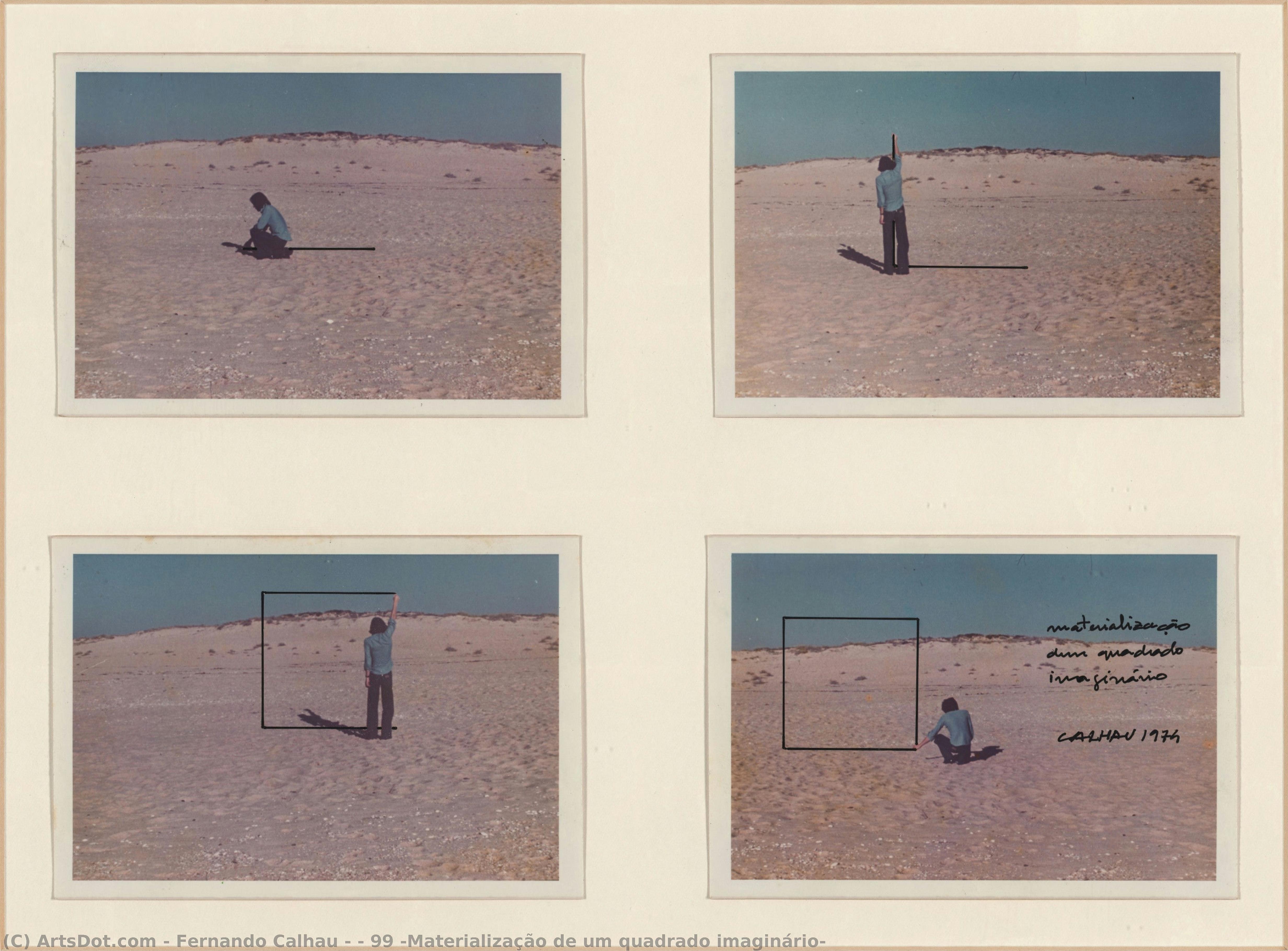
Fernando Calhau’s “# 99 (Materialização de um quadrado imaginário)” is more than just a photograph; it's an evocative meditation on the human condition, rendered with a stark beauty that speaks to themes of isolation, contemplation, and the profound impact of light. Created in 1974, this monochromatic work, measuring 20 x 28 cm, immediately draws the viewer into its unsettling yet compelling world – a grid of four figures standing on a sandy beach, each lost in their own silent drama.
- Conceptual Roots: The photograph’s conceptual nature is evident from the outset. Calhau wasn't interested in simply documenting a coastal scene; he was exploring fundamental questions about form, space, and the psychological effects of environment. The handwritten note – “materialização de um quadrado imaginário” (the materialization of an imaginary square) – hints at a deliberate attempt to construct a visual paradox, inviting viewers to consider the relationship between perception and reality.
- Technical Mastery: Executed with photographic film and paper, the piece reveals Calhau’s meticulous technique. The composite effect, achieved through multiple exposures or digital manipulation (likely both), adds layers of complexity and surrealism. This deliberate distortion elevates the image beyond a straightforward representation, transforming it into a carefully constructed illusion.
Composition and Visual Language
The photograph’s composition is strikingly symmetrical within each panel, creating a sense of order that subtly contrasts with the figures' solitary states. The grid layout itself reinforces this duality – a structured framework containing individual moments of quietude. Strong linear elements define the silhouettes of the figures and their shadows, while geometric shapes—primarily squares formed by the dramatic interplay of light and shadow—dominate the visual field. Calhau masterfully utilizes natural daylight, creating powerful contrasts that emphasize the forms and contribute to the overall sense of unease.
- Perspective & Depth: The relatively flat perspective emphasizes the two-dimensional nature of the panels, further contributing to the photograph’s surreal quality. Limited depth is achieved through blurring in the background, directing the viewer's attention squarely onto the figures and their shadows.
- Texture: The rough texture of the sand adds a tactile element to the image, grounding the ethereal subject matter in a tangible reality.
Symbolism and Emotional Resonance
The solitary figures, positioned at varying distances from the camera, evoke feelings of isolation and contemplation. Their poses – seated, standing with arms outstretched, and mirroring each other – suggest a shared experience of stillness and introspection. The shadows cast by the figures are particularly significant, acting as visual metaphors for concealment or perhaps even the subconscious mind. Calhau’s work taps into universal human emotions—loneliness, vulnerability, and the search for meaning—making it profoundly resonant despite its seemingly simple subject matter.
- Historical Context: Created in 1974, a period of significant social and political change in Portugal, “# 99” can be interpreted through the lens of this era. The themes of isolation and contemplation may reflect a broader sense of uncertainty and questioning prevalent at the time.
- Style & Influences: Calhau’s style aligns with both conceptual photography and surrealism, drawing inspiration from artists who explored the relationship between reality and illusion, such as Giorgio de Chirico.
Collecting and Displaying
"# 99 (Materialização de um quadrado imaginário)" is a compelling addition to any art collection, offering a unique blend of technical skill, conceptual depth, and emotional resonance. Its monochromatic palette and evocative imagery make it particularly well-suited for contemporary interiors, where it can serve as a focal point or contribute to a sense of contemplative calm. ArtsDot offers meticulously crafted hand-painted reproductions that faithfully capture the essence of this remarkable work by Fernando Calhau, ensuring its timeless beauty will be enjoyed for generations to come.
Related Artworks

Artist Biography
Fernando Calhau: A Monochromatic Explorer of the Human Condition
Born in Lisbon, Portugal, in 1948, Fernando Calhau’s artistic journey was one defined by relentless experimentation and a profound engagement with form and space. His life, tragically cut short in 2002, left behind a body of work that continues to intrigue and challenge viewers with its stark beauty and subtle emotional depth. Calhau wasn't merely an artist; he was a meticulous investigator of the visual language, pushing the boundaries of traditional mediums while retaining a deep respect for their inherent qualities.
Calhau’s formal training laid the groundwork for his distinctive style. He began his artistic education at the Escola Superior de Belas Artes de Lisboa (ESBAL), graduating in 1973. This foundational period instilled within him a rigorous approach to technique and an appreciation for the historical lineage of Portuguese art. Crucially, he then secured a scholarship from the Calouste Gulbenkian Foundation, allowing him to pursue his studies at the Slade School of Fine Art in London. It was here, under the guidance of Bartolomeu Cid dos Santos, that he honed his skills in engraving, mastering the intricate process of creating images through meticulous cuts and textures.
A Diverse Practice, A Singular Vision
Calhau’s artistic output spanned a remarkably broad range of media – drawing, engraving, painting, sculpture, photography, and film. This wasn't simply a matter of dabbling in various disciplines; it represented a deeply considered approach to exploring the possibilities of visual communication. He didn’t confine himself to a single style or technique, instead embracing a dynamic interplay between tradition and innovation. His work is characterized by a deliberate minimalism, often employing monochrome palettes – shades of grey, white, and black – that amplify the impact of form and line. This restrained aesthetic wasn't born from a lack of color, but rather a conscious decision to strip away extraneous elements and focus on the essential qualities of his subjects.
Influences on Calhau’s work are readily apparent, particularly in the echoes of Amadeo de Souza Cardoso, known for his evocative watercolor paintings, and Adriano de Sousa Lopes, whose etchings captured the essence of Portuguese landscapes. However, Calhau forged his own unique path, moving beyond mere imitation to synthesize these influences into a distinctly personal vision. His art is not about replicating reality; it’s about distilling it – reducing complex scenes and figures to their most fundamental components.
The Slade Years and Beyond
Calouste Gulbenkian Foundation's scholarship proved pivotal, providing him with the resources and intellectual environment necessary for significant artistic growth. The Slade School of Fine Art offered a rigorous curriculum that emphasized conceptual thinking alongside technical proficiency. During his time there, Calhau began to develop his signature style – characterized by geometric precision, stark contrasts, and an almost meditative quality. He explored themes of isolation, memory, and the human condition through carefully constructed compositions that invited contemplation.
Following his studies in London, Calhau continued to exhibit his work throughout Europe, gaining recognition for his innovative approach to engraving and painting. His pieces are now held in prestigious collections such as the Centro de Arte Moderna Gulbenkian in Lisbon, a testament to the enduring value of his artistic contributions.
Key Works and Legacy
One particularly compelling example of Calhau’s work is "#99 (Materialização de um quadrado imaginário)" – a surreal composite photograph that masterfully explores themes of isolation and shadow through a grid of figures on a beach. This piece, created in 1974, exemplifies his ability to imbue seemingly simple forms with profound emotional resonance. His exploration of the written word, introduced in the 1980s, further solidified his position as an artist deeply engaged with the complexities of language and meaning.
Fernando Calhau’s legacy extends beyond his individual artworks. He was a pioneer in Portuguese art, demonstrating a willingness to challenge conventions and embrace new approaches. His experimentation with diverse mediums and techniques paved the way for future generations of artists to explore the limitless possibilities of visual expression. His work continues to inspire, reminding us that even within the confines of minimalism, there is room for profound depth and emotional impact.

Fernando Calhau
1948 - 2002 , Portugal
Quick Facts
- Artistic Movement Or Style: Diverse media
- Artists Or Movements Influenced By This Artist: ['Minimalism']
- Artists Who Influenced This Artist:
- Cardoso
- Lopes
- Date Of Birth: 1948
- Date Of Death: 2002
- Full Name: Fernando Calhau
- Nationality: Portuguese
- Notable Artworks: ['#99 (Materialização de um quadrado imaginário)']
- Place Of Birth: Lisbon, Portugal
Related Articles
Beyond the Lens: Photography's Enduring Influence on Modern & Contemporary Art
Explore photography's pivotal role in shaping modern & contemporary art. Discover key movements, influential artists like Stieglitz, and expert collecting advice from ArtsDot.
Witnessing History Through Lens & Light: Documentary Photography's Enduring Legacy
Explore the powerful history of documentary photography – from its origins to contemporary masters like Gordon Parks & W. Eugene Smith. Discover how this art form shapes our understanding of society and witness pivotal moments in time.

Monochrome Visions: Exploring the Aesthetic & Historical Significance of Black & White Photography
Explore the rich history & artistic power of black and white photography. From early techniques to iconic masters like Ansel Adams, discover why monochrome continues to captivate art lovers today. Expert insights for collectors.
Documentary Photography's Defining Moments: 10 Masterpieces for Your Home |
Explore 10 defining documentary photography masterpieces – from Dorothea Lange to Robert Capa. Discover powerful stories, iconic images & timeless art for your home. Museum-quality prints at .

Pictorialism: A Search for Artistic Photography's Soul – Aesthetics, Techniques & Legacy
Explore the captivating world of Pictorialism – a pivotal movement that transformed photography into fine art. Discover key artists like Stieglitz & Käsebier, techniques, and collecting tips from experts.