 Preview
 Send
Send Share
Share
 Details

 Download
 Similars
 X-Ray
X-Ray Diaporama
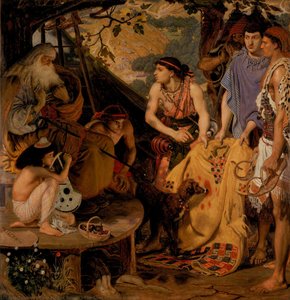
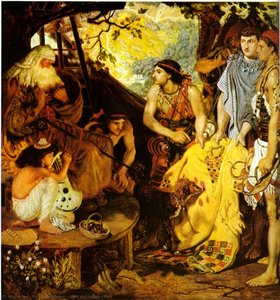
The Coat of Many Colours
 Oil On Canvas
- WallArt
- Pre-Raphaelite Brotherhood
 1866
1866- 19th Century
 1032.0 x 1075.0 cm
 Walker Art Gallery
 Read More
Hand Made Oil Reproduction
Hand-painted oil on canvas in your size and frame, made to order by our artists. ( Buy Print Buy Image)




P118B $10

P118H $10

P118W $10

P438Z $10

P508JH $12

P508YH $12

P805H $10

P805Z $10

P919BZ $10

P919G $10

P919XJ $10

P959ZH $10

P968JZ $12

W106C $8

W218G $10

W218JH $8

W218Y $10

W307PJ $10

W316G $10

W316PJ $8

W316Y $10

W398PJ $8

W4111J $10

W500HY $15

W500JH $15

W692G $12

W849H $8

W940BG $15

W953PJ $8




Pick from our preset sizes that match the artwork's original proportions.

You may enter your own dimensions to fit a specific frame or space. If your selected size does not match the original image's proportions, we will either crop the artwork or extend the painting with additional hand-painted elements. A digital mockup will be sent for your approval before production begins.
Please note that the on-screen preview does not reflect the actual cropping or extension. Only the mockup will accurately show the final composition.
While custom sizes are available, we recommend selecting a dimension from the predefined list to preserve the original proportions.
After order, ArtsDot.com team will email client for instructions and provide a mockup preview
Worldwide Delivery () in 3/4 weeks instead of standard 5 weeks. (16 August). No compromise on quality.

Free Worldwide Express Shipping

High-Quality Linen Canvas

Full Shipping Insurance

Customs Tax Refund Guarantee

True Color Matching Guarantee

60-Day Return Policy (Defects Only)

100% Money-Back Guarantee

Bulk Discount Offer
 Glass option is only available in size under 110 CM

The Coat of Many Colours
Reproduction Medium
Reproduction Size
-


Total Price
$ 263
Artwork Description
A Tapestry of Betrayal and Devotion
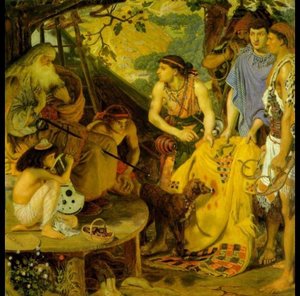
In the grand, sweeping expanse of Ford Madox Brown’s 1866 masterpiece, "The Coat of Many Colours," we are not merely observing a biblical scene; we are witnessing a profound psychological drama frozen in time. This monumental canvas, which commands attention with its staggering scale, captures the harrowing moment from the Book of Genesis when Joseph’s brothers, consumed by a toxic blend of jealousy and resentment, orchestrate his sale into slavery. The painting serves as a window into a world where familial bonds are tested by the weight of favoritism and greed. As the eye wanders across the crowded composition, one feels the palpable tension vibrating between the figures—the heavy silence of the patriarch Jacob, the simmering malice of the brothers, and the innocent vulnerability of the young Joseph. It is a work that transcends its religious origins to touch upon the universal human experience of betrayal.
The technical brilliance of Brown lies in his ability to marry the rigorous precision of academic training with an almost proto-impressionistic vitality. While the composition is structured with the careful deliberation of a classical master, the surface of the painting breathes with life. Brown eschews the sterile, glass-like finishes common in much Victorian art, opting instead for visible, textured brushstrokes that imbue the scene with movement and tactile reality. One can almost feel the heavy weight of the patterned blanket draped across the table and the intricate, multi-hued threads of the titular coat. This deliberate use of texture creates a sensory experience, where light does not simply illuminate the subjects but dances across the folds of fabric and the weathered skin of the characters, heightening the emotional stakes of the narrative.
Symbolism and the Victorian Soul
Beyond its narrative surface, "The Coat of Many Colours" is rich with symbolic depth that would have resonated powerfully with a 19th-century audience. During an era preoccupied with moral rectitude and the sanctity of the family unit, Brown’s depiction of fractured loyalty acted as a mirror to contemporary social anxieties. The vibrant, variegated colors of Joseph's garment serve as a poignant symbol of his father's preferential love—a visual manifestation of the very catalyst for his brothers' descent into cruelty. Every element, from the presence of the dog that adds a touch of domestic realism to the somber shadows pooling in the corners of the gathering, contributes to an atmosphere of impending loss and moral consequence.
For the discerning collector or interior designer, this painting offers more than just aesthetic grandeur; it provides a focal point of profound intellectual and emotional depth. A high-quality reproduction of this work brings into a space a sense of historical gravity and narrative complexity. Whether placed in a formal study, a grand gallery, or a sophisticated living area, the painting invites contemplation and serves as a conversation piece that bridges the gap between ancient scripture and modern emotion. It is an invitation to dwell on the complexities of human nature, making it an incomparable addition to any collection dedicated to the enduring power of storytelling through art.
Related Artworks
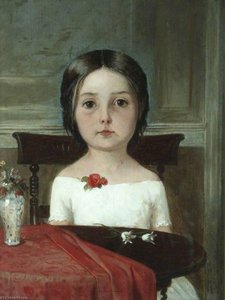
Artist Biography
A Life Painted in Moral and Historical Light
Ford Madox Brown, born on April 16, 1821, in Calais, France, was a figure perpetually navigating the currents of artistic change during the Victorian era. His early life was one of transience, dictated by his parents’ search for affordable living—a shifting existence between the French coast and relatives in Kent. This nomadic upbringing, while limiting formal education, fostered an observant eye and a burgeoning talent for replicating Old Master prints, laying the foundation for his future artistic endeavors. The seeds of Brown's unique style were sown not within grand academies but in the quiet practice of copying, absorbing the techniques and compositions of past masters. His father’s initial aspirations for a naval career for young Ford were ultimately superseded by the undeniable pull of art, leading to studies in Bruges, Ghent, and Antwerp under notable artists like Albert Gregorius and Pieter van Hanselaere. These formative years instilled within him a rigorous technical foundation, yet Brown would soon forge his own path, diverging from conventional artistic norms. The early loss of family members – his mother in 1839, followed by his sister and father in the following years – cast a shadow over his personal life, perhaps contributing to the often-somber and reflective quality found within his work.The Pre-Raphaelite Affinity and Artistic Innovation
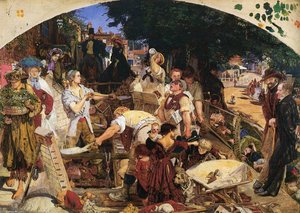
Though never formally a member of the Pre-Raphaelite Brotherhood, Ford Madox Brown exerted a significant influence on its development and shared many of its core tenets. He was an advisor and friend to the group’s founding members—Rossetti, Millais, and Hunt—and his commitment to truthfulness in representation, meticulous detail, and vibrant color resonated deeply with their artistic philosophies. However, Brown's style possessed a distinct character that set him apart. While the Pre-Raphaelites often focused on romanticized narratives or literary subjects, Brown frequently turned to contemporary life and moral themes, imbuing his paintings with a social consciousness rarely seen in Victorian art. Work, begun in 1852 and painstakingly completed over thirteen years, stands as perhaps his most ambitious and iconic achievement. This sprawling canvas is not merely a depiction of laborers; it’s a profound commentary on the social conditions of the working class, capturing their toil, dignity, and vulnerability with unflinching realism. The painting's graphic quality, often described as Hogarthian in its narrative detail, further distinguishes Brown’s approach. His commitment to depicting modern life extended beyond Work, manifesting in other significant pieces that explored themes of poverty, faith, and the human condition. The Last of England, for example, captures a poignant moment of emigration, reflecting anxieties about national identity during a period of social upheaval.Murals, Masterpieces, and a Lasting Legacy
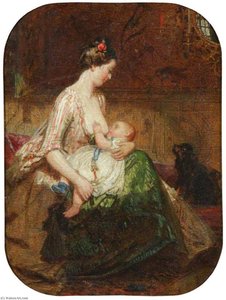
Beyond his easel paintings, Ford Madox Brown’s artistic legacy is indelibly linked to the Manchester Murals. Commissioned for Manchester Town Hall, these twelve monumental works chronicle the city's history, from its Roman origins to its industrial present. The murals are a testament to Brown’s skill as a narrative painter and his ability to synthesize historical research with artistic vision. They represent some of the finest examples of Pre-Raphaelite mural painting, showcasing vibrant colors, meticulous detail, and a compelling sense of drama. These works were not without their challenges; Brown faced financial difficulties and logistical hurdles during their creation, yet he persevered, leaving behind a lasting monument to Mancunian history and artistic innovation. His influence extended beyond his immediate circle, inspiring artists like Thomas Benjamin Kennington, whose work The Pinch of Poverty echoes the social realism found in Brown’s paintings. His dedication to capturing the essence of modern life is also evident in pieces such as Study for the Head of Chaucer, a poignant portrait showcasing realistic detail and melancholic mood.Personal Life and Enduring Influence
Ford Madox Brown's personal life was marked by both joy and sorrow. He married twice—first to Elizabeth Bromley in 1841, who tragically died five years later, and then to Emily Hill in 1853. He fathered five children, including Lucy Madox Brown, herself a talented artist, and Catherine Madox Brown, who also pursued a creative path. These familial connections further enriched his life and provided inspiration for some of his work. Despite facing financial struggles throughout much of his career, Brown remained dedicated to his art, continually experimenting with new techniques and exploring challenging themes. His commitment to artistic integrity and social commentary cemented his place as a pioneer of the Pre-Raphaelite movement and a significant figure in 19th-century British art. He passed away on October 6, 1893, leaving behind a body of work that stands as a testament to his artistic vision and unwavering commitment to truth and beauty.Exploring Ford Madox Brown’s World Today
Numerous resources offer opportunities to delve deeper into the world of Ford Madox Brown. His works can be found in prominent collections such as the Manchester Art Gallery and the Lady Lever Art Gallery, offering visitors a chance to experience his masterpieces firsthand. Online platforms provide high-quality hand-painted reproductions, allowing art enthusiasts to bring his vision into their own homes. Further research can be conducted through resources like Wikipedia and Britannica, which offer comprehensive biographical information and critical analyses of his work.- Key Themes: Social realism, moral commentary, historical narrative, Victorian life.
- Influences: Old Masters, Nazarenes, William Hogarth, Thomas Carlyle.
- Major Works: Work, The Last of England, Manchester Murals, Study for the Head of Chaucer.
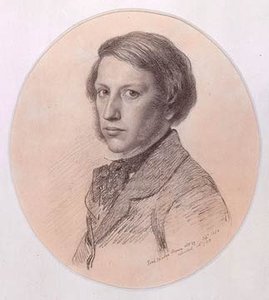
Ford Madox Brown
1821 - 1893 , France
Quick Facts
- Artistic Movement Or Style: Pre-Raphaelite
- Artists Or Movements Influenced By This Artist:
- Pre-Raphaelite Brotherhood
- Thomas Kennington
- Artists Who Influenced This Artist:
- Albert Gregorius
- Pieter van Hanselaere
- Date Of Birth: April 16, 1821
- Date Of Death: October 6, 1893
- Full Name: Ford Madox Brown
- Nationality: British
- Notable Artworks:
- Work
- The Last of England
- Manchester Murals
- Place Of Birth: Calais, France
Related Articles
Ford Madox Brown: Pre-Raphaelite Visionary & Victorian Social Commentary
Explore the life & art of Ford Madox Brown, a pivotal Pre-Raphaelite painter renowned for his powerful social commentary and masterpiece 'Work'. Discover his lasting influence on British art history.
Dante Gabriel Rossetti's 25 Masterpieces: A Journey Through Victorian Art & Symbolism | ArtsDot
Explore 25 iconic artworks by Dante Gabriel Rossetti, a leading Pre-Raphaelite artist. Discover the stories behind masterpieces like 'Proserpine' & 'Beata Beatrix'. Find museum-quality art reproductions and elevate your home decor with ArtsDot.com.
Sir John Everett Millais: Pre-Raphaelite Rebellion & Victorian Narrative Detail
Explore the revolutionary art of Sir John Everett Millais & the Pre-Raphaelite Brotherhood. Discover their radical realism, symbolic narratives, and lasting impact on Victorian aesthetics. A deep dive into 19th-century masterpieces.
Arthur Hughes: Pre-Raphaelite Visions of Beauty & Melancholy
Explore the captivating world of Arthur Hughes (1832-1915), a leading Pre-Raphaelite painter. Discover his dreamy landscapes, poetic narratives & iconic Victorian artworks. Learn about his life, style & collecting today.

The Pre-Raphaelite Brotherhood: Rebellion, Romance & Medieval Revival
Explore the captivating world of the Pre-Raphaelite Brotherhood! Discover their rebellious spirit, iconic masterpieces & lasting influence on art history. Learn about Rossetti, Millais & more.