 Preview
 Send
Send Share
Share
 Details

 Download
 Similars
 X-Ray
X-Ray Diaporama
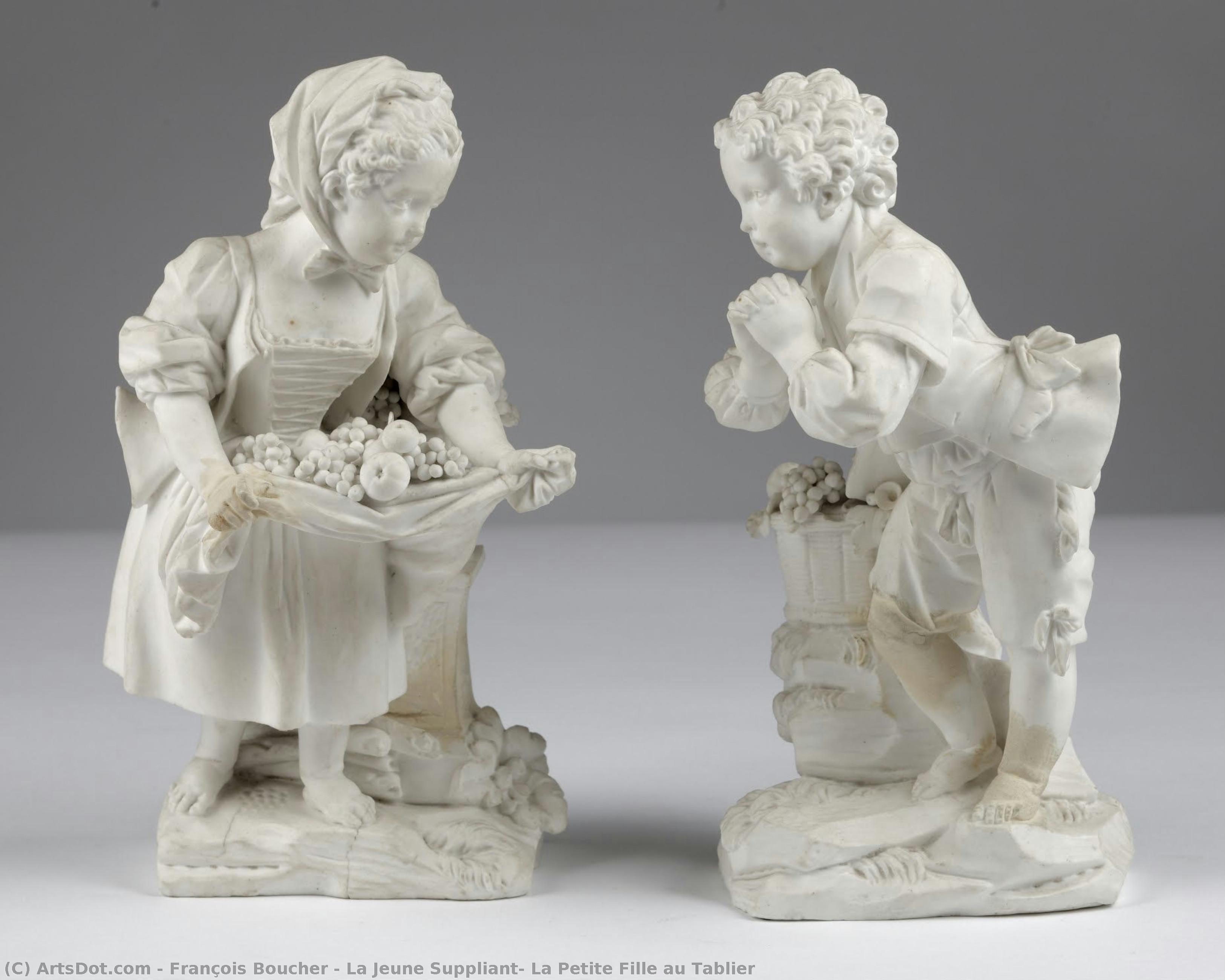
La Jeune Suppliant; La Petite Fille au Tablier


 Read More
Hand Made Oil Reproduction
Hand-painted oil on canvas in your size and frame, made to order by our artists. ( Buy Print Buy Image)




P118B $10

P118H $10

P118W $10

P438Z $10

P508JH $12

P508YH $12

P805H $10

P805Z $10

P919BZ $10

P919G $10

P919XJ $10

P959ZH $10

P968JZ $12

W106C $8

W218G $10

W218JH $8

W218Y $10

W307PJ $10

W316G $10

W316PJ $8

W316Y $10

W398PJ $8

W4111J $10

W500HY $15

W500JH $15

W692G $12

W849H $8

W940BG $15

W953PJ $8




Pick from our preset sizes that match the artwork's original proportions.

You may enter your own dimensions to fit a specific frame or space. If your selected size does not match the original image's proportions, we will either crop the artwork or extend the painting with additional hand-painted elements. A digital mockup will be sent for your approval before production begins.
Please note that the on-screen preview does not reflect the actual cropping or extension. Only the mockup will accurately show the final composition.
While custom sizes are available, we recommend selecting a dimension from the predefined list to preserve the original proportions.
After order, ArtsDot.com team will email client for instructions and provide a mockup preview
Worldwide Delivery () in 3/4 weeks instead of standard 5 weeks. (31 August). No compromise on quality.

Free Worldwide Express Shipping

High-Quality Linen Canvas

Full Shipping Insurance

Customs Tax Refund Guarantee

True Color Matching Guarantee

60-Day Return Policy (Defects Only)

100% Money-Back Guarantee

Bulk Discount Offer
 Glass option is only available in size under 110 CM

La Jeune Suppliant; La Petite Fille au Tablier
Reproduction Medium
Reproduction Size
-


Total Price
$ 288
A Glimpse of Grace: La Jeune Suppliant by François Boucher
François Boucher’s “La Jeune Suppliant; La Petite Fille au Tablier” – a pair of exquisite bisque porcelain figurines crafted around 1752 – offers a captivating window into the opulent world of Rococo France. More than mere decorative objects, these diminutive figures embody the era's fascination with elegance, sentimentality, and the delicate interplay between innocence and aspiration. Modeled after designs by the celebrated Boucher himself and brought to life by the skilled hands of Pierre Blondeau at the Sèvres porcelain factory, they represent a pivotal moment in ceramic artistry – the adoption of “biscuit ware,” a technique that mimicked the appearance of marble with remarkable realism.
The scene unfolds with quiet intimacy. A young girl, her face tilted upward in a gesture of hopeful supplication, extends her hands towards an unseen benefactor. Her simple muslin dress and modest attire contrast subtly with the overflowing basket of fruit she carries – a symbol of abundance and prosperity, yet rendered with a delicate restraint that speaks to the era’s emphasis on understated luxury. Beside her stands another young woman, equally poised and graceful, seemingly offering a silent acknowledgment of the scene's poignant beauty. The figures are positioned within a softly lit interior, suggesting a private moment of contemplation or perhaps a plea for assistance – details that invite viewers to project their own emotions and interpretations onto this timeless tableau.
The Art of Biscuit Ware: A Revolutionary Technique
What truly distinguishes “La Jeune Suppliant” is the innovative use of biscuit ware, a technique pioneered by the Sèvres porcelain factory. Unlike traditional glazed porcelain, biscuit ware undergoes an initial firing process without any surface coating. This results in a matte, almost velvety texture – a deliberate departure from the glossy sheen favored during earlier periods. The artisans at Sèvres meticulously achieved this effect, striving to replicate the appearance of polished marble, a material highly prized for its beauty and association with nobility. This technique was largely inspired by Madame de Pompadour’s desire to see her unfinished order delivered as it was, showcasing the factory's new capabilities and establishing Sèvres as a leader in European ceramics.
The choice of bisque porcelain itself is significant. It provided a remarkable surface for capturing intricate details – the delicate folds of the girls’ clothing, the subtle contours of their faces, and the vibrant colors of the fruit. The factory's ability to faithfully reproduce Boucher’s original designs, down to the smallest brushstroke, speaks volumes about the skill and precision of its artisans. The figures are a testament to the meticulous craftsmanship that defined Sèvres porcelain during this period.
Rococo Sensibility: Symbolism and Emotional Resonance
“La Jeune Suppliant” is deeply rooted in the principles of Rococo art – an aesthetic characterized by its emphasis on grace, elegance, and a celebration of pleasure. The figures’ serene expressions and poised postures evoke a sense of idealized beauty and gentle charm. The act of supplication, while seemingly simple, carries profound symbolic weight. It speaks to themes of humility, vulnerability, and the enduring human need for connection and assistance.
Furthermore, the inclusion of the fruit basket subtly reinforces the era’s fascination with fertility, prosperity, and the bounty of nature. The scene is not merely a depiction of two young girls; it's an exploration of social dynamics, emotional states, and the values that shaped 18th-century French society. The figures embody a refined sensibility, reflecting the aristocratic tastes of Madame de Pompadour and her circle.
A Legacy in Porcelain: Reproduction and Appreciation
Today, “La Jeune Suppliant” remains one of the most beloved examples of Sèvres porcelain from the Boucher period. Its exquisite detail, innovative technique, and evocative subject matter continue to captivate art enthusiasts and collectors alike. High-quality reproductions offer a remarkable opportunity to experience the beauty and artistry of this iconic piece – allowing us to appreciate Boucher’s genius and the unparalleled skill of the Sèvres artisans in the comfort of our own homes. Whether displayed as a cherished heirloom or incorporated into an elegant interior design scheme, these figurines serve as a timeless reminder of the enduring allure of Rococo art.
Related Artworks

Artist Biography
François Boucher: A Life in Rococo
François Boucher (1703-1770) was a pivotal figure in 18th-century French art, renowned as one of the most celebrated painters of the Rococo era. His work embodies the elegance, sensuality, and playful spirit that defined this influential style.
Early Life and Training
Born on September 29, 1703, in Paris, France, François Boucher’s artistic journey began under the tutelage of his father, Jean Boucher, a painter himself. At the age of seventeen, he caught the eye of François Lemoyne, leading to a brief but impactful apprenticeship. He further honed his skills with engraver Jean-François Cars before achieving a significant milestone: winning the prestigious Grand Prix de Rome in 1720.
Rise to Prominence and Artistic Development
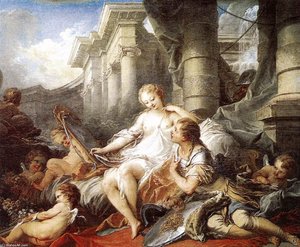
Boucher’s time in Italy, following his win at the Grand Prix, proved formative. Upon returning to France, he was admitted to the Académie Royale de Peinture et de Sculpture in 1731. His *morceau de réception*, “Rinaldo and Armida” (1734), immediately established him as a master of the Rococo style. This period saw his artistic voice fully emerge, characterized by delicate brushwork, pastel palettes, and an emphasis on mythological and pastoral themes.
Key Works and Themes
Boucher’s oeuvre is remarkably diverse, encompassing mythology, portraiture, genre scenes, and decorative arts. Some of his most celebrated works include:
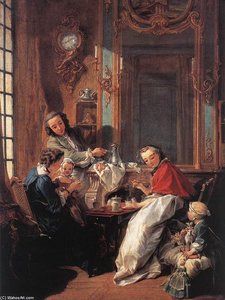
- “The Breakfast” (1739): A charming depiction of domestic life featuring his wife and children.
- “The Triumph of Venus” (1740-1751): A series of paintings showcasing Boucher’s mastery of mythological narratives.
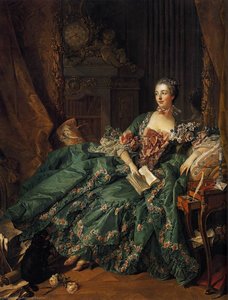
- Numerous portraits of Madame de Pompadour, the influential mistress of King Louis XV, solidifying his position at court.
- Landscape paintings like “The Setting of the Sun”, demonstrating a lyrical and idyllic vision of nature.
Recurring themes in Boucher’s work include love, beauty, leisure, and the idealized world of mythology. His paintings often evoke a sense of playful eroticism and refined elegance.
Influence and Legacy
Boucher's influence extended far beyond painting. He designed costumes and sets for the theater, created tapestries for the Beauvais workshops, and collaborated with the Gobelins Manufactory. His appointment as *Premier Peintre du Roi* in 1765 cemented his status as the leading artist of the French Rococo.
While later critics questioned the perceived superficiality of Rococo art, Boucher’s impact on subsequent generations is undeniable. He influenced artists such as Jean-Honoré Fragonard and contributed significantly to the development of Neoclassicism through his students.
Historical Significance
François Boucher's work provides a valuable window into the tastes and values of 18th-century French society. His paintings reflect the aristocratic culture of the era, characterized by luxury, refinement, and a pursuit of pleasure. He remains a significant figure in art history, celebrated for his technical skill, artistic innovation, and enduring contribution to the Rococo style.

François Boucher
1703 - 1770 , France
Quick Facts
- Birth Date: September 29, 1703
- Birth Place: Paris, France
- Death Date: 1770
- Influenced By: François Lemoyne, Jean-François Cars
- Movement: Rococo
- Name: François Boucher
- Nationality: French
- Notable Works:
- Rinaldo and Armida
- The Breakfast
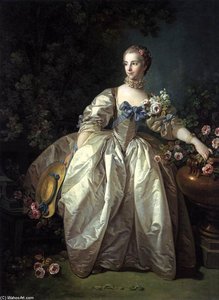
- Madame Boucher
- The Setting of the Sun
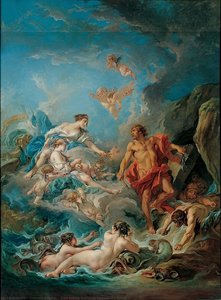
- Vulcan Presenting Venus with Arms for Aeneas
Related Articles

Bronze Sculptures That Defined Art History | ArtsDot
Journey through art history with our Top 10 bronze sculptures! Explore masterpieces by Rodin, Michelangelo & more. Discover stories behind iconic statues and find museum-quality reproductions for your home decor at ArtsDot.com.
François Boucher: Rococo Master of Myth, Sensuality, and the French Court
Explore the captivating world of François Boucher, master of Rococo painting! Discover his iconic works, aristocratic patronage, and lasting influence on French art history. Learn more at ArtsDot.

The Enduring Form: Exploring Themes & Techniques in Sculpture Across Historical Periods
Explore the rich history of sculpture from ancient masterpieces to contemporary innovations. Discover key techniques, influential artists & investment potential for discerning art collectors.

Bronze Age to Modern Masters: 10 Sculptures That Redefined Art | ArtsDot
Journey through art history with 10 legendary bronze sculptures – from Michelangelo's David to Rodin’s Thinker. Explore the stories, techniques & timeless beauty of these masterpieces. Find museum-quality reproductions & elevate your home decor on ArtsDot.com.

The Enduring Form: Sculpture Across History, Technique & Emotional Resonance
Explore the rich history of sculpture with ArtsDot. Discover key techniques, influential artists & investment potential for discerning collectors. Expert insights into valuing and collecting timeless masterpieces.