 Preview
 Send
Send Share
Share
 Details

 Download
 Similars
 X-Ray
X-Ray Diaporama
Karl Friedrich Schinkel
 Drawing
- WallArt
- Neoclassicism, Romanticism
 19th Century
 25.0 x 31.0 cm
 Kupferstichkabinett
 Read More
Hand Made Oil Reproduction
Hand-painted oil on canvas in your size and frame, made to order by our artists. ( Buy Print Buy Image)




P118B $10

P118H $10

P118W $10

P438Z $10

P508JH $12

P508YH $12

P805H $10

P805Z $10

P919BZ $10

P919G $10

P919XJ $10

P959ZH $10

P968JZ $12

W106C $8

W218G $10

W218JH $8

W218Y $10

W307PJ $10

W316G $10

W316PJ $8

W316Y $10

W398PJ $8

W4111J $10

W500HY $15

W500JH $15

W692G $12

W849H $8

W940BG $15

W953PJ $8




Pick from our preset sizes that match the artwork's original proportions.

You may enter your own dimensions to fit a specific frame or space. If your selected size does not match the original image's proportions, we will either crop the artwork or extend the painting with additional hand-painted elements. A digital mockup will be sent for your approval before production begins.
Please note that the on-screen preview does not reflect the actual cropping or extension. Only the mockup will accurately show the final composition.
While custom sizes are available, we recommend selecting a dimension from the predefined list to preserve the original proportions.
After order, ArtsDot.com team will email client for instructions and provide a mockup preview
Worldwide Delivery () in 3/4 weeks instead of standard 5 weeks. (17 August). No compromise on quality.

Free Worldwide Express Shipping

High-Quality Linen Canvas

Full Shipping Insurance

Customs Tax Refund Guarantee

True Color Matching Guarantee

60-Day Return Policy (Defects Only)

100% Money-Back Guarantee

Bulk Discount Offer
 Glass option is only available in size under 110 CM

Karl Friedrich Schinkel
Reproduction Medium
Reproduction Size
-


Total Price
$ 263
Artwork Description
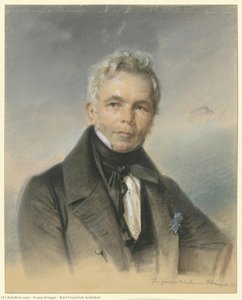
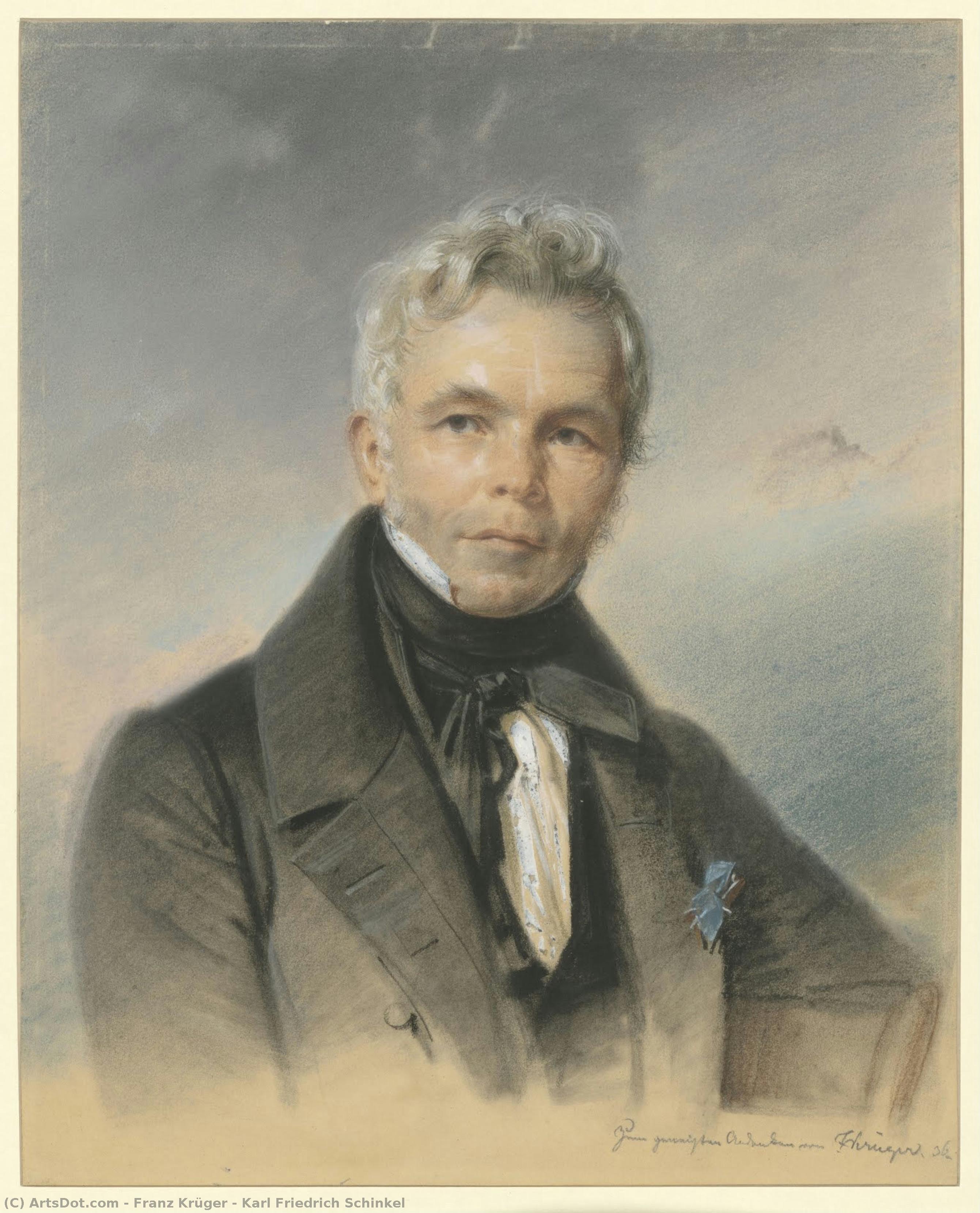
A Glimpse into Prussian Grandeur: Franz Krüger's Portrait of Karl Friedrich Schinkel
This striking black and white drawing offers an intimate portrait of Karl Friedrich Schinkel, the visionary architect and designer who indelibly shaped Berlin’s landscape in the 19th century. Created by the skilled hand of Franz Krüger around 1836, the artwork transcends a simple likeness; it captures the essence of a man whose influence resonated throughout Prussian society and beyond. Measuring 25 x 31 cm, this piece provides a remarkable window into an era defined by Neoclassical ideals, burgeoning industrialization, and the rise of Prussia as a major European power.
The Artist and His Subject: A Meeting of Minds
Franz Krüger (1797-1857), often affectionately known as "Pferde-Krüger" ("Horse-Krüger") due to his celebrated depictions of horses, was a highly sought-after portraitist in Berlin. His ability to capture both the likeness and the character of his subjects made him a favorite among Prussian royalty and the elite. The subject of this drawing, Karl Friedrich Schinkel (1781-1841), stands as one of Germany’s most significant architects. Schinkel's legacy is woven into the fabric of Berlin; from the iconic Altes Museum to the Neue Wache, his designs embody a harmonious blend of classical principles and innovative urban planning. The fact that Krüger was commissioned to portray Schinkel speaks volumes about the esteem in which both men were held within their respective fields.
A Study in Light and Shadow: Technique and Style
The drawing itself is a testament to Krüger’s technical skill. Executed in black and white, the artist masterfully employs shading and line work to create depth and dimension. The meticulous detail evident in Schinkel's facial features—the subtle curve of his lips, the thoughtful gaze of his eyes—reveals a profound understanding of human anatomy and expression. The crisp lines defining his well-tailored suit and neatly tied cravat underscore the formality and dignity associated with Schinkel’s position. The use of light and shadow is particularly noteworthy; it sculpts the face, highlighting key features while subtly obscuring others, creating an air of quiet contemplation. This style aligns with the Romantic movement's emphasis on emotional depth and individual character, though tempered by a Neoclassical sensibility evident in the precise rendering and formal composition.
Beyond Likeness: Symbolism and Historical Context
More than just a portrait, this drawing serves as a visual document of its time. Schinkel’s attire—the suit, tie, and neatly groomed beard—reflects the prevailing fashion and social conventions of 19th-century Prussia. The very act of commissioning such a formal portrait was itself symbolic, signifying status, achievement, and belonging to a privileged class. The historical context is crucial: Prussia was undergoing significant transformation during Schinkel’s lifetime, evolving from a fragmented collection of states into a unified and powerful nation. As its chief architect, Schinkel played a pivotal role in shaping Berlin's identity as the capital of this rising power. Krüger’s portrait captures not only Schinkel’s individual character but also his embodiment of Prussian ambition and cultural refinement.
A Timeless Reflection: The Enduring Appeal
This drawing by Franz Krüger offers a compelling glimpse into the life and times of Karl Friedrich Schinkel, one of Germany's most influential figures. Its technical mastery, historical significance, and subtle emotional depth ensure its enduring appeal to art lovers, collectors, and anyone fascinated by the grandeur of 19th-century Prussia. Owning a reproduction of this artwork is not merely acquiring a decorative piece; it’s possessing a tangible connection to a pivotal moment in European history—a testament to the vision of an architect who shaped a city and the skill of an artist who captured his essence.
Related Artworks
Artist Biography
Joseph Wright of Derby: Illuminating the Industrial Age
Joseph Wright of Derby, a name synonymous with dramatic lighting and scenes of burgeoning industry in 18th-century England, was more than just a painter; he was a visual chronicler of his time. Born in Derby in 1734, Wright’s life unfolded against the backdrop of significant social and economic change – the rise of industrialization, scientific discovery, and shifting societal values. His career, spanning nearly six decades, saw him evolve from a provincial portraitist to one of Britain's most original and influential artists, a position he earned largely through his daring depictions of unconventional subjects and masterful manipulation of light. Wright’s legacy rests not just on the beauty of his paintings but also on their profound insight into a pivotal era in British history.Early Life and Training: A Derby-Bound Artist
Wright's early life remains somewhat shrouded in mystery, though it is known he was apprenticed to a Derbyshire painter named Thomas Hill. This initial training provided him with the fundamentals of portraiture and landscape painting, skills that would later inform his broader artistic ambitions. Crucially, Wright spent time studying under Hudson in London between 1751 and 1753. This period proved formative, exposing him to the prevailing artistic trends of the day – particularly the influence of Dutch masters like Rembrandt and Vermeer – and providing him with experience within the established art world. However, Wright’s heart remained in Derby, a town he considered his true home and the source of much of his inspiration. He returned to Derby after his London training, establishing himself as a respected portraitist amongst the Midlands gentry, producing works that showcased his burgeoning technical skill and ability to capture character with remarkable accuracy.The Rise of the ‘Candlelight’ Style: Innovation and Influence
Wright's artistic breakthrough occurred in the 1760s, marked by a shift towards dramatic scenes illuminated primarily by candlelight. This stylistic choice was revolutionary for its time, moving away from the traditional reliance on natural light and embracing an artificial glow that created a sense of mystery, drama, and intimacy. He drew inspiration from Dutch masters who had pioneered the use of chiaroscuro – the strong contrast between light and dark – but adapted it to his own unique vision. His most celebrated work, *An Experiment on a Bird in the Air Pump* (1768), exemplifies this innovation perfectly. The painting depicts a group of scientists meticulously dissecting a bird within an air pump, bathed in the eerie glow of candlelight. The scene is not merely a scientific observation; it’s a powerful metaphor for the pursuit of knowledge and the potential dangers of unchecked ambition – themes that resonated deeply with contemporary audiences.Connections to the Lunar Society: Painting the Dawn of Scientific Inquiry
Wright's artistic output was inextricably linked to the activities of the Lunar Society, a group of intellectuals, scientists, and industrialists who met regularly in Birmingham and its environs. This society, including figures like Erasmus Darwin (Charles Darwin’s grandfather), Joseph Priestley, and James Watt, represented a burgeoning spirit of scientific inquiry and technological innovation. Wright meticulously documented their meetings and experiments, capturing the atmosphere of intellectual ferment with remarkable sensitivity. Paintings such as *The Alchemist's Boy* (1780) and *Diamond Foundry* (1783) offer glimpses into this world, depicting scenes of chemical experimentation and scientific discovery – often imbued with a sense of both wonder and apprehension. These works are not simply depictions of events; they’re visual narratives that reflect the changing intellectual landscape of Britain.Legacy and Historical Significance
Joseph Wright of Derby died in 1797, leaving behind a body of work that continues to captivate and inspire. He is widely considered the first professional painter to successfully capture the spirit of the Industrial Revolution, not through romanticized depictions of factories and machinery, but by focusing on the human element – the scientists, inventors, and laborers who were shaping a new era in British history. His masterful use of light, his dramatic compositions, and his insightful portrayals of contemporary life have secured his place as one of Britain’s most important artists. His work remains a powerful testament to the transformative power of innovation and the enduring fascination with the mysteries of science and human endeavor. Wright's paintings are now housed primarily in Derby City Council’s collection, ensuring that this remarkable artist continues to be celebrated within his birthplace and beyond.
franz krüger
1797 - 1857 , Germany
Quick Facts
- Artistic Movement Or Style: Romanticism, Neoclassicism
- Artists Or Movements Influenced By This Artist: ['Dutch painting']
- Artists Who Influenced This Artist: ['Hudson']
- Date Of Birth: September 3, 1734
- Date Of Death: August 29, 1797
- Full Name: Joseph Wright of Derby
- Nationality: English
- Notable Artworks:
- An Experiment on a Bird in the Air Pump
- The Slaughtered Lamb
- Place Of Birth: Derby, England
Related Articles

Dark Masterpieces: 10 Iconic Paintings Dominated by Black Tones |
Explore 10 iconic paintings dominated by black tones, from Rembrandt’s chiaroscuro to Goya's dark expressions. Discover the stories behind these masterpieces & find museum-quality art reproductions for your home at .
Mars Black Masterpieces: 10 Iconic Paintings & Timeless Art Decor Ideas
Delve into the power of 'Mars Black' with 10 iconic paintings by masters like Rembrandt & Caravaggio. Explore dramatic chiaroscuro, gothic art, and timeless beauty. Find museum-quality reproductions & elevate your home decor on .
Lamp Black & Masterpieces: 10 Paintings That Define Shadow & Light |
Delve into the captivating world of 'Lamp Black' tones with 10 iconic paintings by masters like Rembrandt & Caravaggio. Explore Baroque chiaroscuro, dramatic lighting & shadow in art history. Find museum-quality reproductions at
Caspar David Friedrich: Romanticism's Master of Landscape & the Sublimity of Inner Experience
Explore the profound landscapes of Caspar David Friedrich, a master of German Romanticism. Discover the symbolism, themes & enduring influence of this iconic artist. A deep dive into his life and work.
Ivory Black Masters: 10 Paintings That Define Dramatic Art |
Delve into the power of 'Ivory Black' with 10 iconic paintings by masters like Rembrandt & Caravaggio. Explore dramatic chiaroscuro, gothic moods & timeless art history. Find museum-quality reproductions and elevate your home decor at