 Preview
 Send
Send Share
Share
 Details

 Download
 Similars
 X-Ray
X-Ray Diaporama
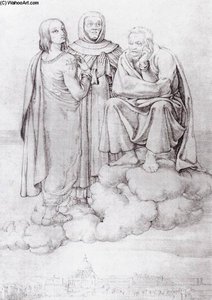
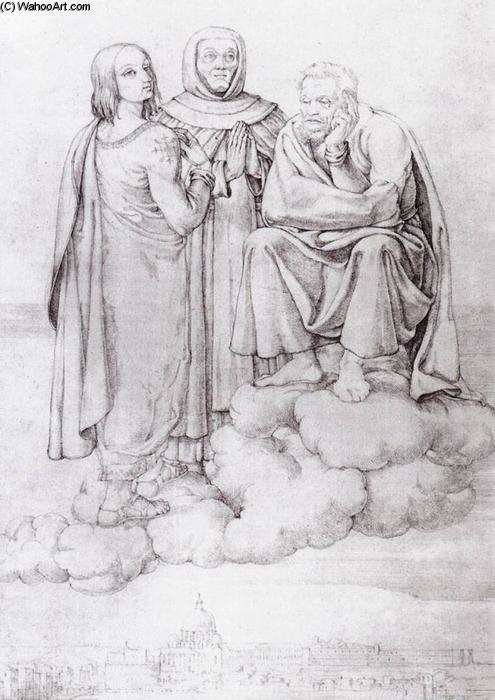
Raphael, Fra Angelico and Michelangelo over Rome
 Acrylic On Canvas
- WallArt
- Nazarene Movement
 1810
1810 311.0 x 200.0 cm
 Städelsche Kunstinstitut Und Städtische Galerie
 Read More
Hand Made Oil Reproduction
Hand-painted oil on canvas in your size and frame, made to order by our artists. ( Buy Print Buy Image)




P118B $10

P118H $10

P118W $10

P438Z $10

P508JH $12

P508YH $12

P805H $10

P805Z $10

P919BZ $10

P919G $10

P919XJ $10

P959ZH $10

P968JZ $12

W106C $8

W218G $10

W218JH $8

W218Y $10

W307PJ $10

W316G $10

W316PJ $8

W316Y $10

W398PJ $8

W4111J $10

W500HY $15

W500JH $15

W692G $12

W849H $8

W940BG $15

W953PJ $8




Pick from our preset sizes that match the artwork's original proportions.

You may enter your own dimensions to fit a specific frame or space. If your selected size does not match the original image's proportions, we will either crop the artwork or extend the painting with additional hand-painted elements. A digital mockup will be sent for your approval before production begins.
Please note that the on-screen preview does not reflect the actual cropping or extension. Only the mockup will accurately show the final composition.
While custom sizes are available, we recommend selecting a dimension from the predefined list to preserve the original proportions.
After order, ArtsDot.com team will email client for instructions and provide a mockup preview
Worldwide Delivery () in 3/4 weeks instead of standard 5 weeks. (26 August). No compromise on quality.

Free Worldwide Express Shipping

High-Quality Linen Canvas

Full Shipping Insurance

Customs Tax Refund Guarantee

True Color Matching Guarantee

60-Day Return Policy (Defects Only)

100% Money-Back Guarantee

Bulk Discount Offer
 Glass option is only available in size under 110 CM

Raphael, Fra Angelico and Michelangelo over Rome
Reproduction Medium
Reproduction Size
-


Total Price
$ 313
Artwork Description
Franz Pforr’s Reverie Above Rome
The artwork, “Raphael, Fra Angelico and Michelangelo over Rome,” by Franz Pforr (1788-1812), stands as a poignant testament to the Nazarene movement's fervent desire for artistic renewal. Executed in 1810 during Pforr’s formative years in Rome alongside fellow artists Johann Friedrich Overbeck, Ludwig Vogel, and Johann Konrad Hottinger, this monochrome pencil drawing transcends mere representation; it embodies a profound spiritual contemplation of art history itself. The piece captures three figures – Raphael, Fra Angelico, and Michelangelo – hovering serenely above the cityscape of Rome, bathed in an ethereal glow that speaks volumes about the artists’ aspirations and the movement's core ethos.Composition and Technique: A Study in Balance
Pforr meticulously crafted this composition with a masterful understanding of classical principles. The trio occupies the upper portion of the frame, arranged in a triangular formation—Raphael positioned on the left, Fra Angelico centrally, and Michelangelo to the right—creating an impression of stability and grandeur. Each figure is rendered as an independent set piece, embodying stillness and conveying an aura of solemn contemplation. Hatching dominates the technique, skillfully employed to sculpt volume and define contours with remarkable precision. The artist’s delicate hatching creates subtle tonal variations that imbue the drawing with depth and texture, mirroring the monumental architecture of Rome below—the Vatican, St Peter's Basilica, and Castel Sant'Angelo—which serves as a backdrop for this symbolic tableau.Historical Context: The Nazarene Revival
The Nazarene movement emerged in response to what its proponents perceived as the excesses of Neoclassical art, prioritizing instead the purity and piety of early Christian iconography. Artists like Pforr sought inspiration from the Gospels and rejected academic conventions, advocating for a return to artistic sincerity and emotional resonance. Their residence at Sant’Isidoro Monastery fostered an environment conducive to intellectual discourse and spiritual reflection—a crucible where ideas about artistic expression flourished. The artist's engagement with Michelangelo’s statue of Christ in Santa Maria sopra Minerva further solidified his commitment to honoring the legacy of Renaissance masters, demonstrating a deep appreciation for both artistic skill and theological contemplation.Symbolism: Artists as Embodiments of Ideal Beauty
The depiction of Raphael, Fra Angelico, and Michelangelo isn't merely biographical; it’s symbolic. These figures represent not just artists but also embodiments of ideal beauty and spiritual enlightenment—the very qualities that the Nazarenes sought to recapture in their own work. Their serene postures convey a sense of transcendence, suggesting that art possesses the capacity to elevate the human spirit beyond earthly concerns. The cityscape beneath them symbolizes the world of artistic culture that these titans had shaped, underscoring the enduring influence of Renaissance ideals on subsequent generations of artists.Concluding Impression: A Legacy of Reverence
“Raphael, Fra Angelico and Michelangelo over Rome” exemplifies Pforr’s unwavering devotion to his artistic vision—a vision rooted in the spiritual fervor of the Nazarene movement and informed by a profound respect for the achievements of past masters. The artwork's enduring appeal lies in its ability to evoke contemplation and inspire admiration for the transformative power of art, securing its place as a cornerstone of Romantic aesthetic thought and a testament to Franz Pforr’s artistic legacy.Related Artworks
Artist Biography
Franz Pforr: A Pioneer of the Nazarene Movement
Early Life and Training
- Born: 1788 in Frankfurt am Main, Hesse, Germany.
- Franz Pforr received his initial artistic training from his father, Johann Georg Pforr, a painter himself.
- His uncle, Johann Heinrich Tischbein the Younger, an art professor and gallery inspector, also played a crucial role in his early development.
- He continued his studies at the Academy of Fine Arts in Vienna, laying the foundation for his future artistic pursuits.
The Nazarene Movement and Roman Period
- In 1810, Pforr moved to Rome alongside fellow artists including Johann Friedrich Overbeck, Ludwig Vogel, and Johann Konrad Hottinger.
- The Nazarene Movement: This group sought a return to the perceived purity of early Christian art, rejecting what they saw as the superficiality of contemporary styles.
- They resided at the abandoned monastery of Sant’Isidoro a Capo le Case, fostering a communal and spiritually focused artistic environment.
- Overbeck became a significant influence during this period, shaping Pforr's aesthetic direction.
Artistic Style and Themes
- Pforr’s work is characterized by its Romanticism and deep religious sentiment.
- He focused on historical and biblical subjects, often depicting scenes with a sense of solemnity and spiritual intensity.
- Chiaroscuro, the dramatic use of light and shadow, is prominent in his paintings, enhancing their emotional impact.
- His style blended elements of German Romanticism with the ideals of the Nazarenes – a focus on simplicity, sincerity, and spiritual depth.
Major Works
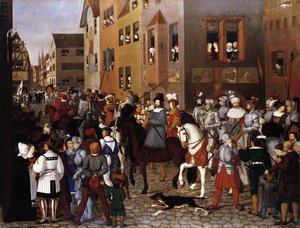
- The Entry of Emperor Rudolf of Habsburg into Basel: A historical painting showcasing Pforr’s narrative skill.
- St George and the Dragon: Demonstrates his ability to depict dramatic scenes with religious symbolism.
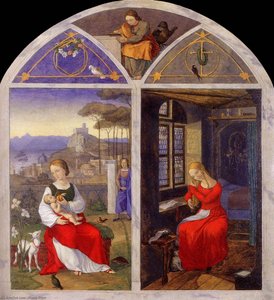
- Shulamit and Mary: An example of his exploration of biblical themes and intimate portrayals.
- Raphael, Fra Angelico and Michelangelo over Rome: A tribute to the masters he admired and a reflection of the Nazarene’s reverence for Renaissance art.
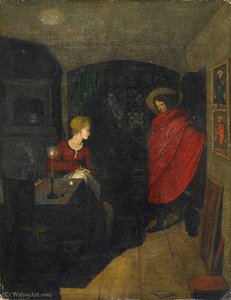
- Nocturnal Homecoming: Showcases his skill in Flemish realism with intimate figures.
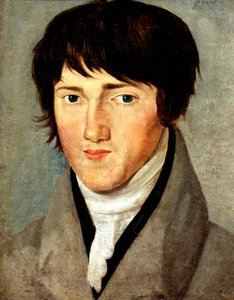
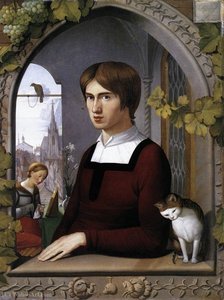
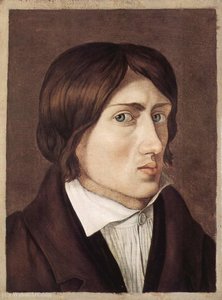
- Several self-portraits provide insight into his personal appearance and artistic sensibility.
Legacy and Historical Significance
- Early Death: Tragically, Franz Pforr died of tuberculosis in Albano Laziale, Rome, in 1812 at the young age of 24.
- Despite his short life, he left a significant mark on the Nazarene movement and early 19th-century art.
- His work embodies the search for spiritual expression that characterized the Romantic era.
- Pforr’s influence can be seen in the subsequent development of German Romantic painting, inspiring artists to explore religious and historical themes with renewed fervor.
- He remains a notable figure for those studying the intersection of art, religion, and national identity in 19th-century Germany.
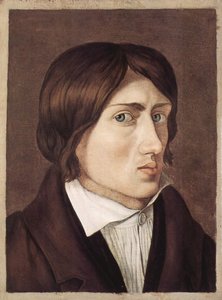
Franz Pforr
1788 - 1812 , Germany
Quick Facts
- Birth Date: 1788
- Birth Place: Hesse, Germany
- Death Date: 1812
- Influenced By:
- Johann Georg Pforr
- Johann Heinrich Tischbein the Younger
- Johann Friedrich Overbeck
- Movement: Nazarene movement
- Name: Franz Pforr
- Nationality: German
- Notable Works:
- The Entry of Emperor Rudolf of Habsburg into Basel
- St George and the Dragon
- Shulamit and Mary
- Raphael, Fra Angelico and Michelangelo over Rome
- Nocturnal homecoming
Related Articles
The Art of Italian Living: Transform Your Home with Timeless Landscapes and Renaissance Masterpieces
Elevate your home with the timeless romance of Italy. Discover expert-curated, hand-painted Italian landscapes and Renaissance-inspired masterpieces. From bespoke oil reproductions to custom portraits from photos, transform your space with elegance and artistic passion.

Romantic Landscapes: 10 Masterpieces for Your Home | ArtsDot
Journey through 10 Romantic landscape masterpieces by Friedrich, Turner & Cole. Explore emotional art, sublime nature scenes & iconic 19th-century paintings. Find museum-quality reproductions for your home at ArtsDot.com – discover the full collection online!

Evocations of Place: A Historical Journey Through Landscape Art
Explore the rich history of landscape art with ArtsDot. Discover renowned artists, movements like Impressionism & Romanticism, and expert guidance for collecting timeless pieces. Find your perfect serene escape today!

John Constable's Masterpieces: Explore 25 Iconic Landscapes for Your Home
Journey through John Constable's 25 most celebrated landscapes. Explore Romanticism, Dedham Vale & his masterful use of light in iconic paintings like 'Hay Wain'. Find museum-quality art reproductions and elevate your home decor on ArtsDot.com.
Evocations of Place: A Historical Journey Through Landscape Art
Explore the rich history of landscape art with ArtsDot. Discover renowned artists, movements like Impressionism & tonalism, and expert guidance for collecting timeless pieces. Find your perfect serene escape today!