 Preview
 Send
Send Share
Share
 Details

 Download
 Similars
 X-Ray
X-Ray Diaporama
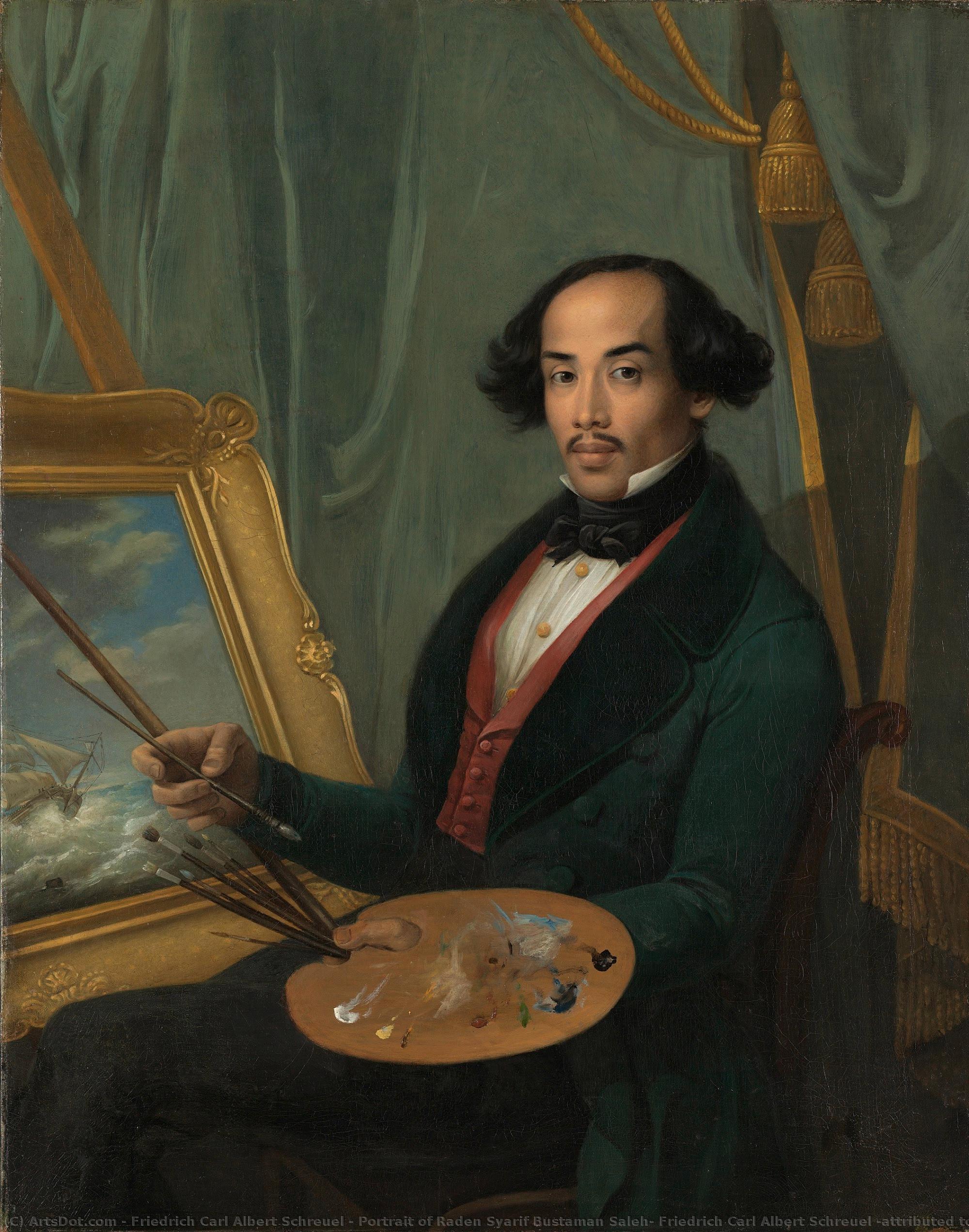
Portrait of Raden Syarif Bustaman Saleh, Friedrich Carl Albert Schreuel (attributed to), c. 1840
 1840
1840 107.0 x 85.0 cm
 Read More
Hand Made Oil Reproduction
Hand-painted oil on canvas in your size and frame, made to order by our artists. ( Buy Print Buy Image)




































Pick from our preset sizes that match the artwork's original proportions.

You may enter your own dimensions to fit a specific frame or space. If your selected size does not match the original image's proportions, we will either crop the artwork or extend the painting with additional hand-painted elements. A digital mockup will be sent for your approval before production begins.
Please note that the on-screen preview does not reflect the actual cropping or extension. Only the mockup will accurately show the final composition.
While custom sizes are available, we recommend selecting a dimension from the predefined list to preserve the original proportions.
After order, ArtsDot.com team will email client for instructions and provide a mockup preview
Worldwide Delivery () in 3/4 weeks instead of standard 5 weeks. (6 September). No compromise on quality.

Free Worldwide Express Shipping

High-Quality Linen Canvas

Full Shipping Insurance

Customs Tax Refund Guarantee

True Color Matching Guarantee

100-Day Return Policy (Defects Only)

100% Money-Back Guarantee

Bulk Discount Offer
 Glass option is only available in size under 110 CM

Portrait of Raden Syarif Bustaman Saleh, Friedrich Carl Albert Schreuel (attributed to), c. 1840
Reproduction Medium
Reproduction Size
-


Total Price
$ 263
Related Artworks





Artist Biography
The Enigmatic Vision of Friedrich Carl Albert Schreuel
Friedrich Carl Albert Schreuel, a name perhaps less immediately recognizable than some of his contemporaries, nevertheless occupies a fascinating and increasingly appreciated niche within the landscape of 19th-century painting. Born in , Schreuel’s life remains shrouded in relative obscurity – a deliberate choice by the artist himself, it seems, who prioritized the quiet contemplation of his craft over the clamor of public recognition. What *is* known paints a picture of an intensely private individual, deeply immersed in the study of light, atmosphere, and the subtle emotional resonances of landscape. He eschewed grand historical narratives or portraiture, instead focusing on scenes that evoke a sense of melancholic beauty and spiritual yearning. This dedication to inner experience, rather than outward spectacle, sets him apart as a uniquely introspective voice within the Romantic tradition.Early Influences and Artistic Development
Schreuel’s early artistic training remains largely undocumented, though scholars speculate a foundation in the Düsseldorf school of painting is likely. The influence of Caspar David Friedrich is undeniable – not in direct imitation, but in a shared preoccupation with the sublime power of nature as a conduit to the divine. However, Schreuel quickly diverged from Friedrich’s more overtly dramatic compositions. Where Friedrich often employed stark contrasts and imposing figures to convey awe, Schreuel favored a softer palette, diffused light, and a sense of quiet intimacy. He was also deeply affected by the work of the English watercolorists, particularly J.M.W. Turner, whose exploration of atmospheric effects profoundly shaped his technique. This fusion of German Romantic sensibility with English watercolor traditions resulted in a distinctive style characterized by delicate brushwork, luminous color washes, and an almost ethereal quality. His early works often depict secluded forests, mist-shrouded valleys, and tranquil bodies of water – motifs that would become hallmarks of his oeuvre.Themes of Solitude and Spiritual Reflection
The core of Schreuel’s artistic vision lies in the exploration of solitude and its relationship to spiritual experience. His paintings are rarely populated; when figures do appear, they are typically small and isolated, dwarfed by the immensity of the natural world. These solitary individuals aren't presented as heroic adventurers conquering nature, but rather as humble observers, lost in contemplation before its grandeur. This is not a celebration of human dominance, but an acknowledgement of human insignificance in the face of something far greater. Schreuel’s landscapes are imbued with a profound sense of *Sehnsucht* – a German term denoting a longing for something indefinite and unattainable. This yearning isn't necessarily tied to a specific religious belief; it is more akin to a universal human desire for meaning, connection, and transcendence. The recurring motifs of twilight, ruins, and abandoned structures further reinforce this theme of loss and the passage of time, suggesting a melancholic awareness of mortality and the ephemeral nature of existence.Technique and Materials
Schreuel’s mastery of technique is often overlooked due to the seemingly effortless simplicity of his compositions. He primarily worked in oil on canvas, but employed watercolor techniques – thin washes of color layered to create luminous effects and subtle gradations of tone. He was a meticulous observer of light, carefully studying its behavior at different times of day and under varying atmospheric conditions. His brushwork is remarkably delicate, often blurring the boundaries between forms and creating a sense of atmosphere that envelops the viewer. He frequently used glazes to build up depth and richness in his colors, achieving a remarkable luminosity that sets his work apart. Unlike many of his contemporaries who favored bold impasto, Schreuel’s surfaces are smooth and refined, allowing the subtle nuances of color and light to take center stage. His choice of subject matter also dictated his technique; he often painted *en plein air*, capturing the fleeting effects of natural light directly from observation.Historical Significance and Legacy
While Schreuel did not achieve widespread fame during his lifetime, his work has experienced a resurgence in recent decades as scholars have begun to recognize its unique contribution to 19th-century art. He represents a quieter, more introspective strand of Romanticism – one that prioritizes inner experience over outward spectacle. His paintings offer a powerful meditation on the themes of solitude, spirituality, and the sublime power of nature.- His influence can be seen in the work of later landscape painters who sought to capture the emotional resonances of the natural world.
- Schreuel’s dedication to atmospheric effects foreshadowed the development of Impressionism.
- He remains a compelling figure for contemporary audiences seeking art that offers solace, contemplation, and a deeper connection to the natural world.