 Preview
 Send
Send Share
Share
 Details

 Download
 Similars
 X-Ray
X-Ray Diaporama
Exterior


 Read More
Hand Made Oil Reproduction
Hand-painted oil on canvas in your size and frame, made to order by our artists. ( Buy Print Buy Image)




































Pick from our preset sizes that match the artwork's original proportions.

You may enter your own dimensions to fit a specific frame or space. If your selected size does not match the original image's proportions, we will either crop the artwork or extend the painting with additional hand-painted elements. A digital mockup will be sent for your approval before production begins.
Please note that the on-screen preview does not reflect the actual cropping or extension. Only the mockup will accurately show the final composition.
While custom sizes are available, we recommend selecting a dimension from the predefined list to preserve the original proportions.
After order, ArtsDot.com team will email client for instructions and provide a mockup preview
Worldwide Delivery () in 3/4 weeks instead of standard 5 weeks. (19 August). No compromise on quality.

Free Worldwide Express Shipping

High-Quality Linen Canvas

Full Shipping Insurance

Customs Tax Refund Guarantee

True Color Matching Guarantee

60-Day Return Policy (Defects Only)

100% Money-Back Guarantee

Bulk Discount Offer
 Glass option is only available in size under 110 CM

Exterior
Reproduction Medium
Reproduction Size
-


Total Price
$ 263
Related Artworks

Artist Biography
The Master of Lombard Renaissance Stone
In the vibrant landscape of the Italian Early Renaissance, few figures embodied the multifaceted spirit of the era quite like Giovanni Antonio Amadeo. A true polymath of the late 15th century, Amadeo moved seamlessly between the roles of sculptor, architect, and engineer, leaving an indelible mark on the Lombardy region. Born in Pavia in 1447, his life was defined by a profound connection to the stone and marble of Northern Italy, transforming cold surfaces into breathing narratives of classical antiquity and biblical grandeur. His artistry was not merely about decoration; it was about the structural and emotional integration of sculpture and architecture, creating spaces where the divine and the human intersected through intricate relief and monumental form.
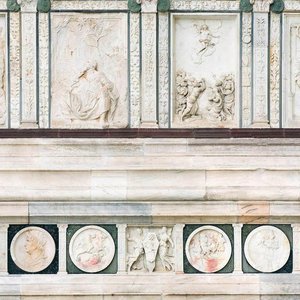
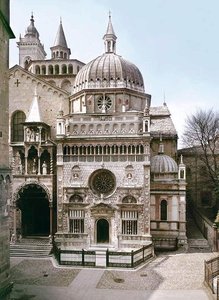
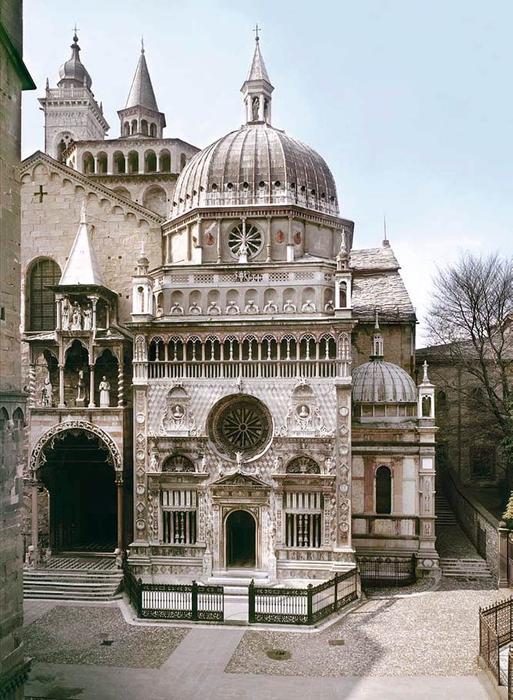
The trajectory of Amadeo’s career was shaped by his ability to navigate the complex patronage of the powerful Sforza dynasty and influential religious figures. One of his most enduring legacies is found in Bergamo, specifically within the Cappella Colleoni. Tasked with completing this funerary chapel originally begun by Guiniforte and Francesco Solari, Amadeo breathed new life into the structure through a breathtaking display of polychrome decoration. He introduced a sophisticated language of ancient-style medallions, delicate small columns, and evocative busts. His mastery of the bas-relief is perhaps most evident in his "Histories from the Old Testament" and "Histories of Hercules," where he utilized the medium to weave complex mythological and sacred tapestries that captivated the eyes of contemporary viewers and continue to awe modern scholars.
Architectural Vision and Engineering Prowess
Beyond the delicate chisel work of a sculptor, Amadeo possessed the strategic mind of an engineer. This duality allowed him to contribute significantly to the structural identity of Milan and Pavia. His collaboration with other titans of the era, such as Donato Bramante, highlights his position within the highest circles of Renaissance intellectualism. Whether working on the facade of Santa Maria presso San Satiro in Milan or serving as the director of works for the new Pavia Cathedral, Amadeo’s hand was present in the very bones of these sacred structures. His ability to manage large-scale projects, such as his tenure at the Ospedale Maggiore of Milan, demonstrates a logistical brilliance that matched his aesthetic sensitivity.
His technical expertise extended far beyond the confines of the church and the cathedral. As a ducal engineer for Ludovico il Moro, Amadeo applied his understanding of geometry and structural integrity to the design of fortifications at Chiavenna and Piattamale. This period of his life reveals an artist whose intellect was deeply rooted in the practicalities of defense and durability, proving that his mastery of form was matched by a command over the physical world. The same precision required to carve the Arca di San Lanfranco in Pavia was applied to the rugged requirements of military architecture, making him a vital asset to the stability and prestige of the Duchy of Milan.
A Legacy Carved in Marble
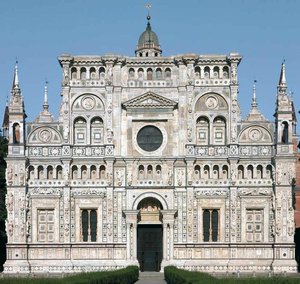
The significance of Giovanni Antonio Amadeo lies in his role as a bridge between the late Gothic traditions and the burgeoning humanism of the Renaissance. His work at the Certosa di Pavia, particularly the intricate bas-reliefs on the facade, showcases a transition toward a more classical, ordered aesthetic that would define the Lombard style for generations. Even in his funerary monuments, such as the tomb of Medea Colleoni, he achieved a synthesis of sculptural narrative and architectural permanence, utilizing reliefs of the virtues to elevate the status of the deceased through art.
To reflect on Amadeo’s vast contributions is to trace the very evolution of Northern Italian art. His career was characterized by several key pillars of achievement:
- Narrative Sculpture: The creation of complex, multi-layered reliefs depicting both biblical histories and classical myths.
- Architectural Integration: The seamless blending of sculptural elements like medallions and columns into the structural facades of cathedrals and chapels.
- Civic and Military Engineering: The application of Renaissance mathematical principles to the design of fortifications and public hospitals.
- Collaborative Mastery: Working alongside legendary figures like Bramante to shape the urban landscape of Milan and Pavia.
Though time has weathered many of the surfaces he once polished, the essence of Amadeo’s genius remains visible in the enduring stone of Lombardy. He remains a central figure for anyone seeking to understand how the Renaissance spirit was physically constructed through the marriage of artistic beauty and engineering strength.
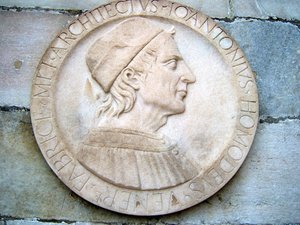
giovanni antonio amadeo
1447 - 1522 , Italy
Quick Facts
- Artistic Movement Or Style: Early Italian Renaissance
- Artists Or Movements Influenced By This Artist:
- Jean Fouquet
- Domenico Veneziano
- Artists Who Influenced This Artist:
- Ghiberti
- Masaccio
- Date Of Birth: c. 1383
- Date Of Death: c. 1447
- Full Name: Tommaso di Cristoforo Fini
- Nationality: Italian
- Notable Artworks:
- Madonna with Child
- Brancacci Chapel frescoes
- Place Of Birth: Panicale, Umbria, Italy