 Preview
 Send
Send Share
Share
 Details

 Download
 Similars
 X-Ray
X-Ray Diaporama
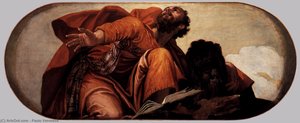
Saint Mark the Evangelist
 Oil On Canvas
- WallArt
- Mannerism
 1535
1535- Renaissance
 72.0 x 74.0 cm
 Museum of Fine Arts
 Read More
Hand Made Oil Reproduction
Hand-painted oil on canvas in your size and frame, made to order by our artists. ( Buy Print Buy Image)




P118B $10

P118H $10

P118W $10

P438Z $10

P508JH $12

P508YH $12

P805H $10

P805Z $10

P919BZ $10

P919G $10

P919XJ $10

P959ZH $10

P968JZ $12

W106C $8

W218G $10

W218JH $8

W218Y $10

W307PJ $10

W316G $10

W316PJ $8

W316Y $10

W398PJ $8

W4111J $10

W500HY $15

W500JH $15

W692G $12

W849H $8

W940BG $15

W953PJ $8




Pick from our preset sizes that match the artwork's original proportions.

You may enter your own dimensions to fit a specific frame or space. If your selected size does not match the original image's proportions, we will either crop the artwork or extend the painting with additional hand-painted elements. A digital mockup will be sent for your approval before production begins.
Please note that the on-screen preview does not reflect the actual cropping or extension. Only the mockup will accurately show the final composition.
While custom sizes are available, we recommend selecting a dimension from the predefined list to preserve the original proportions.
After order, ArtsDot.com team will email client for instructions and provide a mockup preview
Worldwide Delivery () in 3/4 weeks instead of standard 5 weeks. (22 August). No compromise on quality.

Free Worldwide Express Shipping

High-Quality Linen Canvas

Full Shipping Insurance

Customs Tax Refund Guarantee

True Color Matching Guarantee

60-Day Return Policy (Defects Only)

100% Money-Back Guarantee

Bulk Discount Offer
 Glass option is only available in size under 110 CM

Saint Mark the Evangelist
Reproduction Medium
Reproduction Size
-


Total Price
$ 263
Artwork Description
The Scholarly Gaze of Saint Mark
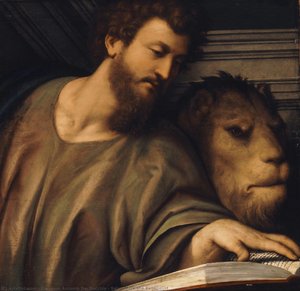
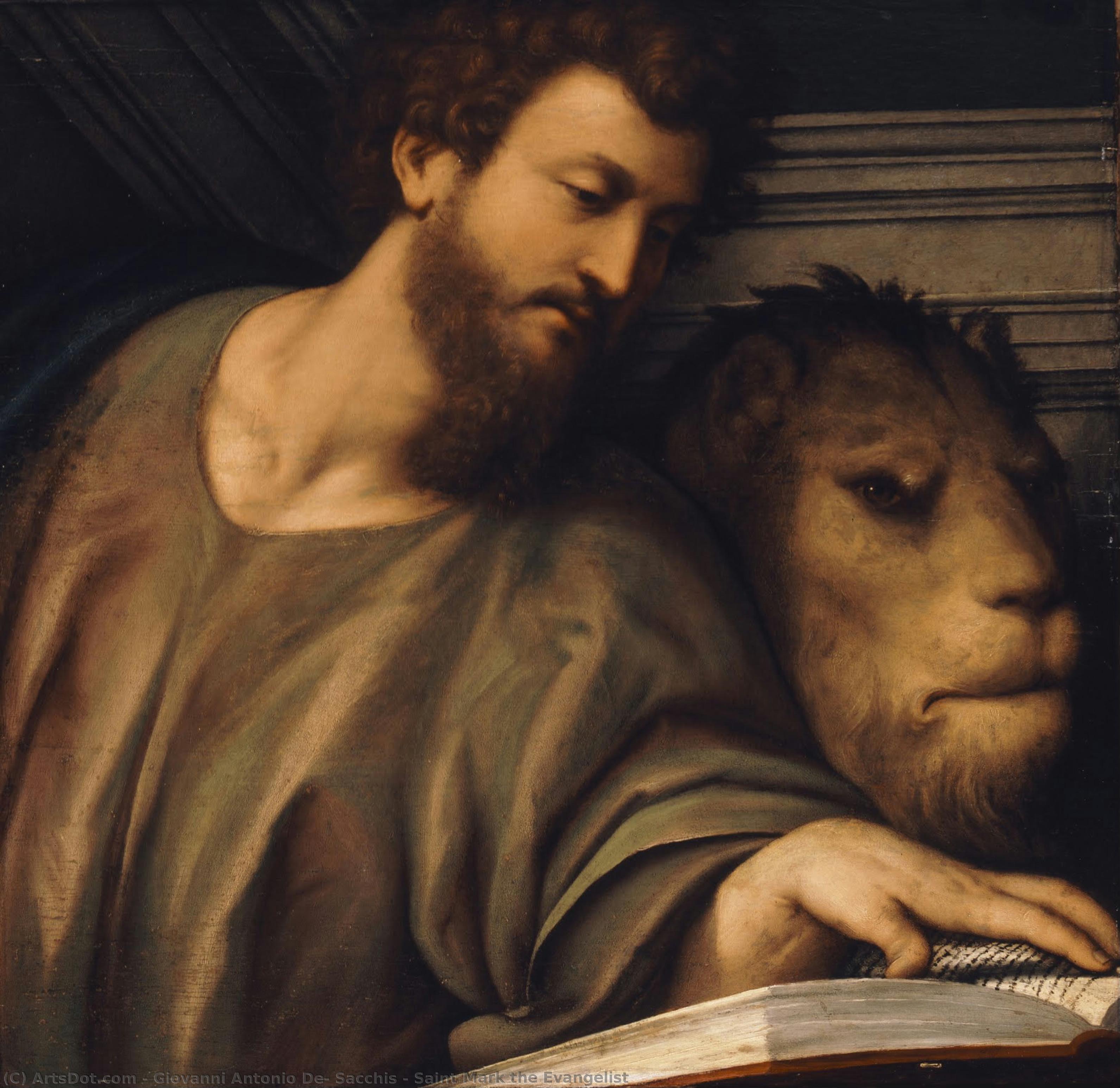
To stand before this portrait of Saint Mark the Evangelist is to step into a moment suspended between divine revelation and meticulous study. The air in the depicted room feels thick with the scent of aged parchment and polished wood, suggesting a private sanctuary dedicated to profound thought. Saint Mark himself is presented not merely as a saintly figurehead, but as an active scholar, deeply engaged with the sacred text held within his hand. His long beard lends him an air of venerable wisdom, while the entire composition draws the viewer into the quiet intensity of intellectual pursuit. The inclusion of scholarly props—the visible books flanking the scene and the precise clock ticking above—anchors this spiritual subject firmly in a tangible reality, suggesting that divine truth is something both revealed and diligently recorded.
Symbolism Woven into Canvas
The symbolism within this work is rich and layered, inviting prolonged contemplation. Most arresting among these elements is the magnificent lion resting upon his shoulder. In Christian iconography, the lion is a potent symbol associated with St. Mark himself, representing the Gospel of Mark and often symbolizing resurrection or divine power. Its gaze, intense and unwavering, seems to mirror the focused concentration of the Evangelist, acting as both guardian and silent witness to his sacred work. Furthermore, the juxtaposition of the eternal spiritual knowledge represented by the scripture against the measurable passage of time, marked by the clock, creates a beautiful tension. It suggests that while divine truth transcends temporal boundaries, its understanding requires disciplined attention.
Mastery in Mannerist Technique
Painted around 1535 by Giovanni Antonio de Sacchis, known to history as Pordenone, this piece exemplifies the vibrant energy of the High Renaissance transitioning into Mannerism. Pordenone’s style is characterized by a restless vitality and an emotional depth that eschews placid perfection for dramatic engagement. Observe the handling of the drapery and the subtle modeling on the faces; there is a deliberate artifice here, a sophisticated elegance typical of the period's masters who pushed beyond High Renaissance balance. The technique allows light to play across the textures—the sheen of the book covers, the depth in the lion’s mane—giving the entire scene an almost palpable dimensionality that elevates it from mere painting to immersive tableau.
A Study in Intellectual Atmosphere for Your Space
For those seeking art that speaks to intellect and enduring wisdom, this reproduction offers a profound focal point. Whether placed in a grand library, a study designed for contemplation, or an entryway meant to inspire thoughtful conversation, the piece commands attention without shouting. It brings with it the gravitas of history and the quiet dignity of scholarship. Owning this work is not simply acquiring decoration; it is curating an atmosphere—a space that encourages one to slow down, to read deeply, and to contemplate the enduring relationship between faith, knowledge, and time.
Related Artworks

Artist Biography
A Life Forged in Vigor: The Turbulent World of Giovanni Antonio de Sacchis, Pordenone
Giovanni Antonio de Sacchis, better known as Pordenone, remains a fascinating and somewhat unsettling figure within the Italian Renaissance. Born around 1484 in the small town of Pordenone, nestled in Friuli, Italy, his artistic journey was anything but conventional. Unlike many of his contemporaries who benefited from established workshops and prolonged apprenticeships, Pordenone’s rise to prominence was marked by a raw energy and deliberate rejection of academic refinement. He wasn't merely a painter; he was an embodiment of the restless spirit of the early 16th century, a period grappling with shifting religious ideologies and burgeoning artistic experimentation. His life, as colorful and dramatic as his canvases, involved three marriages and accusations of fratricide – tales that only add to the mystique surrounding this powerful Mannerist artist. While details of his early training remain scarce, it’s clear he possessed an innate talent for composition and a bold approach to color that would soon distinguish him from other Venetian painters. He absorbed influences from Rome's High Renaissance masters during visits, but crucially, didn’t allow himself to be entirely bound by their classical ideals.From Frescoes to Altarpieces: Pordenone’s Artistic Evolution
Pordenone’s career unfolded rapidly across the cities of Northern Italy – from Udine and Cremona to Genoa and, ultimately, Ferrara. He was a painter in demand, prized for his speed and ability to deliver large-scale works with striking impact. His early frescoes, such as those at the Casa del Popolo in Udine (1509-1512), reveal a burgeoning talent grappling with narrative complexity and dynamic figure arrangements. These works already hint at the theatricality that would become his hallmark. He quickly moved beyond purely decorative schemes, embracing increasingly ambitious altarpieces and religious scenes. A key development was his mastery of oil painting, allowing for richer textures and more nuanced color palettes. His style wasn’t about delicate precision; it was about forceful brushwork, dramatic chiaroscuro, and a deliberate coarseness that shocked and captivated viewers. He favored robust figures with expressive gestures, often depicting moments of intense emotion or spiritual revelation. This approach, while sometimes criticized for its lack of anatomical accuracy, resonated deeply with patrons seeking art that evoked powerful feelings rather than idealized beauty.A Deliberate Coarseness: The Signature Style of Pordenone
What truly sets Pordenone apart is his unique aesthetic – a deliberate embrace of what might be considered ‘imperfection.’ While contemporaries like Titian and Giorgione refined their techniques to achieve seamless realism, Pordenone actively sought out a more rugged, expressive style. His brushstrokes are often visible, creating a sense of movement and immediacy. Figures aren’t always perfectly proportioned; faces can appear rough-hewn, yet intensely alive with emotion. This wasn't due to a lack of skill, but rather a conscious artistic choice. He aimed to shock the viewer, to jolt them out of complacency and force them to confront the raw power of religious narratives. His use of color is equally striking – vibrant reds, blues, and golds dominate his compositions, creating a sense of theatrical grandeur. This deliberate coarseness wasn’t simply a stylistic quirk; it was integral to his artistic philosophy. He believed that art should be visceral and emotionally engaging, even if it meant sacrificing classical ideals of beauty.Influences and Legacy: Pordenone's Impact on Venetian Painting
Pordenone’s influence on later generations of Venetian painters is undeniable. While he didn’t found a formal school, his energetic style and dramatic compositions resonated deeply with artists seeking to break away from established conventions. Titian himself acknowledged Pordenone’s impact, incorporating elements of his boldness into his own work, particularly in his later religious paintings. However, it was Tintoretto who most clearly inherited Pordenone's mantle as the leading painter of large-scale mural commissions in Venice. Tintoretto adopted Pordenone’s dynamic compositions, dramatic lighting effects, and expressive brushwork, pushing these qualities even further to create a uniquely theatrical style. Beyond his direct influence on specific artists, Pordenone helped pave the way for the development of Mannerism – a movement characterized by its emphasis on artifice, elegance, and emotional intensity. His willingness to challenge conventional norms and embrace unconventional techniques inspired countless artists to experiment with new forms of expression.Historical Significance: A Painter Ahead of His Time
Pordenone’s historical significance lies not only in his artistic achievements but also in his embodiment of the changing cultural landscape of the Italian Renaissance. He was a product of his time – a period marked by religious upheaval, political instability, and burgeoning humanism. His art reflects these anxieties and aspirations, offering a glimpse into the complex emotional world of the early 16th century.- His dramatic compositions and expressive figures anticipated the Baroque style.
- He challenged classical ideals of beauty, paving the way for Mannerist experimentation.
- His influence on Titian and Tintoretto cemented his place in Venetian painting history.
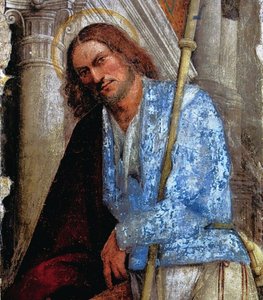
giovanni antonio de sacchis
1539 , Italy
Related Articles

Mark Rothko's Masterpieces: 25 Paintings That Define Abstract Expressionism | ArtsDot
Explore 25 iconic Mark Rothko paintings that define Abstract Expressionism. Discover the stories, colors & emotions behind these masterpieces. Find museum-quality art reproductions and curated decor ideas at ArtsDot.com.

The Enduring Legacy of Oil on Canvas: Technique, History & Aesthetic Impact
Explore the rich history & techniques of oil painting – from Renaissance masters to Impressionism. Discover pigments, layering methods, and why this timeless medium endures. Expert insights for artists & art enthusiasts.

Oil on Canvas: A Historical & Technical Exploration of a Timeless Artistic Medium
Explore the rich history & enduring techniques of oil painting on canvas. Discover the science behind its longevity, conservation practices, and contemporary relevance. Expert insights for art enthusiasts.

The Enduring Power of Painting: A Historical & Contemporary Exploration of Form and Emotion
Explore the rich history & enduring techniques of oil painting with ArtsDot. Discover masterpieces, learn about art collecting, and find authentic handmade reproductions crafted by skilled artists.

The Enduring Legacy of Oil on Canvas: Technique, History & Contemporary Practice
Explore the rich history & enduring techniques of oil painting on canvas. Discover the science behind its longevity, conservation practices, and contemporary relevance. Expert insights for art enthusiasts.