 Preview
 Send
Send Share
Share
 Details

 Download
 Similars
 X-Ray
X-Ray Diaporama
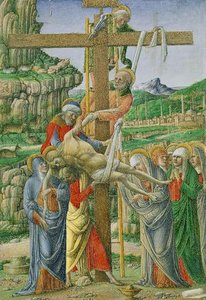
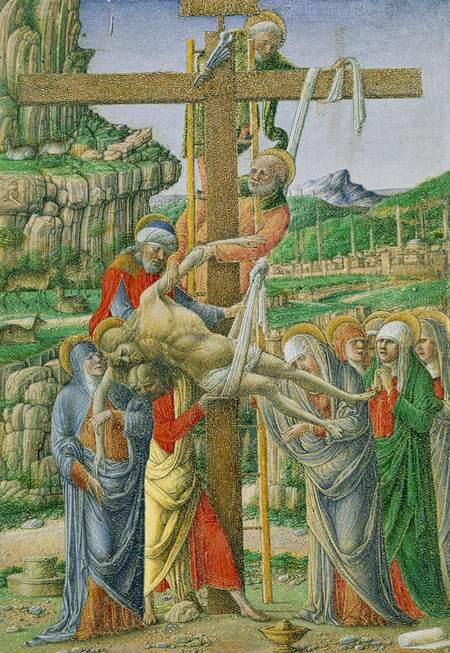
Descent from the Cross
 1475
1475 15.0 x 11.0 cm
 Metropolitan Museum of Art
 Read More
Hand Made Oil Reproduction
Hand-painted oil on canvas in your size and frame, made to order by our artists. ( Buy Print Buy Image)




































Pick from our preset sizes that match the artwork's original proportions.

You may enter your own dimensions to fit a specific frame or space. If your selected size does not match the original image's proportions, we will either crop the artwork or extend the painting with additional hand-painted elements. A digital mockup will be sent for your approval before production begins.
Please note that the on-screen preview does not reflect the actual cropping or extension. Only the mockup will accurately show the final composition.
While custom sizes are available, we recommend selecting a dimension from the predefined list to preserve the original proportions.
After order, ArtsDot.com team will email client for instructions and provide a mockup preview
Worldwide Delivery () in 3/4 weeks instead of standard 5 weeks. (27 August). No compromise on quality.

Free Worldwide Express Shipping

High-Quality Linen Canvas

Full Shipping Insurance

Customs Tax Refund Guarantee

True Color Matching Guarantee

60-Day Return Policy (Defects Only)

100% Money-Back Guarantee

Bulk Discount Offer
 Glass option is only available in size under 110 CM

Descent from the Cross
Reproduction Medium
Reproduction Size
-


Total Price
$ 263
Related Artworks








Artist Biography
The Luminous Legacy of Girolamo da Cremona
In the vibrant tapestry of the Italian Renaissance, few threads shimmer with as much delicate precision and spiritual fervor as those woven by Girolamo da Cremona. Known also to history as Girolamo de' Corradi, this master of the early Renaissance period possessed a rare ability to bridge the gap between the meticulous discipline of manuscript illumination and the grand, sweeping narratives of monumental painting. His life, though shrouded in the characteristic mists of the fifteenth century, reveals an artist whose journey took him through the most prestigious artistic hubs of Italy—from the courts of Ferrara and Mantua to the sacred spaces of Siena, Florence, and Venice. He was not merely a painter of scenes, but a chronicler of the divine, an illuminator who could breathe life into the smallest vellum page and command the vastness of an altarpiece with equal grace.
The foundations of Girolamo’s artistry were deeply rooted in the classical revival that defined his era. While historical records regarding his earliest training remain sparse, the stylistic echoes within his work suggest a profound connection to the masters of the period. He was significantly influenced and furthered by the monumental style of Andrea Mantegna, whose command of perspective and anatomical rigor likely provided the structural backbone for Girolamo’s compositions. This influence allowed him to infuse his religious subjects with a sense of sculptural weight and historical gravity. As he moved through the Italian peninsula, his work began to absorb the humanist ideals of the age—a belief in the dignity of man and the beauty of the natural world—blending these intellectual pursuits with a deep, abiding piety.
A Master of Light and Devotion
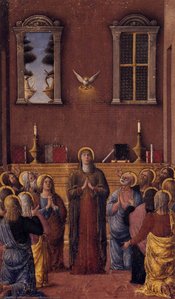
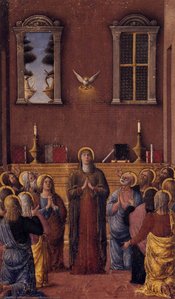
To observe a Girolamo da Cremona masterpiece is to witness a profound dialogue between light and shadow. He was a pioneer in utilizing chiaroscuro not just as a technical tool for volume, but as an emotional instrument to evoke awe. In his religious compositions, light often acts as a surrogate for the divine, descending upon figures with a weight that feels both physical and spiritual. This is perhaps most breathtakingly realized in works such as his Pentecost, housed in the Basilica of San Petronio. In this piece, the artist captures the very moment of spiritual revelation; the air seems thick with the energy of the Holy Spirit, as light illuminates the fervent faces of the apostles, pulling the viewer into a state of shared ecstasy.
His versatility was perhaps his greatest achievement, allowing him to excel in vastly different mediums:
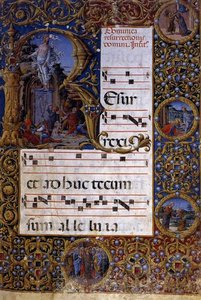
- Manuscript Illumination: As a skilled miniaturist, he brought an exquisite level of detail to early printed books and choirbooks, where his ability to manipulate fine lines and vibrant pigments created miniature worlds of devotion.
- Religious Altarpieces: He commanded the large-scale canvas, using dramatic gestures and complex compositions to tell the stories of the saints and the passion of Christ.
- Portraiture and Narrative: His ability to capture the psychological nuance of his subjects allowed him to move beyond mere likeness, imbuing his figures with a sense of internal life and human dignity.
Beyond the technical brilliance, Girolamo’s historical significance lies in his role as a transitional figure. He stood at the crossroads where the meticulous, almost decorative traditions of the late Gothic period met the burgeoning realism and anatomical precision of the High Renaissance. Through his work, the spiritual intensity of the past was given a new, humanized form. His legacy remains etched in the silent halls of Italy's great basilicas and within the delicate pages of illuminated manuscripts, reminding us of a time when art served as the ultimate window into the soul.
girolamo da cremona (girolamo de corradi)
1483 , Italy
Quick Facts
- Artistic Movement Or Style: Early Renaissance
- Artists Or Movements Influenced By This Artist: ['Leonardo da Vinci']
- Artists Who Influenced This Artist: ['Andrea Mantegna']
- Date Of Death: 1483
- Full Name: Girolamo da Cremona (Girolamo de Corradi)
- Nationality: Italian
- Notable Artworks:
- Pentecost
- Descent from the Cross
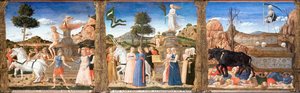
- The Triumphs of Petrarch
- Place Of Birth: Cremona, Lombardy