 Preview
 Send
Send Share
Share
 Details

 Download
 Similars
 X-Ray
X-Ray Diaporama
Merit Offers the Command to Doge Morosini


 Read More
Hand Made Oil Reproduction
Hand-painted oil on canvas in your size and frame, made to order by our artists. ( Buy Print Buy Image)




P118B $10

P118H $10

P118W $10

P438Z $10

P508JH $12

P508YH $12

P805H $10

P805Z $10

P919BZ $10

P919G $10

P919XJ $10

P959ZH $10

P968JZ $12

W106C $8

W218G $10

W218JH $8

W218Y $10

W307PJ $10

W316G $10

W316PJ $8

W316Y $10

W398PJ $8

W4111J $10

W500HY $15

W500JH $15

W692G $12

W849H $8

W940BG $15

W953PJ $8




Pick from our preset sizes that match the artwork's original proportions.

You may enter your own dimensions to fit a specific frame or space. If your selected size does not match the original image's proportions, we will either crop the artwork or extend the painting with additional hand-painted elements. A digital mockup will be sent for your approval before production begins.
Please note that the on-screen preview does not reflect the actual cropping or extension. Only the mockup will accurately show the final composition.
While custom sizes are available, we recommend selecting a dimension from the predefined list to preserve the original proportions.
After order, ArtsDot.com team will email client for instructions and provide a mockup preview
Worldwide Delivery () in 3/4 weeks instead of standard 5 weeks. (16 August). No compromise on quality.

Free Worldwide Express Shipping

High-Quality Linen Canvas

Full Shipping Insurance

Customs Tax Refund Guarantee

True Color Matching Guarantee

60-Day Return Policy (Defects Only)

100% Money-Back Guarantee

Bulk Discount Offer
 Glass option is only available in size under 110 CM

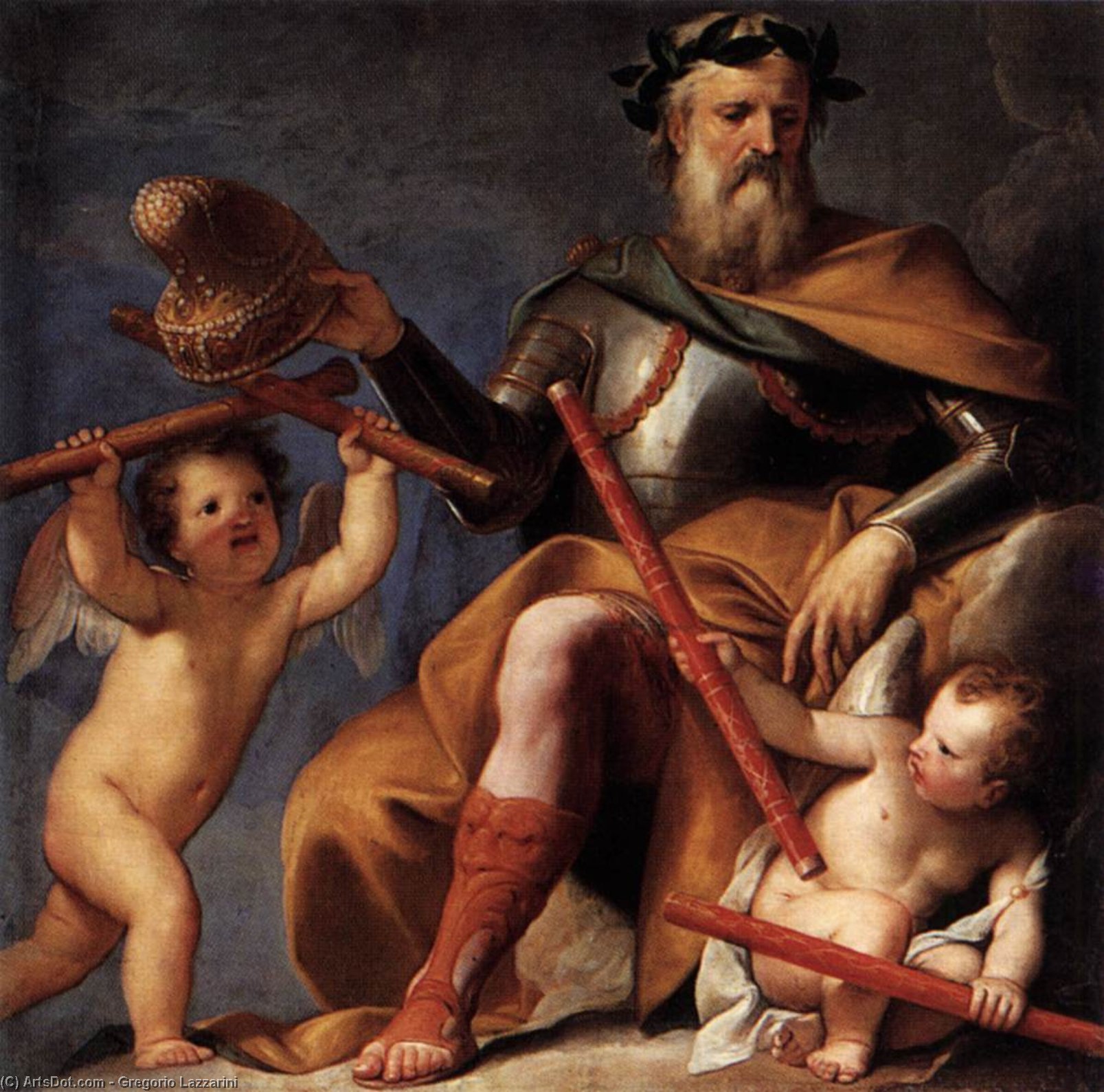
Merit Offers the Command to Doge Morosini
Reproduction Medium
Reproduction Size
-


Total Price
$ 263
Artwork Description
The Grand Narrative of Power and Victory
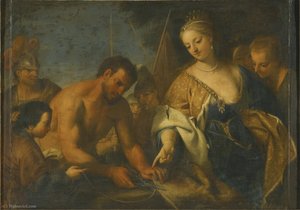
Gregorio Lazzarini’s “Merit Offers the Command to Doge Morosini” is more than just a painting; it's a vibrant snapshot of 17th-century Venice, a city pulsating with political intrigue, naval prowess, and the enduring legacy of its maritime empire. Completed in 1694, this monumental work captures a pivotal moment – the election of Francesco Morosini as Doge, the supreme ruler of the Venetian Republic – amidst the backdrop of the Great Turkish War. The scene unfolds within the Sala dello Scrutinio (Voting Hall) of the Doge’s Palace, a space steeped in history and symbolic weight, where the fate of Venice was decided through elaborate ceremony and carefully orchestrated votes.
Lazzarini masterfully employs a dramatic composition to convey this narrative. Morosini, clad in imposing armor and a feathered hat, stands as the central figure, holding two wooden staffs – symbols of command and authority – while gesturing towards the assembled dignitaries. Surrounding him are three children, representing the future of Venice, one seated thoughtfully and the other two standing attentively. The inclusion of these youthful figures subtly hints at the continuity of Venetian power and the hope for a prosperous era. The backdrop, rendered in a rich, deep blue, provides a dramatic contrast to the warm tones of the figures and adds depth to the scene, creating an atmosphere of both solemnity and grandeur.
A Window into Venetian Politics and Warfare
Understanding the historical context is crucial to appreciating Lazzarini’s work. The Great Turkish War (1685-1699) dominated Venice's existence during this period, threatening its trade routes and territorial control. Francesco Morosini emerged as a brilliant military commander, repeatedly securing victories against the Ottoman Empire in Greece and the Morea. His successes earned him immense prestige and ultimately propelled him to the Doge’s office. The painting isn’t simply a portrait; it's a visual testament to his achievements and the political maneuvering that secured his position.
The depiction of Morosini himself is particularly noteworthy. He embodies the ideal Venetian leader – courageous, decisive, and adorned with symbols of authority. His posture exudes confidence, while the details of his armor and attire reflect the wealth and power of the Republic. The careful rendering of the children underscores the importance of lineage and succession in Venetian society, reinforcing the notion that Morosini’s election was a strategic move to ensure stability and continuity.
The Art of Baroque Grandeur
Lazzarini's style is firmly rooted in the Venetian Baroque tradition, characterized by its dramatic lighting, rich colors, and dynamic compositions. He skillfully employs chiaroscuro – the contrast between light and dark – to create a sense of depth and drama, drawing the viewer’s eye to Morosini as the focal point of the scene. The use of vibrant blues, reds, and golds further enhances the painting's visual impact, reflecting the opulence and splendor associated with Venetian art.
The artist’s technique is remarkably detailed, evident in the meticulous rendering of the armor, clothing, and facial features. Lazzarini demonstrates a mastery of perspective and spatial relationships, creating a convincing illusion of three-dimensionality within the confines of the painting. The brushstrokes are confident and expressive, conveying both technical skill and artistic flair.
Symbolism and Enduring Legacy
Beyond its historical significance, “Merit Offers the Command to Doge Morosini” is rich in symbolism. The wooden staffs represent Morosini’s authority and leadership, while the children symbolize the future of Venice. The blue background evokes the vastness of the sea – a constant presence in Venetian life and a source of both wealth and peril. The painting serves as a powerful reminder of Venice's enduring legacy as a maritime power and its complex political landscape.
Reproductions of this magnificent artwork offer a captivating glimpse into a pivotal moment in Venetian history, inviting viewers to contemplate the interplay of power, ambition, and artistic brilliance. It remains a testament to Lazzarini’s skill and a valuable window into the vibrant world of 17th-century Venice.
Related Artworks

Artist Biography
Johannes Vermeer: A Master of Light and Domesticity
Johannes Vermeer, a name synonymous with quiet beauty and luminous interiors, remains one of the most enigmatic and beloved figures in the history of art. Born in Delft, Netherlands, on October 31, 1632, into a family involved in both crafts and commerce, his life was surprisingly short – he died December 15, 1675 – yet his artistic legacy has endured for centuries. While only around thirty-six of his paintings survive, each one possesses an extraordinary power to transport the viewer into intimate moments of everyday life, rendered with a meticulousness and sensitivity rarely matched by his contemporaries. His work wasn’t initially celebrated during his lifetime; he was a moderately successful provincial genre painter, largely known within Delft and The Hague, and remained obscure for nearly two centuries after his death until a renewed interest in the 19th century brought him back into the spotlight.Early Life and Artistic Beginnings
Vermeer’s early life remains shrouded in some mystery. Born into a family of artisans – his father, Reynier Jansz, was a weaver producing fine satin fabric – he inherited both the weaving business and an art dealing operation upon his father's death in 1652. This entrepreneurial background likely instilled in him a keen eye for detail and an understanding of value, qualities that would later inform his artistic practice. He married Catherina Bolnes in 1653, a woman from the Catholic minority within Delft’s predominantly Protestant community. This union led to his conversion to Catholicism, a significant factor in shaping his artistic output, as it opened doors to patrons who might otherwise have been inaccessible. Vermeer's early works demonstrate an exploration of various styles prevalent at the time, including those of Anthony van Dyck and Hendrick ter Brugghen, reflecting a deliberate assimilation of established techniques. Notably, he seems to have lacked a formal apprenticeship, relying instead on independent study and observation – a characteristic that contributed to his unique and highly personal style.The Development of a Distinctive Style
Vermeer’s artistic development is marked by a gradual refinement of his technique and a deepening engagement with the nuances of light and color. His early paintings, such as *Christ in the House of Mary and Martha* (1655-56), show an attempt to emulate the styles of prominent artists of the era, but it’s within the mid-1650s that his distinctive voice begins to emerge. He developed a remarkable ability to capture the subtle effects of light – often using a technique known as *chiaroscuro* – creating a sense of depth and atmosphere that was revolutionary for its time. His meticulous attention to detail, combined with an intuitive understanding of human psychology, allowed him to portray ordinary people in extraordinary ways, imbuing even the most mundane scenes with a profound sense of dignity and emotion. The “pearl pictures,” including *Girl with a Pearl Earring* (1665), exemplify this mastery – their luminous quality and captivating gaze have captivated viewers for generations.Themes and Subjects: A Window into Domestic Life
Vermeer’s oeuvre is dominated by scenes of domestic life, primarily focused on women and children within intimate interiors. He rarely depicted grand historical or mythological subjects, choosing instead to explore the quiet moments of everyday existence – a milkmaid pouring milk, a woman receiving a letter, a group of musicians gathered in a room. These seemingly simple scenes are imbued with a remarkable sense of realism and psychological depth. His paintings often feature familiar objects – furniture, textiles, musical instruments – arranged with an almost obsessive precision, creating a carefully constructed illusion of space and time. The recurring presence of women suggests a particular interest in the female experience, though their identities remain largely enigmatic. Some scholars believe that Vermeer’s interiors may have been based on rooms within his own house in Delft, further contributing to the sense of intimacy and immediacy that characterizes his work.Legacy and Historical Significance
Despite his obscurity during much of his life, Johannes Vermeer's reputation has soared dramatically in the 20th and 21st centuries. His paintings are now considered among the most important treasures of the Dutch Golden Age, prized for their technical brilliance, emotional resonance, and profound insights into human nature. The rediscovery of Vermeer’s work in the 19th century, thanks to the efforts of Gustav Friedrich Waagen and Théophile Thoré-Bürger, marked a turning point in his artistic history. Today, his paintings are exhibited in some of the world's leading museums – including the Rijksmuseum in Amsterdam, the Louvre in Paris, and the Metropolitan Museum of Art in New York – where they continue to inspire awe and wonder. Vermeer’s legacy extends beyond his individual works; he is remembered as a pioneer of modern painting, whose innovative use of light, color, and composition laid the foundation for generations of artists to come. His work continues to be studied and analyzed by art historians and critics, ensuring that his place in the pantheon of great masters remains secure.
gregorio lazzarini
1657 - 1730 , Italy
Quick Facts
- Artistic Movement Or Style: Dutch Golden Age
- Artists Or Movements Influenced By This Artist:
- Gustave Moreau
- Symbolism
- Artists Who Influenced This Artist:
- Rembrandt
- Caravaggio
- Date Of Birth: October 31, 1632
- Date Of Death: December 16, 1675
- Full Name: Johannes Vermeer
- Nationality: Dutch
- Notable Artworks:
- Girl with a Pearl Earring
- The Milkmaid
- View of Delft
- Place Of Birth: Delft, Netherlands
Related Articles

Jacopo Tintoretto's Masterpieces: 25 Paintings That Define Venetian Drama | ArtsDot
Explore 25 breathtaking masterpieces by Jacopo Tintoretto, the Venetian master of drama and light. Discover the stories behind iconic Renaissance paintings & find museum-quality art reproductions to elevate your home decor on ArtsDot.com.

Baroque Drama: Bringing Opulence & Emotion into Contemporary Interiors
Explore the opulent world of Baroque interior design! Discover key elements, modern applications & how to bring dramatic elegance into your home with 's authentic reproductions.

The Dramatic Flourish: Exploring the Baroque Movement's Enduring Legacy in Art History
Explore the dramatic world of Baroque art! Discover iconic artists like Caravaggio & Rubens, defining techniques, and its lasting impact on art history. Expert insights for collectors & enthusiasts at ArtsDot.

Baroque Masterpieces: 10 Paintings That Defined an Era |
Journey through the drama & grandeur of Baroque art! Explore 10 masterpieces by Caravaggio, Rembrandt, Rubens & more. Discover stunning oil paintings, rich colors & timeless stories. Find museum-quality reproductions at .

The Visceral Stage: Exploring Dramatic Narratives & Emotional Intensity in Baroque Art
Explore the dramatic world of Baroque art! Discover iconic masters like Caravaggio & Rembrandt, their techniques, and the movement's lasting impact. Expert insights for collectors & enthusiasts at ArtsDot.