 Preview
 Send
Send Share
Share
 Details

 Download
 Similars
 X-Ray
X-Ray Diaporama
Monsieur Suisse
 Oil On Canvas
- WallArt
- Realism
 1861
1861- 19th Century
 59.0 x 49.0 cm
 Metropolitan Museum of Art
 Read More
Hand Made Oil Reproduction
Hand-painted oil on canvas in your size and frame, made to order by our artists. ( Buy Print Buy Image)




P118B $10

P118H $10

P118W $10

P438Z $10

P508JH $12

P508YH $12

P805H $10

P805Z $10

P919BZ $10

P919G $10

P919XJ $10

P959ZH $10

P968JZ $12

W106C $8

W218G $10

W218JH $8

W218Y $10

W307PJ $10

W316G $10

W316PJ $8

W316Y $10

W398PJ $8

W4111J $10

W500HY $15

W500JH $15

W692G $12

W849H $8

W940BG $15

W953PJ $8




Pick from our preset sizes that match the artwork's original proportions.

You may enter your own dimensions to fit a specific frame or space. If your selected size does not match the original image's proportions, we will either crop the artwork or extend the painting with additional hand-painted elements. A digital mockup will be sent for your approval before production begins.
Please note that the on-screen preview does not reflect the actual cropping or extension. Only the mockup will accurately show the final composition.
While custom sizes are available, we recommend selecting a dimension from the predefined list to preserve the original proportions.
After order, ArtsDot.com team will email client for instructions and provide a mockup preview
Worldwide Delivery () in 3/4 weeks instead of standard 5 weeks. (17 August). No compromise on quality.

Free Worldwide Express Shipping

High-Quality Linen Canvas

Full Shipping Insurance

Customs Tax Refund Guarantee

True Color Matching Guarantee

60-Day Return Policy (Defects Only)

100% Money-Back Guarantee

Bulk Discount Offer
 Glass option is only available in size under 110 CM

Monsieur Suisse
Reproduction Medium
Reproduction Size
-


Total Price
$ 263
Artwork Description
A Glimpse into Realism: The Soul of Monsieur Suisse
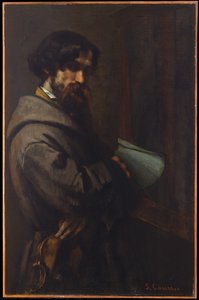
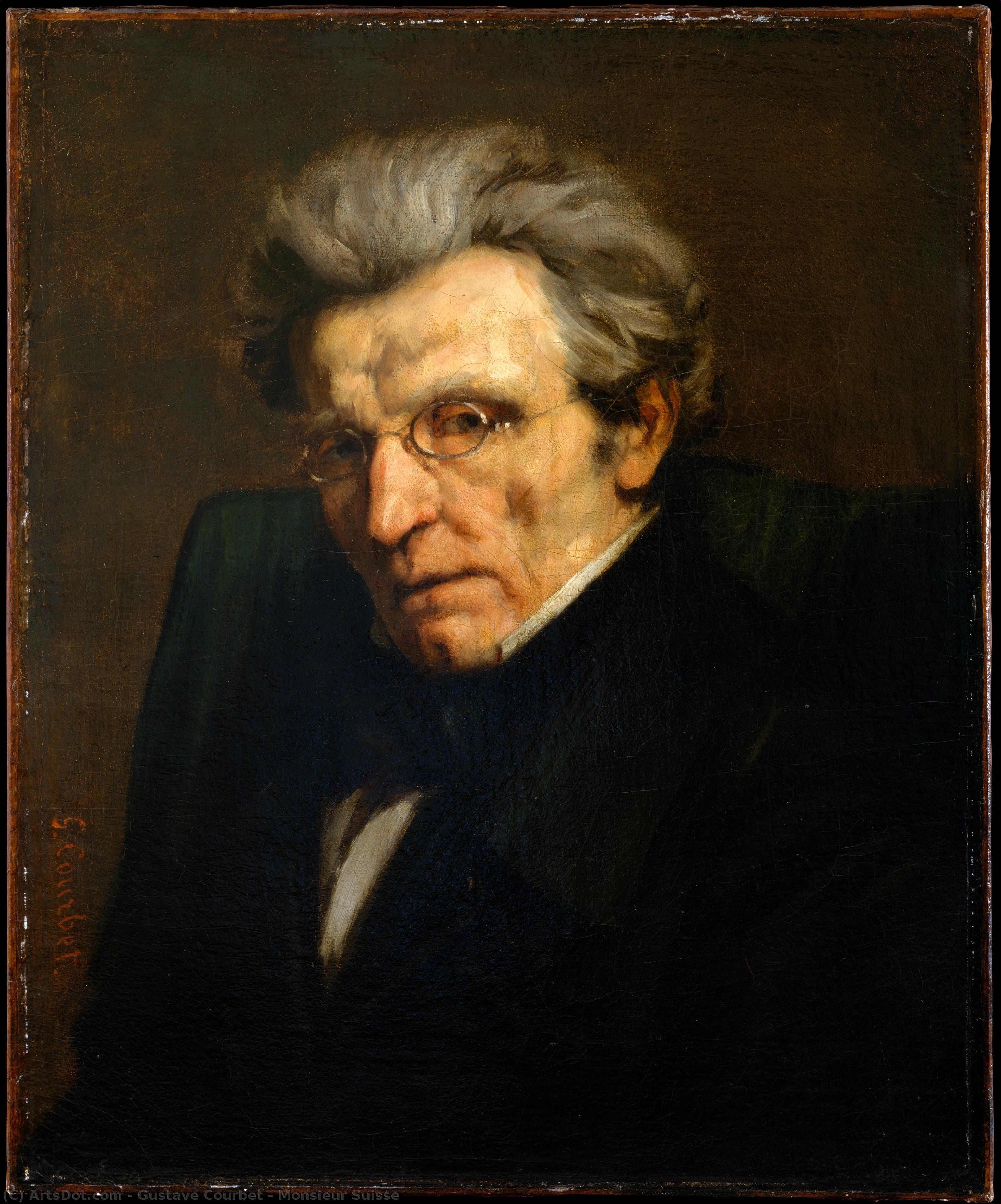
In the quiet intensity of Gustave Courbet’s 1861 masterpiece, Monsieur Suisse, we encounter more than just a portrait; we meet the very heartbeat of the Realist movement. This oil on canvas, a profound study of character, presents us with Martin François Suisse, a man whose life was inextricably linked to the bohemian spirit of 19th-century Paris. As Courbet captures him, we see a figure that transcends mere likeness, embodying an era of radical artistic shifts. The subject sits with a certain gravity, his gaze directed toward the viewer with a stern, contemplative expression that demands engagement. There is no attempt to soften his features or idealize his presence; instead, Courbet offers us a raw, unvarnished truth that serves as a cornerstone for anyone captivated by the power of honest observation.
The painting’s historical resonance is deeply rooted in the Académie Suisse, an informal and rebellious art school that provided a sanctuary for artists seeking to escape the rigid constraints of academic tradition. By choosing to immortalize Suisse—a man who served as a model and a patron to the burgeoning avant-garde—Courbet pays homage to the intellectual fervor of his youth. The portrait acts as a bridge between the old world of polished perfection and the new world of unadorned reality. For the collector or the lover of history, this piece offers a window into a time when art began to look directly at the faces of the people, finding beauty not in myth, but in the tangible textures of existence.
Mastery of Light and Materiality
Technically, Monsieur Suisse is a triumph of Courbet’s signature Realist style. The artist eschews the romanticized, ethereal light favored by his predecessors, opting instead for a diffused, naturalistic illumination that breathes life into the composition. This soft light dances across the subject's swept-back white hair and settles upon the heavy textures of his attire, highlighting the tactile quality of the black coat and the subtle sheen of his tie. Courbet’s brushwork is meticulous yet possesses an organic vitality; he employs tonal modulation to create a sense of profound depth and physical weight. The presence of the green upholstered chair behind him adds a splash of muted color that anchors the composition, providing a structural contrast to the dark, somber tones of the man's clothing.
Every stroke serves the purpose of conveying materiality. One can almost feel the weight of the fabric and the solidity of the sitter’s presence. This commitment to the physical essence of his subject is what makes a reproduction of this work so impactful for interior design. The painting possesses a quiet, commanding strength that can anchor a room, offering a sophisticated focal point that invites long periods of contemplation. It does not shout for attention with garish colors; rather, it commands respect through its understated elegance and the sheer integrity of its execution.
An Enduring Legacy for the Modern Collector
For the discerning interior designer or art enthusiast, Monsieur Suisse represents a perfect marriage of historical significance and aesthetic versatility. The painting’s palette—dominated by deep blacks, earthy tones, and subtle greens—complements a wide array of modern decor, from classical European estates to contemporary minimalist lofts. It brings an air of intellectual depth and "old-world" prestige to any space, acting as a conversation piece that speaks of rebellion, truth, and the enduring human spirit.
Owning a high-quality reproduction of this work is an opportunity to surround oneself with the legacy of a true revolutionary. Courbet’s ability to find the monumental within the everyday continues to inspire those who seek art that is both emotionally resonant and visually grounded. Monsieur Suisse remains a testament to the idea that the most profound truths are often found in the most direct observations, making it an essential acquisition for any collection dedicated to the transformative power of Realism.
Artist Biography
A Rebel’s Brush: The Life and Legacy of Gustave Courbet
Born in the quiet village of Ornans, France, in 1819, Jean Désiré Gustave Courbet emerged as a defiant force against the established artistic norms of his time. His story isn't simply one of paint and canvas; it’s a narrative woven with threads of social commentary, political conviction, and an unwavering commitment to portraying the world exactly as he saw it – unidealized, raw, and profoundly real. Growing up in a relatively prosperous bourgeois family, Courbet received encouragement from his mother to pursue his artistic inclinations, a nurturing that would ultimately fuel a revolution in the art world. His formal training began at the École des Beaux-Arts in Paris in 1839, but he quickly found himself chafing against the academic conventions and Romantic idealism prevalent there. While acknowledging influences like Eugène Delacroix and Théodore Géricault, Courbet forged his own path, one that prioritized observation over imagination and truth over tradition.The Birth of Realism: Challenging Artistic Conventions
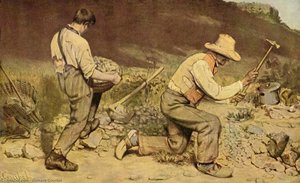
Courbet’s artistic development was marked by a deliberate rejection of the prevailing aesthetic standards. He wasn't interested in mythological narratives or heroic allegories; his gaze was fixed on the everyday lives of ordinary people, particularly those engaged in labor and rural existence. This commitment to depicting the world without embellishment – what would become known as Realism – initially met with scorn and derision from critics accustomed to more polished and idealized representations. Early works explored landscapes and portraits, but soon shifted towards scenes of working-class life, rendered on a monumental scale traditionally reserved for historical or religious paintings. This deliberate choice wasn’t merely stylistic; it was a statement about the inherent dignity and importance of these often-overlooked subjects. The Stone Breakers, completed in 1849 but tragically destroyed during World War II, exemplified this approach – a stark depiction of two laborers toiling away, their faces obscured by exhaustion and hardship. This painting, along with others like A Burial at Ornans (1850), challenged the very definition of what constituted “worthy” subject matter for high art.Major Works and Artistic Philosophy
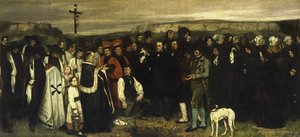
A Burial at Ornans, a colossal canvas depicting a provincial funeral, caused an uproar when it was exhibited in 1850-51. Its sheer size – typically reserved for grand historical paintings – combined with its unflinching realism and lack of emotional idealization shocked audiences. Courbet didn’t portray the mourners as noble or grief-stricken figures; he presented them as ordinary people, their faces etched with a mixture of sorrow, boredom, and resignation. This honesty was revolutionary. His artistic philosophy extended beyond subject matter to encompass technique. He favored a direct, impasto style – applying paint thickly onto the canvas – that emphasized the materiality of the medium itself. The Painter’s Studio (1855), an allegorical work reflecting his artistic beliefs and engagement with contemporary social issues, further solidified his reputation as a provocative and independent artist. His participation in the Salon des Refusés in 1863 – an exhibition of works rejected by the official Salon – cemented his status as a rebel and champion of artistic freedom. Even landscapes like View in the Forest of Fontainebleau (1855) were imbued with a sense of realism, capturing the natural beauty of the forest without romanticizing it.Legacy and Historical Significance
Gustave Courbet’s influence on subsequent art movements is undeniable. While he drew inspiration from earlier masters like Caravaggio for their dramatic realism and use of light and shadow, his impact extended far beyond mere imitation. He profoundly influenced the Impressionists and Post-Impressionists by liberating them from the constraints of traditional representation, encouraging them to explore new ways of seeing and depicting the world. His emphasis on social commentary paved the way for later socially engaged artists who used their work as a platform for political activism. Courbet wasn’t just a painter; he was a vocal advocate for artistic freedom and political change, actively participating in the tumultuous events of his time, including the Paris Commune of 1871 – an involvement that led to a period of exile in Switzerland. He died in 1877, leaving behind a body of work that continues to inspire and provoke audiences today.- Pioneer of Realism
- Challenged academic conventions
- Influenced Impressionism & Post-Impressionism
- Advocate for artistic freedom
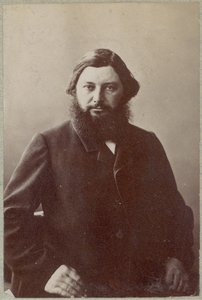
Gustave Courbet
1819 - 1877 , France
Quick Facts
- Artistic Movement Or Style: Realism
- Artists Or Movements Influenced By This Artist:
- Impressionism
- Post-Impressionism
- Artists Who Influenced This Artist:
- Delacroix
- Géricault
- Caravaggio
- Date Of Birth: July 31, 1819
- Date Of Death: April 29, 1877
- Full Name: Gustave Courbet
- Nationality: French
- Notable Artworks:
- The Stone Breakers
- A Burial at Ornans
- The Painter's Studio
- Place Of Birth: Ornans, France
Related Articles
25 Klimt Masterpieces: A Journey Through Iconic Art & Decor
Delve into the world of Gustav Klimt with our top 25 masterpieces! Explore his iconic paintings – 'The Kiss,' 'Portrait of Adele,' and more. Discover museum-quality reproductions & curated decor ideas. Explore the full collection online at ArtsDot.com.
Academic Realism's Finest: 10 Masterpieces for Art Lovers & Home Decor
Explore 10 defining Academic Realism masterpieces by Bouguereau, Gérôme & Cabanel. Discover the stories behind these iconic paintings and bring timeless art into your home with museum-quality reproductions from ArtsDot.com. Explore the full collection online!
Gustave Courbet: Realism's Revolutionary Vision & the Social Canvas of 19th-Century France
Explore the revolutionary art of Gustave Courbet, pioneer of Realism. Discover his iconic paintings, social commentary, and lasting impact on 19th-century French art history. Expert analysis & insights.
Romantic Realism's Finest: 10 Masterpieces for Your Home | ArtsDot
Explore 10 defining masterpieces of Romantic Realism! Discover Courbet, Millet & Daumier's powerful paintings—capturing emotion and social realities. Find museum-quality reproductions for your home at ArtsDot.com.

Academic Realism: Technique, History & Enduring Influence on Art
Explore the captivating world of Academic Realism! Discover key artists, techniques & its lasting impact on art history. Expert insights & high-quality reproductions at ArtsDot.