 Preview
 Send
Send Share
Share
 Details

 Download
 Similars
 X-Ray
X-Ray Diaporama
 Stats
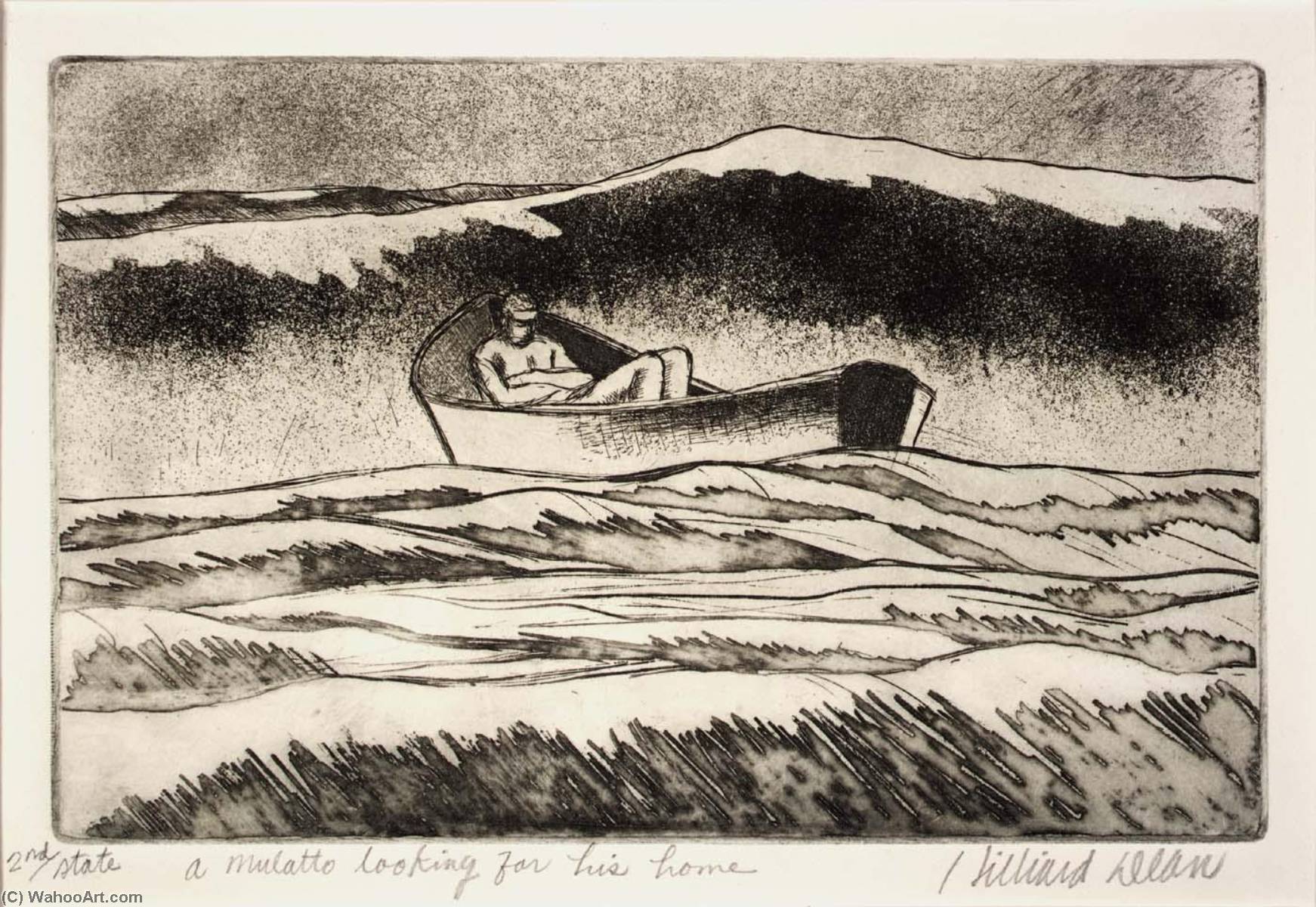
StatsA Mulatto Looking for His Home
 Contemporary Realism
 1969
1969 18.0 x 27.0 cm
 Read More
Giclée / Art Print
Museum-quality giclée or canvas print with fast production and flexible finish options. ( Buy Hand Made Painting Switch to Digital Image)




































Pick from our preset sizes that match the artwork's original proportions.

You may enter your own dimensions to fit a specific frame or space. If your selected size does not match the original image's proportions, we will either crop the artwork or extend the image with a mirrored or solid-fill edge. A digital mockup will be sent for your approval before production begins.
Please note that the on-screen preview does not reflect the actual cropping or extension. Only the mockup will accurately show the final composition.
While custom sizes are available, we recommend selecting a dimension from the predefined list to preserve the original proportions.
Worldwide Delivery () in 2 weeks instead of standard 4/5 weeks. (8 September)

Free Worldwide Express Shipping

High-Quality Linen Canvas

Full Shipping Insurance

Customs Tax Refund Guarantee

True Color Matching Guarantee

100-Day Return Policy (Defects Only)

100% Money-Back Guarantee

Bulk Discount Offer
 Glass option is only available in size under 110 CM

A Mulatto Looking for His Home
Giclée / Art Print
Reproduction Size
-


Total Price
$ 63
Artist Background
Hilliard Dean was an American artist known for his contributions to the Postwar and Contemporary art movements. His work often addressed issues of racism, inequality, and social justice, making him a prominent figure in the art world. The Smithsonian American Art Museum has an extensive collection of his artworks, including A Mulatto Looking for His Home.Painting Analysis
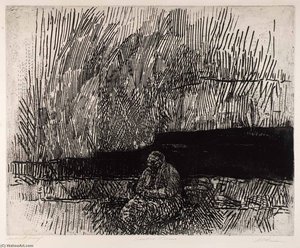
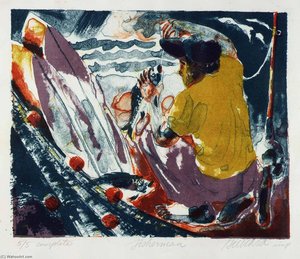
The painting depicts a mulatto man in a boat, lost in thought as he navigates through the water. The use of black and white hues creates a sense of melancholy and introspection, drawing the viewer into the subject's emotional state. The composition is simple yet powerful, with the man's figure positioned centrally, surrounded by the vastness of the sea.Artistic Style
Hilliard Dean's artistic style is characterized by his use of lithography and aquatint techniques, which create a unique texture and visual effect. His work often features bold lines, geometric shapes, and a limited color palette, giving his paintings a distinctive look. For more information on the artist's style and technique, visit ArtsDot.com.Conclusion
A Mulatto Looking for His Home is a significant painting that showcases Hilliard Dean's artistic skill and social commentary. The artwork is a powerful exploration of identity, belonging, and social justice, making it a valuable addition to any art collection. To learn more about the artist and his work, visit the Smithsonian American Art Museum or explore the extensive collection of artworks on ArtsDot.com.Some of Hilliard Dean's notable works include:
- Untitled (C)
- Strick up the Band
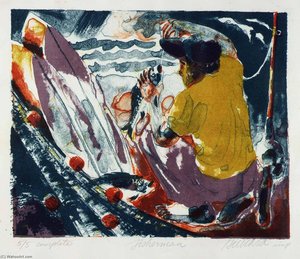
- Fisherman
Related Artworks


Artist Biography
The Quiet Observer: The Artistic Journey of Hilliard Dean
In the vast and often turbulent landscape of twentieth-century American art, certain voices emerge not through loud proclamations, but through a profound, quiet resonance. Hilliard Reynolds Dean, born in Washington, D.C., in 1933, belongs to this rare category of artists whose work serves as a meticulous mirror to the human condition. While his biographical details may remain somewhat enigmatic to the casual observer, his presence in the American canon is firmly established through a body of work that balances technical precision with an aching sensitivity to the social fabric of his era. His journey, which saw him move from the urban heart of the nation's capital to establishing himself as a respected educator and painter in Ohio, reflects a life dedicated to the disciplined study of light, shadow, and the subtle complexities of identity.
Dean’s artistic development was deeply rooted in the tradition of careful observation. He did not merely seek to replicate the world, but to interpret its emotional weight through meticulous realism. This approach drew significant inspiration from the masters of the Impressionist and Realist movements, particularly Eugène Boudin and Gustave Courbet. From these predecessors, Dean inherited a devotion to plein air sensibilities and an unflinching honesty in depicting ordinary subjects. His technique became a sophisticated language of tonal gradations and nuanced color palettes, allowing him to capture the atmospheric essence of a scene—conveying not just the visual reality of a landscape or a portrait, but the underlying psychological temperature of the moment.
Narratives of Identity and Social Resonance
Beyond the technical mastery of his brush and printmaking tools, Dean’s work is profoundly significant for its engagement with the social and political currents of the Postwar and Contemporary periods. He possessed a remarkable ability to distill complex, often heavy, narratives into compositions that were deceptively simple yet emotionally arresting. His graphic works, particularly his etchings and aquatints, allowed him to explore themes of racial injustice, inequality, and the search for belonging with a poignant, stark clarity.
One of his most enduring achievements is the 1969 etching series, "A Mulatto Looking for His Home." This work stands as a powerful testament to his commitment to social commentary, using the interplay of black and white hues to evoke a sense of melancholy and introspection. Through this piece, Dean addressed the profound struggles of identity and the search for place within a fractured society. His ability to weave such heavy themes into the texture of his prints ensured that his work would resonate far beyond the gallery walls, touching upon the very heart of the American experience.
A Legacy Captured in Light and Form
The breadth of Dean’s oeuvre is characterized by a seamless transition between the figurative and the abstract, as well as between landscape and genre scenes. His celebrated paintings, such as "Fisherman" (1968) and "Strick up the Band," serve as evocative windows into rural American life. In these works, one finds a dedication to capturing the essence of labor and human connection, rendered with a precision that honors the dignity of his subjects. Whether through the textured surfaces of his lithographs or the atmospheric depth of his oil paintings, Dean’s legacy is defined by several key artistic pillars:
- Technical Versatility: His mastery over diverse media, including etching, aquatint, and painting, allowed for a wide range of expressive textures.
- Social Integrity: A steadfast commitment to addressing issues of race and social justice through a lens of humanistic empathy.
- Observational Depth: An ability to transform everyday scenes—from the movement of water to the stillness of a portrait—into profound meditations on existence.
- Historical Significance: His inclusion in prestigious collections, such as the Smithsonian American Art Museum, cements his role as a vital contributor to the narrative of African-American and American art history.
Ultimately, the work of Hilliard Dean invites the viewer into a state of contemplation. He remains an artist who found greatness in the small, the overlooked, and the everyday, leaving behind a visual record that is as much about the beauty of the seen world as it is about the depth of the unseen soul.
Quick Facts
- Artistic Movement Or Style: Realistic Painting Style
- Full Name: Hilliard Dean
- Nationality: American
- Notable Artworks:
- Fisherman
- Strick up the Band
- A Mulatto Looking for His Home
- Place Of Birth: Washington, District of Columbia
Related Articles

Etching: A Historical Survey of Technique, Aesthetic Qualities & Enduring Artistic Significance
Explore the rich history of etching, from its origins to Rembrandt's masterful innovations. Discover the technique, aesthetic qualities & enduring legacy of this captivating art form. Expert insights for collectors and enthusiasts.

American Realism's Defining Works: 10 Masterpieces for Your Home
Explore 10 defining American Realism masterpieces – Hopper, Homer & more. Discover the stories behind these iconic paintings and bring timeless art to your home with ArtsDot's museum-quality reproductions. Explore the full collection online.

Grant Wood & American Regionalism: Identity, Myth & the Rural Landscape
Explore the world of Grant Wood & American Regionalism with ArtsDot. Discover the symbolism behind 'American Gothic', recurring themes, and the movement's lasting impact on art history. High-quality reproductions available.

Etching Masters: 10 Legendary Prints That Revolutionized Art | ArtsDot
Journey through 10 legendary etching masterpieces by Rembrandt, Dürer & Goya. Explore the history of printmaking and discover timeless art for your home. Find museum-quality reproductions at ArtsDot.com.

The Intricate World of Etching: A Historical Survey of Technique, Aesthetic Evolution, and Enduring Artistic Impact
Explore the rich history of etching, from its origins to modern practice. Discover techniques, key artists like Rembrandt, and insights for collectors. A comprehensive guide by ArtsDot.