 Preview
 Send
Send Share
Share
 Details

 Download
 Similars
 X-Ray
X-Ray Diaporama
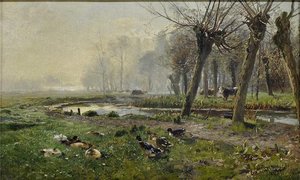
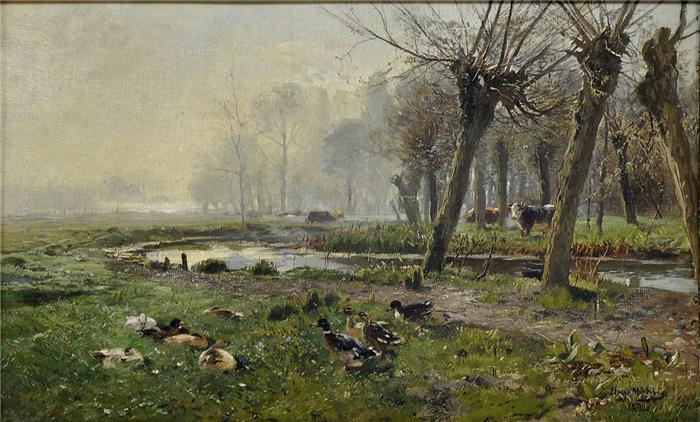
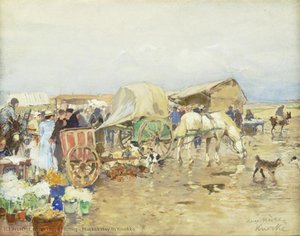
Lower Rhine Landscape (also known as Niederrheinische Landschaft)
 1890
1890 36.0 x 59.0 cm
 Read More
Giclée / Art Print
Museum-quality giclée or canvas print with fast production and flexible finish options. ( Buy Hand Made Painting Buy Image)




































Pick from our preset sizes that match the artwork's original proportions.

You may enter your own dimensions to fit a specific frame or space. If your selected size does not match the original image's proportions, we will either crop the artwork or extend the image with a mirrored or solid-fill edge. A digital mockup will be sent for your approval before production begins.
Please note that the on-screen preview does not reflect the actual cropping or extension. Only the mockup will accurately show the final composition.
While custom sizes are available, we recommend selecting a dimension from the predefined list to preserve the original proportions.
Worldwide Delivery () in 2 weeks instead of standard 4/5 weeks. (26 August)

Free Worldwide Express Shipping

High-Quality Linen Canvas

Full Shipping Insurance

Customs Tax Refund Guarantee

True Color Matching Guarantee

60-Day Return Policy (Defects Only)

100% Money-Back Guarantee

Bulk Discount Offer
 Glass option is only available in size under 110 CM

Lower Rhine Landscape (also known as Niederrheinische Landschaft)
Giclée / Art Print
Reproduction Size
-


Total Price
$ 63
Related Artworks










Artist Biography
A Legacy of Light: The Life and Art of Hugo Mühlig
In the golden era of German Impressionism, few artists captured the ephemeral dance of sunlight upon the rural landscape as poignantly as Hugo Mühlig. Born in Dresden in 1854, Mühlig was destined for a life steeped in pigment and canvas. He was a child of artistic lineage, the son of the esteemed landscape painter Meno Mühlig and the nephew of Bernhard Mühlig. This familial immersion provided him with an early, intimate education in the nuances of nature, yet his journey would eventually transcend the traditional boundaries of his upbringing to embrace the vibrant, breathing energy of the Impressionist movement.
Mühlig’s formal training began under the watchful eye of his father before he transitioned to the prestigious Dresden Academy of Fine Arts. It was here, specifically as a master-student under Viktor Paul Mohn between 1877 and 1880, that his technical foundation was solidified. While his early drawings remained anchored in the meticulous realism of the school of Ludwig Richter, a restless creative spirit began to stir within him. He sought to move beyond mere anatomical or botanical accuracy, yearning instead to capture the atmospheric soul of a moment—the way heat shimmers over a field or how a sudden breeze disturbs a cluster of wildflowers.
The Düsseldorf Years and the Impressionist Shift
From 1881 onwards, Mühlig’s life became inextricably linked with the vibrant artistic community of Düsseldorf. This period marked his most significant stylistic evolution. Moving away from the rigid constraints of academic convention, he began to explore the picturesque landscapes of the Schwalm region and the Lower Rhine. As a freelance painter catering to the burgeoning art market rather than relying on state commissions, Müh lig possessed a unique freedom to experiment with light and color.
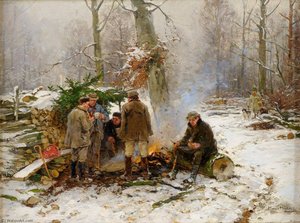
His technique became a fascinating duality of precision and spontaneity. At a distance, his works—often executed in small or medium formats—reveal an incredible attention to detail and a perfect reproduction of material textures. However, upon closer inspection, the viewer discovers a masterful use of impressionistic brushwork. He utilized short, virtuoso strokes to create a sense of movement and luminosity. His subjects—farmers, hunters, musicians, and travelers at fairgrounds—were rarely static; they were characters caught in the radiant, unadulterated glow of bright sunlight, a technique that echoes the brilliance found in the works of Monet and Renoir.
Themes of Rural Vitality and Lasting Significance
The heart of Mühlig’s oeuvre lies in his profound sensitivity toward the human experience within the natural world. He did not merely paint landscapes; he painted lives lived within them. His canvases are populated by the rhythmic pulse of rural existence, portraying everyday individuals immersed in their labors or leisure with an emotional resonance that transcends simple visual representation. Whether it is a quiet moment of respite during a winter chill or the bustling energy of a summer market, Mühlig’s work celebrates the dignity and beauty of the common man.
Though much of his work remains in private collections due to his independent career path, his historical significance is cemented by the presence of his masterpieces in major institutions, including:
- The Neue Galerie Berlin
- The Kunstmuseum Düsseldorf
- The Neue Galerie Kassel
- The Wallraf-Richartz-Museum in Cologne
Hugo Mühlig remains a pivotal figure of the late Victorian era, representing a bridge between the disciplined realism of the German tradition and the emotive, light-drenched freedom of Impressionism. His ability to marry meticulous detail with the fleeting essence of light ensures that his paintings continue to breathe with life, offering modern viewers a window into a luminous, sun-drenched past.
hugo mühlig
1854 - 1929
Quick Facts
- Artistic Movement Or Style: Impressionism
- Artists Or Movements Influenced By This Artist:
- Monet
- Renoir
- Artists Who Influenced This Artist:
- Ludwig Richter
- Viktor Paul Mohn
- Date Of Death: 1929
- Full Name: Hugo Mühlig
- Nationality: German
- Notable Artworks:
- Market day in Knokke
- The Hunters' Breakfast
- Medieval Houses
- Place Of Birth: Dresden, Germany