 Preview
 Send
Send Share
Share
 Details

 Download
 Similars
 X-Ray
X-Ray Diaporama
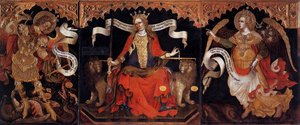
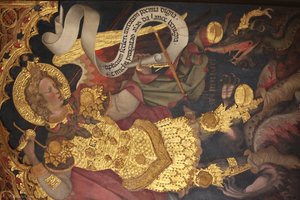
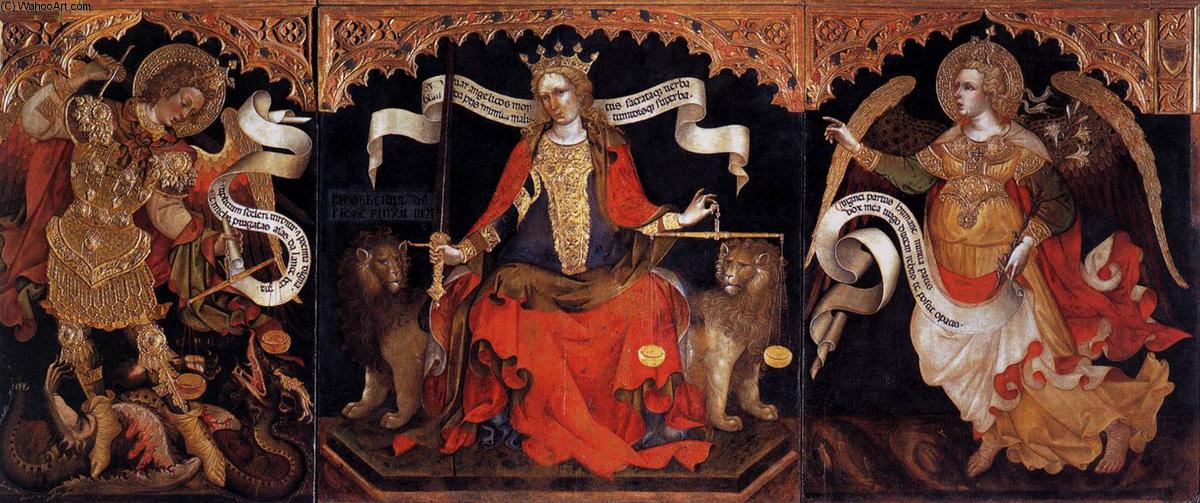
Justice between the Archangels Michael and Gabriel
 Tempera
- Gothic
 1421
1421 208.0 x 490.0 cm
 Gallerie dell'Accademia
 Read More
Hand Made Oil Reproduction
Hand-painted oil on canvas in your size and frame, made to order by our artists. ( Buy Print Buy Image)




P118B $10

P118H $10

P118W $10

P438Z $10

P508JH $12

P508YH $12

P805H $10

P805Z $10

P919BZ $10

P919G $10

P919XJ $10

P959ZH $10

P968JZ $12

W106C $8

W218G $10

W218JH $8

W218Y $10

W307PJ $10

W316G $10

W316PJ $8

W316Y $10

W398PJ $8

W4111J $10

W500HY $15

W500JH $15

W692G $12

W849H $8

W940BG $15

W953PJ $8




Pick from our preset sizes that match the artwork's original proportions.

You may enter your own dimensions to fit a specific frame or space. If your selected size does not match the original image's proportions, we will either crop the artwork or extend the painting with additional hand-painted elements. A digital mockup will be sent for your approval before production begins.
Please note that the on-screen preview does not reflect the actual cropping or extension. Only the mockup will accurately show the final composition.
While custom sizes are available, we recommend selecting a dimension from the predefined list to preserve the original proportions.
After order, ArtsDot.com team will email client for instructions and provide a mockup preview
Worldwide Delivery () in 3/4 weeks instead of standard 5 weeks. (17 August). No compromise on quality.

Free Worldwide Express Shipping

High-Quality Linen Canvas

Full Shipping Insurance

Customs Tax Refund Guarantee

True Color Matching Guarantee

60-Day Return Policy (Defects Only)

100% Money-Back Guarantee

Bulk Discount Offer
 Glass option is only available in size under 110 CM

Justice between the Archangels Michael and Gabriel
Reproduction Medium
Reproduction Size
-


Total Price
$ 288
Artwork Description
A Vision of Divine Authority – Justice Between the Archangels Michael and Gabriel
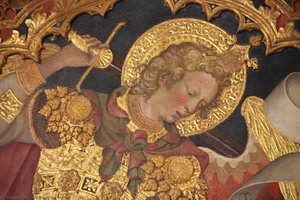
Jacobello del Fiore’s “Justice between the Archangels Michael and Gabriel,” painted in 1421, is more than just a religious panel; it's a vibrant distillation of Venetian artistic sensibilities at the cusp of the Renaissance. This triptych, currently housed within the Galleria dell’Accademia in Venice, offers a profound glimpse into the city’s burgeoning artistic identity – a synthesis of Byzantine grandeur, Gothic formality, and the nascent humanism that would soon dominate European art. The scene unfolds with arresting clarity: a regal woman, embodying Justice herself, is seated at the heart of the composition, framed by two towering archangels—Michael on the left, Gabriel on the right—engaged in a silent dialogue of divine authority.
The panel’s immediate impact lies in its rich color palette – deep reds and golds dominate, punctuated by earthy browns that ground the scene. These hues aren't merely decorative; they evoke a sense of solemnity and power, mirroring the weighty themes at play. The artist masterfully employs linear perspective, creating a shallow depth of field that draws the viewer’s eye directly to the central figure, elevating her importance within the narrative. The meticulous detailing in the drapery, the intricate patterns on the banners, and the carefully rendered faces all contribute to an atmosphere of opulent grandeur.
A Bridge Between Styles: Del Fiore's Venetian Legacy
Understanding Jacobello del Fiore requires acknowledging his pivotal role as a transitional figure. Born around 1370 in Venice, he emerged during a period of significant artistic change. His early works, exemplified by the “Master of the Giovaneli Madonna,” demonstrate a clear debt to the Late Gothic style prevalent in Padua and other northern Italian cities – a style characterized by elongated figures, flattened perspective, and an emphasis on symbolic representation. However, Del Fiore quickly evolved, absorbing the innovations of Paolo Veneziano, a Venetian master known for his Byzantine-influenced compositions. This shift is particularly evident in “Justice,” where the linear clarity and refined modeling of form begin to assert themselves, foreshadowing the Renaissance’s embrace of naturalism.
Del Fiore's artistic journey reflects Venice itself – a city that served as a vital crossroads for trade, culture, and artistic exchange. The influence of Byzantine art is undeniable, particularly in the use of rich colors and the hierarchical arrangement of figures. Yet, he skillfully integrated these influences with the emerging Venetian style, creating a unique synthesis that defined his oeuvre. The panel’s creation coincided with Venice's rise as a major European power, and Del Fiore’s work reflects this city’s growing confidence and artistic ambition.
Symbolism Woven into the Divine Tapestry
The composition of “Justice” is laden with symbolic meaning. The central figure, often interpreted as representing Wisdom or Justice itself, holds a scroll and scepter – potent emblems of authority and governance. Her placement at the heart of the scene underscores her paramount importance within the divine order. The archangels Michael and Gabriel, flanking her, represent opposing forces—Michael, the protector and warrior, and Gabriel, the messenger and herald—engaged in a silent exchange of power. The lion beneath Justice’s throne is a traditional symbol of strength and courage, reinforcing the theme of righteous judgment.
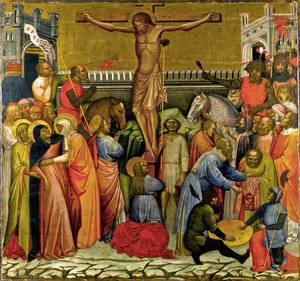
The inclusion of longinus, who lances Christ, and the centurion who orders Christ's legs to be broken, are further reminders of the sacrifice made for humanity. The banner bearing the image of the Virgin Mary adds another layer of religious significance, connecting the earthly realm with the divine. Every element within the panel contributes to a complex tapestry of symbolism, inviting contemplation on themes of faith, royalty, and spiritual governance.
A Timeless Masterpiece: Reproduction and Beyond
“Justice between the Archangels Michael and Gabriel” stands as a testament to Jacobello del Fiore’s artistic skill and his pivotal role in Venetian art history. Reproductions offer an accessible way to experience the beauty and complexity of this remarkable panel, bringing its rich symbolism and evocative atmosphere into any space. Whether adorning a grand salon or a smaller study, a high-quality reproduction captures the essence of Del Fiore's masterpiece—a timeless reminder of Venice’s artistic legacy and the enduring power of divine justice.
Related Artworks
Artist Biography
A Venetian Bridging Worlds: The Art of Jacobello del Fiore
Jacobello del Fiore, a name resonating softly through the annals of early Renaissance Venice, represents a pivotal moment in the city’s artistic evolution. Born around 1370 into a family steeped in the traditions of painting – his father, Francesco del Fiore, being a prominent figure within the Scuola dei Pittori – Jacobello inherited not just a profession but a legacy. He emerged during a period where the elegant, elongated forms and rich symbolism of the Gothic style were beginning to yield to the burgeoning humanism and naturalistic observation that would define the Renaissance. His work embodies this transition, a delicate balance between the fading medieval world and the dawn of a new artistic era. Venice itself, a vibrant crossroads of cultures and commerce, profoundly shaped his aesthetic, blending Byzantine influences with mainland Italian innovations.From Gothic Roots to Emerging Modernity
Jacobello’s early training undoubtedly took place within his father's workshop, alongside his brothers Nicola and Pietro. This formative period instilled in him a mastery of traditional techniques and an appreciation for the Late Gothic masters who dominated the artistic landscape of the time. Artists like Altichiero da Verona and Jacopo Avanzi cast a long shadow over Venetian painting, and their influence is readily apparent in Jacobello’s initial works. The “Crucifixion” held within the Matthiesen Collection stands as a testament to this early style – its composition dramatic, figures posed with expressive gestures, and colors applied with a vibrant intensity reminiscent of Altichiero's dynamic narratives. However, even within these early pieces, hints of a developing sensibility emerge. Around 1401, a subtle shift began to occur in Jacobello’s artistic approach. He started loosening the rigid constraints of Gothic formalism, placing greater emphasis on linear clarity and incorporating influences from Lombardy, particularly the work of Michelino da Besozzo. This wasn't a wholesale rejection of his earlier training but rather an expansion of his vocabulary, a willingness to experiment with new forms and ideas. This period saw him move towards what some scholars have termed a “neo-giottoesque” style, referencing the foundational influence of Giotto di Bondone while forging a distinctly Venetian interpretation.A Legacy in Paint: Key Works and Commissions
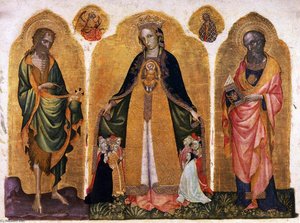
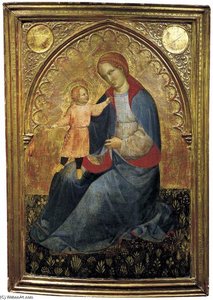
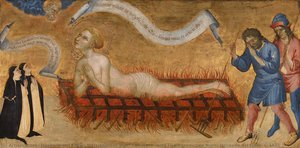
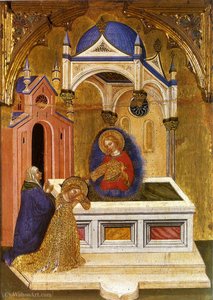
Throughout his career, Jacobello del Fiore received commissions primarily along the Adriatic coast and within Venice itself, reflecting the city’s extensive trade networks and cultural reach. The “Madonna and Child of Piazzo Giovaneli” is a particularly significant work from this period, often cited as emblematic of his evolving style and contributing to his recognition as an artist of considerable talent. The 1407 “Triptych of the Virgin of Mercy with Saints James and Anthony Abbot,” created for Pesaro, showcases his increasing engagement with Lombard influences, evident in the refined details and elegant drapery. Further demonstrating this stylistic development is the "Triptych of the Adoration of the Magi," now housed in Stockholm’s Nationalmuseum. Later works, such as the imposing “Justice between the Archangels Michael and Gabriel” (1421), reveal a mature artist at the height of his powers – a refined style characterized by intricate symbolism and meticulous attention to detail. The "Martyrdom of Saint Lawrence, with Two Benedictine Nuns" exemplifies his ability to depict complex narrative scenes with both emotional depth and technical skill. These commissions weren’t merely exercises in artistic expression; they were integral parts of the religious and civic life of Venice and its surrounding territories.Historical Significance and Enduring Influence
Jacobello del Fiore occupies a unique position within Venetian art history as a crucial link between the Late Gothic and early Renaissance periods. He wasn’t simply imitating existing styles; he was actively synthesizing them, creating something new and distinctly Venetian. While deeply indebted to mainland masters, he developed a local aesthetic that contributed significantly to the artistic identity of Venice. His ability to adapt and incorporate diverse influences while maintaining his own unique voice makes him a pivotal figure in understanding the transition from medieval to Renaissance art in Italy. The work of scholars like Andrea de Marchi has been instrumental in solidifying Jacobello’s place within the artistic canon, particularly through identifying him as the “Master of the Giovaneli Madonna” and connecting disparate early works under a unified authorship. His paintings are not merely beautiful objects; they are windows into a moment of profound cultural change, reflecting the intellectual ferment and artistic innovation that characterized Venice during this transformative era. Jacobello del Fiore’s legacy lies in his ability to bridge worlds, to honor tradition while embracing modernity, and to create art that continues to resonate with beauty and meaning centuries later.
Jacobello del Fiore
1370 - 1439 , Italy
Quick Facts
- Artistic Movement Or Style: Gothic & Renaissance
- Artists Or Movements Influenced By This Artist: ['Venetian style']
- Artists Who Influenced This Artist:
- Altichiero da Verona
- Jacopo Avanzi
- Michelino da Besozzo
- Date Of Birth: c. 1370
- Date Of Death: 1439
- Full Name: Jacobello del Fiore
- Nationality: Italian
- Notable Artworks:
- Crucifixion
- Madonna and Child
- Triptych of Mercy
- Adoration Magi
- Justice Triptych
- Saint Lawrence
- Place Of Birth: Venice, Italy
Related Articles
High Medieval Art: 10 Masterpieces That Shaped an Era | ArtsDot
Journey through High Medieval Art! Explore 10 iconic masterpieces – from Giotto's frescoes to stunning Gothic cathedrals. Discover the stories behind these timeless paintings, sculptures & illuminated manuscripts. Find museum-quality art reproductions at ArtsDot.com.
Late Medieval Masterpieces: 10 Artworks That Defined an Era | ArtsDot
Journey through 10 defining Late Medieval masterpieces – from Giotto's frescoes to Jan van Eyck’s realism. Explore the stories, techniques & vibrant colors of Gothic art. Find museum-quality reproductions and elevate your home decor with ArtsDot.com! Discover all masterpieces on ArtsDot.com
The Radiant Dusk of Medieval Vision: Exploring Late Gothic Art's Synthesis of Faith, Form & Emotionality (c. 1300-1500)
Explore the exquisite beauty & spiritual depth of Late Gothic art (c. 1300-1500). Discover key artists, symbolism, and its lasting influence on the Renaissance. Expert insights at ArtsDot.
The Shadow of Faith: Exploring Gothic Art's Spiritual Intensity & Architectural Innovation
Explore the spiritual intensity & architectural innovation of Gothic art! Discover the symbolism behind cathedrals, stained glass & master artists like Giotto and Monet. A deep dive into medieval history & artistic expression.
Beyond Borders: The Spiritual & Stylistic Innovations of International Gothic Art
Explore the exquisite beauty & spiritual depth of International Gothic art. Discover key artists like Simone Martini & Pol de Limbourg, its origins, symbolism, and lasting influence on European painting. Expert insights at ArtsDot.