 Preview
 Send
Send Share
Share
 Details

 Download
 Similars
 X-Ray
X-Ray Diaporama
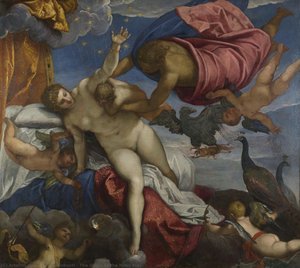
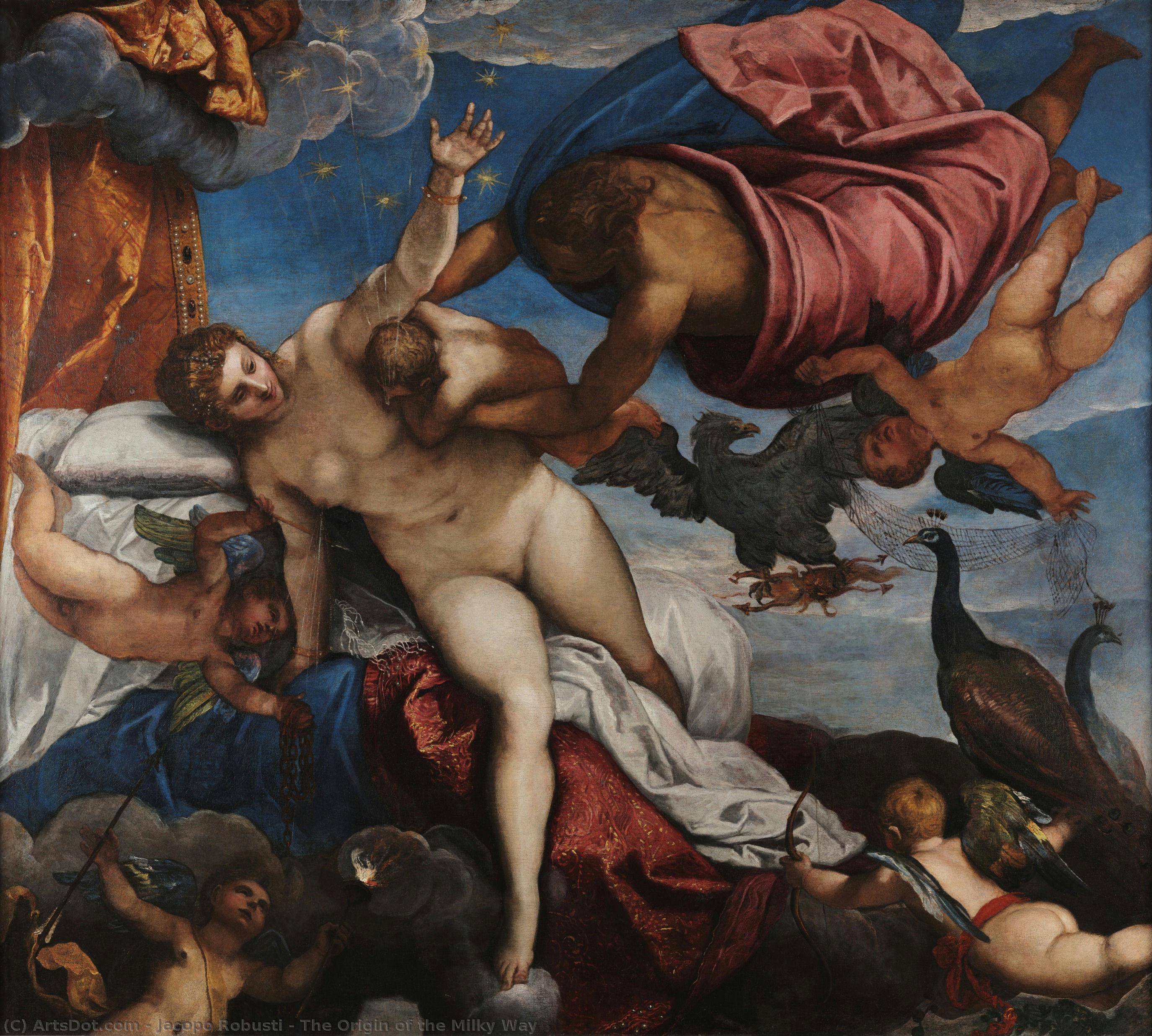
The Origin of the Milky Way
 Oil On Canvas
- WallArt
- Venetian Mannerism
 1575
1575- Renaissance
 149.0 x 168.0 cm
 National Gallery
 Read More
Hand Made Oil Reproduction
Hand-painted oil on canvas in your size and frame, made to order by our artists. ( Buy Print Buy Image)




P118B $10

P118H $10

P118W $10

P438Z $10

P508JH $12

P508YH $12

P805H $10

P805Z $10

P919BZ $10

P919G $10

P919XJ $10

P959ZH $10

P968JZ $12

W106C $8

W218G $10

W218JH $8

W218Y $10

W307PJ $10

W316G $10

W316PJ $8

W316Y $10

W398PJ $8

W4111J $10

W500HY $15

W500JH $15

W692G $12

W849H $8

W940BG $15

W953PJ $8




Pick from our preset sizes that match the artwork's original proportions.

You may enter your own dimensions to fit a specific frame or space. If your selected size does not match the original image's proportions, we will either crop the artwork or extend the painting with additional hand-painted elements. A digital mockup will be sent for your approval before production begins.
Please note that the on-screen preview does not reflect the actual cropping or extension. Only the mockup will accurately show the final composition.
While custom sizes are available, we recommend selecting a dimension from the predefined list to preserve the original proportions.
After order, ArtsDot.com team will email client for instructions and provide a mockup preview
Worldwide Delivery () in 3/4 weeks instead of standard 5 weeks. (23 August). No compromise on quality.

Free Worldwide Express Shipping

High-Quality Linen Canvas

Full Shipping Insurance

Customs Tax Refund Guarantee

True Color Matching Guarantee

60-Day Return Policy (Defects Only)

100% Money-Back Guarantee

Bulk Discount Offer
 Glass option is only available in size under 110 CM

The Origin of the Milky Way
Reproduction Medium
Reproduction Size
-


Total Price
$ 263
Artwork Description
A Celestial Genesis in Venetian Color
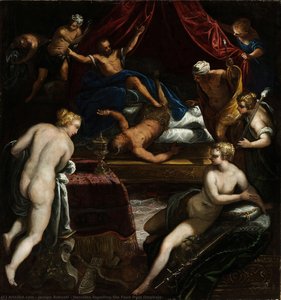
In the heart of the National Gallery in London hangs a masterpiece that transcends the boundaries of mere paint and canvas, inviting the viewer into a cosmic event of unparalleled drama. Jacopo Tintoretto’s “The Origin of the Milky Way,” executed around 1575, is not simply an astronomical observation but a profound meditation on the very moment of creation. As one gazes upon this monumental work, the eyes are immediately drawn to the central figure: a woman poised in the throes of labor, her form serving as the vessel for a divine incarnation. This is a scene where the earthly and the ethereal collide, as if the heavens themselves were being birthed through human experience. The composition is a swirling, energetic tapestry of life, where angels descend from the clouds and naked men engage in acts of worship, all while birds soar upward toward an unfolding sky. It is a visual symphony that captures the breathtaking tension between the physical struggle of birth and the infinite expansion of the universe.
The emotional resonance of this piece lies in its ability to evoke both awe and intimacy. For the collector or the interior designer, this artwork offers more than just a focal point; it provides a window into the soul of the Venetian Renaissance. The painting’s subject matter—rooted in the idea of divine genesis—speaks to themes of renewal, fertility, and the eternal cycle of life. There is an inherent movement within the frame that prevents the eye from resting, instead encouraging a continuous journey through the layers of light and shadow. To possess a reproduction of such a work is to bring a sense of profound cosmic energy into a space, transforming a room into a sanctuary of contemplation and intellectual depth.
The Revolutionary Hand of the Venetian Master
To understand the impact of this painting, one must look closely at the revolutionary technique employed by Jacopo Robusti, known to history as Tintoretto. Moving away from the balanced, static perfection of the High Renaissance, Tintoretto embraced a style characterized by rapid, vigorous brushstrokes and an almost restless energy. He was a master of the alla prima method, applying paint directly to the canvas with an immediacy that captures fleeting moments of light and motion. This approach allows the pigments to appear as though they are still vibrating on the surface. His use of iridescent glazes creates an ethereal glow, particularly in the way the stars seem to spill from the heavens, mimicking the very substance of the Milky Way itself.
The technique is inseparable from the symbolism. The dramatic use of light—a precursor to the chiaroscuro that would define the Baroque era—serves to highlight the theological weight of the scene. The shadows are not merely dark spaces but are filled with mystery and the unknown, while the highlights represent divine grace descending upon the world. For those seeking to decorate a sophisticated interior, the interplay of these luminous pigments offers a rich, textured aesthetic that complements both classical and contemporary settings. A high-quality reproduction of this masterpiece preserves that essential "flicker" of light, ensuring that the dramatic intensity and the painterly texture of Tintoretto’s genius can inspire and captivate anyone fortunate enough to live alongside it.
Related Artworks


Artist Biography
early life and training
jacopo robusti, also known as tintoretto, was an italian painter identified with the venetian school. he was born in venice in 1518 and his father was a dyer. tintoretto is known to have had at least one sibling, a brother named domenico robusti. he is believed to have originated from brescia, in lombardy, then part of the republic of venice.artistic style and influences
tintoretto's artistic style was characterized by his bold brushwork and inventiveness in composition. he was influenced by the works of michelangelo, but ultimately spent most of his career rejecting the high renaissance style with his own approach.notable works
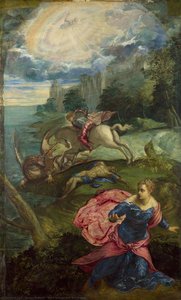
- saint george and the dragon (158 x 100 cm, national gallery, london, oil on canvas), a painting that showcases tintoretto's unique ability to capture the essence of a place.
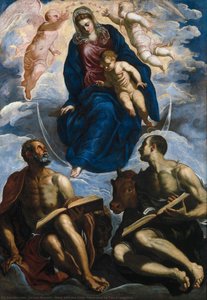
- mary with the child, venerated by two evangelists (160 x 228 cm, canvas), a work that demonstrates tintoretto's mastery of light and shadow.
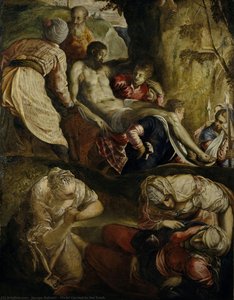
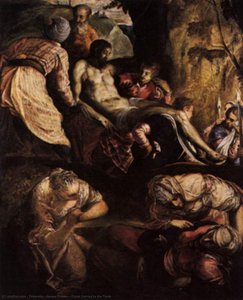
- christ carried to the tomb (scottish national gallery, edinburgh, oil on canvas), a painting that exemplifies tintoretto's boldness and inventiveness in composition.
museums and collections
tintoretto's works can be found in various museums around the world, including the gallerie dell'accademia (venezia, italy), the national gallery (london, united kingdom), and the scottish national gallery (edinburgh, scotland).legacy
tintoretto remains one of the most prolific italian painters of the venetian school, known for his bold brushwork and inventiveness in composition. his legacy continues to inspire artists and art enthusiasts alike.- view more works by jacopo robusti on ArtsDot.com
- read more about the venetian school and its notable artists on wikipedia

jacopo robusti
1518 - 1594 , Italy
Quick Facts
- Artistic Movement Or Style: Late Renaissance, Mannerism, Venetian school
- Artists Or Movements Influenced By This Artist: ['Paolo Veronese']
- Artists Who Influenced This Artist:
- Titian
- Michelangelo
- Giovanni Francesco Caroto
- Date Of Birth: c. 1518, Venice, Italy
- Date Of Death: May 31, 1594, Venice, Italy
- Full Name: Jacopo Robusti Tintoretto
- Nationality: Italian
- Notable Artworks:
- The Worship of Venus
- Assumption of the Virgin
- Last Supper (San Giorgio Maggiore)
- Origin of the Milky Way
- Place Of Birth: Venice, Italy
Related Articles

Jacopo Tintoretto's Masterpieces: 25 Paintings That Define Venetian Drama | ArtsDot
Explore 25 breathtaking masterpieces by Jacopo Tintoretto, the Venetian master of drama and light. Discover the stories behind iconic Renaissance paintings & find museum-quality art reproductions to elevate your home decor on ArtsDot.com.
The Golden Light of Innovation: Exploring the Venetian Renaissance Art Movement (1430–1580)
Explore the Golden Age of Venetian art (1430–1580). Discover Giorgione, Titian & Tintoretto's techniques, the 'colorito' revolution, and lasting influence. Expert insights for collectors & enthusiasts.

Jacopo Palma il Giovane: A Venetian Master's Poetic Evolution
Explore the captivating world of Jacopo Palma il Giovane, a pivotal Venetian Renaissance master. Discover his unique style, influenced by Titian & Tintoretto, and learn about key works perfect for discerning collectors.
Venetian Splendor: Transform Your Home with the Timeless Elegance of Italian Renaissance Masterpieces
Transform your home with the luminous beauty of Venetian Renaissance masterpieces. ArtsDot.com offers exquisite, hand-painted oil reproductions and custom portraits that bring timeless Italian splendor to any space. Discover expert art consultation and bespoke elegance today.
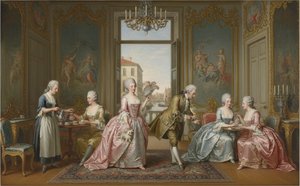
Pietro Longhi's Venetian Scenes: A Study of Rococo Society & Domestic Life
Explore the captivating world of Pietro Longhi's Venetian scenes! Discover insightful analysis of his Rococo masterpieces & social commentary on 18th-century life. Learn about this 'Venetian Hogarth' and his lasting artistic legacy.