 Preview
 Send
Send Share
Share
 Details

 Download
 Similars
 X-Ray
X-Ray Diaporama
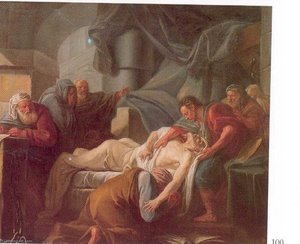
L'EVANOUISSEMENT


 Read More
Hand Made Oil Reproduction
Hand-painted oil on canvas in your size and frame, made to order by our artists. ( Buy Print Buy Image)




P118B $10

P118H $10

P118W $10

P438Z $10

P508JH $12

P508YH $12

P805H $10

P805Z $10

P919BZ $10

P919G $10

P919XJ $10

P959ZH $10

P968JZ $12

W106C $8

W218G $10

W218JH $8

W218Y $10

W307PJ $10

W316G $10

W316PJ $8

W316Y $10

W398PJ $8

W4111J $10

W500HY $15

W500JH $15

W692G $12

W849H $8

W940BG $15

W953PJ $8




Pick from our preset sizes that match the artwork's original proportions.

You may enter your own dimensions to fit a specific frame or space. If your selected size does not match the original image's proportions, we will either crop the artwork or extend the painting with additional hand-painted elements. A digital mockup will be sent for your approval before production begins.
Please note that the on-screen preview does not reflect the actual cropping or extension. Only the mockup will accurately show the final composition.
While custom sizes are available, we recommend selecting a dimension from the predefined list to preserve the original proportions.
After order, ArtsDot.com team will email client for instructions and provide a mockup preview
Worldwide Delivery () in 3/4 weeks instead of standard 5 weeks. (17 August). No compromise on quality.

Free Worldwide Express Shipping

High-Quality Linen Canvas

Full Shipping Insurance

Customs Tax Refund Guarantee

True Color Matching Guarantee

60-Day Return Policy (Defects Only)

100% Money-Back Guarantee

Bulk Discount Offer
 Glass option is only available in size under 110 CM

L'EVANOUISSEMENT
Reproduction Medium
Reproduction Size
-


Total Price
$ 413
Artwork Description
The Echoes of Everyday Life: An Encounter in Shadow and Light
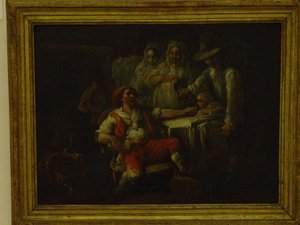
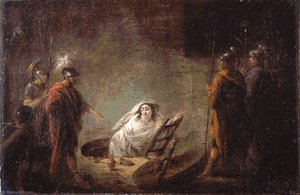
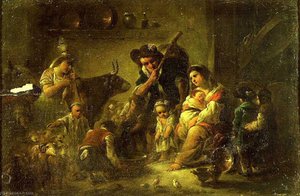
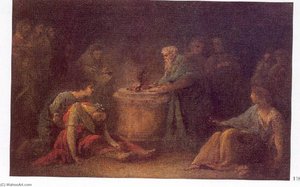
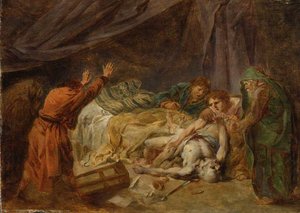
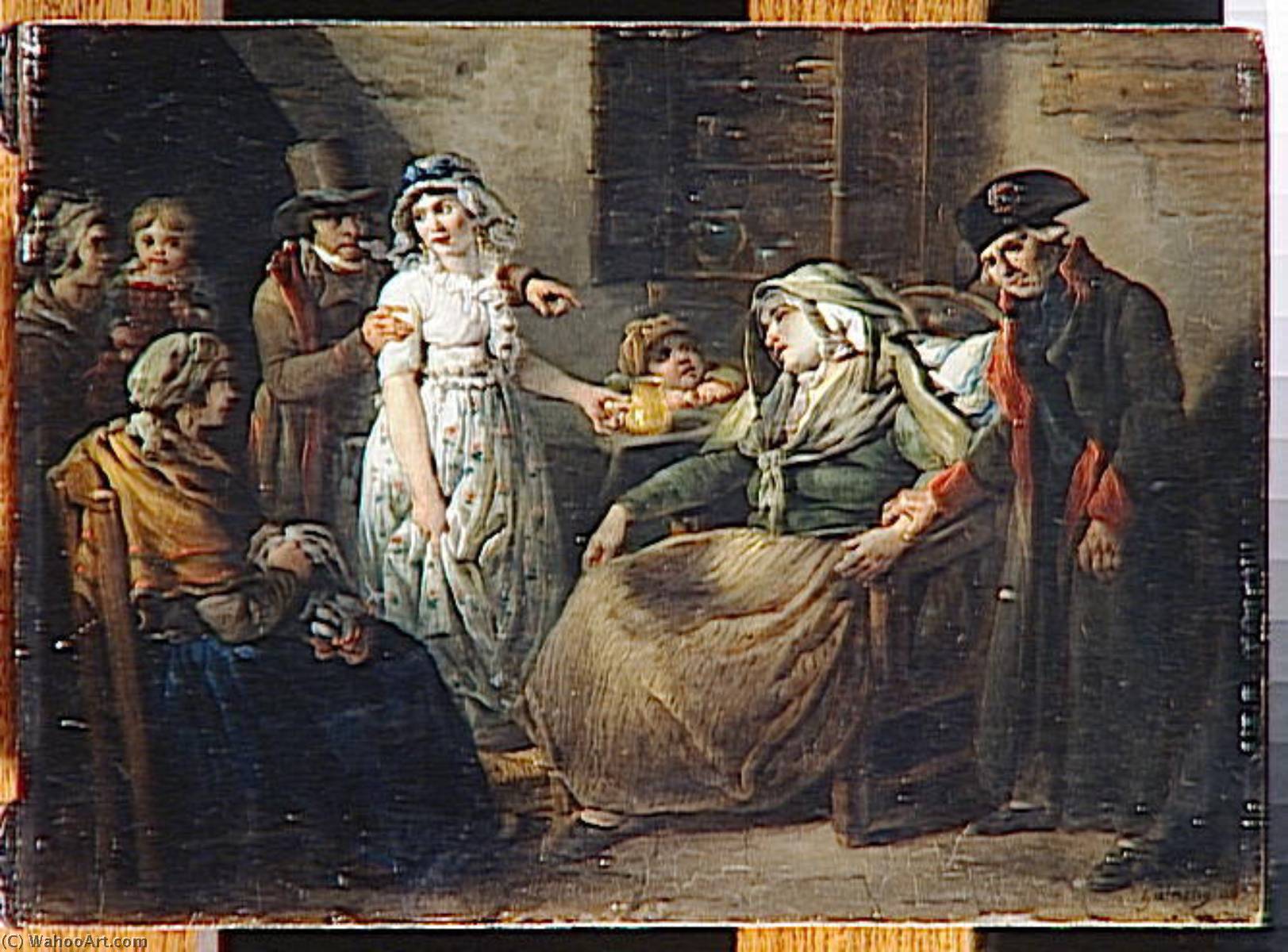
To stand before L'Évanouissement is to step unceremoniously into the smoky embrace of a late eighteenth-century gathering place, a scene rendered with the poignant immediacy of memory itself. This painting does not merely depict a room; it captures a moment suspended in time—a confluence of human drama played out against the backdrop of muted earth tones and deep shadow. The composition is richly populated, drawing the viewer into its crowded intimacy. At the heart of the tableau lies a tender, yet fraught interaction: a woman, perhaps embodying the resilience of poverty, cradles a child while being approached by a man whose gesture suggests either charity or transaction. These figures anchor the narrative, compelling us to question the nature of the exchange unfolding before our eyes.
Mastery in Technique and Atmosphere
The technical brilliance evident in this work is remarkable, showcasing an artist deeply versed in the nuances of oil paint on canvas. Observe how the light behaves; it is not a uniform wash but a dramatic, directional beam that carves figures out of the surrounding gloom. This masterful use of chiaroscuro lends the entire scene a palpable weight and emotional gravity. The visible brushwork speaks to a traditional hand, suggesting an artist who treated paint not just as pigment, but as texture—the rough weave of coarse fabric, the yielding softness of skin, the dark gleam of polished wood. While the overall perspective possesses a certain flatness characteristic of the period, it is counterbalanced by the organic clustering of forms and the subtle foreshortening that pulls the eye deep into the background recesses.
Historical Resonance and Social Commentary
Dating to an era where genre painting flourished as a mirror to society, L'Évanouissement functions as more than mere decoration; it is social commentary rendered with profound empathy. The atmosphere is thick with unspoken narratives—the weary resignation etched upon some faces contrasts sharply with the fleeting amusement seen in others. This depiction of daily life, particularly one tinged with hardship or social unrest, invites contemplation on class divides and human dignity. It speaks to a time when public spaces served as both theaters for pleasure and stark arenas for survival.
Symbolism of Despair and Connection
The symbolism woven throughout the piece is subtle but pervasive. The muted palette of browns, grays, and ochres establishes a tone of melancholy, suggesting lives lived under duress. Yet, these somber tones are punctuated by warmer accents—a splash of red in a garment or the flush on a cheek—which serve to draw our focus back to the core human connections. The child held aloft becomes a potent symbol: innocence juxtaposed against the gritty reality surrounding it. It is an invitation for the collector, or the designer seeking authentic depth for their space, to consider not just the beauty of the rendering, but the weight of the story it carries.
Bringing the Masterpiece Home
For those who wish to incorporate this evocative mood into a modern interior, acquiring a high-quality reproduction allows one to harness the emotional power and technical finesse of Gamelin’s vision. Imagine this scene illuminated in your drawing-room or gallery—the drama of the light playing across the texture of the canvas, transforming a mere wall hanging into a focal point of contemplation. It is an artwork that whispers tales of humanity's enduring spirit amidst the shadows.
Related Artworks
Artist Biography
A Life Unexpected: The Artistic Journey of Jacques Gamelin
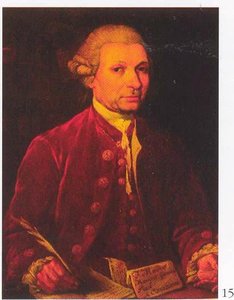
Jacques Gamelin, born in the vibrant city of Carcassonne, France, in 1738, embarked on a path far removed from the world of art. Initially destined for commerce as the son of a successful merchant, his early life was steeped in the practicalities of trade. A Jesuit education provided him with a solid foundation, but it was his entry into the service of Nicolas Joseph de Marcassus, Baron de Puymaurin, that proved to be the pivotal moment shaping his destiny. Puymaurin, a discerning patron, quickly recognized Gamelin’s lack of aptitude for business and instead perceived a nascent artistic talent yearning to bloom. This recognition defied familial expectations; Gamelin's father initially resisted the notion of formal art training. However, Puymaurin’s unwavering belief in his protégé led him to personally finance Gamelin’s education at the Académie Royale de Toulouse.From Toulouse to Rome: Cultivating a Classical Style
Five years of dedicated study at the Académie culminated in Gamelin winning its prestigious first prize, opening doors to further refinement in Paris. Yet, it was with Puymaurin’s continued generosity that Gamelin truly flourished, traveling to Rome – the heart of artistic innovation and historical reverence. There, he immersed himself in the world of classical masters under the tutelage of two towering figures: Jacques-Louis David, champion of Neoclassical severity and civic virtue, and Joseph-Marie Vien, known for his elegant simplicity and focus on line. This period profoundly influenced Gamelin’s developing style, instilling a deep appreciation for anatomical precision, dramatic composition, and narrative clarity. He eventually achieved the distinction of becoming a painter to Pope Clement XIV, a testament to his growing skill and reputation.A Return to Toulouse: Teaching and The ‘Nouveau Recueil’
The unexpected inheritance following his father's death dramatically altered Gamelin’s circumstances, transforming him from a financially dependent artist into a man of independent means. He returned to Toulouse, not merely as an established painter but also as a dedicated educator, taking up a teaching position at the Académie Royale. However, it is for a singular work that Jacques Gamelin is most remembered today: the Nouveau Recueil d’Ostéologie et de Myologie. This ambitious project, funded by his inheritance, was far more than a simple anatomical atlas. It stands as a remarkable fusion of scientific accuracy and artistic imagination. The plates showcase not only detailed depictions of bones and muscles but also striking scenes imbued with symbolism – resurrections, crucifixions, and even playful skeletons engaging in macabre revelry.Battle Scenes and Engravings: A Legacy of Dramatic Storytelling
Beyond the Nouveau Recueil, Gamelin’s artistic output centered on powerful paintings and engravings depicting battle scenes. These works, now found in museums across France, reveal a mastery of dynamic composition, emotional intensity, and meticulous detail. He captured not just the physical chaos of warfare but also the underlying human drama – courage, sacrifice, and the brutal realities of conflict. His skill as an engraver further disseminated his images, allowing a wider audience to experience his compelling narratives. The vignettes adorning the title pages and throughout the Nouveau Recueil, featuring battles and encounters with death, demonstrate his versatility and penchant for evocative storytelling.Historical Significance: Bridging Science and Art
Jacques Gamelin occupies a unique position in art history. He wasn’t solely a painter of grand historical narratives or a meticulous anatomical illustrator; he was an artist who seamlessly blended these seemingly disparate disciplines. His Nouveau Recueil, with its arresting imagery, transcends the boundaries of scientific documentation and enters the realm of allegorical expression. While his battle scenes showcase a command of classical technique, they also reflect the turbulent era in which he lived. Gamelin’s legacy lies not only in the beauty and skill of his individual works but also in his ability to synthesize art, science, and storytelling into a cohesive and compelling vision – a testament to an artistic journey born from unexpected circumstances and nurtured by unwavering patronage.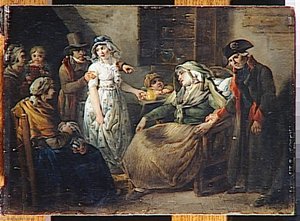
jacques gamelin
1738 - 1803
Quick Facts
- Artistic Movement Or Style: Neoclassical, Battle scenes
- Artists Or Movements Influenced By This Artist: ['Goya']
- Artists Who Influenced This Artist:
- Jacques-Louis David
- Joseph-Marie Vien
- Date Of Birth: October 3, 1738
- Date Of Death: October 12, 1803
- Full Name: Jacques Gamelin
- Nationality: French
- Notable Artworks:
- Les Soeurs de la Charité
- Vieillard inconnu
- Les Vestales Générosité
- Place Of Birth: Carcassonne, France
Related Articles

Rococo's Radiant Legacy: 10 Masterpieces for Your Home |
Indulge in the elegance of Rococo! Explore 10 masterpieces by Fragonard, Boucher & Watteau. Discover the stories behind these iconic paintings and bring timeless art to your home with museum-quality reproductions from .

The Rococo Aesthetic: Opulence, Rebellion & the Pursuit of Pleasure in 18th-Century Art
Explore the opulent world of Rococo art! Discover its origins, key artists like Watteau & Boucher, and lasting influence on design. Expert insights for collectors & enthusiasts.

The Enduring Legacy of Oil on Canvas: Technique, History & Aesthetic Impact
Explore the rich history & techniques of oil painting – from Renaissance masters to Impressionism. Discover pigments, layering methods, and why this timeless medium endures. Expert insights for artists & art enthusiasts.

Oil on Canvas: A Historical & Technical Exploration of a Timeless Artistic Medium
Explore the rich history & enduring techniques of oil painting on canvas. Discover the science behind its longevity, conservation practices, and contemporary relevance. Expert insights for art enthusiasts.
Reflections of an Age: Social Commentary & Artistic Representation in 18th-Century Society
Explore the social commentary & artistic representation of 18th-century society. Discover Rococo masterpieces, portraiture's power, and shifting historical perspectives. Expert insights for art lovers.