 Preview
 Send
Send Share
Share
 Details

 Download
 Similars
 X-Ray
X-Ray Diaporama
Stańczyk
 Oil On Canvas
- WallArt
- Romanticism
 1862
1862- 19th Century
 88.0 x 120.0 cm
 Muzeum Narodowe
 Read More
Hand Made Oil Reproduction
Hand-painted oil on canvas in your size and frame, made to order by our artists. ( Buy Print Buy Image)




P118B $10

P118H $10

P118W $10

P438Z $10

P508JH $12

P508YH $12

P805H $10

P805Z $10

P919BZ $10

P919G $10

P919XJ $10

P959ZH $10

P968JZ $12

W106C $8

W218G $10

W218JH $8

W218Y $10

W307PJ $10

W316G $10

W316PJ $8

W316Y $10

W398PJ $8

W4111J $10

W500HY $15

W500JH $15

W692G $12

W849H $8

W940BG $15

W953PJ $8




Pick from our preset sizes that match the artwork's original proportions.

You may enter your own dimensions to fit a specific frame or space. If your selected size does not match the original image's proportions, we will either crop the artwork or extend the painting with additional hand-painted elements. A digital mockup will be sent for your approval before production begins.
Please note that the on-screen preview does not reflect the actual cropping or extension. Only the mockup will accurately show the final composition.
While custom sizes are available, we recommend selecting a dimension from the predefined list to preserve the original proportions.
After order, ArtsDot.com team will email client for instructions and provide a mockup preview
Worldwide Delivery () in 3/4 weeks instead of standard 5 weeks. (17 August). No compromise on quality.

Free Worldwide Express Shipping

High-Quality Linen Canvas

Full Shipping Insurance

Customs Tax Refund Guarantee

True Color Matching Guarantee

60-Day Return Policy (Defects Only)

100% Money-Back Guarantee

Bulk Discount Offer
 Glass option is only available in size under 110 CM

Stańczyk
Reproduction Medium
Reproduction Size
-


Total Price
$ 263
Artwork Description
A Portrait of Solitude and National Soul
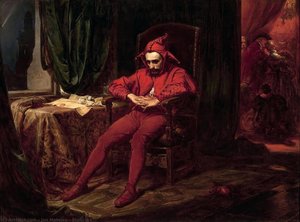
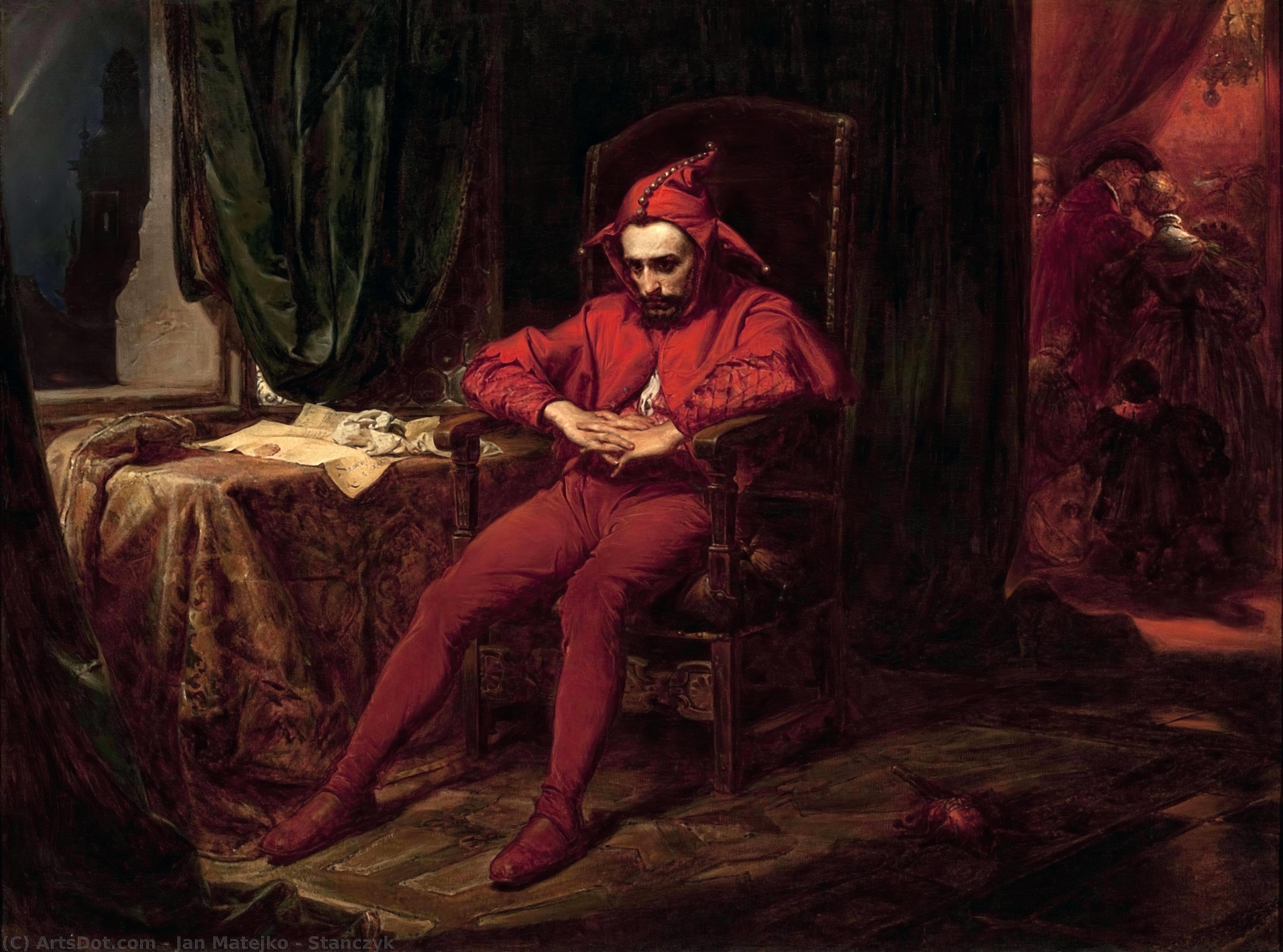
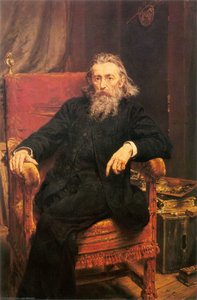
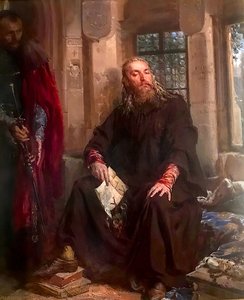
In the quiet, heavy atmosphere of Jan Matejko’s 1862 masterpiece, Stańczyk, one does not merely encounter a portrait, but a profound psychological landscape. The painting presents us with the legendary court jester, not in the midst of a comedic performance or a moment of levity, but captured in a state of deep, melancholic introspection. Seated alone amidst the opulence of a grand interior, his hands are tightly clasped, and his gaze wanders toward an unseen horizon, heavy with the weight of foreknowledge. This is not the face of a fool, but that of a visionary—a man who perceives the gathering shadows of political decline while those around him remain lost in the festivities of the moment.
The composition is a masterclass in Romantic Grandeur, where every element serves to heighten the emotional tension. Matejko utilizes a striking color palette dominated by the vibrant, commanding crimson of Stańczyk’s robe. This deep red acts as the visual heartbeat of the canvas, symbolizing both the resilience of the Polish spirit and the simmering passion of a man burdened by duty. The brilliance of this hue is set against a backdrop of somber, shadowy drapery and muted tones, creating a chiaroscuro effect that pulls the viewer’s eye directly into the sitter's contemplative expression. Through his expert use of impasto, Matejko breathes life into the fabric; the thick, textured layers of paint give the heavy velvet of the cloak a palpable weight, making the physical presence of the figure feel almost overwhelming.
Historical Echoes and Symbolic Depth
To understand Stańczyk is to understand the heartbeat of 19th-century Poland. Painted during a period of profound national mourning following the territorial losses of the Austro-Prussian War, the work serves as a silent, powerful protest. The setting—a scholarly and courtly environment suggested by the presence of manuscripts and fine furniture—contrasts sharply with the internal turmoil of the protagonist. While figures in the distant background appear engaged in the trivialities of social life, Stańczyk remains isolated by his wisdom. He embodies the "intellectual's burden," representing a nation that possesses the dignity and history to endure, yet faces an uncertain, fragmented future.
For the discerning collector or interior designer, this painting offers more than mere decoration; it provides a focal point of intellectual and emotional gravity. The meticulous attention to detail—from the intricate patterns on the floor to the subtle light reflecting off the scholarly documents—makes it an ideal centerpiece for spaces that demand character and narrative depth. Whether placed in a private library or a sophisticated contemporary salon, a high-quality reproduction of this work brings with it an aura of historical importance and a timeless conversation about resilience, wisdom, and the enduring strength of the human spirit.
Related Artworks

Artist Biography
early life and education
jan alojzy matejko, a renowned polish painter, was born on june 24, 1838, in kraków, poland. his father, franciszek ksawery matejko, was a czech-born tutor and music teacher. jan's early life was marked by the kraków revolution of 1846 and the 1848 siege of kraków by the austrians, events that would later influence his artistic themes. matejko attended st. ann's high school but dropped out in 1851 due to poor grades. however, he showed exceptional talent for art from an early age. he studied at the school of fine arts in kraków from 1852 to 1858, specializing in historical painting under the tutelage of wojciech korneli stattler and władysław łuszczkiewicz.artistic career
matejko's first major work, tsars shuyski before zygmunt iii, was completed in 1853. he began exhibiting his historical paintings at the kraków society of friends of fine arts in 1855. notable works include:- rejtan (1866): a large oil on canvas painting depicting a pivotal moment in polish history.
- union of lublin (1869): a significant piece showcasing matejko's skill in capturing historical events.
- battle of grunwald (1878): a masterpiece that highlights his ability to convey the intensity of battle scenes.
museological contributions and legacy
matejko spent most of his life in kraków, eventually becoming a director at the jan matejko academy of fine arts, formerly known as the kraków academy of fine arts. his students included prominent painters such as maurycy gottlieb, jacek malczewski, józef mehoffer, and stanisław wyspiański. notable works available on ArtsDot:- jan matejko: varna (romanticism)
- jan matejko: still life (romanticism)
- jan matejko: the union of lublin (298 x 512 cm, romanticism, oil on canvas)
references:
discovering the masterpieces of muzeum narodowe krakow, poland (wikipedia.org)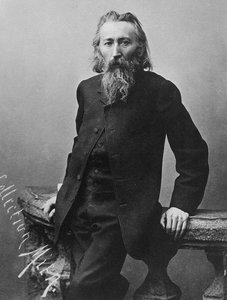
Jan Matejko
1838 - 1893 , Poland
Quick Facts
- Artistic Movement Or Style: Romanticism
- Artists Or Movements Influenced By This Artist: ['Maurycy Gottlieb']
- Artists Who Influenced This Artist:
- Wojciech Korneli Stattler
- Władysław Łuszczkiewicz
- Date Of Birth: June 24, 1838
- Date Of Death: November 1, 1893
- Full Name: Jan Alojzy Matejko
- Nationality: Polish
- Notable Artworks:
- Battle of Grunwald
- Union of Lublin
- Place Of Birth: Kraków, Poland
Related Articles
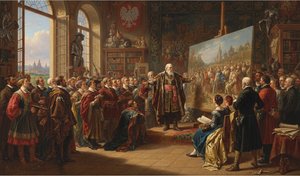
Jan Matejko: Historical Narrative & National Identity in 19th-Century Polish Painting
Explore the powerful historical paintings of Jan Matejko, Poland's national artist. Discover his iconic works & learn how he shaped Polish identity in the 19th century. High-quality reproductions available.
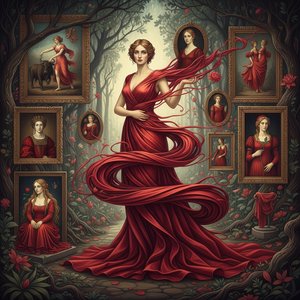
Crimson Threads of Narrative: Exploring Symbolism & Representation in Artworks Featuring the Red Dress
Explore the rich symbolism of the red dress in art history! From ancient power displays to iconic portraits like Cézanne’s 'Madame Cezanne', discover the cultural and artistic significance behind this captivating color. Expert analysis & insights.

The Enduring Legacy of Oil on Canvas: Technique, History & Aesthetic Impact
Explore the rich history & techniques of oil painting – from Renaissance masters to Impressionism. Discover pigments, layering methods, and why this timeless medium endures. Expert insights for artists & art enthusiasts.

Oil on Canvas: A Historical & Technical Exploration of a Timeless Artistic Medium
Explore the rich history & enduring techniques of oil painting on canvas. Discover the science behind its longevity, conservation practices, and contemporary relevance. Expert insights for art enthusiasts.

The Enduring Power of Painting: A Historical & Contemporary Exploration of Form and Emotion
Explore the rich history & enduring techniques of oil painting with ArtsDot. Discover masterpieces, learn about art collecting, and find authentic handmade reproductions crafted by skilled artists.
![The Battle of Grunwald [Tannenberg]](/media/artworks/images/thumbnails/3d/0e/3d0e7fdbfd494a6fa807757d11601cf9.jpg)