Menu
FREE ART CONSULTATION
PreviewPreview AR previewAR preview Buy Print Buy PrintBuy Image Buy Image SendSend
DetailsDetails Add to favorites Add to favorites DownloadDownload SimilarsSimilars X-RayX-Ray DiaporamaDiaporama

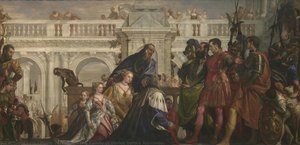
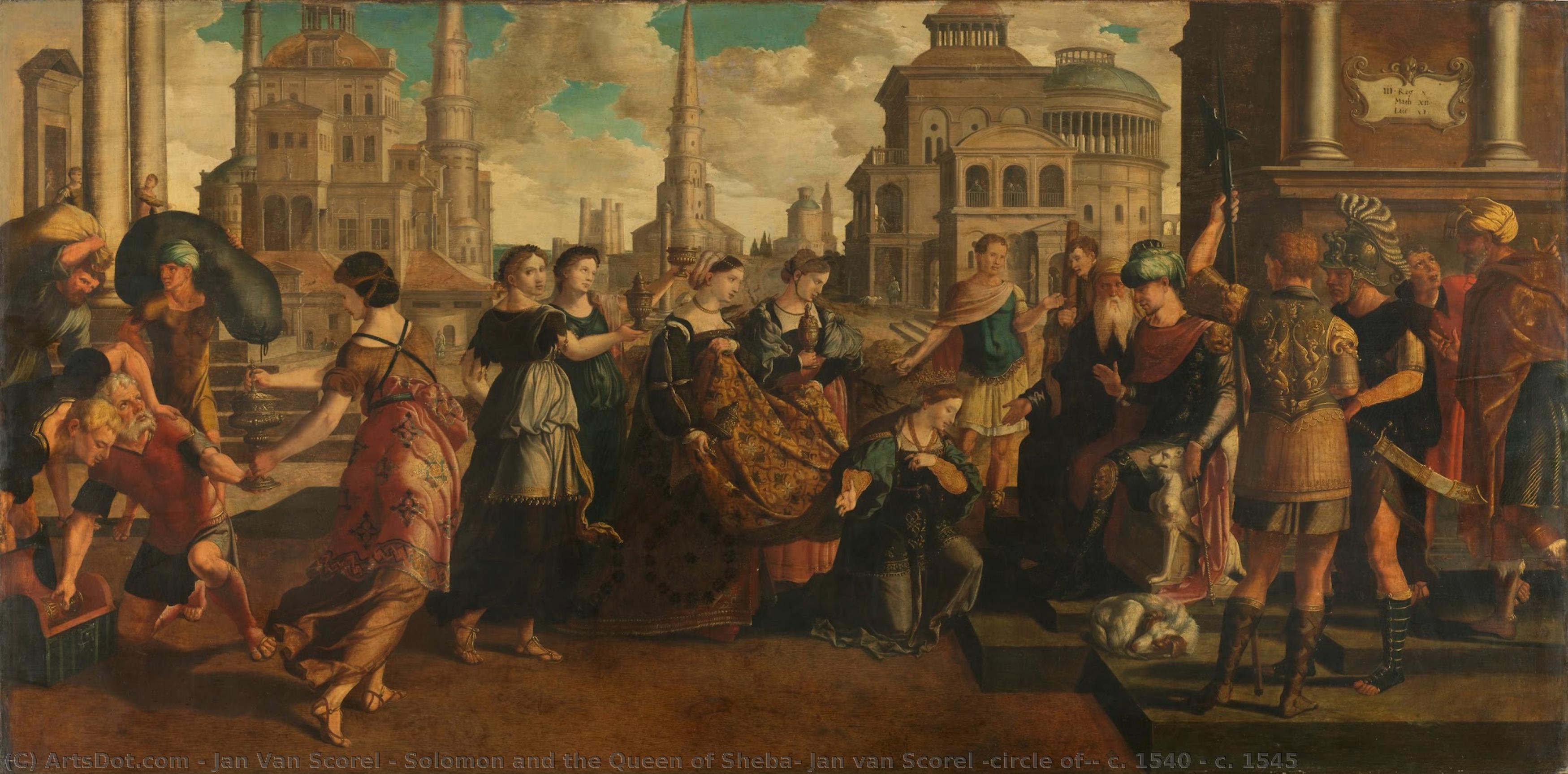
Solomon and the Queen of Sheba, Jan van Scorel (circle of), c. 1540 - c. 1545

  • Creation date1545
  • Dimensions96.0 x 194.0 cm

Explore Jan van Scorel's unique blend of Dutch & Italian Renaissance art! Discover his Romanist style, collaborations, & iconic works like 'Sippenaltar'. #arthistory #renaissance

Hand Made Oil Reproduction

Hand-painted oil on canvas in your size and frame, made to order by our artists. (Buy Print Buy PrintBuy Image Buy Image)

Standard
custom
CM
INCH

Pick from our preset sizes that match the artwork's original proportions.

width
height

You may enter your own dimensions to fit a specific frame or space. If your selected size does not match the original image's proportions, we will either crop the artwork or extend the painting with additional hand-painted elements. A digital mockup will be sent for your approval before production begins.
Please note that the on-screen preview does not reflect the actual cropping or extension. Only the mockup will accurately show the final composition.
While custom sizes are available, we recommend selecting a dimension from the predefined list to preserve the original proportions.

Examples of what can be changed: Replace face with customer photo; Add pet (e.g., replace cat with dog); Include hidden message in background; Change background landscape or elements.
After order, ArtsDot.com team will email client for instructions and provide a mockup preview

Worldwide Delivery () in 3/4 weeks instead of standard 5 weeks. (31 August). No compromise on quality.

why_choose_icon
Free Worldwide Express Shipping
why_choose_icon
High-Quality Linen Canvas
why_choose_icon
Full Shipping Insurance
why_choose_icon
Customs Tax Refund Guarantee
why_choose_icon
True Color Matching Guarantee
why_choose_icon
60-Day Return Policy (Defects Only)
why_choose_icon
100% Money-Back Guarantee
why_choose_icon
Bulk Discount Offer

Total Price

$ 263

reproduction

Solomon and the Queen of Sheba, Jan van Scorel (circle of), c. 1540 - c. 1545

Reproduction Medium

Reproduction Size

-

Total Price

$ 263

The painting depicts the Queen of Sheba’s meeting with Solomon, King of Israel, which is described in 1 Kings 10:1-10 and mentioned briefly in Matthew 12:42 and Luke 11:13 (as cited in the cartouche in the upper right corner; see Inscriptions). The Queen of Sheba had come to see whether Solomon’s fame was justified, and found that his ‘wisdom and prosperity’ even exceeded the reports she had heard earlier in her own land, which is thought to have been in eastern Africa. The queen is shown just to the right of centre, kneeling in deference before Solomon who is seated on a throne on a slightly raised podium. The two central personages are incorporated into a wide, multi-figured composition set against a backdrop of fanciful ‘classicising’ buildings. According to the biblical accounts, after the Queen of Sheba was satisfied that Solomon was a worthy ruler, she bestowed on him gifts of gold and great quantities of precious stones and spices, represented in this painting as the gifts held by the female servants. Hoogewerff was the first to propose an attribution of Solomon and the Queen of Sheba to Jan Swart,8 even though he himself questioned this attribution several years later.9 His first suggestion has nonetheless been maintained in the literature, but without any conclusive arguments by scholars. This is hardly surprising, since attributions to Jan Swart derive from only a very few monogrammed woodcuts and one drawing, and the picture of Swart’s painted oeuvre is still unclear.10 General similarities nonetheless exist to some works that have traditionally been given to this artist. The painting Hoogewerff cited for comparison, Bathsheba’s Bath in Cologne,11 while quite Scorelesque, shows a similar conception for background architecture. Jan Swart’s drawing Esther before Ahasuerus12 depicts a similar event and displays a similar convention for costume, although facial types differ. The closest compositional relationship, however, is between the figures on the right side of the Rijksmuseum painting and the ruler figure, his companions, the raised podium and dog in Jan van Scorel’s Martyrdom of St Lawrence, a work that is known only through copies.13 Scorel’s lost original, one of the altarpieces for the abbey of Marchiennes, dates from the same period that Hoogewerff gives for Solomon and the Queen of Sheba, c. 1540-45.14 The attribution of the Rijksmuseum painting is complicated by the fact that so many figures and motifs have been taken from Italianate sources, many of which could have been known through prints or workshop drawings or both. Hoogewerff pointed out a number of related motifs in Raphael’s Stanze and Loggia for the kneeling man on the left, the woman turning back to him, and the Queen of Sheba’s retinue.15 Baldassare Peruzzi’s fresco of Solomon and the Queen of Sheba (c. 1519), as known through an engraving by Marcantonio Raimondi (RP-P-OB-39.162),16 could have provided the general lines of the composition as well as the architectural background. Some of the figures, such as the man carrying a sack on his shoulders, reappear in Marcantonio Raimondi’s prints, such as the Man Carrying the Base of a Column (RP-P-OB-36.682), and in Jan van Scorel’s works, such as the boy kneeling on one knee in the foreground of the Lokhorst Triptych.17 Hoogewerff suggested that Mantegna’s frescoes in the church of the Eremetani in Padua provided the source for the standing soldier seen from behind on the right,18 but in fact this figure more probably derives from Marcantonio Raimondi’s print after a drawing by Peruzzi of the Triumph of Scipio (RP-P-OB-76.081).19 This print is also the source for the soldier standing just to the right. Although Hoogewerff proposed German influences for the architecture in Solomon and the Queen of Sheba,20 the extraordinary tapering towers in the background are closer to fantasy structures in a print series by Lambert Suavius dated 1560.21 Because Solomon with the Queen of Sheba was found together with Jan van Scorel’s Bathsheba (SK-A-670) in a government building in Groningen,22 it has long been assumed that the two paintings were pendants.23 Physical evidence supports this assumption. The format and measurements are close, although not identical. The panels have been constructed from three wider and one narrow plank, the latter in the same position in both paintings, just above the bottom plank. The planks in both panels have half-lap joins, which is a less common method of joining. Both panels have gouged cargo marks on their reverses, and these marks are similar in shape to each other, as well as to another in a painting that is close in date, the St Sebastian in Rotterdam dated 1542.24 This information indicates that the two panels were constructed as parts of the same commission. The brushstrokes detected in the preparatory stage are atypical of Scorel, but the white priming and black chalk underdrawing in Solomon and the Queen of Sheba link to the painting practices of Score../..

Artist Biography

early life and training

jan van scorel, a prominent dutch painter, was born in schoorl, netherlands, in 1495. his early life and training are not well-documented, but it is believed that he studied under various masters, including pieter gerritsz in haarlem, jacob cornelisz in amsterdam, or jan gossaert in utrecht.

career and influences

van scorel's travels took him to italy, where he absorbed the italian style of painting, becoming one of the early painters of the romanist style. his work was influenced by giorgione, and he also collaborated with maarten van heemskerck. van scorel's experiences in jerusalem are depicted in many of his later works, showcasing his unique blend of dutch and italian styles.

notable works and legacy

some of van scorel's notable works include:
  • sippenaltar (1520), completed in the village of obervellach
  • portraits, altarpieces, and landscapes, many of which were destroyed during the reformation iconoclasm
  • collaborations with maarten van heemskerck and michelangelo
van scorel's legacy is marked by his significant contributions to the dutch renaissance, introducing italian elements into netherlandish painting. his work can be seen in various museums, including the van gogh museum (netherlands), which also features an extensive collection of van gogh's works.

artistic style and significance

key aspects of van scorel's style:
  • blending of italian and dutch influences
  • use of romanist styles in netherlandish painting
  • collaborations with prominent artists of the time
van scorel's work is a testament to the cultural exchange and artistic innovation of the renaissance period. his legacy continues to inspire art enthusiasts and scholars alike.

further reading and resources

for more information on jan van scorel and his works, visit: note: the provided links are relevant to the topic and from the specified website (ArtsDot.com) and wikipedia. the article is formatted using the requested html tags, and the biography is written in english with a style suitable for an art expert academic writer.
Jan van Scorel

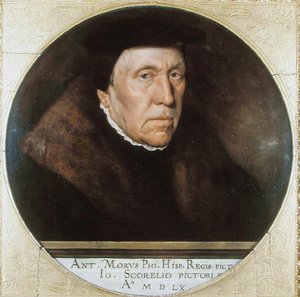
Jan van Scorel

1495 - 1562 , Netherlands

Quick Facts

  • Artistic Movement Or Style: Romanist, Renaissance
  • Artists Or Movements Influenced By This Artist:
    • Maarten van Heemskerck
    • Italian Renaissance
  • Artists Who Influenced This Artist:
    • Pieter Gerritsz
    • Jacob Cornelisz
    • Jan Gossaert
    • Giorgione
  • Date Of Birth: 1495-08-01
  • Date Of Death: 1562-12-06
  • Full Name: Jan van Scorel
  • Nationality: Dutch
  • Notable Artworks:
    • Sippenaltar
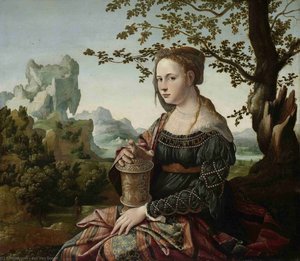
    • Mary Magdalene (Scorel)
  • Place Of Birth: Schoorl, Netherlands
Explore artworks organized by themes, styles, and characteristics.