 Preview
 Send
Send Share
Share
 Details

 Download
 Similars
 X-Ray
X-Ray Diaporama
 Stats
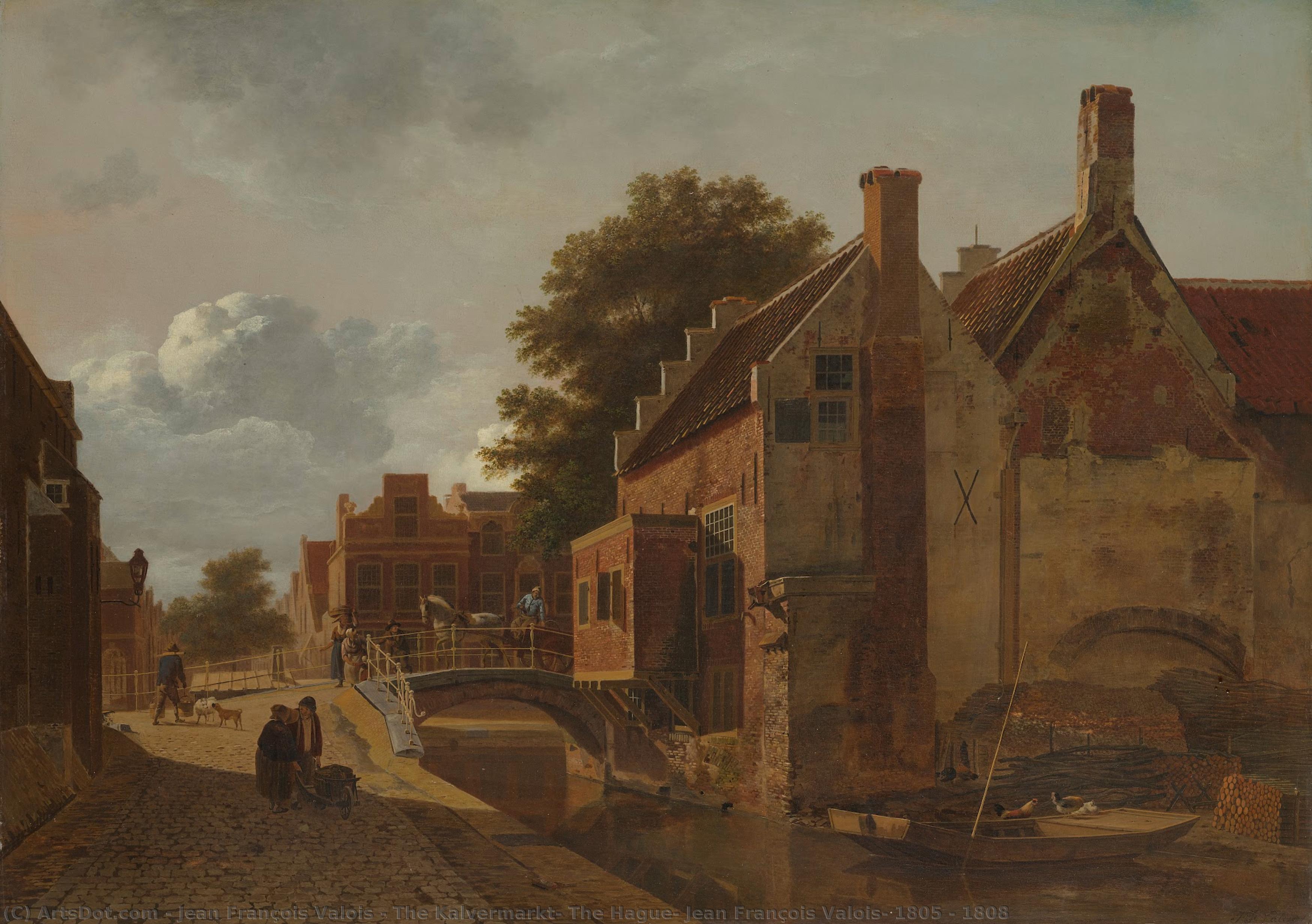
StatsThe Kalvermarkt, The Hague, Jean François Valois, 1805 - 1808
 1808
1808 45.0 x 62.0 cm
 Read More
Hand Made Oil Reproduction
Hand-painted oil on canvas in your size and frame, made to order by our artists. ( Switch to Print Switch to Digital Image)




































Pick from our preset sizes that match the artwork's original proportions.

You may enter your own dimensions to fit a specific frame or space. If your selected size does not match the original image's proportions, we will either crop the artwork or extend the painting with additional hand-painted elements. A digital mockup will be sent for your approval before production begins.
Please note that the on-screen preview does not reflect the actual cropping or extension. Only the mockup will accurately show the final composition.
While custom sizes are available, we recommend selecting a dimension from the predefined list to preserve the original proportions.
After order, ArtsDot.com team will email client for instructions and provide a mockup preview
Worldwide Delivery () in 3/4 weeks instead of standard 5 weeks. (10 September). No compromise on quality.

Free Worldwide Express Shipping

High-Quality Linen Canvas

Full Shipping Insurance

Customs Tax Refund Guarantee

True Color Matching Guarantee

100-Day Return Policy (Defects Only)

100% Money-Back Guarantee

Bulk Discount Offer
 Glass option is only available in size under 110 CM

The Kalvermarkt, The Hague, Jean François Valois, 1805 - 1808
Reproduction Medium
Reproduction Size
-


Total Price
$ 263
Related Artworks









Artist Biography
Rembrandt Peale: A Pioneer of American Portraiture
Rembrandt Peale, born near present-day Richboro, Pennsylvania in February 22, 1778, and passing away on October 3, 1860, stands as a pivotal figure in the early development of American portrait painting. More than simply a recorder of likenesses, Peale was a dedicated scholar, museum curator, and influential educator who profoundly shaped the artistic landscape of his nation. His career spanned over seven decades, witnessing and contributing to the burgeoning cultural identity of the United States during a period of immense transformation. Initially influenced by his father, Charles Willson Peale – himself a renowned artist and naturalist – Rembrandt inherited not only technical skills but also a deep-seated passion for observation and documentation. This foundation would prove crucial as he navigated the evolving artistic currents of the late 18th and early 19th centuries.- Early Life and Artistic Training: Peale’s childhood was immersed in art, with his father providing a rigorous education encompassing drawing, painting, and scientific study. He began sketching at age eight, producing a remarkably mature self-portrait at thirteen – a piece that continues to be studied for its technical skill and expressive quality. This early dedication demonstrated an innate talent and a commitment to mastering the craft of portraiture.
- Influence of French Neoclassicism: Following a sojourn in Paris during his early thirties, Peale was deeply impacted by the prevailing artistic trends of the time, particularly the elegance and precision of French neoclassicism. This exposure informed his approach to composition, technique, and subject matter, resulting in portraits that exuded a sense of formality and intellectual gravitas.
- Family Legacy: Rembrandt’s life was inextricably linked to that of his siblings – Raphael, Rubens, and Titian Peale – all accomplished artists who furthered the family's artistic legacy. Their collaborative efforts extended beyond individual works, encompassing shared projects such as group portraits and museum exhibitions.
A Career Defined by Portraits and Museums
Peale’s career unfolded across several distinct phases, each marked by significant achievements and evolving artistic interests. Initially, he focused primarily on portraiture, quickly establishing himself as a sought-after artist among the prominent figures of his day. He produced numerous likenesses of leading politicians, businessmen, and intellectuals, capturing their personalities with remarkable accuracy and detail. His portraits were not merely representations of appearance; they aimed to convey character, status, and intellectual pursuits.- Notable Commissions: Peale’s most celebrated commissions included portraits of George Washington (particularly the iconic “Patriae Pater”), Thomas Jefferson, John Marshall, and Charles Pinckney – figures who would shape the destiny of the young nation. These works cemented his reputation as a leading portraitist and secured his place in American art history.
- Court of Death: Perhaps his most ambitious undertaking was "Court of Death" (1820), a monumental group portrait depicting prominent figures from Pennsylvania society arranged around a symbolic representation of death. This complex and emotionally charged work demonstrated Peale’s ability to synthesize artistic skill with historical and cultural commentary.
- Museum Curator: Beyond his painting career, Peale played a crucial role in the development of American museums. He served as curator of the Philadelphia Museum (later the Franklin Institute) from 1812 until his death, transforming it into one of the nation’s first and most influential scientific and artistic institutions.
Technique and Style
Peale's style evolved considerably throughout his career, reflecting both his adherence to classical principles and his growing engagement with contemporary trends. Initially influenced by the formal elegance of French neoclassicism, he gradually incorporated elements of realism and dramatic lighting into his work. His portraits are characterized by meticulous attention to detail, precise rendering of textures and fabrics, and a subtle use of color. He was particularly adept at capturing the nuances of facial expression, conveying a sense of psychological depth and individual character.- Neoclassical Influence: Peale’s early works demonstrate a clear debt to the conventions of neoclassical portraiture – balanced compositions, idealized forms, and restrained colors.
- Realist Tendencies: As he matured as an artist, Peale began to incorporate elements of realism into his portraits, paying closer attention to the details of clothing, accessories, and the surrounding environment.
- Dramatic Lighting: He skillfully employed dramatic lighting techniques to create a sense of mood and highlight key features of his subjects’ faces.
Legacy and Historical Significance
Rembrandt Peale's contributions extend far beyond his individual artistic achievements. As a museum curator, he played a vital role in fostering public interest in art and science, laying the foundation for the development of American cultural institutions. His portraits provide invaluable insights into the personalities and aspirations of leading figures from the late 18th and early 19th centuries, offering a window into the social and political landscape of early America. Furthermore, his dedication to education and mentorship influenced generations of artists who followed in his footsteps. Peale’s legacy as a pioneering portraitist and museum advocate remains firmly established within the annals of American art history.
jean françois valois
1778 - 1853 , Suriname
Quick Facts
- Artistic Movement Or Style: Neoclassicism
- Artists Or Movements Influenced By This Artist:
- John Varley
- William Hazlitt
- Artists Who Influenced This Artist:
- Charles Willson Peale
- Rembrandt Harmenszoon van Rijn
- Date Of Birth: Feb 22, 1778
- Date Of Death: Oct 3, 1860
- Full Name: Rembrandt Peale
- Nationality: American
- Notable Artworks:
- Court of Death
- George Washington, Patriae Pater
- Rubens Peale with a Geranium
- Place Of Birth: Near present-day Richboro, PA