 Preview
 Send
Send Share
Share
 Details

 Download
 Similars
 X-Ray
X-Ray Diaporama
 Stats
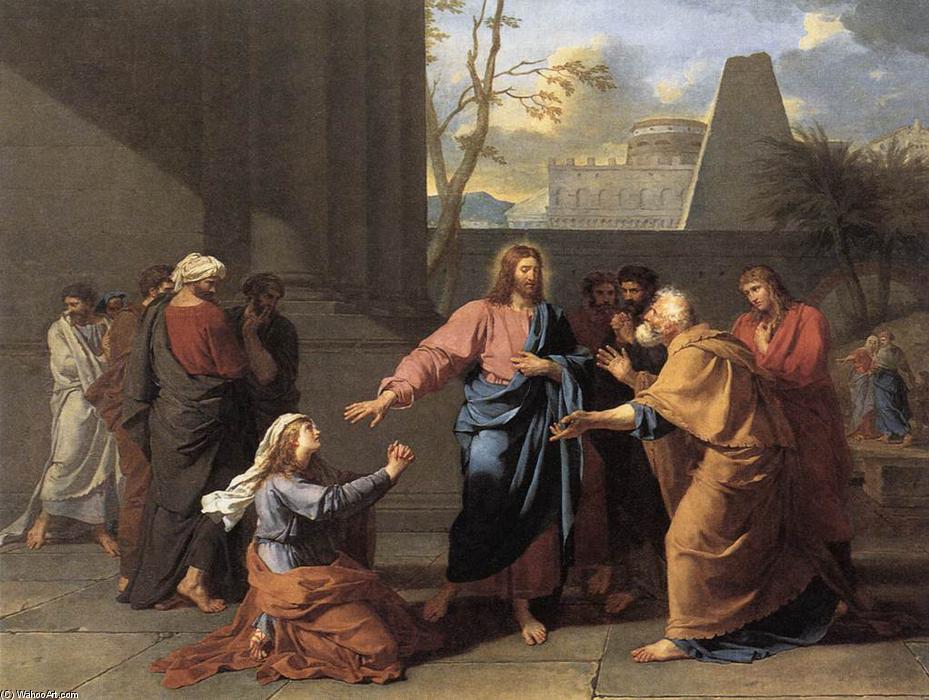
StatsThe Woman of Canaan at the Feet of Christ
 Acrylic On Canvas
- WallArt
- Baroque Painting
 1784
1784 114.0 x 146.0 cm
 The Louvre
 Read More
Hand Made Oil Reproduction
Hand-painted oil on canvas in your size and frame, made to order by our artists. ( Switch to Print Switch to Digital Image)




P118B $10

P118H $10

P118W $10

P438Z $10

P508JH $12

P508YH $12

P805H $10

P805Z $10

P919BZ $10

P919G $10

P919XJ $10

P959ZH $10

P968JZ $12

W106C $8

W218G $10

W218JH $8

W218Y $10

W307PJ $10

W316G $10

W316PJ $8

W316Y $10

W398PJ $8

W4111J $10

W500HY $15

W500JH $15

W692G $12

W849H $8

W940BG $15

W953PJ $8




Pick from our preset sizes that match the artwork's original proportions.

You may enter your own dimensions to fit a specific frame or space. If your selected size does not match the original image's proportions, we will either crop the artwork or extend the painting with additional hand-painted elements. A digital mockup will be sent for your approval before production begins.
Please note that the on-screen preview does not reflect the actual cropping or extension. Only the mockup will accurately show the final composition.
While custom sizes are available, we recommend selecting a dimension from the predefined list to preserve the original proportions.
After order, ArtsDot.com team will email client for instructions and provide a mockup preview
Worldwide Delivery () in 3/4 weeks instead of standard 5 weeks. (9 September). No compromise on quality.

Free Worldwide Express Shipping

High-Quality Linen Canvas

Full Shipping Insurance

Customs Tax Refund Guarantee

True Color Matching Guarantee

100-Day Return Policy (Defects Only)

100% Money-Back Guarantee

Bulk Discount Offer
 Glass option is only available in size under 110 CM

The Woman of Canaan at the Feet of Christ
Reproduction Medium
Reproduction Size
-


Total Price
$ 263
Jean-Germain Drouais’s “The Woman of Canaan at the Feet of Christ” – A Testament to Faith and Divine Grace
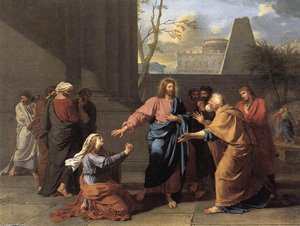
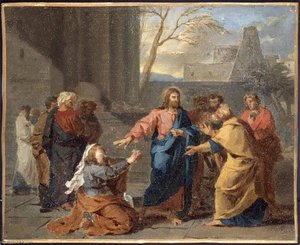
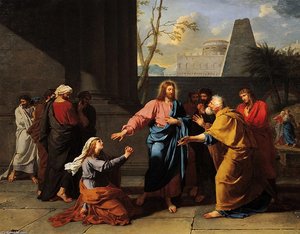
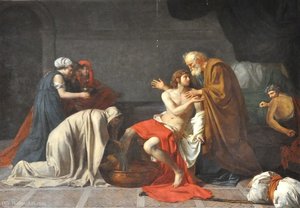
Painted in 1784, Jean-Germain Drouais's "The Woman of Canaan at the Feet of Christ" is more than just a religious scene; it’s a profound meditation on faith, humility, and the transformative power of divine grace. This captivating work, currently residing within the Louvre Museum in Paris, immediately draws the viewer into a tableau brimming with emotional intensity and classical elegance. Drouais, a student of Jacques-Louis David and a rising star of the French art world, masterfully captures a pivotal moment from Matthew 15:21-28 – the encounter between Jesus and a Canaanite woman pleading for her daughter’s healing.
The composition is meticulously balanced. At its heart stands Christ, depicted with an almost serene detachment as he turns his head away from the supplicant. His posture suggests a measured response, perhaps reflecting the limitations placed upon him by Jewish law at that time. However, it's the woman’s unwavering devotion that truly commands attention. Kneeling before him, her hands outstretched in supplication, she embodies a profound vulnerability and desperate hope. The other figures – disciples murmuring amongst themselves, a few birds perched near the upper left corner – subtly contribute to the scene’s atmosphere of quiet contemplation and spiritual urgency.
A Masterclass in Rococo Style and Classical Influence
Drouais's style is firmly rooted in the Rococo tradition, yet infused with a distinctly classical sensibility inherited from his mentor, David. The painting showcases a remarkable command of light and shadow, creating a sense of depth and realism within the scene. Notice how Drouais skillfully employs chiaroscuro – the dramatic contrast between light and dark – to highlight key elements, particularly the woman’s face and hands, drawing the viewer's eye directly to her plea. The figures are rendered with delicate precision, their drapery flowing gracefully around them, a hallmark of Rococo artistry. The use of muted earth tones—ochres, browns, and creams—evokes a sense of solemnity and reverence, while subtle hints of color in the woman’s garments add a touch of warmth to the composition.
Technically, Drouais demonstrates an impressive understanding of oil painting techniques. The brushstrokes are smooth and blended, creating a luminous surface that captures the texture of fabrics and skin. The artist's attention to detail is evident in the rendering of the birds, their feathers meticulously depicted with remarkable accuracy. This level of technical skill speaks volumes about Drouais’s dedication to his craft and his mastery of the medium.
Symbolism and Spiritual Depth
Beyond its aesthetic beauty, “The Woman of Canaan at the Feet of Christ” is rich in symbolic meaning. The woman's act of kneeling before Jesus represents a profound surrender – a recognition of her own helplessness and a desperate plea for divine intervention. Her unwavering faith, despite the apparent indifference of Christ and his disciples, underscores the importance of perseverance in the face of adversity. The birds, often interpreted as symbols of hope and divine messengers, add another layer of meaning to the scene. The woman’s request for her daughter's healing is not merely a plea for physical well-being but also a yearning for spiritual restoration.
Furthermore, the setting – a region of Tyre and Sidon—reflects the broader context of the Gospel story, highlighting the challenges faced by those living outside the boundaries of Jewish society. The woman’s status as a Canaanite outsider underscores the universality of faith and the belief that God's grace extends to all people, regardless of their background or social standing.
A Timeless Image of Faith and Compassion
"The Woman of Canaan at the Feet of Christ" remains a powerful and enduring work of art. It’s a testament to Drouais’s artistic talent, his classical training, and his ability to capture profound spiritual truths. Whether viewed as a historical masterpiece or a poignant meditation on faith and compassion, this painting continues to resonate with viewers today, offering a timeless reminder of the transformative power of hope and unwavering belief.
Related Artworks
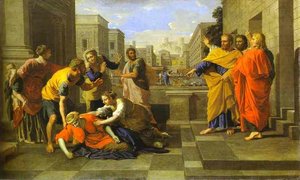
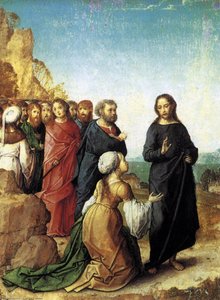
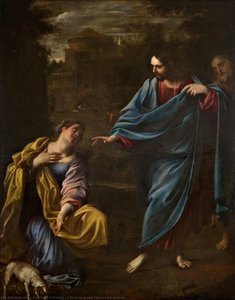
Artist Biography
George Morland: A Life of Rustic Charm and Scandalous Excess
George Morland (1763-1804) remains a captivating figure in British art, simultaneously celebrated for his deceptively simple scenes of rural life and shadowed by a reputation for dissolute living. Born in London to Henry Morland, a successful painter specializing in portraits and fantastical subjects alongside a lucrative forgery business, George’s artistic journey was shaped by both privilege and hardship. His early years were marked by prodigious talent – he began painting at the age of eight – nurtured within a family deeply involved in the art trade, yet ultimately constrained by his father's gambling debts and precarious financial situation.
Morland’s style is instantly recognizable: small-scale genre paintings depicting scenes from the lives of ordinary people, primarily those found in taverns, stables, and rural landscapes. Unlike many of his contemporaries who focused on idealized pastoral settings, Morland captured a more gritty reality – the boisterous gatherings of pub patrons, the weary animals awaiting their fate, and the everyday routines of working-class life. His technique is characterized by loose, expressive brushwork, a vibrant use of color, and an uncanny ability to convey atmosphere and mood. He wasn’t interested in grand narratives or heroic figures; instead, he found beauty and interest in the mundane details of human interaction and animal behavior.
- Early Influences: Morland's artistic development was undoubtedly influenced by his father’s diverse practice, exposing him to a wide range of subjects and techniques. However, it is believed that he also drew inspiration from artists like William Hogarth, whose satirical scenes offered a critical commentary on society, and the Dutch masters, particularly their masterful use of light and shadow.
- A Turbulent Life: Despite his artistic success, Morland’s life was marked by instability and financial difficulties. He frequently found himself in debt, imprisoned for unpaid bills, and even resorting to hiding from creditors. This tumultuous existence fueled rumors about his excessive drinking habits and a generally dissolute lifestyle – stories that would later contribute significantly to his posthumous reputation.
- Popularity and Imitation: During his lifetime, Morland’s paintings enjoyed immense popularity, both with the public and within artistic circles. His work was widely reproduced in prints, often by his brother-in-law William Ward, leading to a proliferation of forgeries and imitations. This widespread dissemination undoubtedly contributed to his fame but also cast a shadow over his artistic integrity.
The Morland Aesthetic: Detail, Observation, and Emotional Resonance
What distinguishes Morland’s work is not simply the subject matter, but the way he approached it. He was a meticulous observer of detail, capturing the textures of rough-hewn wood, the sheen of wet fur, and the expressions on the faces of his subjects with remarkable accuracy. His paintings are filled with small, seemingly insignificant details that collectively create a vivid sense of place and atmosphere. He wasn’t striving for photographic realism; rather, he aimed to evoke an emotional response in the viewer through carefully rendered observation.
Morland's use of color is particularly noteworthy. He employed a bright, often slightly garish palette – reds, yellows, and greens dominate his compositions – creating a sense of immediacy and vitality. His brushwork is loose and expressive, conveying movement and energy. He masterfully used light to create dramatic effects, highlighting key elements within the scene and casting shadows that add depth and dimension.
Despite the often-chaotic scenes depicted, Morland’s paintings possess a remarkable sense of harmony and balance. He skillfully arranged his figures and objects within the frame, creating compositions that are both visually engaging and emotionally resonant. His ability to capture the essence of everyday life – the joy, the hardship, and the simple pleasures – is what continues to captivate viewers today.
Connections and Influences: Girtin and Beyond
George Morland’s work had a significant impact on his contemporary artist, Thomas Girtin. Girtin, known for his meticulously detailed landscapes and scenes of urban life, was deeply influenced by Morland's approach to depicting figures within a landscape setting. Evidence suggests that they collaborated on several projects, including the etching *The Earth Stopper*, where Girtin’s landscape elements are combined with Morland’s figure compositions.
Furthermore, Morland’s popularity led to numerous printmakers attempting to replicate his style, resulting in a vast number of imitations circulating throughout England. This widespread reproduction undoubtedly contributed to the development of a distinct “Morland School” of painting, characterized by its small scale, loose brushwork, and focus on rural life.
The story of Morland’s relationship with Girtin is particularly intriguing, involving tales of shared experiences in the north east and collaborative efforts. While some details remain shrouded in speculation, it highlights the complex interplay between artists and their influences within the British art world of the late 18th and early 19th centuries.
Legacy and Historical Significance
Despite his scandalous reputation and the prevalence of forgeries, George Morland’s work has endured as a significant contribution to British genre painting. His paintings offer a valuable glimpse into the lives of ordinary people during a period of rapid social and economic change. Morland's ability to capture the spirit of everyday life – the humor, the hardship, and the simple pleasures – continues to resonate with viewers today.
His work is now recognized for its technical skill, emotional depth, and unique artistic vision. Morland’s legacy extends beyond his individual paintings; he helped to establish a new genre of British art that focused on depicting the lives of ordinary people in a realistic and engaging manner. He remains a fascinating and enduring figure in the history of British painting, a testament to the power of observation, skill, and a touch of scandalous charm.
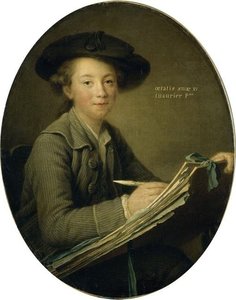
jean germain drouais
1763 - 1788 , France
Quick Facts
- Artistic Movement Or Style: Genre painting
- Artists Or Movements Influenced By This Artist: ['Thomas Girtin']
- Artists Who Influenced This Artist: ['Henry Morland']
- Date Of Birth: June 26, 1763
- Date Of Death: Oct. 29, 1804
- Full Name: George Morland
- Nationality: English
- Notable Artworks:
- Mail Coach in a Storm
- Dogs Hesitating
- Place Of Birth: London, England
Related Articles
Alte Pinakothek's Masterpieces: 25 Iconic Paintings for Art Lovers | ArtsDot
Journey through Alte Pinakothek's 25 most iconic paintings! Explore masterpieces by Dürer, Rembrandt & Rubens. Discover art history, techniques & find museum-quality reproductions for your home at ArtsDot.com.
Echoes of Faith: Devotion as Central Theme in Western Art History
Explore the rich history of religious art with ArtsDot.com! Discover iconic artworks, symbolism & techniques from antiquity to the Renaissance. Enhance your art appreciation today.
Fra Angelico's Masterpieces: 25 Renaissance Paintings for Your Home | ArtsDot
Explore 25 breathtaking masterpieces by Fra Angelico, a Renaissance master. Discover the stories behind his iconic frescoes, Annunciations & religious art. Find museum-quality reproductions and elevate your home decor with ArtsDot.com.
Sacred Narratives on Canvas: Exploring Devotional Imagery Across Art History
Explore the rich history of devotional art! Discover iconic masterpieces, symbolism & techniques from antiquity to the Renaissance. Expert insights for collectors & enthusiasts at ArtsDot.

Giotto's Masterpieces: 25 Renaissance Artworks for Your Home | ArtsDot
Explore 25 breathtaking artworks by Giotto di Bondone, a Renaissance master. Discover the stories behind iconic frescoes & paintings like the Scrovegni Chapel cycle. Find museum-quality Giotto reproductions and elevate your home decor with ArtsDot.com.