 Preview
 Send
Send Share
Share
 Details

 Download
 Similars
 X-Ray
X-Ray Diaporama
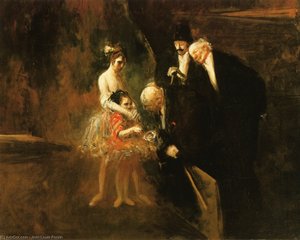
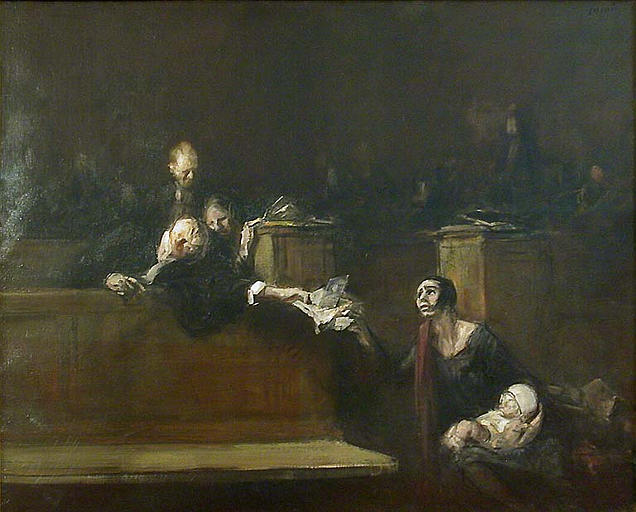
Scène de tribunal


 Read More
Hand Made Oil Reproduction
Hand-painted oil on canvas in your size and frame, made to order by our artists. ( Buy Print Buy Image)




P118B $10

P118H $10

P118W $10

P438Z $10

P508JH $12

P508YH $12

P805H $10

P805Z $10

P919BZ $10

P919G $10

P919XJ $10

P959ZH $10

P968JZ $12

W106C $8

W218G $10

W218JH $8

W218Y $10

W307PJ $10

W316G $10

W316PJ $8

W316Y $10

W398PJ $8

W4111J $10

W500HY $15

W500JH $15

W692G $12

W849H $8

W940BG $15

W953PJ $8




Pick from our preset sizes that match the artwork's original proportions.

You may enter your own dimensions to fit a specific frame or space. If your selected size does not match the original image's proportions, we will either crop the artwork or extend the painting with additional hand-painted elements. A digital mockup will be sent for your approval before production begins.
Please note that the on-screen preview does not reflect the actual cropping or extension. Only the mockup will accurately show the final composition.
While custom sizes are available, we recommend selecting a dimension from the predefined list to preserve the original proportions.
After order, ArtsDot.com team will email client for instructions and provide a mockup preview
Worldwide Delivery () in 3/4 weeks instead of standard 5 weeks. (17 August). No compromise on quality.

Free Worldwide Express Shipping

High-Quality Linen Canvas

Full Shipping Insurance

Customs Tax Refund Guarantee

True Color Matching Guarantee

60-Day Return Policy (Defects Only)

100% Money-Back Guarantee

Bulk Discount Offer
 Glass option is only available in size under 110 CM

Scène de tribunal
Reproduction Medium
Reproduction Size
-


Total Price
$ 313
Artwork Description
A Theater of Justice and Despair
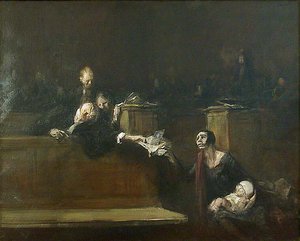
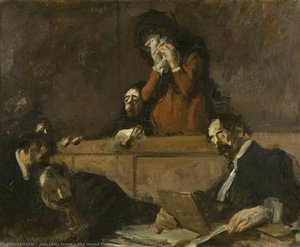
In the shadowy corridors of nineteenth-century Parisian life, few scenes capture the raw, unvarnished tension of human drama as poignantly as Jean Louis Forain’s Scène de tribunal. This evocative oil painting transports the viewer directly into the heart of a courtroom, not as a detached observer, but as a witness to a moment of profound legal and emotional upheaval. The composition is masterfully crowded, creating a sense of claustrophobia that mirrors the suffocating weight of judgment. At the center of this swirling chaos, a man presents a document—perhaps a final plea or a damning piece of evidence—to a judge, while nearby, a woman weeps with a dramatic intensity that pierces through the somber atmosphere. The painting does not merely depict a legal proceeding; it captures the very essence of human suffering and the heavy hand of institutional power.
Forain, a master of both caricature and fine art, utilizes a style that leans heavily into Romanticism, prioritizing emotional expression and narrative tension over mere anatomical precision. The technique is characterized by loose, expressive brushstrokes that lend a sense of immediacy and movement to the figures, as if the scene were captured in a fleeting, breathless moment. Through the skillful use of chiaroscuro, Forain orchestrates a dramatic interplay between light and shadow. Deep, murky blacks and earthy browns dominate the periphery, casting long, heavy shadows that seem to press inward on the central figures. This darkness is punctuated by sudden, sharp highlights—the pale skin of a grieving face or the stark white of a document—which guide the eye through the complex layers of the composition and emphasize the psychological weight of the encounter.
Symbolism and the Weight of History
Beyond its surface-level drama, Scène de tribunal serves as a profound meditation on the themes of injustice and the fragility of truth. Every element within the frame is laden with symbolic significance. The document being presented acts as a focal point for the struggle between fact and fate, representing the thin line upon which a life may hang during a trial. The woman’s visible grief serves as a powerful symbol of the collateral damage caused by legal decisions, embodying the loss and heartbreak that often follow in the wake of judgment. Forain’s background as a satirist for Parisian journals like Le Rire Satirique informs this work deeply; he possesses an uncanny ability to observe the social strata of his time, using the courtroom setting to critique the potential coldness and chaos of the legal system.
For collectors and interior designers alike, this piece offers a commanding presence that demands attention. Its dark, muted palette of grays, blacks, and deep reds makes it an exquisite centerpiece for a sophisticated study, a library, or a formal gallery space where one wishes to evoke a sense of history and intellectual depth. The painting’s ability to stir complex emotions—ranging from sorrow to a haunting sense of tension—makes it more than just a decoration; it is a conversation piece that invites contemplation. Owning a high-quality reproduction of this masterpiece allows one to bring the dramatic, atmospheric soul of 19th-century France into a modern setting, providing a window into a world where every shadow tells a story and every gesture carries the weight of destiny.
Related Artworks

Artist Biography
Early Life and Artistic Beginnings
- Born: Reims, France (1852)
- Died: 1931
- Jean Louis Forain's artistic journey began in Reims, France, on October 23, 1852. His family relocated to Paris when he was eight years old, a pivotal move that shaped his future career.
- His father, an ornamental sign painter, provided initial support and exposure to art.
- Forain started as a caricaturist, contributing satirical drawings to Parisian journals like Le Monde Parisien and Le Rire Satirique. This honed his observational skills and wit.
- Formal training followed at the École des Beaux Arts under Jean-Léon Gérôme and Jean-Baptiste Carpeaux.
Impressionist Influences and Artistic Development
- Forain became involved with the Impressionist movement, participating in several exhibitions between 1879 and 1884.
- He was influenced by core Impressionist principles: capturing fleeting moments, light effects, and scenes from everyday life.
- Unlike some contemporaries focused on landscapes, Forain centered his work on Parisian popular entertainments – bustling cafés, racetracks, ballet.
- His style developed with loose brushwork, bold colors, and a keen eye for urban atmosphere.
Notable Works and Artistic Style
- Forain worked in oils, watercolors, pastels, etchings, and lithographs.
- "On the Verses of Verlaine, A Rogue Takes a Stroll in the Country," exemplifies his ability to capture French life with detail.
- His watercolors are celebrated for vibrant colors and atmosphere.
- Forain’s style blended caricature and Impressionism, creating humorous and insightful works.
- He was skilled at portraying human figures, often exaggerating features for memorable characters.
- His depictions of Parisian nightlife, opera audiences, and racegoers offer a window into late 19th-century French society.
Later Life and Legacy
- During World War I, Forain contributed patriotic illustrations. He even enlisted in the camouflage section.
- In his later years, he depicted scenes of law courts and Parisian institutions.
- He was elected a member of the Royal Academy of Arts in London.
- Jean-Louis Forain passed away on July 11, 1931, leaving behind a significant body of work admired for its wit, observation, and portrayal of Parisian life.
Collections and Further Exploration
- Musée Maurice Denis (France)
- Musée National Jean-Jacques Henner (Paris, France)
- Explore more artworks: Jean Louis Forain | 121 Artworks
- Order paintings reproductions: Order Paintings Reproductions of Jean Louis Forain
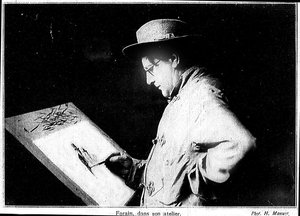
Jean Louis Forain
1852 - 1931 , France
Quick Facts
- Artistic Movement Or Style: Impressionism
- Artists Or Movements Influenced By This Artist: ['Henri de Toulouse-Lautrec']
- Artists Who Influenced This Artist:
- Jean-Léon Gérôme
- Jean-Baptiste Carpeaux
- Edgar Degas
- Honoré Daumier
- Date Of Birth: October 23, 1852
- Date Of Death: July 11, 1931
- Full Name: Jean-Louis Forain
- Nationality: French
- Notable Artworks:
- On the Verses of Verlaine
- La République sur le banc
- Place Of Birth: Reims, France
Related Articles
Romantic Realism's Finest: 10 Masterpieces for Your Home | ArtsDot
Explore 10 defining masterpieces of Romantic Realism! Discover Courbet, Millet & Daumier's powerful paintings—capturing emotion and social realities. Find museum-quality reproductions for your home at ArtsDot.com.

The Enduring Legacy of Oil on Canvas: Technique, History & Aesthetic Impact
Explore the rich history & techniques of oil painting – from Renaissance masters to Impressionism. Discover pigments, layering methods, and why this timeless medium endures. Expert insights for artists & art enthusiasts.

19th Century Masterpieces: 10 Paintings That Defined an Era | ArtsDot
Journey through 19th century art with ArtsDot! Explore 10 iconic paintings – from Monet & Renoir to Courbet – and discover the stories behind Romanticism, Realism & Impressionism. Find museum-quality reproductions for your home decor. Explore the full collection online!

Oil on Canvas: A Historical & Technical Exploration of a Timeless Artistic Medium
Explore the rich history & enduring techniques of oil painting on canvas. Discover the science behind its longevity, conservation practices, and contemporary relevance. Expert insights for art enthusiasts.

The Enduring Power of Painting: A Historical & Contemporary Exploration of Form and Emotion
Explore the rich history & enduring techniques of oil painting with ArtsDot. Discover masterpieces, learn about art collecting, and find authentic handmade reproductions crafted by skilled artists.