 Preview
 Send
Send Share
Share
 Details

 Download
 Similars
 X-Ray
X-Ray Diaporama
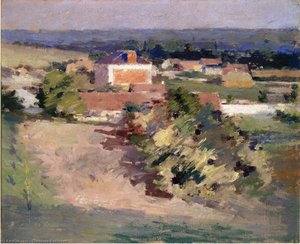
Alto dos Sete Moinhos


 Read More
Giclée / Art Print
Museum-quality giclée or canvas print with fast production and flexible finish options. ( Buy Hand Made Painting Buy Image)




P118B $10

P118H $10

P118W $10

P438Z $10

P508JH $12

P508YH $12

P805H $10

P805Z $10

P919BZ $10

P919G $10

P919XJ $10

P959ZH $10

P968JZ $12

W106C $8

W218G $10

W218JH $8

W218Y $10

W307PJ $10

W316G $10

W316PJ $8

W316Y $10

W398PJ $8

W4111J $10

W500HY $15

W500JH $15

W692G $12

W849H $8

W940BG $15

W953PJ $8




Pick from our preset sizes that match the artwork's original proportions.

You may enter your own dimensions to fit a specific frame or space. If your selected size does not match the original image's proportions, we will either crop the artwork or extend the image with a mirrored or solid-fill edge. A digital mockup will be sent for your approval before production begins.
Please note that the on-screen preview does not reflect the actual cropping or extension. Only the mockup will accurately show the final composition.
While custom sizes are available, we recommend selecting a dimension from the predefined list to preserve the original proportions.
Worldwide Delivery () in 2 weeks instead of standard 4/5 weeks. (21 August)

Free Worldwide Express Shipping

High-Quality Linen Canvas

Full Shipping Insurance

Customs Tax Refund Guarantee

True Color Matching Guarantee

60-Day Return Policy (Defects Only)

100% Money-Back Guarantee

Bulk Discount Offer
 Glass option is only available in size under 110 CM

Alto dos Sete Moinhos
Giclée / Art Print
Reproduction Size
-


Total Price
$ 63
Collectible Description
A Serene Vision of Rural Portugal
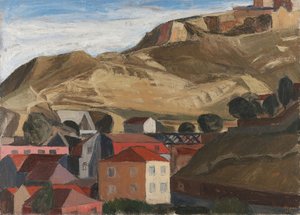
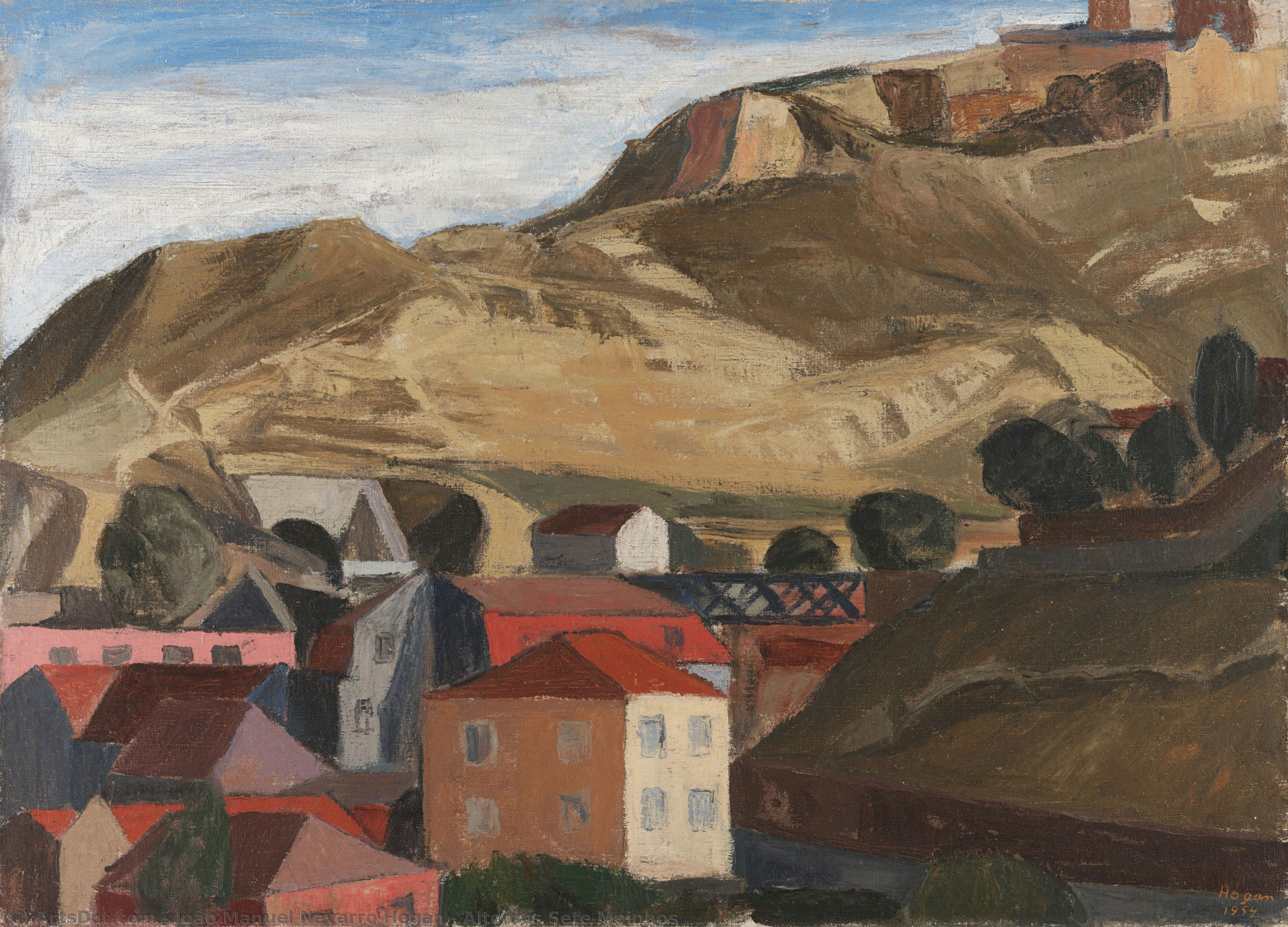
In the quietude of 1953, João Manuel Navarro Hogan captured a moment of profound stillness in his masterpiece, Alto dos Sete Moinhos. This evocative landscape invites the viewer into a small, idyllic village nestled within rolling hills, where time seems to have slowed to the gentle rhythm of nature. The composition is anchored by charming houses crowned with warm, red-tiled roofs, which glow softly against the verdant backdrop of the Portuguese countryside. Scattered trees punctuate the terrain, their organic forms providing a delicate contrast to the structural lines of the dwellings. Through his brush, Hogan does more than merely depict a location; he breathes life into a landscape where the presence of two solitary figures—one near the heart of the scene and another drifting toward the periphery—suggests a deep, quiet connection between humanity and the earth.
The emotional resonance of this piece lies in its ability to evoke nostalgia and peace. For the collector or interior designer, Alto dos Sete Moinhos serves as a window into a simpler era, offering a sense of sanctuary within a modern space. The painting captures the essence of rural life, where the atmosphere is thick with tranquility and the beauty of the mundane is elevated to the level of the sublime. It is an ideal centerpiece for a room designed for reflection, providing a focal point that is both intellectually stimulating and emotionally soothing.
The Mastery of Form and Lineage
To understand the technical brilliance of Alto dos Sete Moinhos, one must look to Hogan’s unique artistic lineage. As a descendant of a family of painters, Hogan possessed an innate understanding of color and light, yet he famously eschewed formal academic constraints in favor of a self-taught, intuitive approach. This freedom allowed him to synthesize the naturalist traditions of Portuguese masters like Silva Porto with the structural innovations of Cézanne and the expressive energy of Van Gogh. In this work, we see the fruits of that synthesis: a landscape that possesses both a soft, atmospheric quality and a robust, geometric solidity.
His background as a carpenter is subtly whispered through his handling of form; there is a structural integrity to the houses and the hills that suggests a deep respect for architecture and weight. The technique avoids mere imitation of reality, instead using deliberate strokes to build a sense of permanence. For those seeking a high-quality reproduction, this painting offers a sophisticated interplay of texture and tone, making it a versatile addition to any curated collection. It stands as a testament to Hogan's ability to transform the landscape into a meditative study of shape, light, and the enduring spirit of the Portuguese countryside.
Related Artworks
Artist Biography
Early Life and Artistic Development
- Born: Lisbon, Portugal, February 4, 1914
- Family Background: Descendant of a family of painters; grandson of watercolorist Ricardo Hogan and nephew of painter Álvaro Navarro Hogan. This artistic lineage significantly influenced his early exposure to art.
- Formal Education: Briefly attended the Escola Superior de Belas Artes de Lisboa (1930-31), but ultimately rejected formal artistic training, preferring a self-taught approach.
- Early Influences: Initially inspired by Portuguese naturalists like Silva Porto, Columbano, and Malhoa. Later embraced the styles of Van Gogh and Cézanne, incorporating geometric elements into his landscapes and emphasizing structural solidity in his compositions.
- Trade: Worked as a carpenter alongside his artistic pursuits, demonstrating a practical skill that likely informed his understanding of structure and form.
Artistic Career and Style
- Early Themes: Primarily focused on landscape painting, interpreting it extensively throughout his career. Initially painted outdoors in the outskirts of Lisbon and Beira Baixa.
- Evolution of Style: Transitioned from a more detailed, representational style to a rawer, more imaginative approach. His landscapes became increasingly simplified yet expressive.
- Geometric Interpretation: Incorporated geometric elements into his landscape depictions, reflecting the influence of Cézanne and emphasizing structural clarity.
- Color Palette: Employed a vibrant color palette, often drawing inspiration from Van Gogh's use of bold colors to convey emotion and energy.
Major Achievements and Recognition
- First Solo Exhibition: 1951 at the Sociedade Nacional de Belas Artes (SNBA).
- International Representation: Participated in the II Bienal de S. Paulo, Brazil (1953) and the 1st Biennial of São Paulo, Brazil (1957).
- Calouste Gulbenkian Foundation Prizes: Received 1º Painting Prize at the II Plastic Arts Exhibition of the Calouste Gulbenkian Foundation (1961) and the 1st Silva Porto Painting Prize, Sociedade Nacional de Instrução (SNI), Lisbon (1964).
- Engraving Career: Began engraving in 1957 under the influence of William Hayter. Founding member of the Sociedade Cooperativa de Gravadores Portugueses and directed several engraving courses.
Later Years and Legacy
- Collections and Museums: His work is represented in significant collections, including the Soares dos Reis National Museum (Porto), the Chiado Museum, and the Modern Art Center of the Calouste Gulbenkian Foundation (Lisbon).
- Death: Died in Lisbon in 1988.
- Anthological Exhibition: Honored with an anthological exhibition at the Centro de Arte Moderna da Fundação Calouste Gulbenkian in 1992, solidifying his place as a significant figure in Portuguese art history.
- Historical Significance: Recognized for his unique blend of naturalism and geometric abstraction, contributing to the development of modern Portuguese painting. His dedication to teaching engraving played a crucial role in nurturing younger generations of artists.
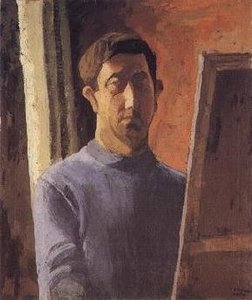
joão manuel navarro hogan
1914 - 1988 , Portugal
Quick Facts
- Artistic Movement Or Style: Naturalism, Landscape painting
- Artists Who Influenced This Artist:
- Silva Porto
- Columbano
- Malhoa
- Van Gogh
- Cézanne
- Date Of Birth: February 4, 1914
- Date Of Death: 1988
- Full Name: João Hogan
- Nationality: Portuguese
- Place Of Birth: Lisbon, Portugal
Related Articles

John Constable's Masterpieces: Explore 25 Iconic Landscapes for Your Home
Journey through John Constable's 25 most celebrated landscapes. Explore Romanticism, Dedham Vale & his masterful use of light in iconic paintings like 'Hay Wain'. Find museum-quality art reproductions and elevate your home decor on ArtsDot.com.
Cultivating Visions: A Historical Journey Through Rural Landscapes in Art
Explore the rich history of rural landscape painting with ArtsDot. Discover Impressionist masterpieces, key artists & movements. Find your perfect serene artwork and bring nature's beauty home.

Evocations of Place: A Historical Journey Through Landscape Art
Explore the rich history of landscape art with ArtsDot. Discover renowned artists, movements like Impressionism & Romanticism, and expert guidance for collecting timeless pieces. Find your perfect serene escape today!
Serene Visions: Exploring Themes of Tranquility in Art History & Contemporary Practice
Explore the history of serene landscape art & discover artists who evoke tranquility. Find the perfect calming artwork for your home with expert guidance from ArtsDot.

Romantic Landscapes: 10 Masterpieces for Your Home | ArtsDot
Journey through 10 Romantic landscape masterpieces by Friedrich, Turner & Cole. Explore emotional art, sublime nature scenes & iconic 19th-century paintings. Find museum-quality reproductions for your home at ArtsDot.com – discover the full collection online!