 Preview
 Send
Send Share
Share
 Details

 Download
 Similars
 X-Ray
X-Ray Diaporama
Skinner Boxes\n\nView 1


 Read More
Giclée / Art Print
Museum-quality giclée or canvas print with fast production and flexible finish options. ( Buy Hand Made Painting Buy Image)




P118B $10

P118H $10

P118W $10

P438Z $10

P508JH $12

P508YH $12

P805H $10

P805Z $10

P919BZ $10

P919G $10

P919XJ $10

P959ZH $10

P968JZ $12

W106C $8

W218G $10

W218JH $8

W218Y $10

W307PJ $10

W316G $10

W316PJ $8

W316Y $10

W398PJ $8

W4111J $10

W500HY $15

W500JH $15

W692G $12

W849H $8

W940BG $15

W953PJ $8




Pick from our preset sizes that match the artwork's original proportions.

You may enter your own dimensions to fit a specific frame or space. If your selected size does not match the original image's proportions, we will either crop the artwork or extend the image with a mirrored or solid-fill edge. A digital mockup will be sent for your approval before production begins.
Please note that the on-screen preview does not reflect the actual cropping or extension. Only the mockup will accurately show the final composition.
While custom sizes are available, we recommend selecting a dimension from the predefined list to preserve the original proportions.
Worldwide Delivery () in 2 weeks instead of standard 4/5 weeks. (18 August)

Free Worldwide Express Shipping

High-Quality Linen Canvas

Full Shipping Insurance

Customs Tax Refund Guarantee

True Color Matching Guarantee

60-Day Return Policy (Defects Only)

100% Money-Back Guarantee

Bulk Discount Offer
 Glass option is only available in size under 110 CM

Skinner Boxes\n\nView 1
Giclée / Art Print
Reproduction Size
-


Total Price
$ 63
Collectible Description
A Quiet Encounter with Architectural Solitude
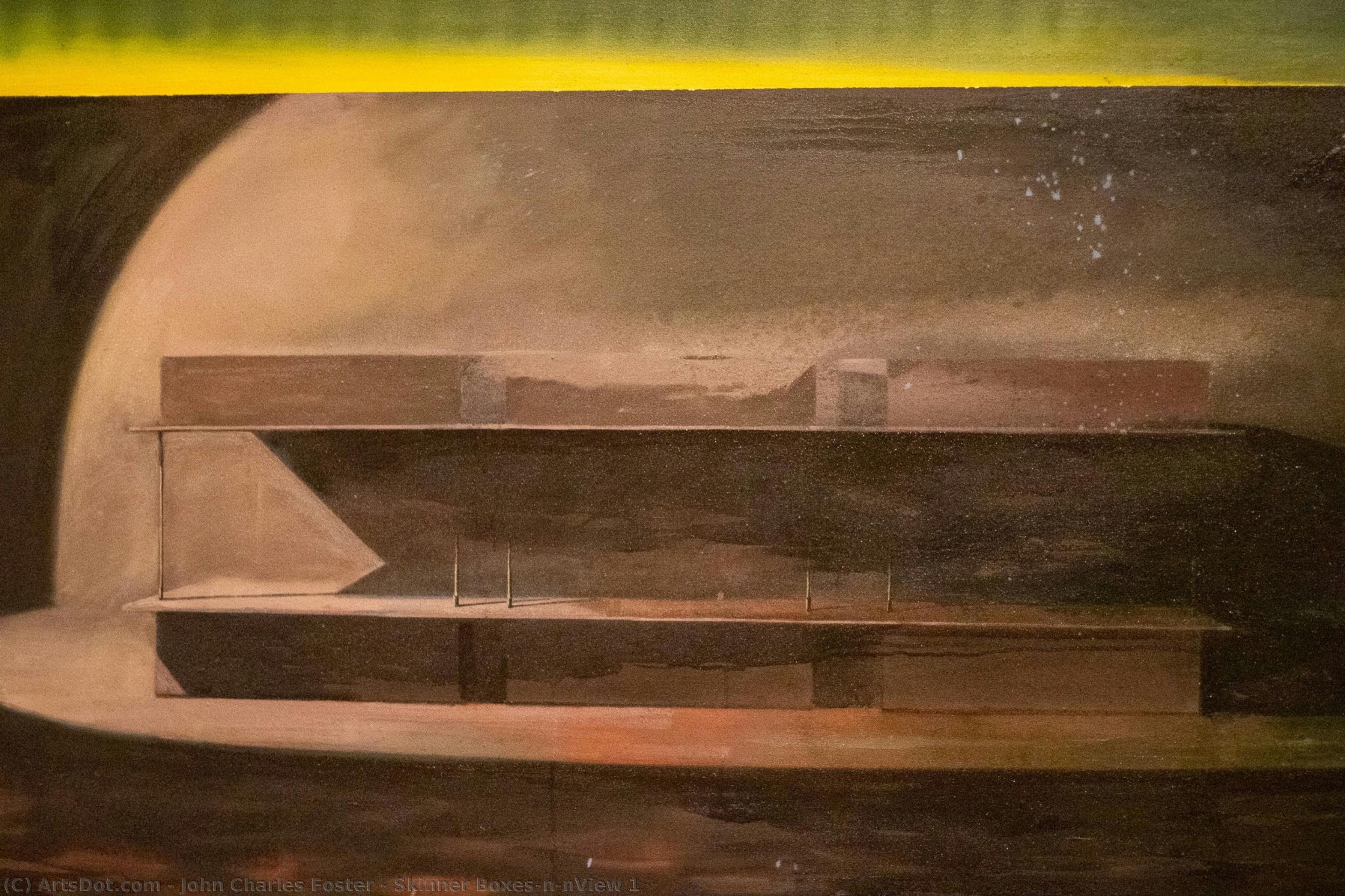
In the evocative piece Skinner Boxes, the viewer is transported into a serene yet enigmatic landscape that invites deep contemplation. The composition centers around a striking wooden structure, distinguished by its vibrant yellow roof that catches the light like a beacon of warmth amidst a quiet setting. This primary building, with its intricate arrangement of windows, suggests a lived-in history, a place where the passage of time is marked not by clocks, but by the shifting shadows across its timbered walls. The presence of a solitary chair positioned near the heart of the scene acts as a poignant invitation; it is a silent sentinel that hints at human presence and the potential for stillness, suggesting an outdoor sanctuary designed for reflection or perhaps a communal gathering point frozen in a moment of peaceful repose.
The artist, John Charles Foster, masterfully employs a sense of depth and spatial layering to guide the eye through this tranquil world. Beyond the central architectural marvel, smaller structures emerge from the background—one nestled to the left and another receding into the distance on the right—creating a rhythmic progression that expands the perceived horizon. This careful arrangement of elements evokes the essence of a pastoral retreat, where the boundaries between man-made shelter and the natural environment begin to blur. The technique used here emphasizes texture and light, allowing the viewer to almost feel the grain of the wood and the warmth of the sun hitting the golden roof, making the scene feel less like a static image and more like a breathing, living memory.
The Art of Atmosphere and Interior Inspiration
For the discerning collector or interior designer, Skinner Boxes offers much more than mere decoration; it provides an emotional anchor for a room. The painting’s palette, anchored by the bold yet earthy yellow of the roof, possesses a unique ability to inject vitality into a space while maintaining a sense of calm. It is a piece that speaks to the concept of "sanctuary," making it an ideal centerpiece for sophisticated living areas, studies, or reading nooks where one seeks to cultivate an atmosphere of intellectual and spiritual quietude.
The symbolic weight of the work lies in its ability to evoke nostalgia and the beauty of simplicity. The architectural elements serve as metaphors for stability and shelter, while the empty chair represents the "liminal space"—the threshold between being and doing. When choosing a high-quality reproduction of this work, one is not just acquiring an image, but capturing a mood of profound tranquility. It serves as a window into a world where complexity is stripped away to reveal the quiet majesty of structure and light, offering a timeless aesthetic that complements both contemporary minimalist interiors and more traditional, classic decor.
Related Artworks
Artist Biography
Richard Estes: Capturing the Illusion of Reality
Richard Estes, born in Dresden, Germany, on May 14, 1932, emerged as a pivotal figure in the late 20th-century art world, primarily recognized for his groundbreaking contributions to photorealism. His career, spanning several decades and marked by an evolution from early social realism to meticulously rendered cityscapes and portraits, reflects a profound engagement with perception, reflection, and the very nature of representation. Estes’s work isn't simply about replicating what is seen; it’s about distilling the essence of observation into a captivating visual experience. His journey began within the constraints of post-war Eastern Europe, where he honed his artistic skills at the Academy of Fine Arts in Dresden, absorbing influences from masters like Edgar Degas and Edward Hopper – artists who both explored the complexities of modern life through carefully observed detail. This early training laid the groundwork for his later pursuit of objectivity, a characteristic that would become central to his photographic style.Early Years and Transition to Photorealism
Following World War II, Estes relocated to New York City in 1961, immersing himself in the burgeoning avant-garde scene. This period proved transformative, exposing him to a diverse range of artistic movements including Tachisme and Fluxus. However, it was his encounter with photography that truly ignited his creative vision. Initially working as a graphic artist for various magazines and advertising agencies, Estes began experimenting with photographing urban environments – reflections in shop windows, mirrored surfaces, and the shimmering facades of city buildings. He quickly realized the potential of this medium to capture not just visual likeness but also the inherent illusionism of light and space. His early photographs were characterized by a soft focus, mimicking the qualities of traditional painting, and a deliberate avoidance of sharp edges – a technique that would become synonymous with his style. This shift away from representational art was partly influenced by his desire to move beyond the perceived limitations of academic painting and explore new ways of engaging with reality.The Development of His Signature Style
Estes’s distinctive photorealistic paintings are instantly recognizable for their almost photographic clarity. He meticulously constructed scenes using a projector, projecting photographs onto canvases and then painstakingly recreating them with layers of thin paint. This process allowed him to achieve an unparalleled level of detail and luminosity, capturing the subtle nuances of light and reflection that define his subjects. His preferred motifs – bustling city streets, mirrored storefronts, and interior spaces – are not merely decorative; they serve as a meditation on perception and the constructed nature of reality. The reflections themselves become integral elements of the composition, blurring the boundaries between foreground and background, subject and observer. Crucially, Estes avoided any overt narrative or symbolic content, focusing instead on presenting his subjects with an almost clinical detachment, inviting viewers to contemplate their own experience of seeing. This commitment to pure observation was a radical departure from many contemporary artists who were exploring more subjective forms of expression.Critical Acclaim and Lasting Influence
Richard Estes’s work gained significant recognition throughout the 1960s and 70s, establishing him as a key figure in the photorealist movement alongside artists like Chuck Close and John Baeder. His paintings were exhibited extensively in galleries and museums around the world, including the Art Institute of Chicago and the Whitney Museum of American Art. He received numerous awards and accolades, including the Praemium Imperiale in 1997, a prestigious international art prize. Despite his critical success, Estes remained remarkably private about his artistic process, preferring to let his paintings speak for themselves. His influence extends far beyond the photorealist movement; his exploration of reflection and illusion has resonated with artists working across various media, including sculpture, installation, and digital art. His work continues to be studied and admired for its technical mastery, its philosophical depth, and its enduring appeal.A Legacy of Illusion
Richard Estes passed away in 2007, leaving behind a substantial body of work that challenges our understanding of representation and perception. His paintings are not simply copies of reality; they are carefully constructed illusions—a testament to the power of observation and the enduring fascination with the way we see the world. His legacy lies not only in his technical skill but also in his willingness to question the very foundations of art, prompting viewers to consider the relationship between image and reality, subject and observer. His work remains a powerful reminder that even seemingly straightforward depictions can be profoundly complex and intellectually stimulating.
john charles foster
1932 - 2004 , United Kingdom
Quick Facts
- Artistic Movement Or Style: Photorealism
- Artists Or Movements Influenced By This Artist: ['Chuck Close']
- Artists Who Influenced This Artist:
- Edgar Degas
- Edward Hopper
- Date Of Birth: May 14, 1932
- Full Name: Richard Estes
- Nationality: American
- Notable Artworks: ['Telephone Booths']
- Place Of Birth: New York City, USA
Related Articles
Golden Hues: 10 Masterpieces Dominated by Chrome Yellow | ArtsDot
Immerse yourself in golden light! Explore 10 famous paintings dominated by 'Chrome Yellow', from Van Gogh’s Sunflowers to Monet's Haystacks. Discover the stories behind these iconic Impressionist & Post-Impressionist masterpieces and find museum-quality art reproductions at ArtsDot.com.

Cézanne's Masterpieces: 25 Iconic Artworks to Transform Your Space
Journey through 25 iconic artworks by Paul Cézanne – a master of Impressionism and Post-Impressionism. Explore his landscapes, still lifes, and the stories behind these timeless masterpieces. Discover museum-quality reproductions & curated decor at ArtsDot.com.
Golden Hues: Top 10 Paintings Dominated by Yellow Ochre |
Explore 10 iconic paintings bathed in golden yellow ochre! From Van Gogh's sunflowers to Monet’s haystacks, discover the stories behind these masterpieces. Find museum-quality art reproductions & elevate your home decor on .
The Golden Hue: Exploring Symbolism & Emotion in Yellow Art
Explore the rich symbolism & emotional power of yellow in art history! From Van Gogh to Kandinsky, discover how artists used this vibrant hue. Expert analysis & high-quality reproductions at ArtsDot.
F.A.Q.: Multi-Panel Group Set Art – A Sophisticated Decor Solution for Elite Collectors
Discover 's exquisite multi-panel art sets – a sophisticated decor solution for elite collectors. Custom designs, premium reproductions & expert guidance. Elevate your space with lasting beauty.