 Preview
 Send
Send Share
Share
 Details

 Download
 Similars
 X-Ray
X-Ray Diaporama
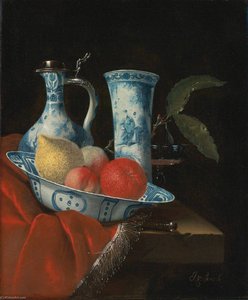
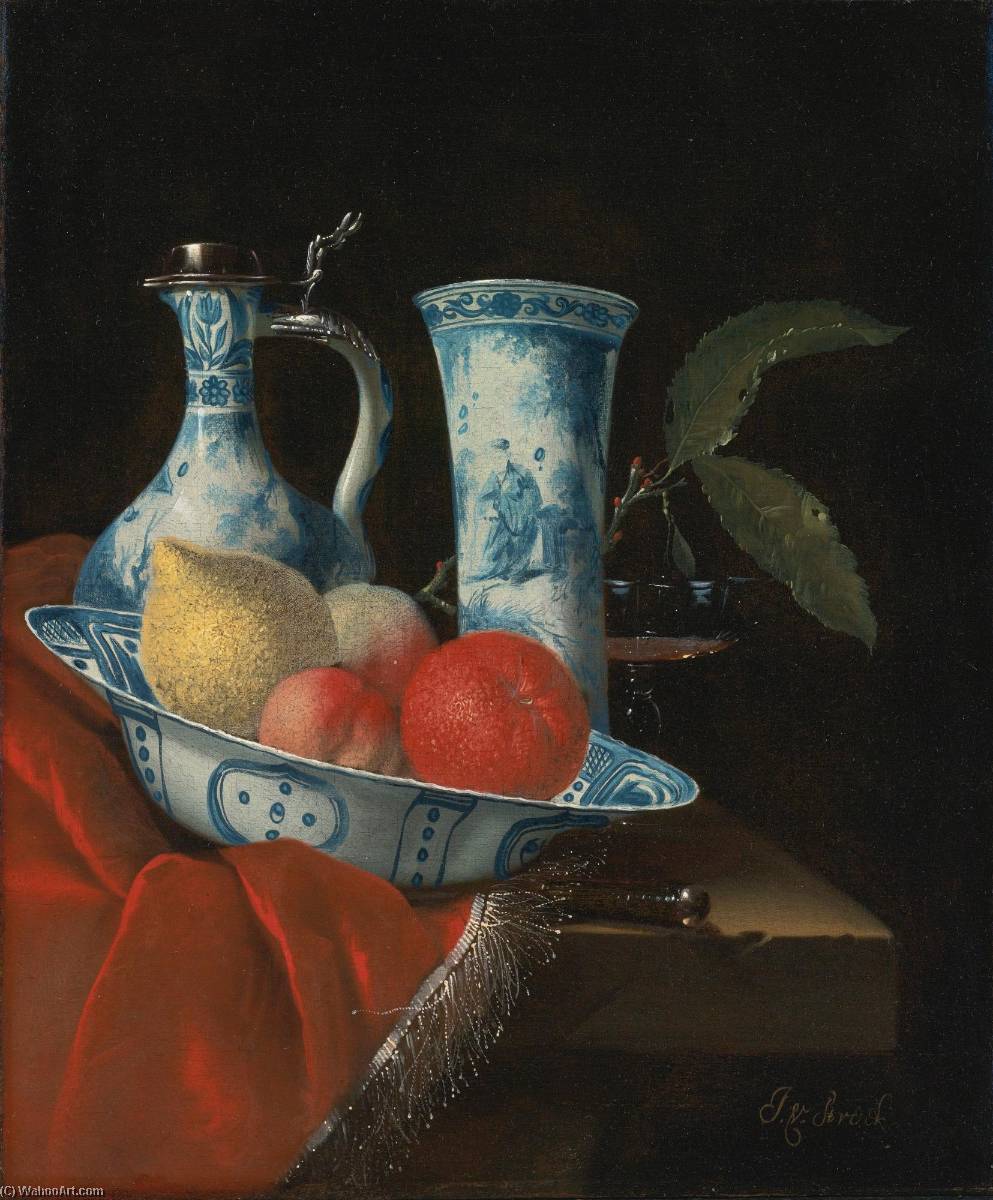
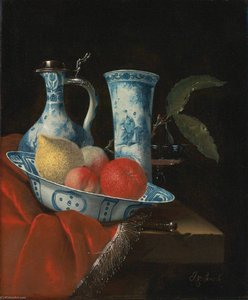
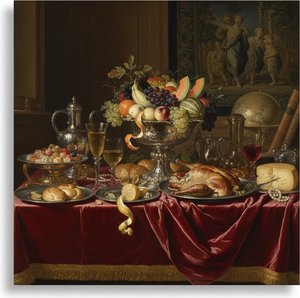
Still life of a blue and white Wan li bowl with peaches, a lemon and an orange, a porcelain ewer and vase, a wine glass and a knife, on a partly draped stone ledge

 Read More
Giclée / Art Print
Museum-quality giclée or canvas print with fast production and flexible finish options. ( Buy Hand Made Painting Buy Image)




































Pick from our preset sizes that match the artwork's original proportions.

You may enter your own dimensions to fit a specific frame or space. If your selected size does not match the original image's proportions, we will either crop the artwork or extend the image with a mirrored or solid-fill edge. A digital mockup will be sent for your approval before production begins.
Please note that the on-screen preview does not reflect the actual cropping or extension. Only the mockup will accurately show the final composition.
While custom sizes are available, we recommend selecting a dimension from the predefined list to preserve the original proportions.
Worldwide Delivery () in 2 weeks instead of standard 4/5 weeks. (1 September)

Free Worldwide Express Shipping

High-Quality Linen Canvas

Full Shipping Insurance

Customs Tax Refund Guarantee

True Color Matching Guarantee

60-Day Return Policy (Defects Only)

100% Money-Back Guarantee

Bulk Discount Offer
 Glass option is only available in size under 110 CM

Still life of a blue and white Wan li bowl with peaches, a lemon and an orange, a porcelain ewer and vase, a wine glass and a knife, on a partly draped stone ledge
Giclée / Art Print
Reproduction Size
-


Total Price
$ 63
Related Artworks

Artist Biography
The Silent Echoes of the Golden Age
In the heart of Amsterdam, amidst the bustling commerce and maritime grandeur of the seventeenth century, Juriaen van Streeck captured a world that was as much about what was passing away as what was being gained. Born on the rare and fleeting date of February 29, 1632, his very arrival during a leap year seemed to foreshadow a life dedicated to the study of transience. As a master of the Dutch Golden Age, Streeck did not merely paint objects; he orchestrated silent dramas where every peeled lemon and polished helmet whispered of the inevitable passage of time. His work stands as a profound testament to the Baroque preoccupation with memento mori, inviting viewers to find deep philosophical meaning within the stillness of a composed scene.
The foundation of Streeck’s extraordinary technical skill was laid under the watchful eye of Willem Kalf, one of the most formidable masters of the still life genre. From Kalf, Streeck inherited a rigorous commitment to scientific observation and a fascination with the interplay of light upon diverse textures. This apprenticeship instilled in him a method of painstaking layering, using glazes to breathe life into porcelain, silver, and fruit. While his mentor often focused on the opulence of luxury goods, Streeck expanded this vocabulary to include a broader, more somber range of subjects. His canvases became arenas where the tactile beauty of a velvet drapery could sit in haunting proximity to the stark reality of a skull or a dead animal, creating a tension between earthly delight and spiritual reflection.
A Symphony of Texture and Symbolism
To gaze upon a Streeck composition is to enter a realm where the material world is rendered with startling clarity. He possessed an uncanny ability to manipulate light, making the surface of a blue and white Wan li bowl appear cool and vitreous, while simultaneously capturing the soft, yielding fuzz of a ripening peach. This mastery of texture served a higher purpose than mere virtuosity; it was the vehicle for his symbolic language. In his hands, a collection of items—books, letters, musical instruments, or even weaponry—transcended their physical forms to become metaphors for human achievement and its ultimate fragility.
The artist’s repertoire was remarkably diverse, showcasing a versatility that allowed him to excel across various still life subgenres:
- Pronkstilleven: Opulent displays of luxury goods, including fine glassware and exotic fruits, reflecting the wealth of the Dutch Republic.
- Vanitas Compositions: Somber arrangements featuring skulls, extinguished candles, or decaying organic matter to remind the viewer of mortality.
- Object Studies: Meticulous renderings of man-made artifacts such as helmets, books, and intricate musical instruments.
This ability to weave together the beautiful and the macabre ensured his place in the pantheon of great Dutch painters. His work did not just decorate the homes of wealthy Amsterdam merchants; it provided a space for quiet contemplation amidst the noise of a burgeoning empire.
Legacy and the Final Act
As the decades progressed, Streeck’s life took turns far removed from the quietude of his studio. While he remained a celebrated painter, historical records suggest a more grounded existence in his later years, noting that he eventually served as an innkeeper in the Kerkstraat. This transition from the refined world of fine art to the communal atmosphere of an inn reflects the multifaceted nature of life in the Dutch Golden Age, where the boundaries between high culture and everyday commerce were often fluid. Despite these shifts, his artistic influence continued to ripple through the next generation, notably impacting artists like Barend van der Meer.
Juriaen van Streeck passed away in 1687, leaving behind a body of work that remains a cornerstone of Baroque art history. He died not just as a painter of objects, but as a chronicler of the human condition. His legacy survives in every glint of light on a silver goblet and every shadow cast by a wilting petal found in his masterpieces. Through his eyes, we are reminded that while beauty is ephemeral and life is fleeting, the profound truths captured in art possess an eternal resonance, standing defiant against the very decay he so masterfully depicted.
Quick Facts
- Artistic Movement Or Style: Dutch Baroque
- Artists Or Movements Influenced By This Artist: ['Baroque']
- Artists Who Influenced This Artist: ['Willem Kalf']
- Date Of Birth: February 29, 1632
- Full Name: Juriaen van Streeck
- Nationality: Dutch
- Notable Artworks:
- Still Life with Peaches and Lemons
- Fruit Still Life
- Place Of Birth: Amsterdam, Netherlands
Related Articles

Dutch Masters: 10 Golden Age Paintings That Still Inspire |
Journey into the Dutch Golden Age! Explore 10 iconic paintings by Rembrandt, Vermeer & Hals. Discover the stories behind these Baroque masterpieces and find museum-quality art reproductions to elevate your home decor on .
Abraham Hendricksz van Beyeren: Pioneering Dutch Still Life & the Banquet Tradition
Explore the captivating world of Dutch Golden Age still life with Abraham van Beyeren. Discover his innovative techniques, symbolic banquet scenes & lasting influence on art history. Learn about collecting these masterpieces.

Rembrandt's Masterpieces: Explore 25 Iconic Paintings & Prints | ArtsDot
Journey through Rembrandt van Rijn's 25 most iconic paintings & etchings. Explore Dutch Golden Age masterpieces, dramatic chiaroscuro, and timeless portraits. Find museum-quality art reproductions to elevate your home decor on ArtsDot.com.

Golden Age Reflections: Dutch Baroque Painting & Cultural Innovation
Explore the Dutch Golden Age of painting! Discover key artists like Vermeer & ter Borch, their innovative techniques, and the rich cultural context behind these Baroque masterpieces. Learn about collecting & appreciating this iconic art period.

Illuminating Innovation: Exploring the Dutch Golden Age of Painting
Explore the Dutch Golden Age of painting with ArtsDot. Discover Rembrandt, Vermeer & other Masters. Learn about key characteristics, iconic artworks, and lasting influence. Expert insights for collectors & enthusiasts.